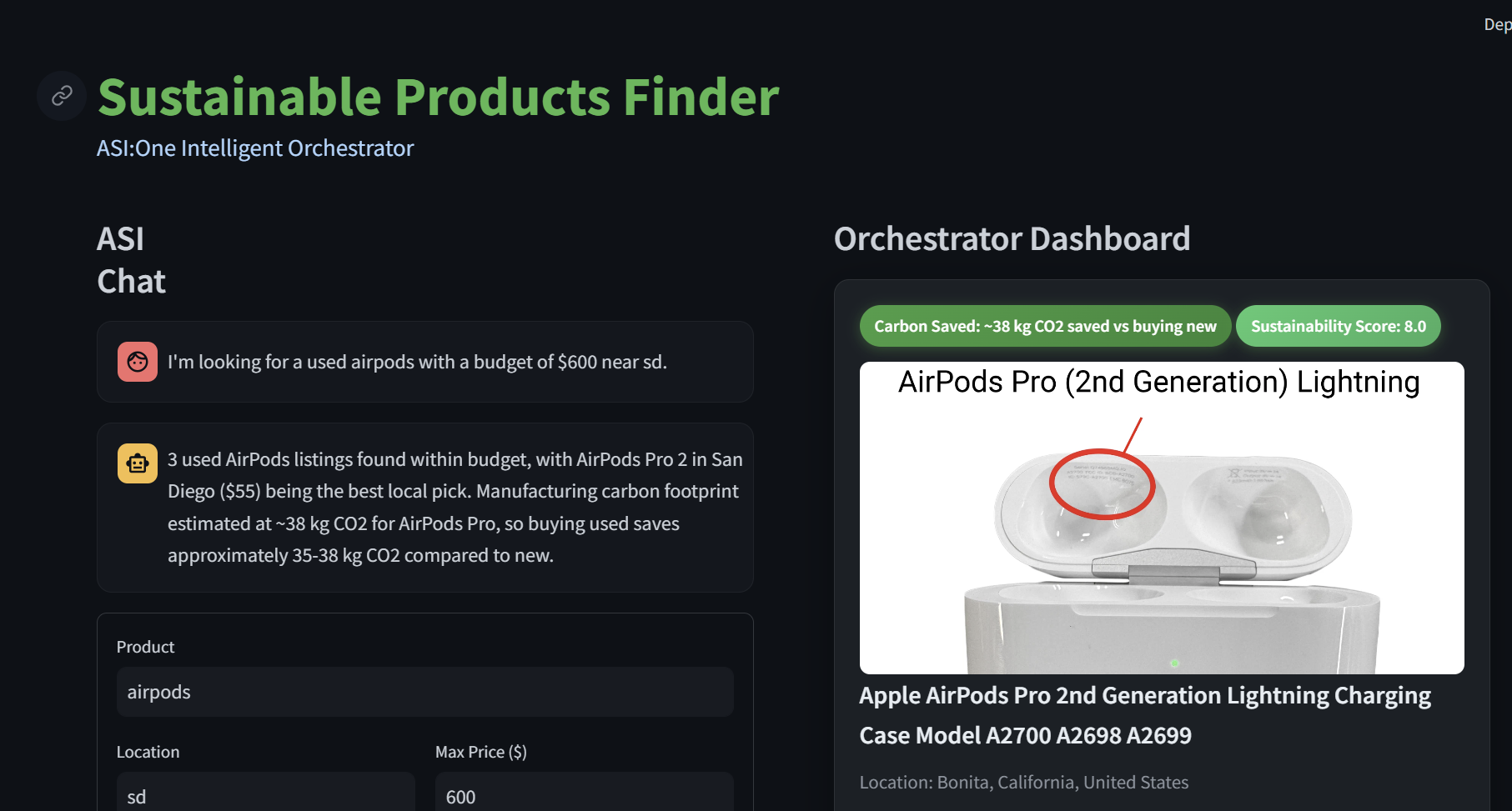
Inspiration The project began as an attempt to solve a common friction point in sustainable living: the difficulty of finding high-quality second-hand goods and the most eco-friendly. While major retailers make it effortless to purchase new products, finding a reliable used or refurbished alternative usually requires manual, time-consuming searches across multiple platforms. We wanted to build a tool that automates this discovery process and provides immediate data on the environmental benefit of choosing used over new.
How it was Built The core of the application is a Python-based agentic system. We used the uagents framework to orchestrate the search logic and the browser-use-sdk to handle the actual web navigation. Unlike traditional scrapers that rely on fixed APIs, this system uses a headless browser to interact with sites like eBay and Facebook Marketplace just as a user would. We also developed a custom scoring engine in a separate module, carbon.py, which calculates the estimated carbon savings for various product categories based on their manufacturing data.
Lessons Learned The primary lesson from this project is that sustainability is often a data accessibility problem. Most consumers are willing to make greener choices if they have the right information at the right time. Technically, we learned that LLM-driven browser automation is an incredibly powerful way to handle unstructured web data, though it requires careful prompt engineering to ensure the browser doesn't get stuck or distracted by ads.
Challenges The most significant challenge was managing the inherent latency of browser automation. Loading full web pages and waiting for elements to render takes time. We addressed this by implementing a parallelized execution model, launching multiple search tasks simultaneously to minimize the wait for the user. We also had to build a robust fallback mechanism to provide high-quality search results even if a specific platform's anti-bot measures temporarily blocked the browser.
You can review the full implementation in the
agents.py and
carbon.py files.

Log in or sign up for Devpost to join the conversation.