-
-
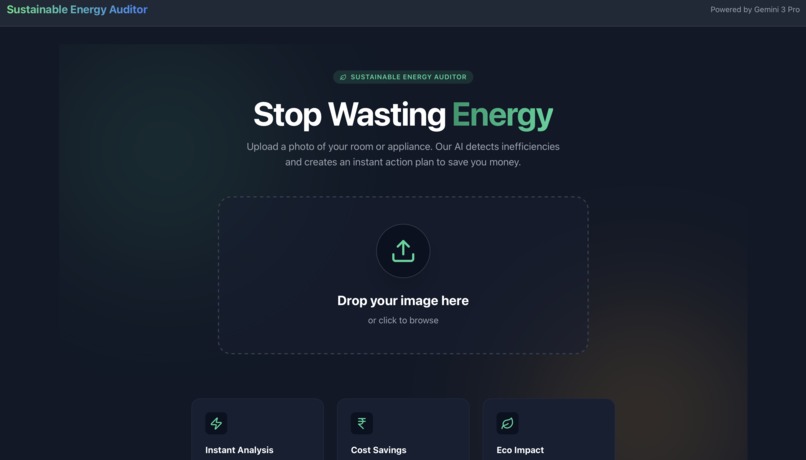
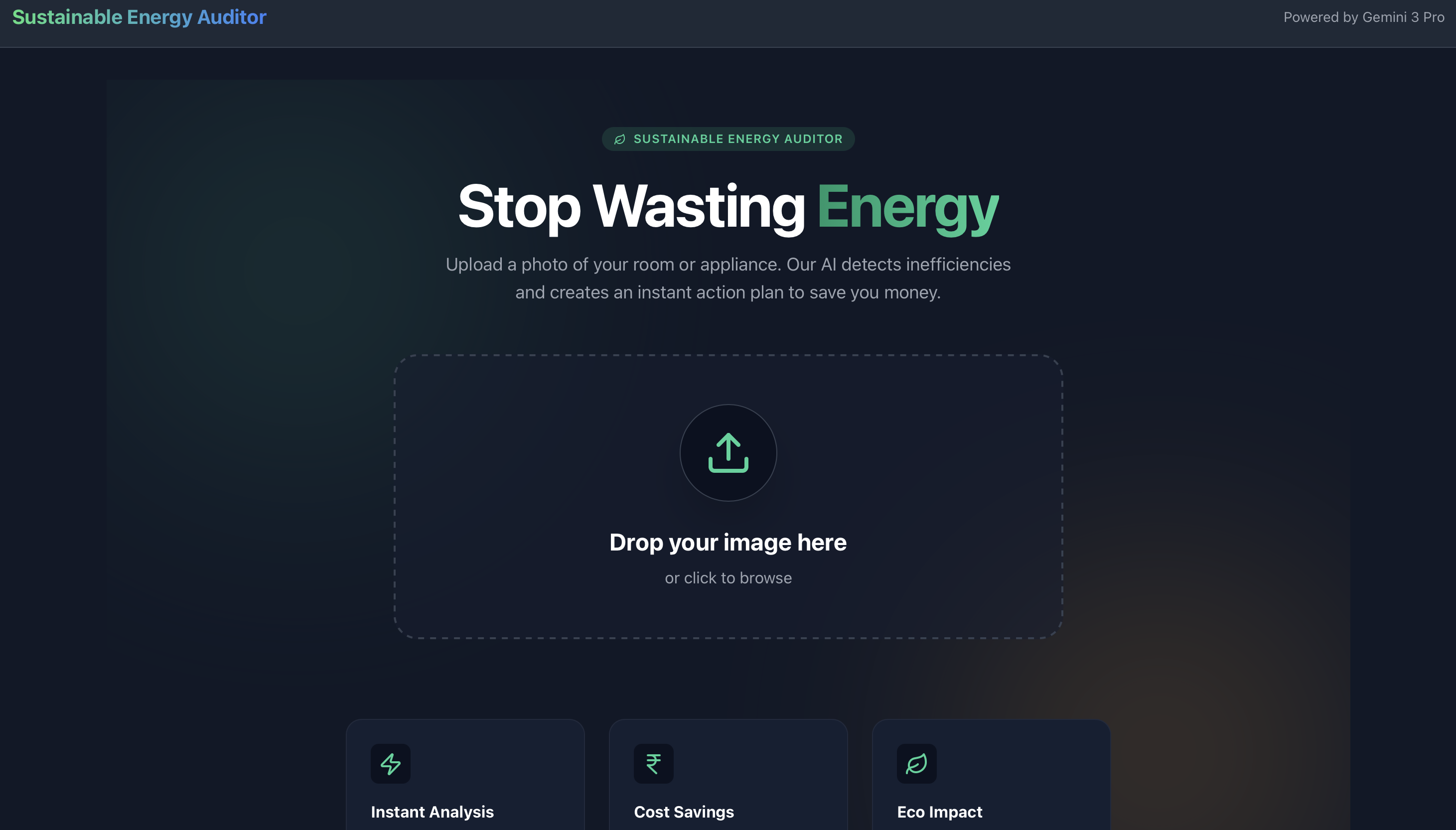
Homepage
-
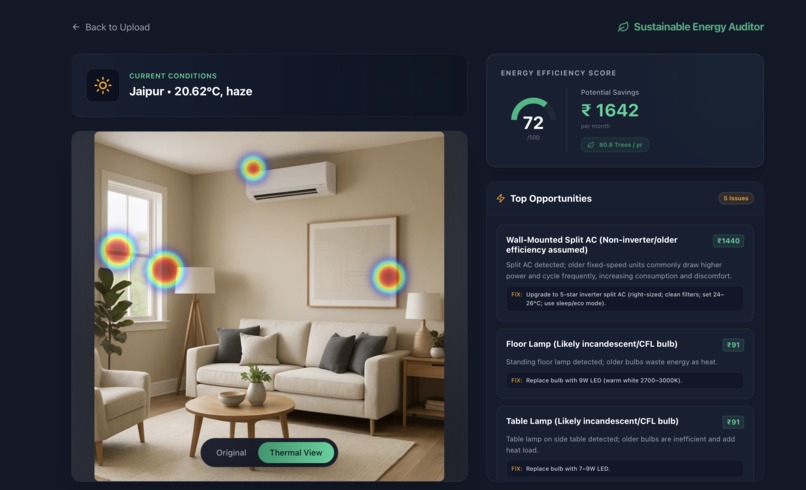
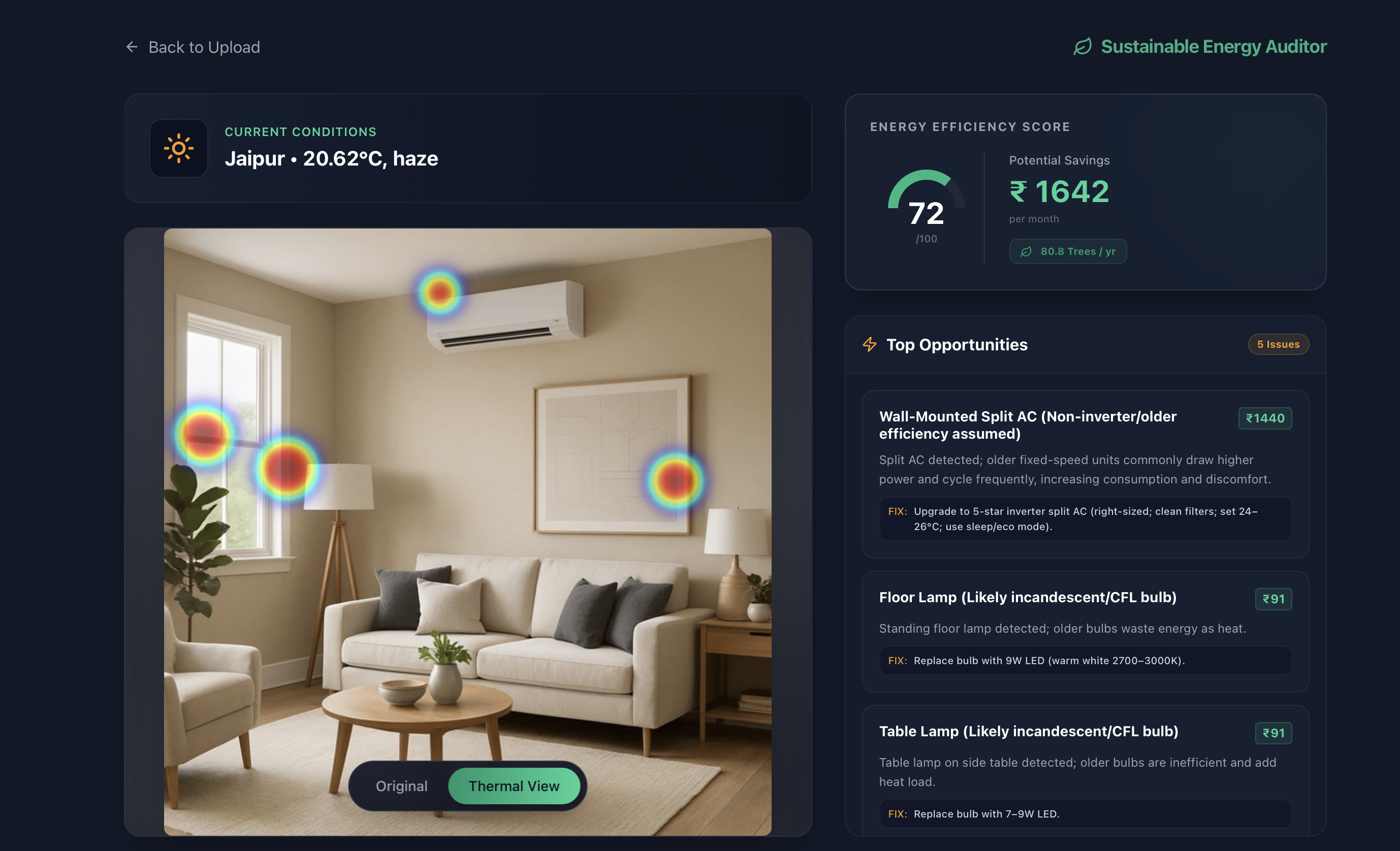
Dashboard
Inspiration
What it does# Sustainable Energy Auditor: Towards Net Zero 🌍💡
Inspiration 💡
The idea was born from a simple frustration: Electricity bills are rising, and the planet is warming, but most people don't know where to start saving. Professional energy audits are expensive, time-consuming, and intrusive.
I asked myself: Why can't I just take a picture of my room and have an AI tell me what's wrong? Inspired by climate tech and the rapid advancements in multimodal AI, I set out to build a tool that democratizes energy efficiency—making it accessible to anyone with a smartphone.
What it does 🚀
Sustainable Energy Auditor is an intelligent web application that uses Computer Vision to analyze your living spaces.
- Upload: You upload a photo of a room.
- Analyze: The AI (powered by Gemini/Azure OpenAI) scans for appliances, lighting types, and thermal leaks (like single-pane windows).
- Calculate: It deterministically calculates potential savings based on wattage deltas and local weather context (e.g., cooling loads in Jaipur).
- Visualize: It generates a thermal heatmap overlay to visually pinpoint "hot spots" of energy waste.
How we built it 🛠️
The project is a full-stack application built with:
- Frontend: React + Vite + TailwindCSS for a responsive, modern UI.
- Backend: FastAPI (Python) for high-performance async processing.
- AI Engine: We integrated Azure OpenAI (GPT-4o) and Google Gemini Vision for object detection and reasoning.
- Computer Vision: OpenCV was used to generate the thermal heatmap overlays based on bounding box data.
- Weather API: Integration with OpenWeatherMap to provide location-specific context for cooling/heating load calculations.
Challenges we ran into 🚧
Hallucinations vs. Physics: Initially, the LLM would "guess" savings numbers, which were inconsistent. To fix this, we implemented a Deterministic Calculation Engine. The AI now identifies the device (e.g., "60W Incandescent Bulb"), but we use Python to calculate the savings using physics-based formulas: $$ \text{Savings} = (\text{Watts}{old} - \text{Watts}{new}) \times \text{Hours} \times \frac{30}{1000} \times \text{Tariff} $$
Granular Detection: The model initially grouped all lights into one box. We had to refine the prompting strategy to enforce "granular detection," ensuring every single downlight and table lamp was identified as a unique opportunity.
Aspect Ratio Hell: Displaying the generated heatmap perfectly over the original image across different device sizes was a CSS challenge. We solved it by enforcing strict aspect-ratio containers and using
object-fit: containlogic.
Accomplishments that I'm proud of 🏆
- The Heatmap Visualization: Seeing the red "thermal" zones overlay perfectly on the real image was a "magic moment."
- Real-World Accuracy: The system correctly identified that a "Decorative Chandelier" creates a completely different energy footprint than a "LED Strip," something generic calculators miss.
- Speed: Optimizing the backend to cache image hashes (SHA256), making repeated analyses instant.
What I learned 📚
- Prompt Engineering is Engineering: Getting structured JSON out of an LLM requires rigorous constraints and robust error handling.
- Hybrid AI Patterns: The best results come from combining GenAI's reasoning with traditional code's deterministic math.
- CV Pipelines: Learned how to manipulate image byte streams in Python for real-time processing without saving to disk unnecessarily.
What's next for Sustainable Energy Auditor 🔮
- AR Integration: A live mobile app mode where you just point your camera around the room.
- Marketplace: One-click purchasing of the recommended LED bulbs or efficient fans directly from the dashboard.
- Solar Potential: Estimating rooftop solar potential based on exterior photos.

Log in or sign up for Devpost to join the conversation.