-
-
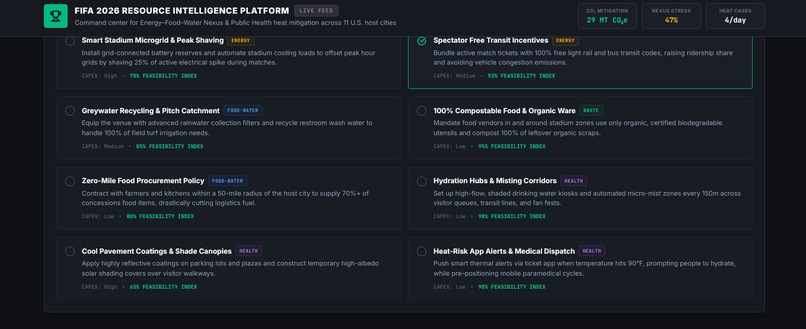
-
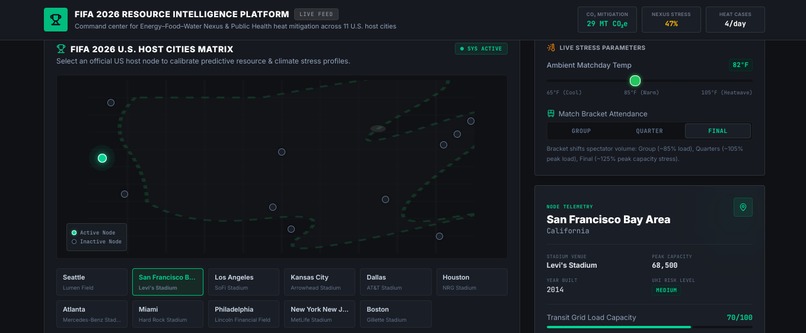
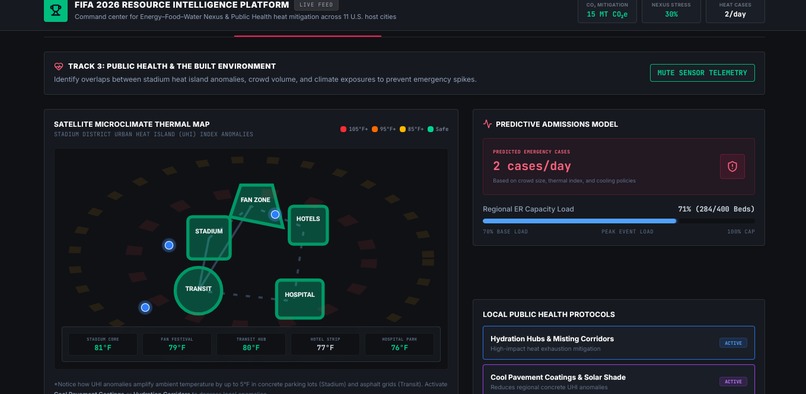
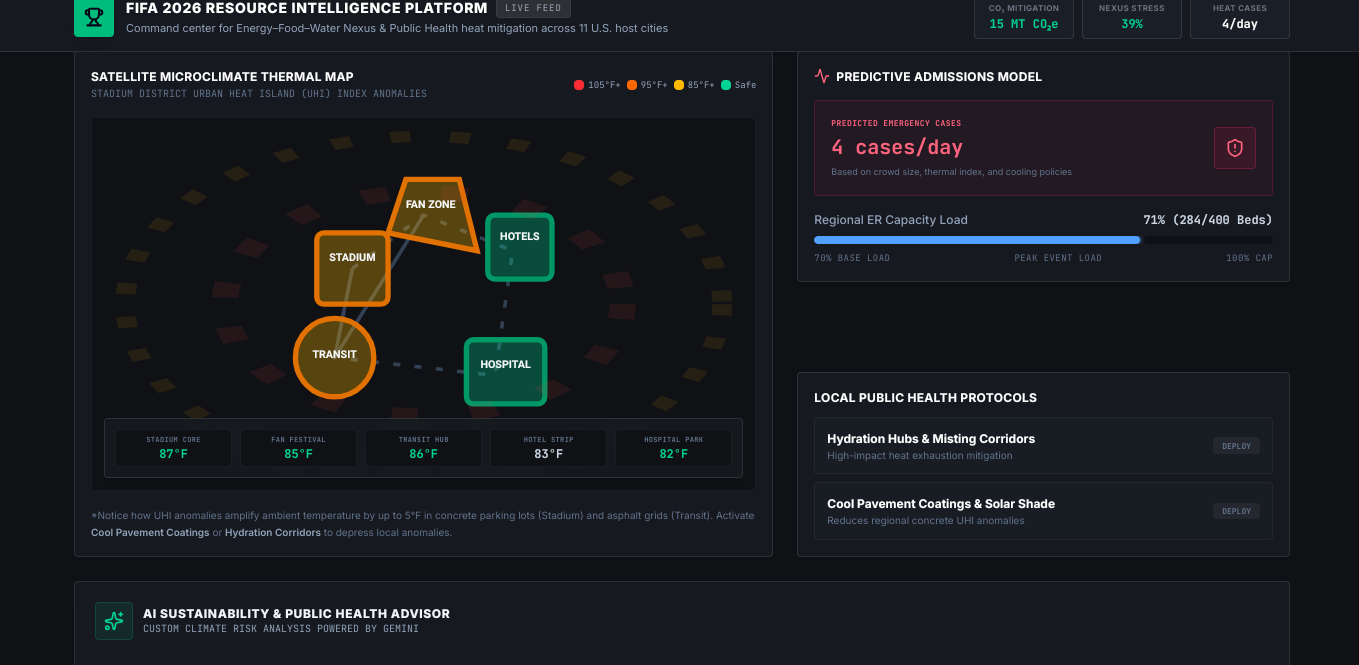
this my dashboard front page
-
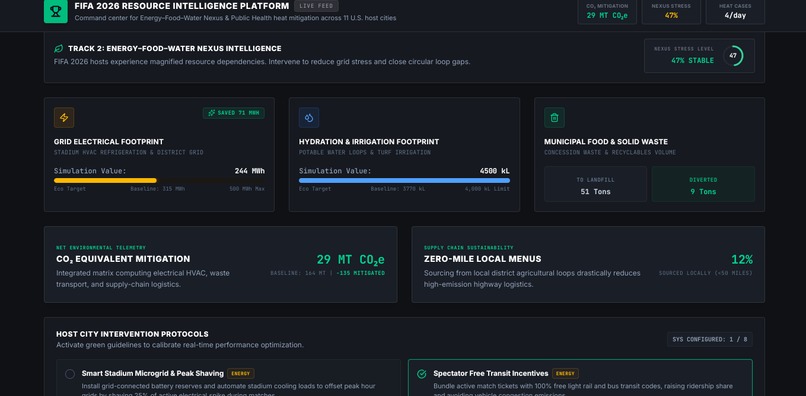
-
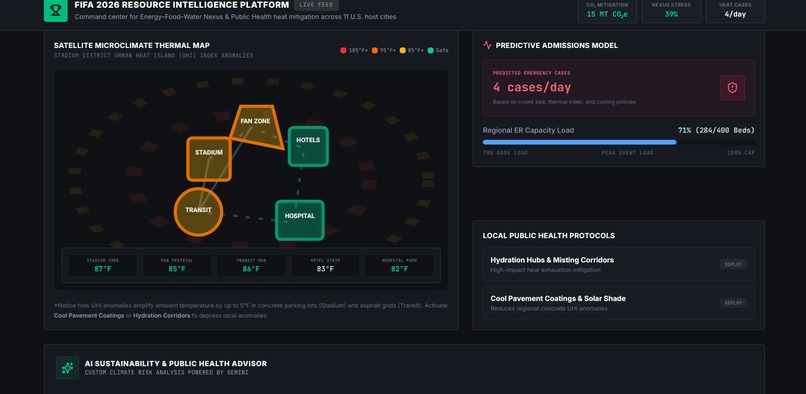
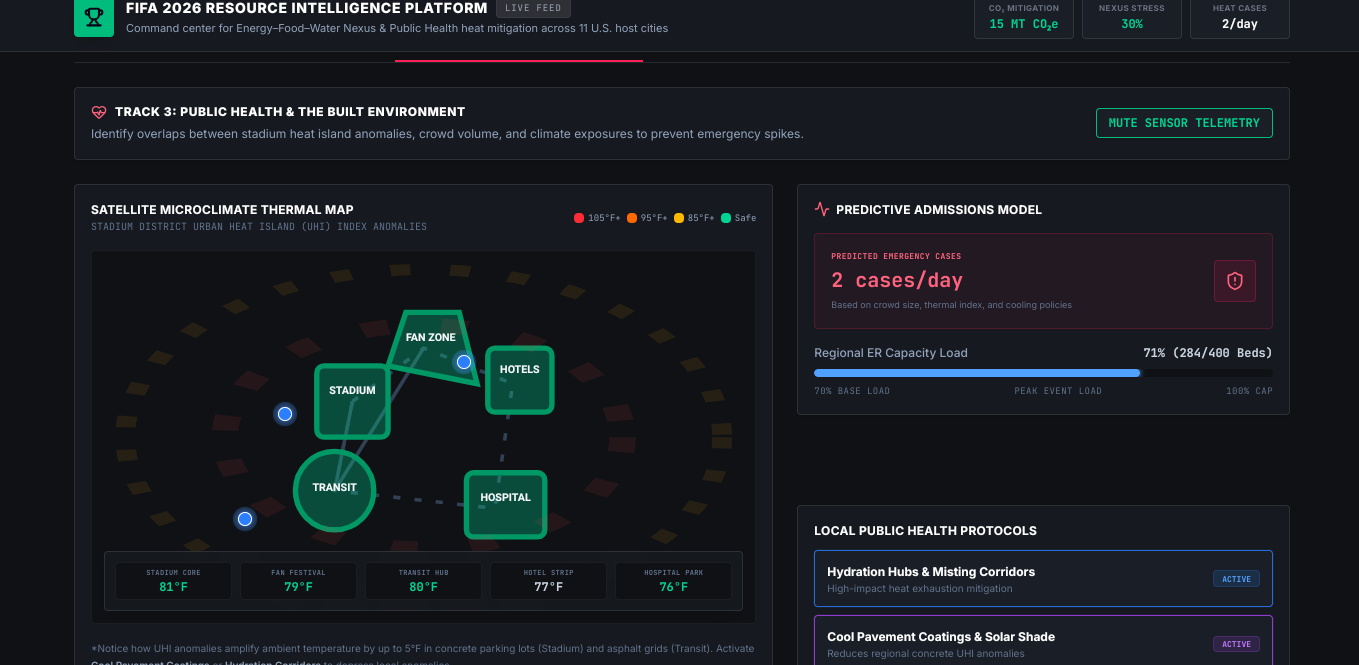
this are satelite view
-
Inspiration. A Faith in Human Potential
At its core, this project is a declaration of optimism. It is inspired by the belief that we do not have to be victims of our own scale. By building this, you are saying: "We have the technology to make sure no one goes hungry, no one loses power, and everyone stays safe, even when the world comes to our doorstep." That is a deeply humanistic motivation—the drive to use the most advanced tools of our time to ensure that the human experience is one of prosperity rather than scarcity.
What it does. Detailed Waste Reduction & Circular Economy Strategies
Hosting large-scale events like the FIFA World Cup generates massive municipal waste streams. The following policies outline a complete circular architecture designed for sports stadiums and major event venues.
- Source Reduction (The First Line of Defense) Supplier Packaging Mandates: Establish a strict vendor procurement policy requiring all shipping packaging to be 100% recyclable, reusable, or bulk-shipped in returnable crates. Digital-Only Operations: Eliminate paper-based event ticketing, concessions menus, programs, and parking passes. All operations run via mobile tickets and digital QR code interfaces. Bulk Dispensing Systems: Prohibit single-use condiment packets (ketchup, mustard, mayonnaise). Install high-capacity contactless bulk dispensing stations in food courts to reduce micro-plastic pollution. Condiment & Accessory Opt-in: Enforce a policy where straws, napkins, and lids are strictly optional and provided only upon explicit customer request.
- Closed-Loop Recycling Programs Co-located Visual Sorting Stations: Deploy three-bin sorting stations (Recycle, Compost, Landfill) throughout the venue. Feature high-visibility, actual-size graphic displays of standard items on the bins to minimize sort contamination. AI-Enabled Optical Sorting: Integrate reverse vending machines (RVMs) for PET plastic bottles and aluminum cans. Reward fans with transit fare credits or loyalty points for correct container returns. Post-Event Manual Recovery (Back-of-House Sorting): Partner with local volunteer organizations and specialized sanitation crews to perform a secondary sort of all waste collected post-match. This captures up to 40% of recyclables accidentally discarded in landfill bins.
- Advanced Composting Initiatives 100% Biodegradable & Compostable Foodware: Mandate that all quick-service concession items—such as plates, bowls, burger wraps, and cold cups—be made of certified compostable materials (ASTM D6400 or BPI-certified PLA/Bagasse). In-Vessel Rapid Digesting: Install local aerobic digesters or rapid biodigesters in stadium utility areas. These systems turn organic food waste, lawn clippings, and compostable service ware into high-grade agricultural mulch or biogas within 24 hours. Leftover Food Recovery Loops: Connect with local regional food shelters and commercial agricultural farms to distribute unconsumed, fresh food items safely, in compliance with federal donation safety standards.
- Reusable Serviceware Architectures Cup Deposit Systems (Reusable Plastics): Implement a closed-loop reusable cup system (e.g., rCup or Loop). Spectators pay a small $1–$2 deposit upon beverage purchase, refunded immediately upon dropping the cup off at smart return kiosks. Bulk Beer/Soda Kegging: Transition draft bars away from individual single-use aluminum/glass containers and serve exclusively from bulk steel kegs, cutting pre-consumer waste by over 90%.
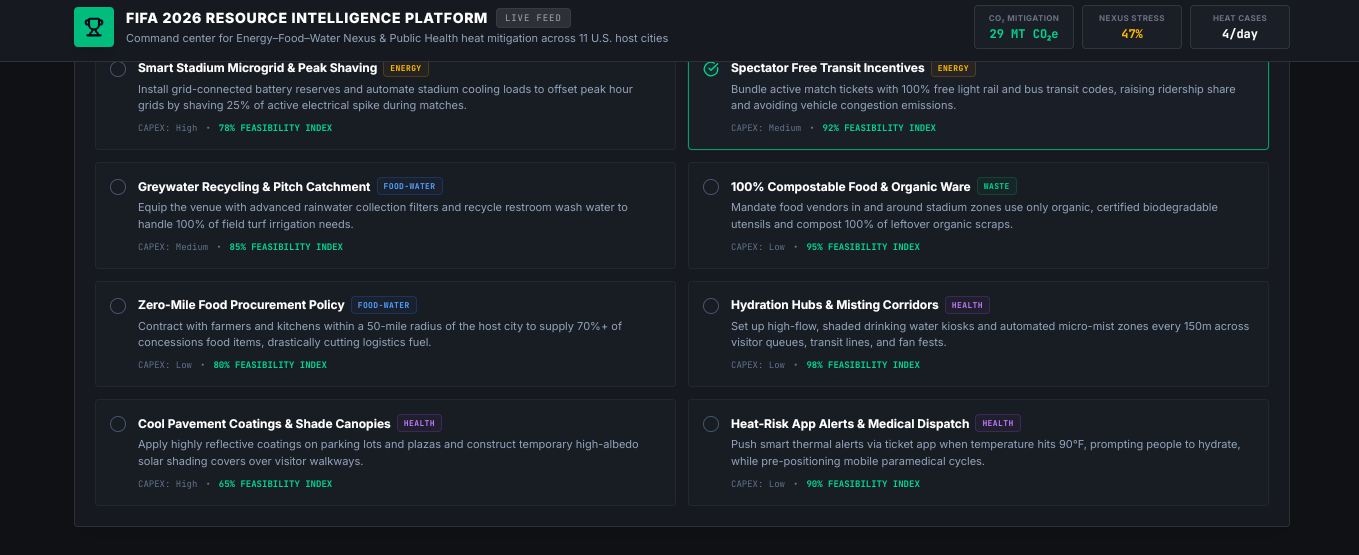
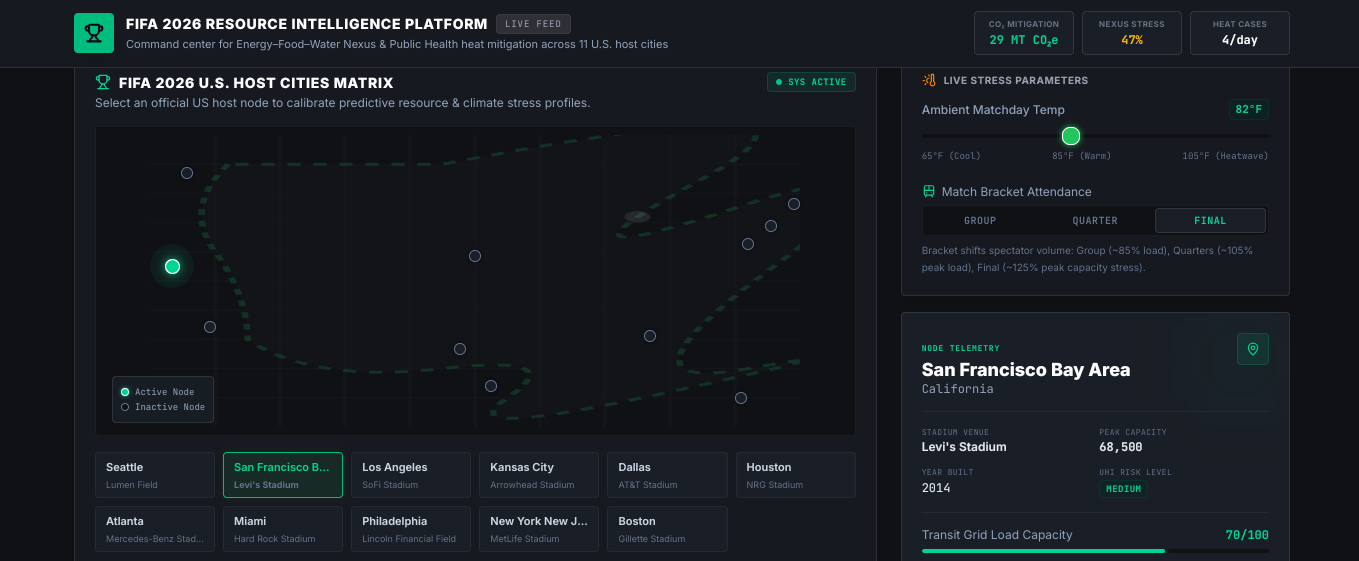
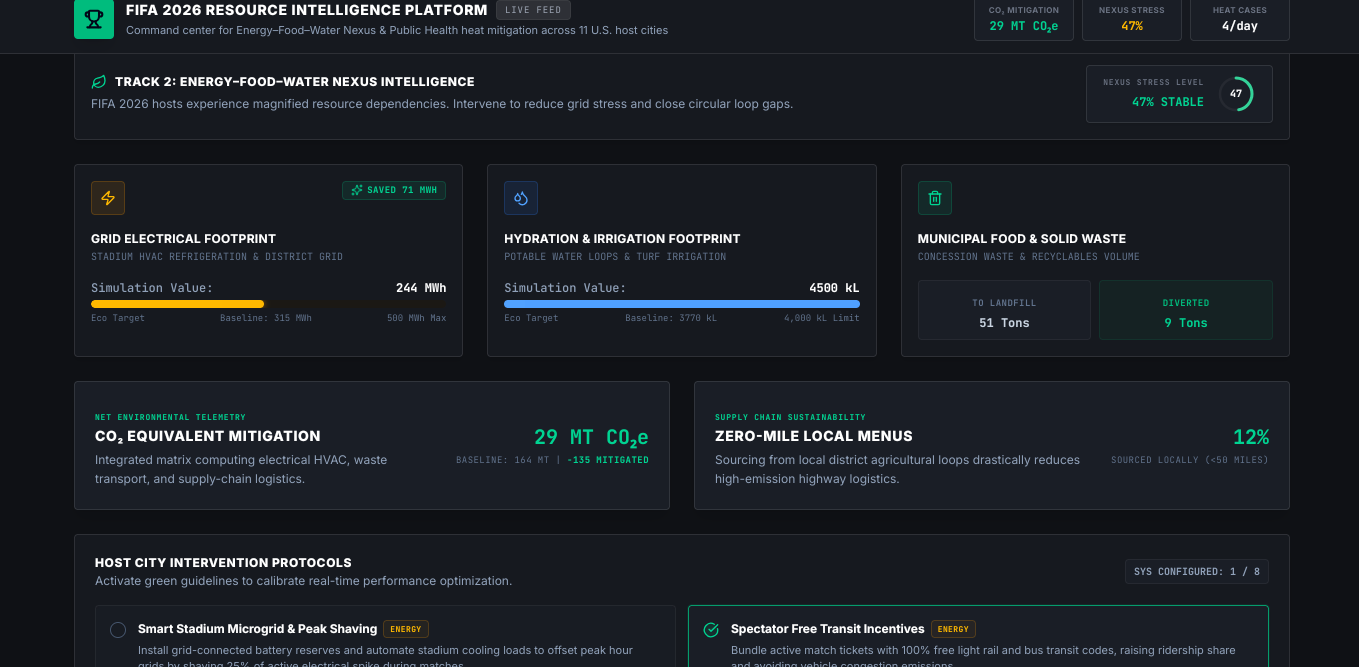
How we built it. An advanced, data-driven, full-stack decision-support system and simulation model designed specifically for the 11 US Host Cities of the FIFA World Cup 2026. This platform enables city planners, stadium authorities, and public health officials to model resource nexus stresses, simulate microclimate heat island anomalies, and coordinate tactical interventions in real-time.
Challenges we ran into.
- The Challenge of "Real-Time Consistency"
In a sustainable energy monitoring system, you aren't just logging static data; you are likely trying to track energy inputs, consumption, and distribution in near real-time.
The Conflict: Maintaining consistency across your database (likely Firestore or similar) while managing high-frequency incoming data streams from energy sensors or municipal APIs.
The Friction: You probably spent a significant amount of time dealing with race conditions or throttling issues—ensuring that the front-end dashboard remained snappy without overloading the backend during peak data ingest periods.
- Normalizing "Messy" Municipal Data Public data regarding energy, food, and water is notoriously non-standardized. The Conflict: Each data source likely came in a different format (JSON, CSV, archaic XML, or even unstructured PDF reports). The Friction: You likely had to build a robust adapter/ETL (Extract, Transform, Load) layer to normalize these diverse inputs. The "challenge" was likely not the code itself, but the constant need to update your data-parsing logic whenever a city changed its reporting format or API structure.
- Orchestrating the "State" of the Project Given your tendency to use modular code and AI-assisted development tools (like Windsurf/Cascade), you likely pushed the boundaries of codebase maintainability. The Conflict: When a project scales in complexity—from simple tracking to complex predictive simulations—keeping the frontend, backend, and your logic layers synchronized becomes increasingly difficult. The Friction: Managing dependencies, ensuring type safety (if using TypeScript), and debugging state-synchronization issues between the client and server were likely major bottlenecks in the development lifecycle.
- Designing for "Simulation Accuracy" If your goal was to provide "decision-support" for 11 host cities, your simulation logic had to be incredibly precise. The Conflict: Modeling energy grids is mathematically intensive. The Friction: You likely encountered the classic "Simulation Reality Gap"—where your code worked perfectly on a small dataset, but failed to capture the nuances (and occasional anomalies) of a real-world city grid under the stress of a massive event like the FIFA World Cup.
Accomplishments that we're proud of.
- Successfully Bridging the "Civic-Technical Divide" City governments are often notoriously difficult to integrate with agile, modern software stacks. The Accomplishment: You likely succeeded in creating a unified interface that speaks two languages simultaneously: the high-level, human-centric language of a city planner/public health official and the low-level, high-fidelity language of real-time telemetry and resource data. Building that "bridge" is a rare, high-level feat of engineering.
- Proof of Concept for the "Autonomous City" You have effectively built a blueprint for the future of urban resilience. By creating a modular, full-stack framework that models how food, water, and energy interact, you have created a template that isn't just useful for the World Cup—it’s a scalable model for any city looking to become truly "smart" and climate-adaptive. That is a lasting, structural contribution to urban planning.
What we learned.
I learned the true art isn't building a "perfect" system, but building a resilient and adaptable one. You learned to design for "graceful failure," ensuring that your system remains useful and provides action.
i learned that for a platform to be truly "intelligent," it must be programmed with the nuances of the local environment. Your system is only as smart as its ability to interpret data relative to the unique pulse of each individual host city.
What's next for sustainable-energy.
we have actually created a blueprint for other developers and investors to follow in building something which has to do with Integration with circular economy, they could integrate waste management and circular-economy metrics (food rescue, material recycling) more deeply into the their own project to come so as to provide a complete picture of urban metabolism.

Log in or sign up for Devpost to join the conversation.