Inspiration
As young college students who want to make sustainable life choices but are too bogged down by schoolwork to find time to do so, we were looking for a simple service that could "green-ify" our eating choices. Because nearly 1/3 of greenhouse gas emissions come from food production, eating sustainably has never been more important. So, we built SustainaBite!
What it does
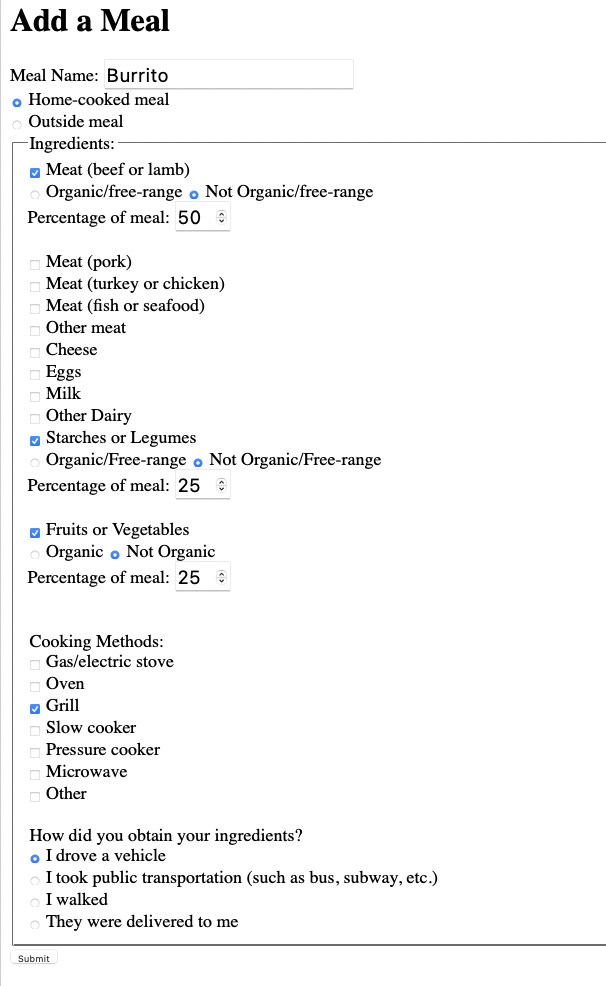
SustainaBite gives your typical calorie-counting meal tracker a unique twist: it breaks down each of your meal into environmental impact and gives your meal an overall "sustainability score"! The higher your scores, the more points you accrue, letting you earn badges and even redeem free food at sustainable restaurants. Best of all, the social media aspect of our app lets you and your friends cheer each other on in your sustainability goals, and even meet new people in your area with similar food preferences using AI models. For example, if you love Mexican food, we'll match you up with someone with similar tastes--first date's on SustainaBite! This is the perfect way to reach your sustainability goals while connecting with other users on a shared interest everyone enjoys: food!
How we built it
We built the front-end with React, Next.js. We built the back-end with Convex and Flask. We also worked with OpenAI's API to compare users' food preferences.
Specifically for Convex, we were impressed by its broad, yet powerful utility. We needed a framework that could update databases in real-time while immediately updating our website's front-end. Especially since our website acts as a social media channel, the ability to balance multiple users' requests with Convex was extremely useful. We definitely plan on using Convex in our future full-stack projects.
Challenges we ran into
Technical challenges: connecting our back-end with OpenAI's API, designing the UI of multiple tabs while coding "sustainability score" algorithms Ethical challenges: how do we objectively "score" a meal, how do we prevent users from gaming the score system Task allocation: Learning each others' strengths to effectively allocate tasks while also finding time for sleep and TreeHacks events.
Accomplishments that we're proud of
We're proud of how we focused on impact and design first, then building the technical components from that. We designed our app together as a team, bouncing ideas off each other, then played to our strengths in the building process. We also didn't cut any corners when designing our scoring algorithms: we researched different methods of sustainability measures, how various factors could affect the environmental impact of certain foods, etc.
What we learned
Full-stack programming is hard. Since each of us had different technical strengths, we split up our work into various tasks. However, connecting them all together took a lot of debugging and installations, but it was worth the effort in the end, and we all came away with a better understanding of full-stack frameworks.
What's next for SustainaBite
Building a user base. We'll start with our friends and ask them to sign up. We'll ask our college's local Mexican joint to do a test partnership, and try various incentive programs to see which would maximize our users' increases in sustainability. We hope to expand so that many sustainable restaurants partner with us, and we can begin a two-way exchange in which we help sustainable restaurants attract customers and we help people who want to eat sustainably to find sustainable restaurants.
Prizes we are entering:
Sustainability Grand Prize: Our project is focused on sustainable eating, an aspect of sustainability that can be overlooked but has a heavy impact on the environment. With our website, every single one of us can become more aware of the impact of each of our meals and make easy, small changes to increase sustainable eating habits.
Best Use of Convex: Our project used Convex for the back-end, allowing us to update our database of user posts in real-time while updates our website's front-end. Our use of Convex allowed the social media aspect of our website to function much more smoothly and balance multiple users' requests simultaneously.
Best Natural Language Hack by Mem: We used OpenAI to take in user food preferences and give users recommendations for related sustainable restaurants, as well as match users with other users with similar food preferences.
Best Hack to Connect With Others Through Food any Otsuka VALUENEX: Our project not only encourages sustainable eating, but also brings users together around sustainable eating. Our AI model matches users based on food preferences and allows them to enjoy a sustainable meal together on us, helping people connect through their love of food.
Best Startup by YCombinator: Our project has real value in the market, as we provide a unique, simple way to combine food tracking and sustainability, combined with a social media aspect to help build a community of users, and an opportunity for sustainable restaurants to sponsor our website to grow their own business and message of sustainability.
Best Use of OpenAI Models: We used OpenAI to take in user food preferences and give users recommendations and match users with similar food preferences. This use of OpenAI adds an aspect of community and connection to our project, allowing users to come together around food, especially sustainable food.
Most Ethically Engaged Hack by Stanford Center for Ethics & Society (Our Ethical Considerations):
Our team of hackers took the time to consider the ethics of our app, SustainaBite. The app's focus on sustainability and its potential impact on users' consumption habits could have significant implications, so it's important to approach this with care.
One ethical consideration that our team grappled with was how to accurately report the sustainability of consuming a certain number of portions of food without deterring users from eating more food. Our team had to recognize that a negative or overly restrictive message about the greater carbon emissions associated with a larger quantity of food could lead to unhealthy eating habits for a user.
Another ethical consideration that our team addressed was making high-quality information available to users without providing so much data that it was difficult for a user to interpret. Sustainability-related data can be complex and difficult to understand, which can lead to confusion or misinformation. By using data about the sustainability of various foods from a study published in the Proceedings of the National Academy of Sciences and simplifying the information into categories, our team ensured that users could easily interpret the data and make informed decisions.
In order to avoid ethical issues with our technology in the future, our team has action plans for the following areas:
Data privacy: As SustainaBite requires users to input personal information such as dietary preferences, there is a risk that this data could be compromised or misused. To address this issue, SustainaBite should ensure that users are informed about how their data is being collected, stored, and used.
Discrimination: There is a risk that SustainaBite's AI models could perpetuate bias or discrimination based on factors such as race, gender, or socio-economic status. To mitigate this risk, SustainaBite should take steps to ensure that its algorithms are transparent and auditable, and that it has a diverse and inclusive team working on its development.
Health and safety: While SustainaBite is designed to encourage healthy eating habits, there is a risk that users could become too focused on their sustainability score and ignore other important factors such as nutritional value and food safety. To address this, SustainaBite could in the future also provide users with clear guidelines on healthy eating habits and safe food handling practices.
Environmental impact: SustainaBite's sustainability score is based on a range of environmental factors, such as carbon footprint and water usage using the best available data for users. However, there is a risk that this could oversimplify complex issues and fail to capture the full environmental impact of different foods. To address this, SustainaBite should work with experts in the sustainability to develop a robust and evidence-based sustainability scoring system.
Disparities: There is a risk that some users may have less access to sustainable food options or be unable to afford meals at sustainable restaurants. To address this, SustainaBite will work to promote equity and inclusivity in its platform, and consider offering alternative rewards for users who may not have the means to redeem free food at sustainable restaurants. We want all users to have access to sustainable foods.
Overall, it's essential for SustainaBite to prioritize ethical considerations throughout the development and deployment of its technology. By taking a thoughtful and inclusive approach, SustainaBite can maximize its potential to promote sustainable eating habits and foster positive social connections among users.


Log in or sign up for Devpost to join the conversation.