Inspiration: At the Hackathon, we tackled the Southern Company Retirement Transition problem. With 31% of the technical workforce retiring soon, deep experiential knowledge is disappearing. Existing tools fail because field workers don’t type after shifts. We needed a way to seamlessly capture this expertise and stop the unsustainable practice of calling retirees late at night.
What it does: SKIM is a GPS-based 'Living Field Knowledge Map' for Atlanta Gas Light's territory. It allows veteran technicians to capture institutional knowledge - like unmarked pipelines or sticking valves - directly onto the map using zero-typing methods like Voice Pins, Photo Pins, and 45-second Job Checkpoints. New technicians automatically see these veteran notes based on their location before touching any equipment.
How we built it: Leveraging an agile, product-led approach, we focused entirely on the user experience of non-laptop frontline workers. We built a system with three core capture methods requiring zero behavior change. The backend automatically transcribes voice notes, extracts insights, tags GPS coordinates, and attributes data to specific veterans.
Challenges we ran into: The core challenge was adoption: traditional knowledge platforms fail because field techs won't type after a long job. We had to figure out how to extract high-fidelity tactical data-like torque specifics or seasonal pressure drops - using only frictionless voice and photo prompts.
Accomplishments that we're proud of: We built a solution that delivers immediate value on day one. By replacing late-night retiree phone calls with a proactive, location-based map, we solved the immediate operational gap while creating a system to permanently preserve decades of ground truth field experience.
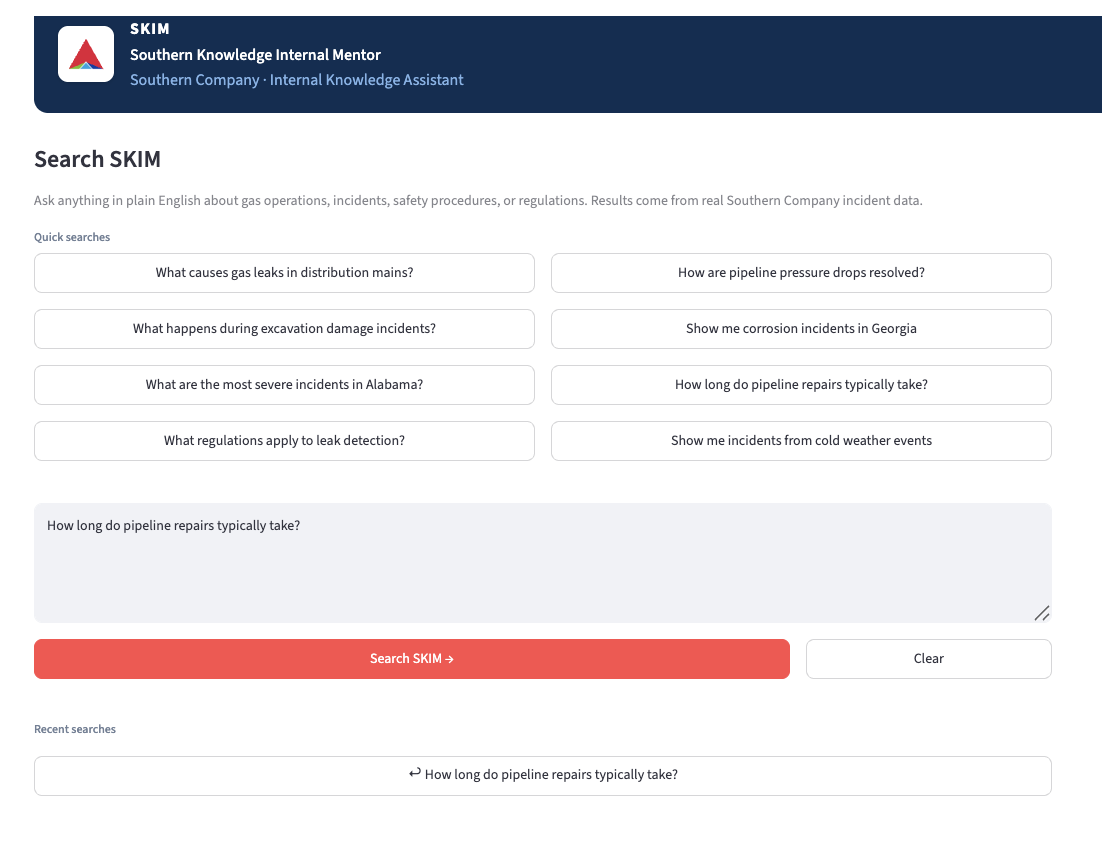
What we learned: We learned that real institutional knowledge lives in the hands and memories of field workers, not in documents. To build a true AI system for utilities, we must first build a proprietary training dataset of this ground truth through frictionless, voice-based field capture.
What's next for SKIM: Currently in Phase 1, humans read human knowledge. Phase 2 (Years 1–2) will introduce AI that automatically suggests relevant pins based on job type, location, and weather. In Phase 3 (Years 2–3), SKIM will become a fully-trained AI assistant that technicians can query directly, creating an unreplicable competitive moat where knowledge permanently stays on the pipe.
Built With
- anthropic
- claude
- css
- html
- javascript
- leaflet.js
- ollama
- python
- react
- web


Log in or sign up for Devpost to join the conversation.