-
-
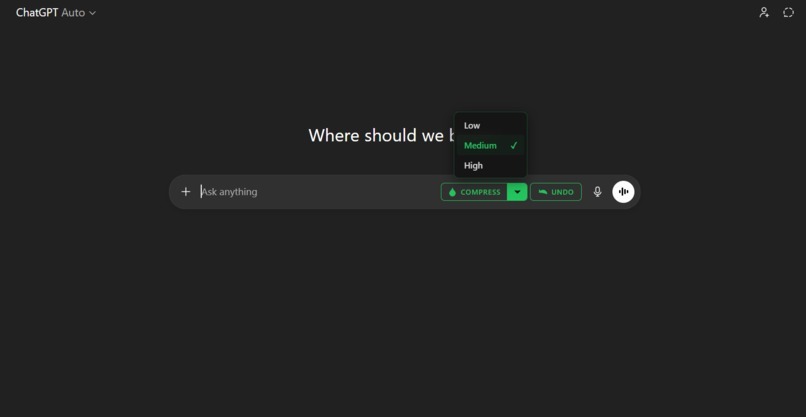
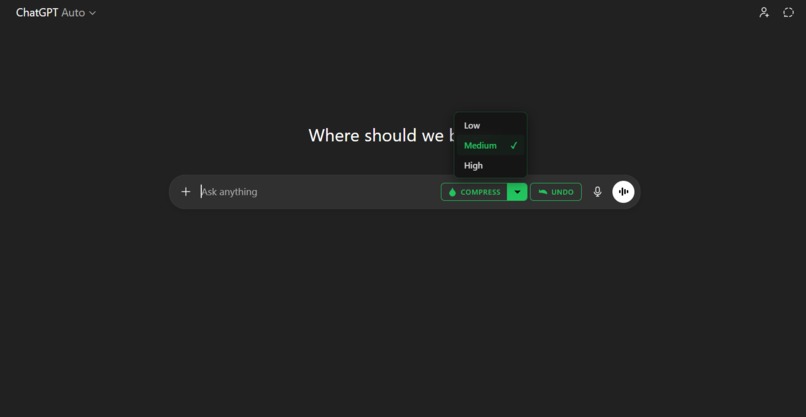
sustAIn integrates into AI tools like ChatGPT, letting users compress prompts with adjustable compression levels directly in their workflow.
-
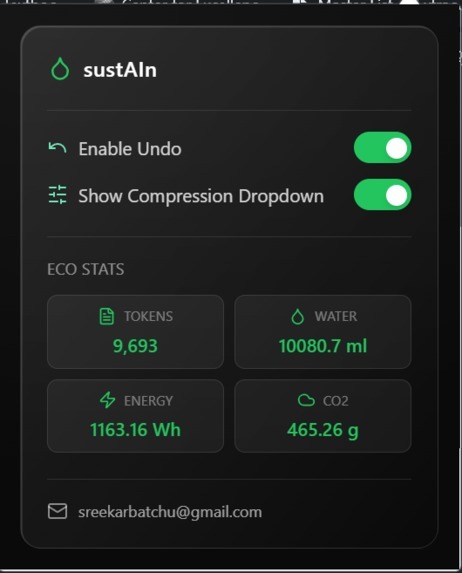
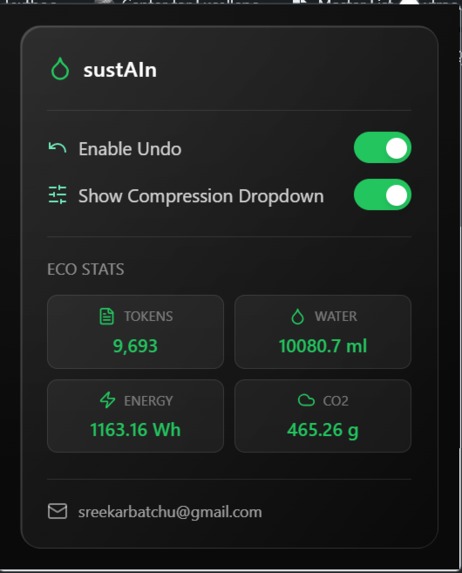
The sustAIn dashboard shows estimated savings from prompt compression, including tokens, water, energy, and CO₂.
Inspiration
What inspired me to build sustAIn was the realization that every AI prompt has an environmental cost that most people never see. Behind every response are data centers consuming electricity, cooling systems using water, and infrastructure producing carbon emissions. Today, data centers already use around 415 terawatt-hours of electricity annually, about 1.5% of global electricity consumption, and that number is projected to more than double as AI adoption grows.
There is also a much less visible but equally important impact: freshwater usage. Estimates suggest that AI systems could drive 4.2 to 6.6 billion cubic meters of water demand by 2027, which is roughly 1.1 to 1.7 trillion gallons of water. Much of this is freshwater used for cooling servers and supporting energy production, which makes it especially concerning as water scarcity becomes a global issue. Even a single model like GPT-3 has been estimated to consume around 700,000 liters (about 185,000 gallons) of clean water during training alone.
What makes this problem different is that none of it is visible to the user. Typing a prompt feels instant and weightless, but at scale, billions of prompts translate into real energy use, real cooling demand, and real resource consumption. As AI becomes part of everyday workflows, even small inefficiencies in how prompts are written can compound into a much larger environmental footprint.
I wanted to build something that makes that invisible impact visible. Instead of telling people to stop using AI, I wanted to help them use it more responsibly. sustAIn was inspired by the belief that smarter prompting can mean less wasted computation, less wasted energy, less water consumed, and less CO₂ emitted. To me, this project is about showing that innovation and sustainability can go hand in hand, and that even a small change in how we interact with AI can scale into something meaningful.
What it does
sustAIn is a browser extension that makes AI prompting more efficient by compressing long prompts into shorter ones while preserving the core instructions and intent. It integrates directly into platforms like ChatGPT, Claude, Gemini, Perplexity, Microsoft Copilot, and DeepSeek, so users can improve their prompts without changing the way they already work.
The tool gives users different compression levels, lets them instantly undo changes, and tracks the estimated environmental impact of their savings through metrics like water, energy, and CO₂. In simple terms, sustAIn helps people use AI more responsibly by reducing unnecessary prompt bloat while keeping output quality strong.
How I built it
I built sustAIn as a Chrome extension using HTML, CSS, and JavaScript, focusing on making the experience seamless inside the AI tools people already use. I designed and implemented the full frontend, including in-page controls, onboarding tutorial, popup dashboard, and environmental impact tracking.
On the technical side, the core idea is using a lightweight local AI model (TinyBERT) for prompt compression. Unlike large language models that operate at billions of parameters, this model is only about 57 MB and runs directly in the browser. Instead of generating text, it performs token-importance analysis, identifying which parts of a prompt are essential and which can be removed.
This is important because it addresses a common concern: using AI to reduce AI usage. The key difference is scale. sustAIn uses a very small amount of local computation to reduce a much larger amount of cloud computation required for full LLM inference. The compression step runs entirely on the user’s device, meaning no additional server-side compute, no extra data center load, and effectively negligible additional energy or water usage compared to the savings it enables.
I also implemented multiple compression modes, undo functionality, and a system to estimate token savings and translate them into environmental impact metrics. A major part of development was balancing compression strength with output quality to ensure reliability.
Challenges I ran into
One of the biggest challenges I ran into was figuring out how to make prompt compression actually work inside a real Chrome extension instead of just as a local prototype. Running advanced compression locally sounds simple in theory, but browser extensions have strict packaging, performance, and compatibility limits. I had to rethink the architecture so the tool could stay lightweight, responsive, and practical enough for everyday use.
Accomplishments that I'm proud of
I’m proud that I was able to take an idea that started as a technical concept and turn it into a real, usable product. sustAIn became much more than a prototype, I built it into a working browser extension with a polished interface, an onboarding tutorial, different compression levels, undo functionality, and a popup dashboard. I think one of the things I’m happiest about is that it actually feels like something people could use in their everyday workflow.
I’m also proud that the project connects technology with a larger purpose. The extension helps reduce unnecessary AI prompt bloat, but it also makes people think about the hidden environmental impact of AI by showing estimated water, energy, and CO₂ savings. I also spent a lot of time testing compression settings to make sure the tool could save resources while still keeping output quality strong. To me, the biggest accomplishment was building something that feels practical, thoughtful, and meaningful at the same time.
What I learned
I learned how important tradeoffs are in engineering. There was no perfect solution that gave maximum compression, perfect quality, zero friction, and zero cost all at once. I had to make decisions about what mattered most and test where the best balance was. More than anything, this project taught me that even small improvements in efficiency can become meaningful when they scale, especially in something as widely used as AI.
What's next for sustAIn
What’s next for sustAIn is turning it from a hackathon project into a real tool people can install and use every day. One of my biggest goals is to publish sustAIn as a Chrome extension so it can be publicly available and accessible to anyone who wants to make their AI usage more efficient and sustainable. I also want to keep improving the compression engine so it handles a wider range of prompts more accurately, especially structured prompts like code, JSON, and detailed formatting instructions.

Log in or sign up for Devpost to join the conversation.