-
-
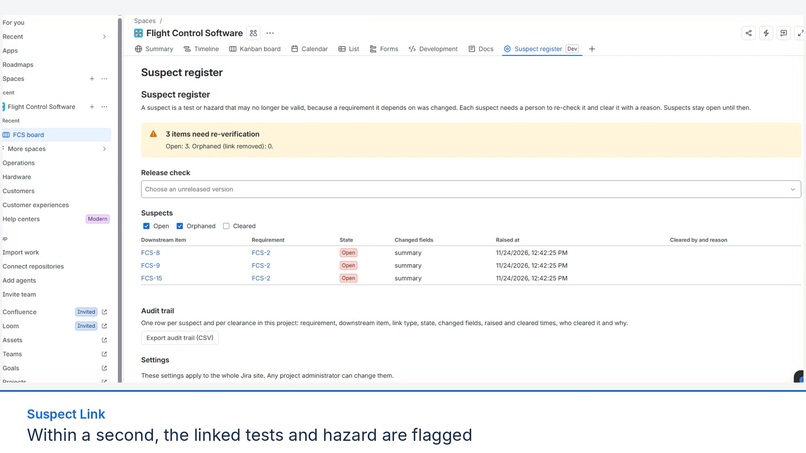
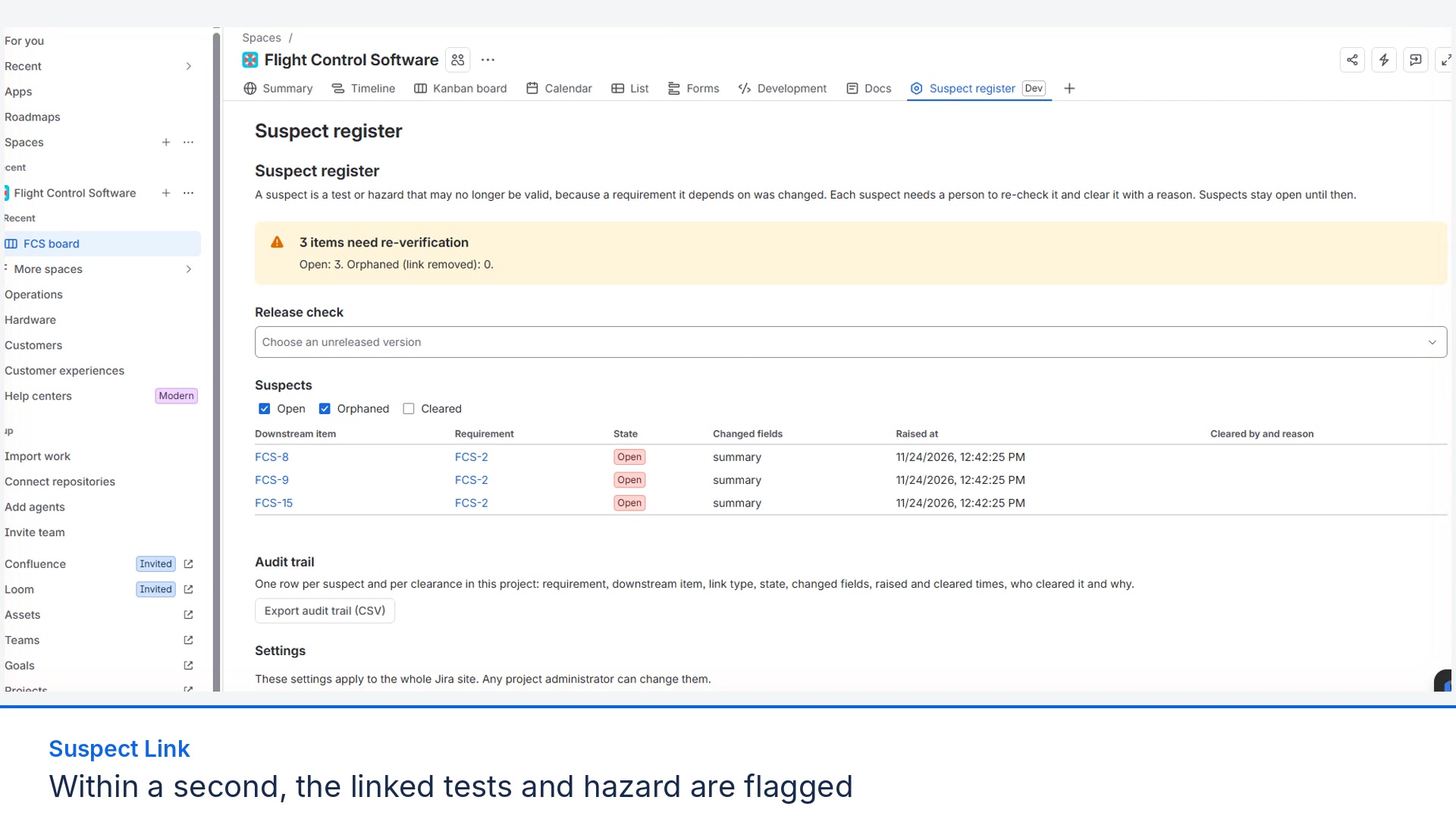
A requirement changed: its tests and hazard are flagged
-
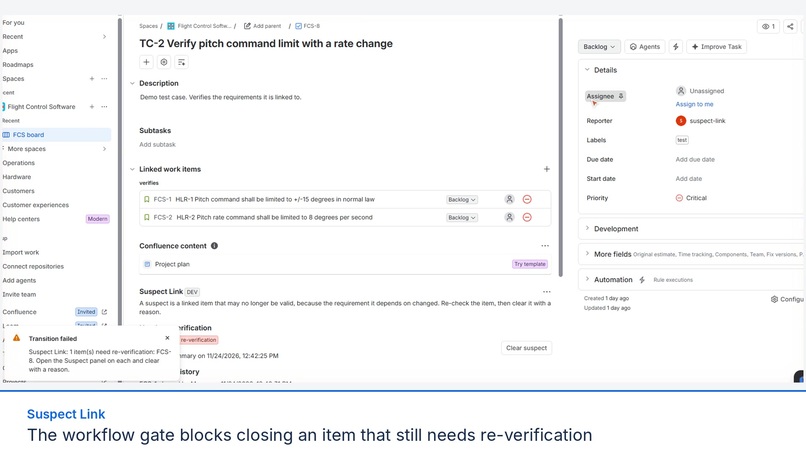
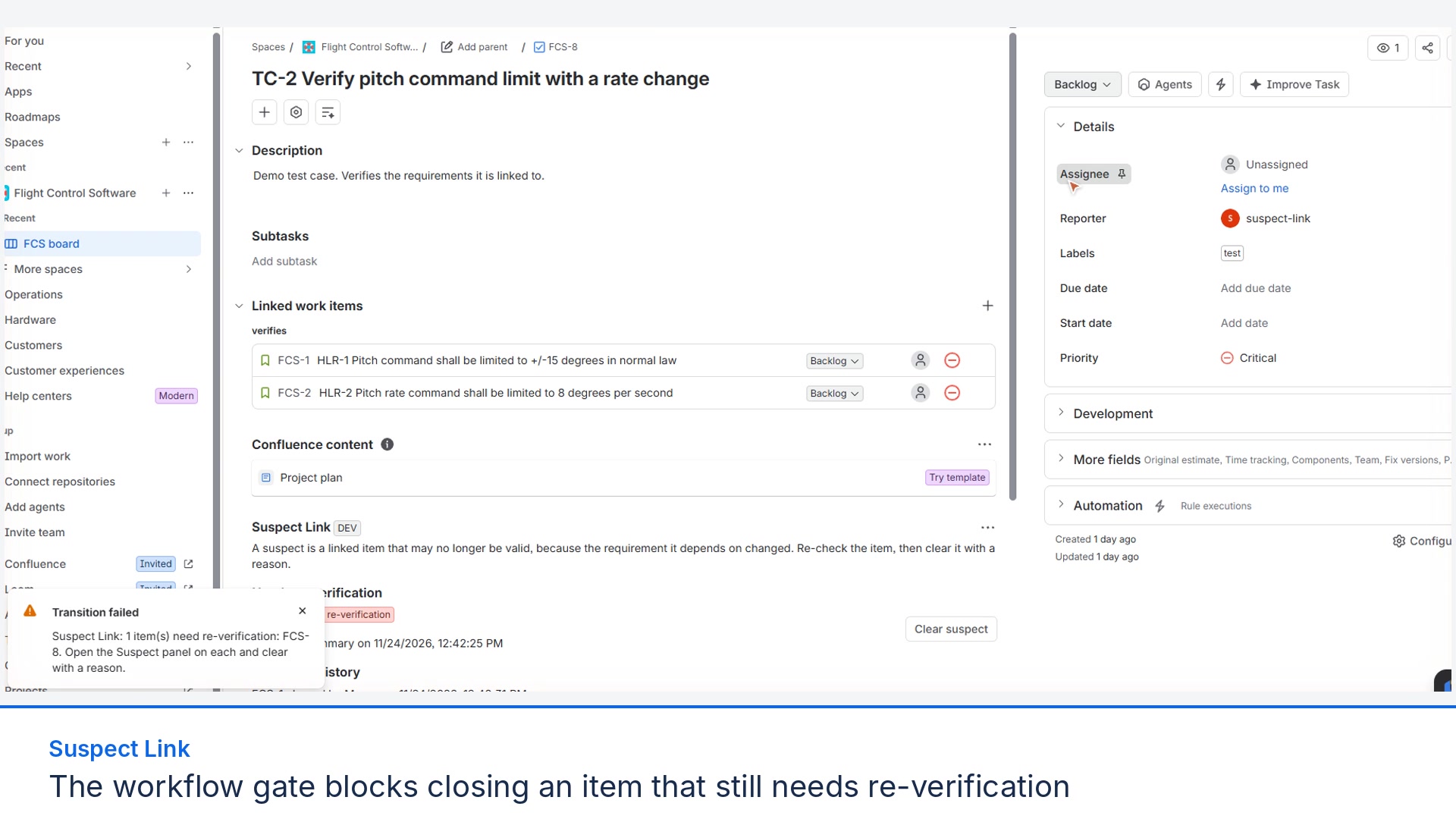
The workflow gate blocks Done until the item is re-verified
-
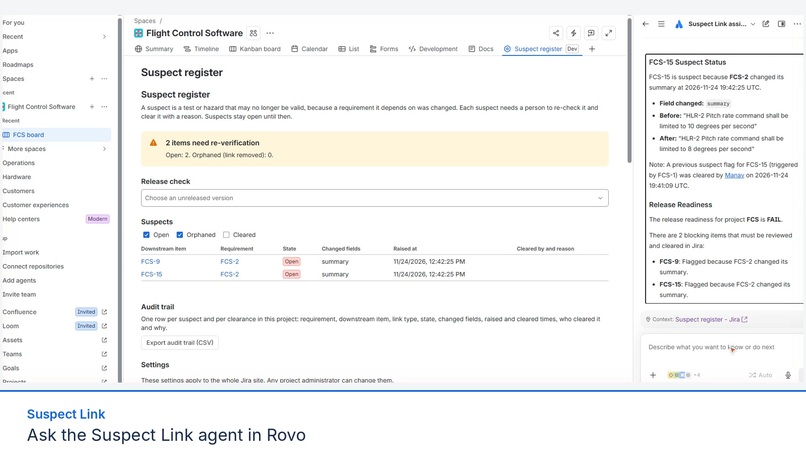
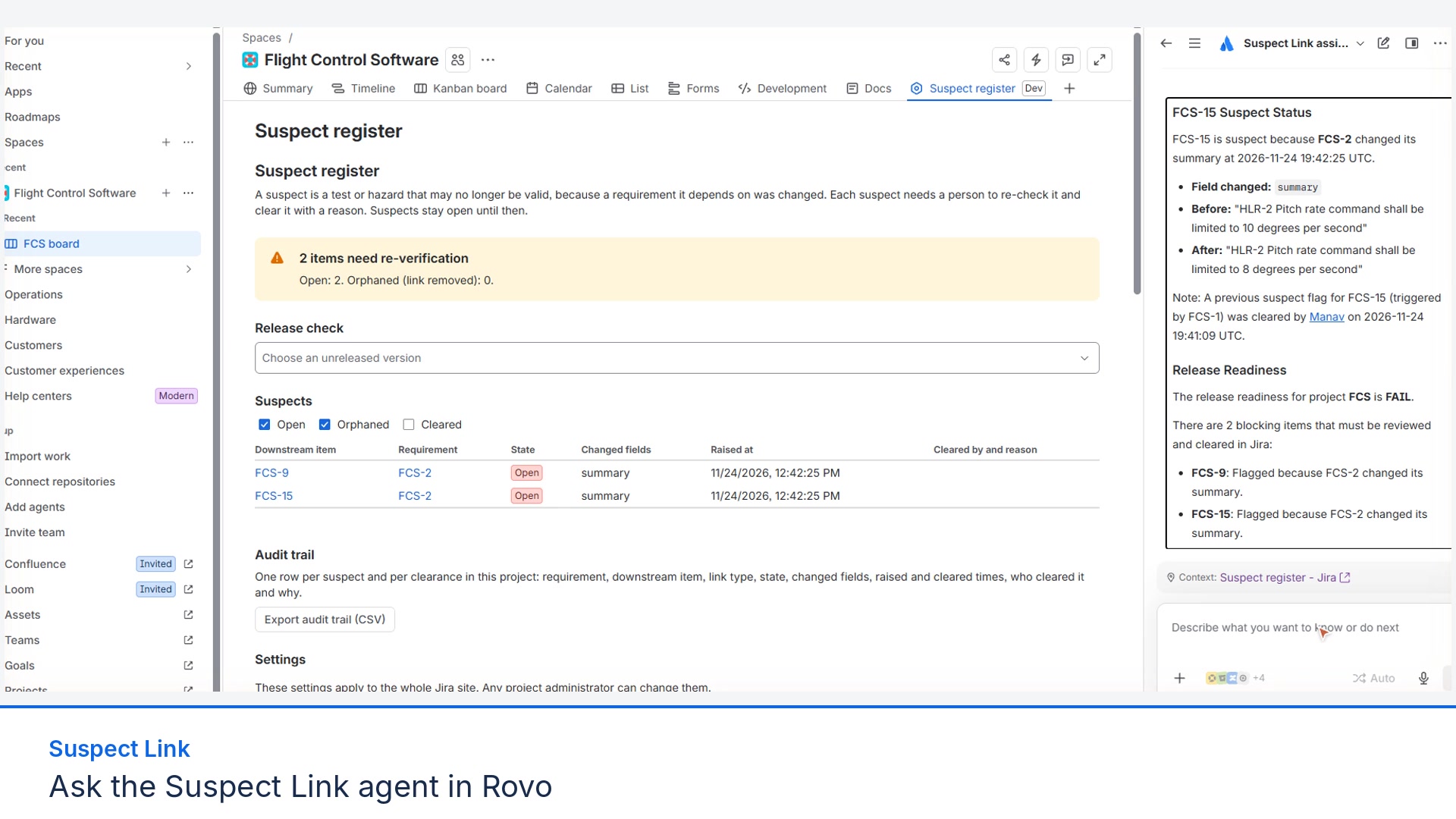
Rovo agent: why an item is suspect and whether the release is ready
-
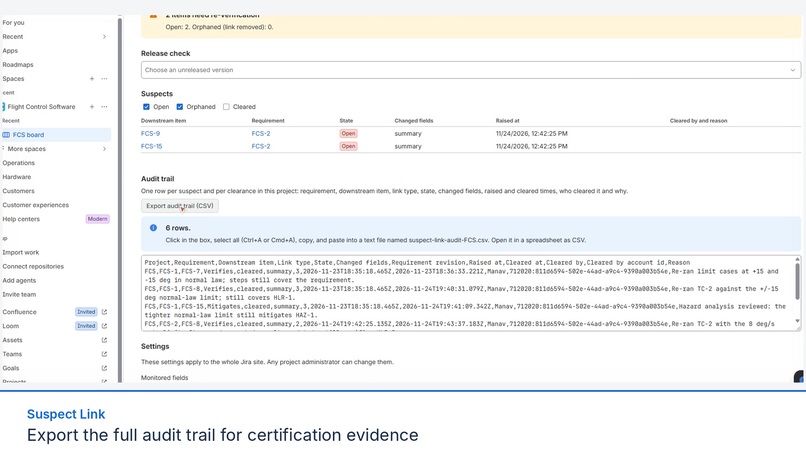
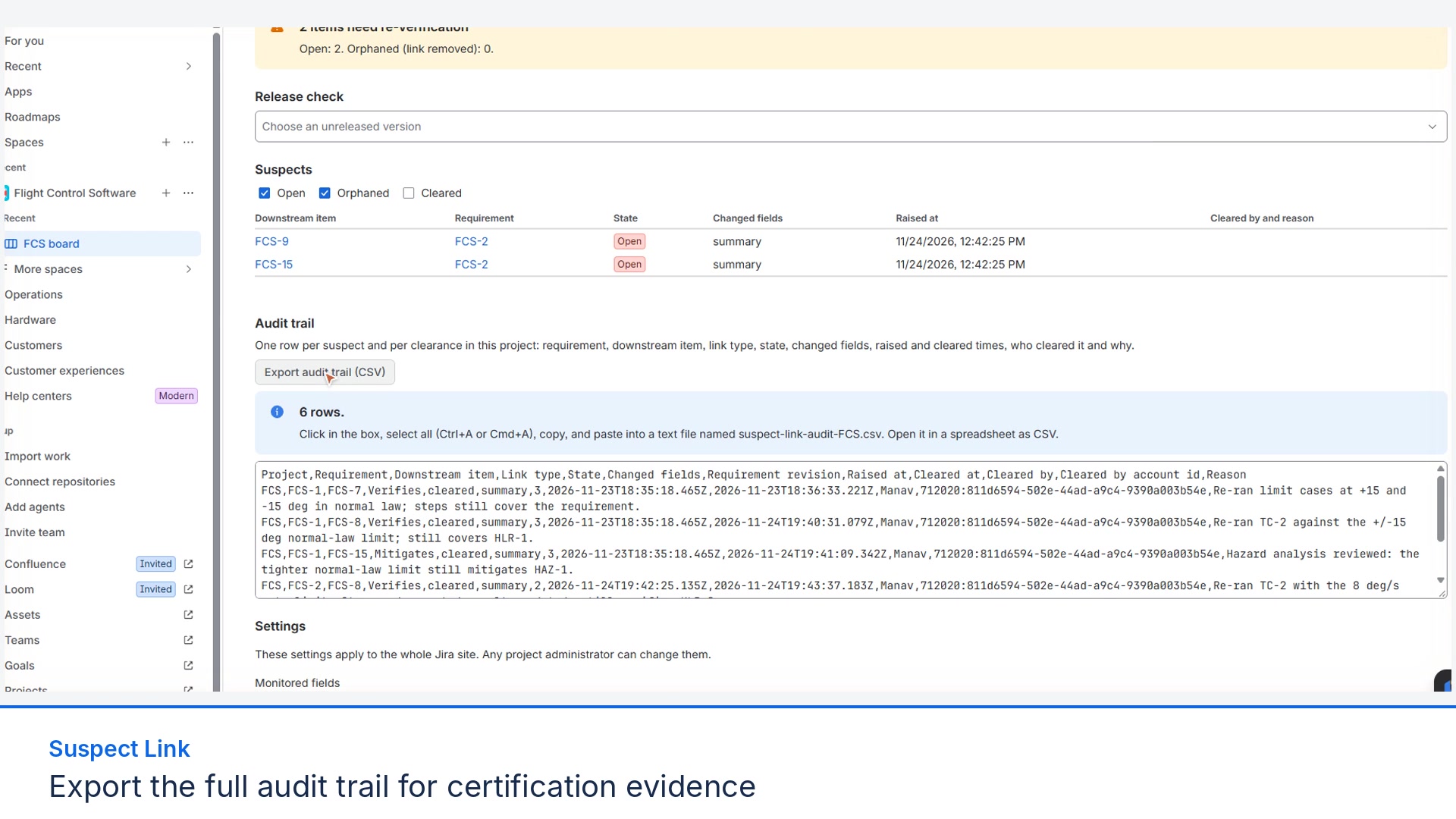
Audit trail export: every flag and clearance, who and why
Inspiration
In safety-critical software (avionics under DO-178C, medical devices under IEC 62304, cars under ISO 26262), every requirement is linked to the tests that verify it and the hazards it helps control. When a requirement changes, those links quietly go stale: the test still says "passed", but it was passed against the old wording. Dedicated requirements tools call these suspect links and won't let you ship until someone re-checks them. Teams that run their engineering in Jira don't get that safety net. I wanted to add it to Jira without making anyone change how they work.
What it does
Suspect Link watches the requirements in a Jira project.
- Flag. When a requirement's summary or description really changes (formatting-only edits are ignored), every test and hazard linked to it through a trace link type such as Verifies or Mitigates is flagged as a suspect, within about a second.
- Re-verify. The issue panel on each flagged item shows which requirement changed, which field, and when. An engineer re-checks the item and clears the flag with a written reason. The reason is stored with their name and the time in the item's clearance history. If the requirement changes again, it's flagged again.
- Gate. A Jira workflow rule, Suspect Link gate, blocks a transition (for example to Done) while the item still needs re-verification, with a message that names the item. Scope can be the item, its sub-tree or a whole fix version.
- Suspect register. A project page shows release readiness, a release check per unreleased version, the suspect table, and site settings (monitored fields, which end of each link type is the requirement, gate scope, fail-closed).
- Rovo agent. The Suspect Link assistant answers "Why is FCS-15 suspect?" with the requirement text before and after the change and who cleared earlier flags, and "Is FCS ready to release?" with a pass or fail and the blocking items. It only reads; clearing a flag always stays a human decision.
- Audit trail. The full history of flags and clearances exports as CSV: certification evidence, not just a dashboard.
- Demo data and re-check. One click sets up a small DO-178C style project (6 requirements, 8 tests, 4 hazards, 17 links). Re-check all links records baselines for newly linked requirements and marks suspects whose link was removed as orphaned.
How I built it
A Forge app for Jira (Node 24 runtime, UI Kit):
triggermodules on issue-updated and issue-link created/deleted events, comparing a hash of the normalised text with a stored baseline, so only real changes flag.jira:workflowValidatorfor the gate,jira:issuePanelfor flags and clearing,jira:projectPagefor the register.rovo:agentwith three read-onlyactionmodules (list-suspects, explain-suspect, release-readiness). Actions read Jira as the asking user, so people only get answers about issues they can see.- Forge custom entities (KVS) with indexes for suspects by downstream item, by requirement and by project and state.
- A domain layer with no Forge imports (direction rules, change detection, suspect state machine, gate decision), tested with 200 unit tests against in-memory fakes. No outside network calls: all data stays in Forge storage.
Challenges I ran into
Moving from tests to a real Jira site surfaced six things the docs didn't tell me:
- Forge custom entities reject attributes the manifest doesn't declare, so records keep their indexed fields at the top level and everything else in one JSON payload attribute.
- The create-issue-link REST call names its two ends the opposite way to the link phrases; I only caught it when the demo showed "HLR-1 verifies TC-1".
- Seeding demo data hit the 25-second function limit, so the seed works in time-boxed, resumable steps.
- Rovo actions don't receive the caller's account ID where resolvers do.
- Jira admins who aren't project admins couldn't reach settings.
- The register page could briefly report a failed load before Jira passed it the project context.
Accomplishments that I'm proud of
The whole loop works end to end on a live site: edit a requirement, see the linked tests and hazard flagged, get blocked by the gate, clear with a reason, ship, and ask Rovo for a release verdict that cites issue keys and never invents data.
What I learned
Traceability is only as good as its weakest stale link, and the fix is mostly workflow, not AI: make the change visible, make the person accountable, and block the release until it's done. Rovo is most useful here as a read-only explainer on top of hard facts.
What's next for Suspect Link
More monitored fields (acceptance criteria, attachments), suspect links across projects, rovo:mcp tools so outside assistants can query the impact graph, and baselines tied to Jira versions.
