-
-
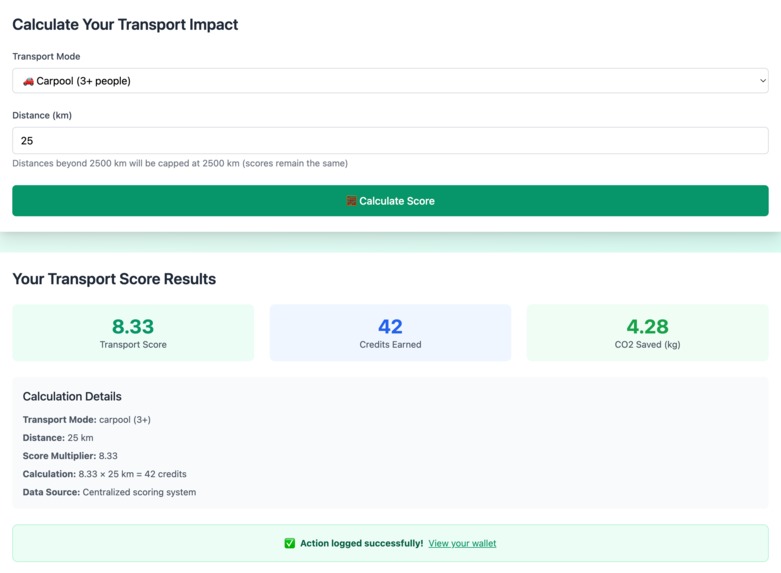
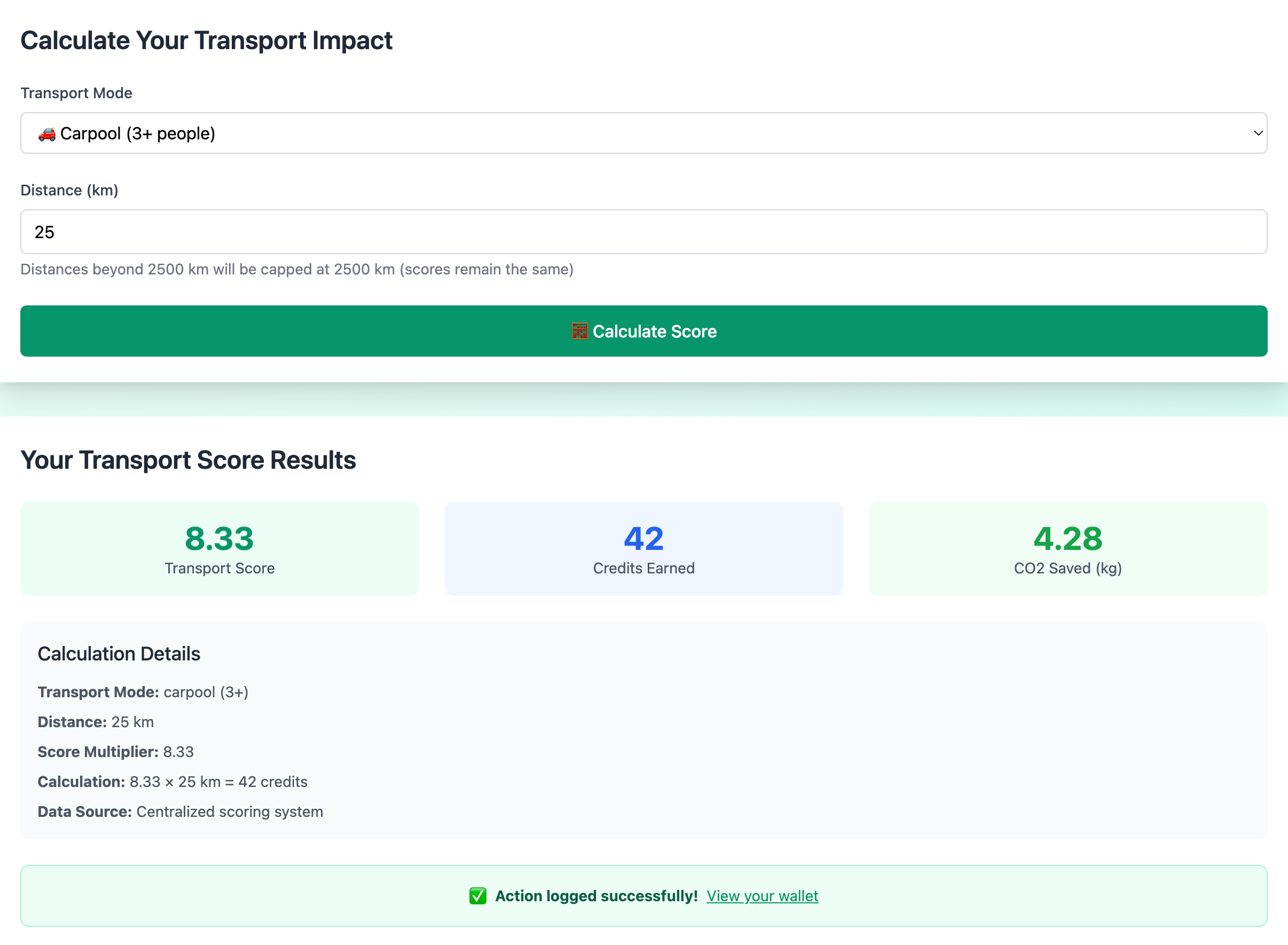
Impact of Choices
-
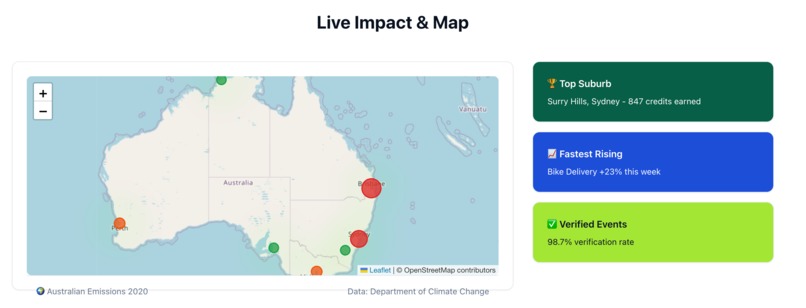
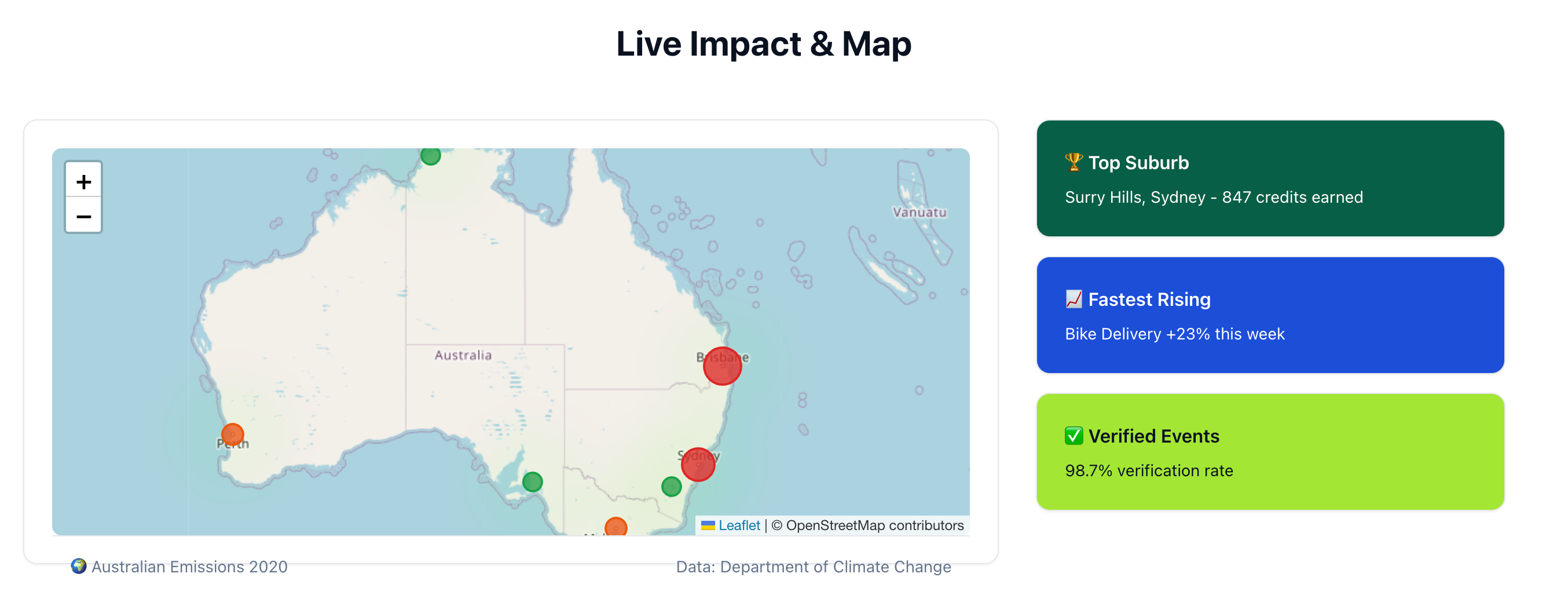
Adoption and Emissions
-
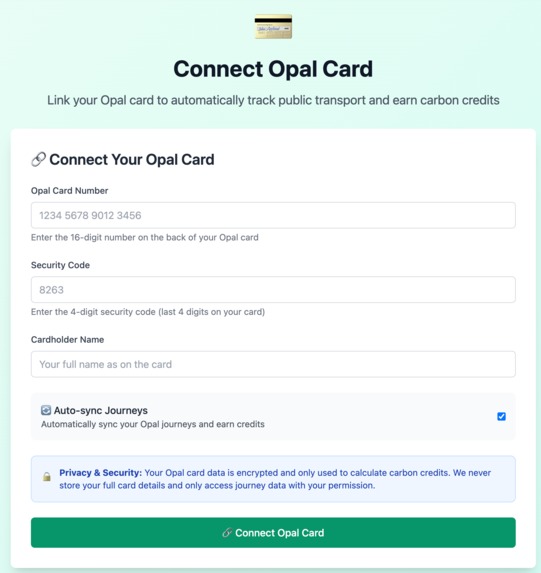
Opal Integration
-
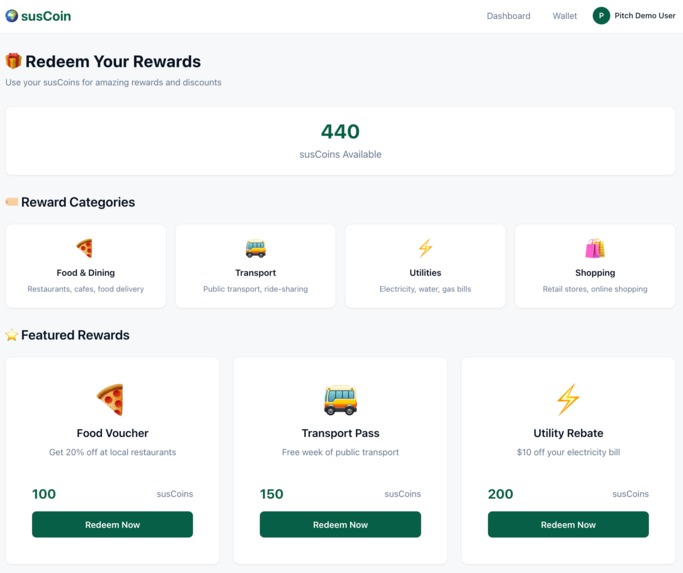
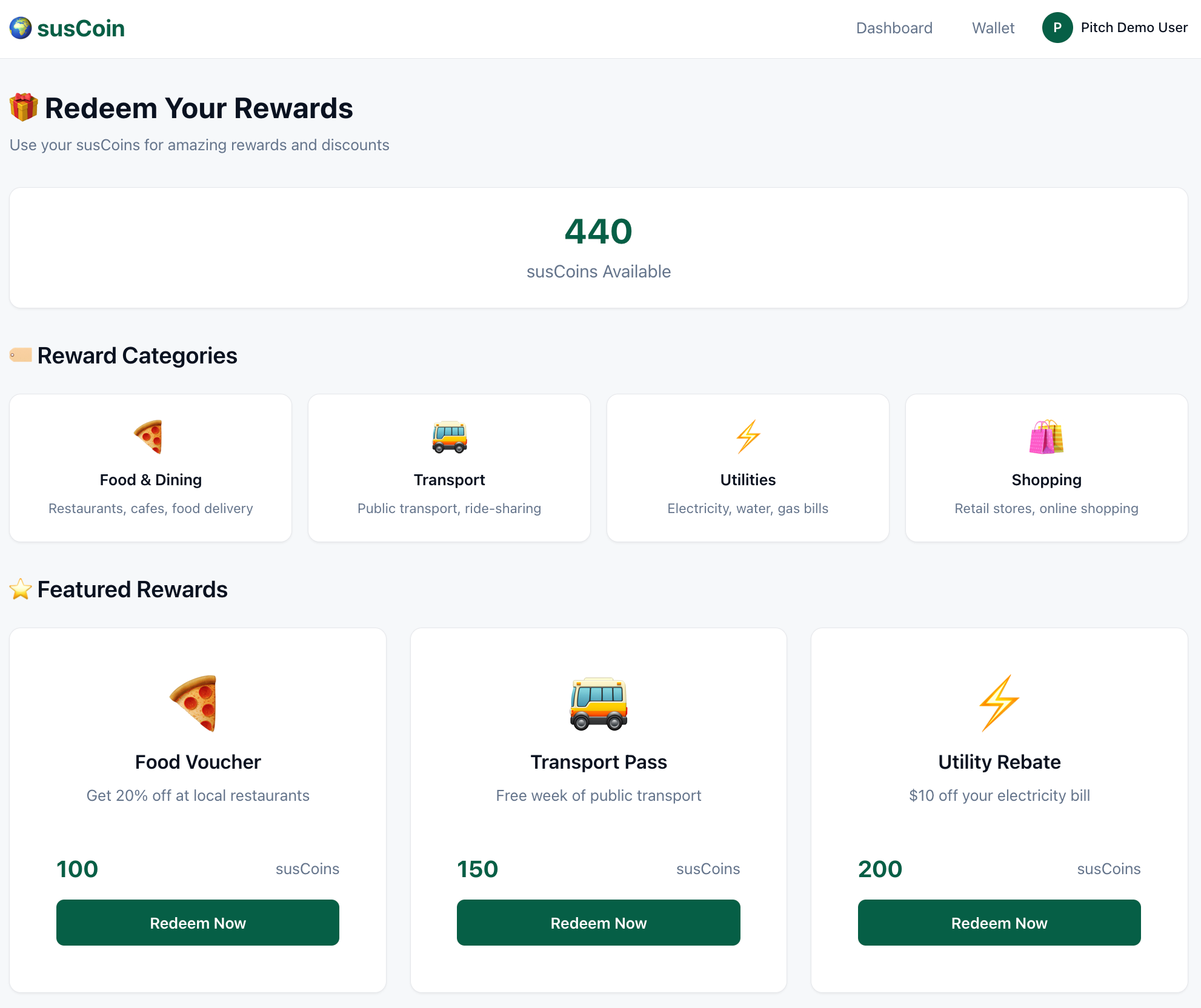
Wallet and Redemption

Inspiration
We were inspired by a simple question: what if every sustainable choice in a city was rewarded instantly, just like earning points in a game?
With climate change accelerating and cities under pressure to manage resources, we saw a gap: people want to make greener choices, but incentives are weak and impact is invisible. susCoin was born to turn low-carbon actions into everyday economic rewards.
What it does
susCoin is a reward layer for cities that converts verified sustainable actions (taking public transport, biking instead of driving, reducing energy use, installing solar, recycling) into a transparent, digital coin.
- Users earn susCoins when they log or verify actions.
- susCoins can be redeemed at local businesses for food, fuel credits, or discounts.
- Governments and companies can plug into the system to run targeted incentives and track real-time CO₂ reductions.
- A community dashboard shows the collective carbon savings and economic circulation.
How we built it
- Frontend: EJS + TailwindCSS, with live dashboards, wallet view, redeem marketplace, and community impact counters.
- Backend: Node.js with Express & Socket.io for real-time updates.
- Database: SQLite for wallet ledger, activity logs, redemptions, and partner catalogs.
- Scoring: Emission factor datasets (IPCC, EPA, Australian Government) + a custom CSV of transport scores to calculate coins based on CO₂ avoided.
- APIs: Integrated with Google Maps Distance Matrix for transport verification, PVOutput for solar panel generation, and open energy data for electricity baselines.
- Docs: Transparent formulas, anti-cheat rules, and partner APIs included in
/docs/.
Formula used for calculation
$$ \text{susCoins} = \Bigg\lfloor \Big(\text{Score}_{mode} \times \frac{Distance}{5}\Big) \times \alpha \Bigg\rfloor $$
where alpha is a scaling factor and Score mode is the score value taken from our emissions table.
Challenges we ran into
- Merging divergent data sources: aligning credible carbon emission factors with real-world APIs.
- Verification vs user experience: making sure logging is not just self-reporting but also feasible to demo in 24 hours.
- Git conflicts: integrating multiple teammates’ contributions under time pressure.
- Design balance: keeping the interface simple while showcasing enough features to prove scalability.
Accomplishments that we're proud of
- Built a working end-to-end system: log an action → calculate verified CO₂ saved → earn susCoins → redeem at a partner.
- Designed a transparent scoring model backed by open datasets.
- Created a real-time dashboard showing both personal and community impact.
- Developed docs + partner integration flows, showing how a café, fuel station, or government utility could plug in immediately.
What we learned
- How to turn abstract sustainability concepts into quantifiable, gamified incentives.
- The importance of API integration for credibility — a self-reported app isn’t enough.
- How to structure a project for both hackathon demo speed and real-world scalability.
- That storytelling (problem → solution → impact) is just as critical as the code when pitching to judges or stakeholders.
What's next for susCoin
- Government integration: plug into transport cards, utility bills, and waste collection systems.
- Private sector adoption: CSR programs and loyalty rewards where companies sponsor susCoin multipliers.
- Stronger verification: geo-tracking, receipts, and IoT sensor APIs to prevent abuse.
- Mobile app: easier action logging and QR code redemption.
- Scale internationally: adapt emission factors for different countries and integrate with local sustainability initiatives.
Built With
- australian-government-emission-factors
- chart.js
- chart.js-(impact-visualization-graphs)-other:-markdown-+-latex-(documentation-and-formulas)
- css
- css-frameworks-&-libraries:-express.js-(backend)
- csv-data-processing
- ejs
- ejs-(templating)-database:-sqlite-(wallet-ledger
- epa-emission-factors
- express.js
- fetch-api
- git
- google-maps-distance-matrix-api
- helmet.js
- html
- icao-carbon-emissions-calculator
- ipcc-/-epa-/-australian-government-emission-factors-cloud-&-tools:-github-(repo-and-version-control)
- ipcc-emission-factors
- javascript
- json
- leaflet.js
- nanoid
- node.js
- node.js-runtime-(server-environment)
- nodemon
- npm
- ocr-(tesseract.js-for-bill-parsing)
- open-energy-datasets-(electricity-usage-baselines)
- openrouteservice-api
- pvoutput-api-(solar-panel-generation-data)
- redemptions)-apis-&-data-sources:-google-maps-distance-matrix-api-(transport-verification)
- rest-apis
- smart-meter-data-apis
- socket.io
- socket.io-(real-time-updates)
- sqlite
- strava-api
- tailwindcss-(ui-styling)


Log in or sign up for Devpost to join the conversation.