Inspiration
As a kid I lived inside stories. I invented adventures, and I even built complete board games out of cardboard and paper. One of them was my own handmade replica of L'Isola di Fuoco, a board game about a volcano island that I used to play at my neighbours' house, the Dore family in Mondragone Italy. Some of the happiest, funniest afternoons of my childhood happened around that board: the tension of racing for the treasure, the volcano, everybody shouting at once.
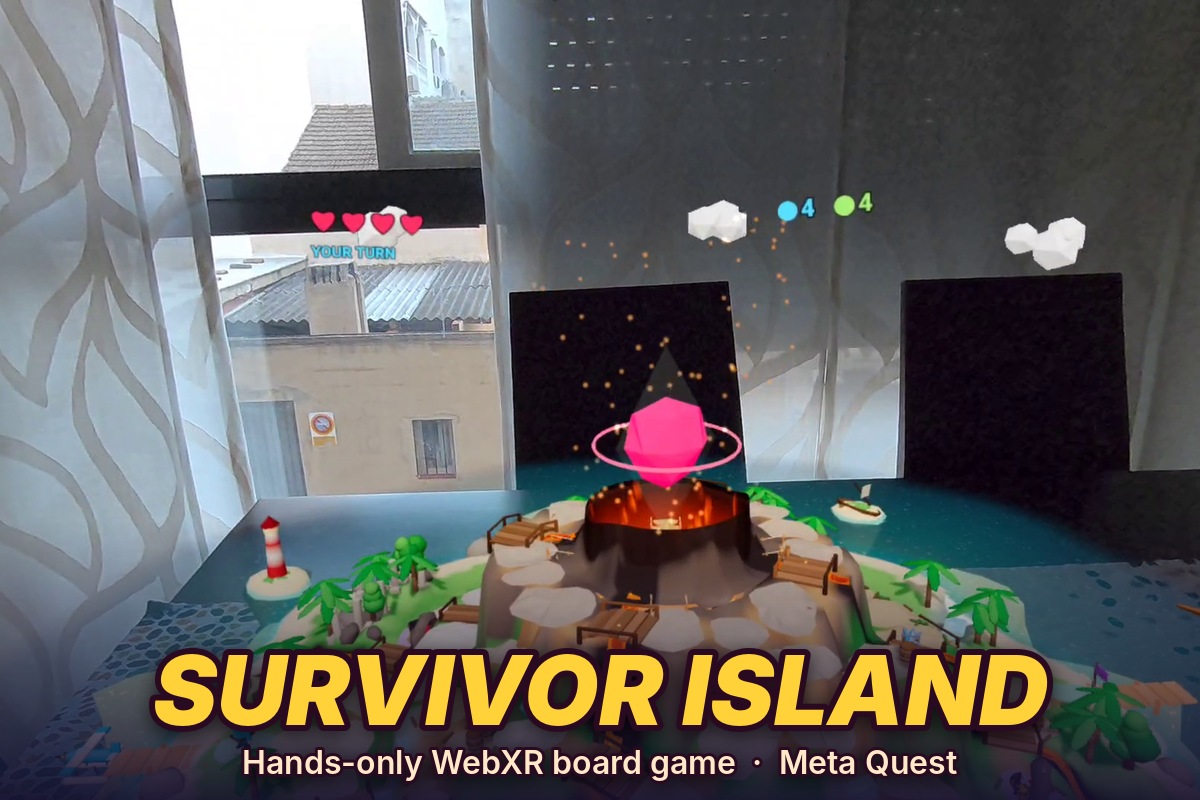
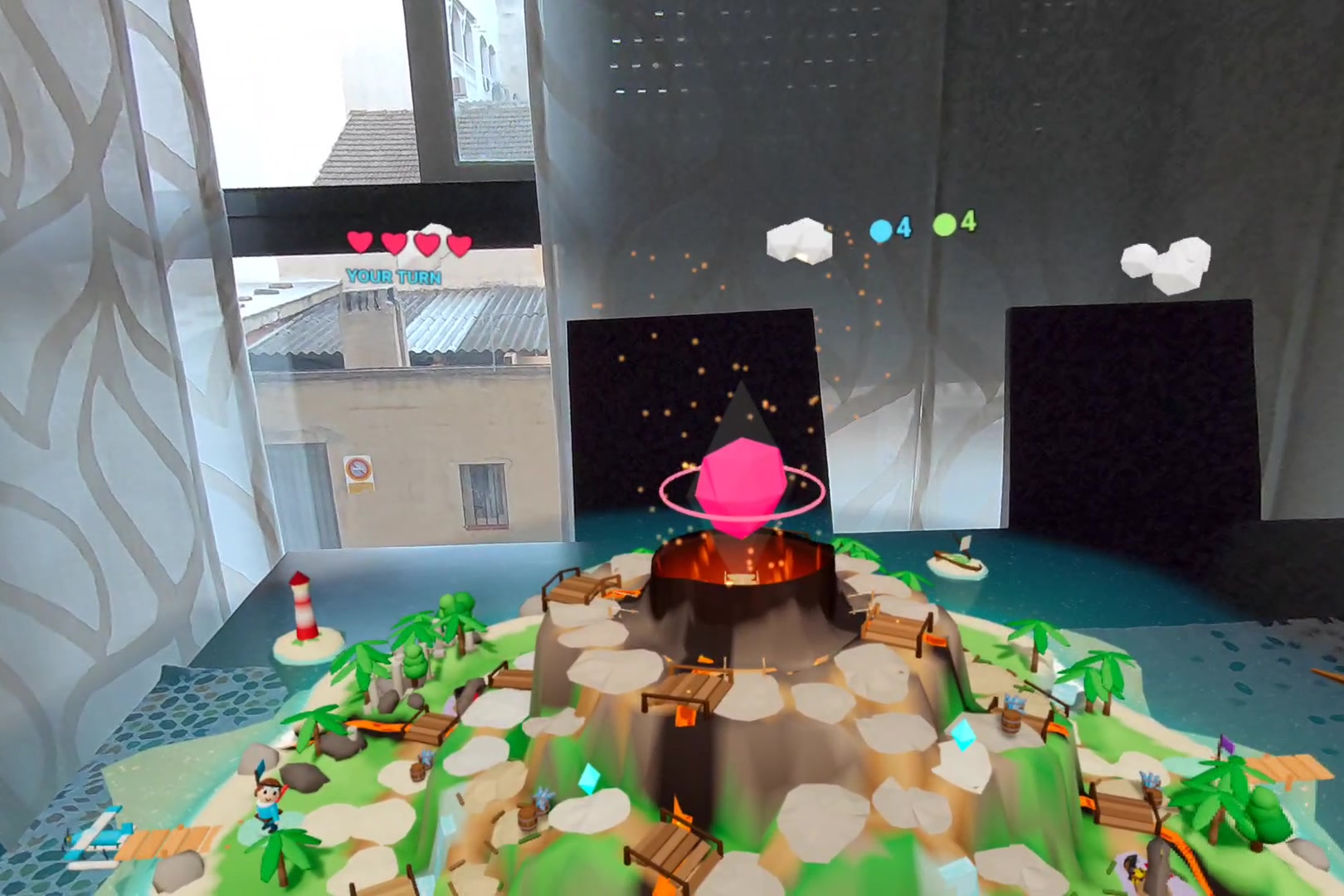
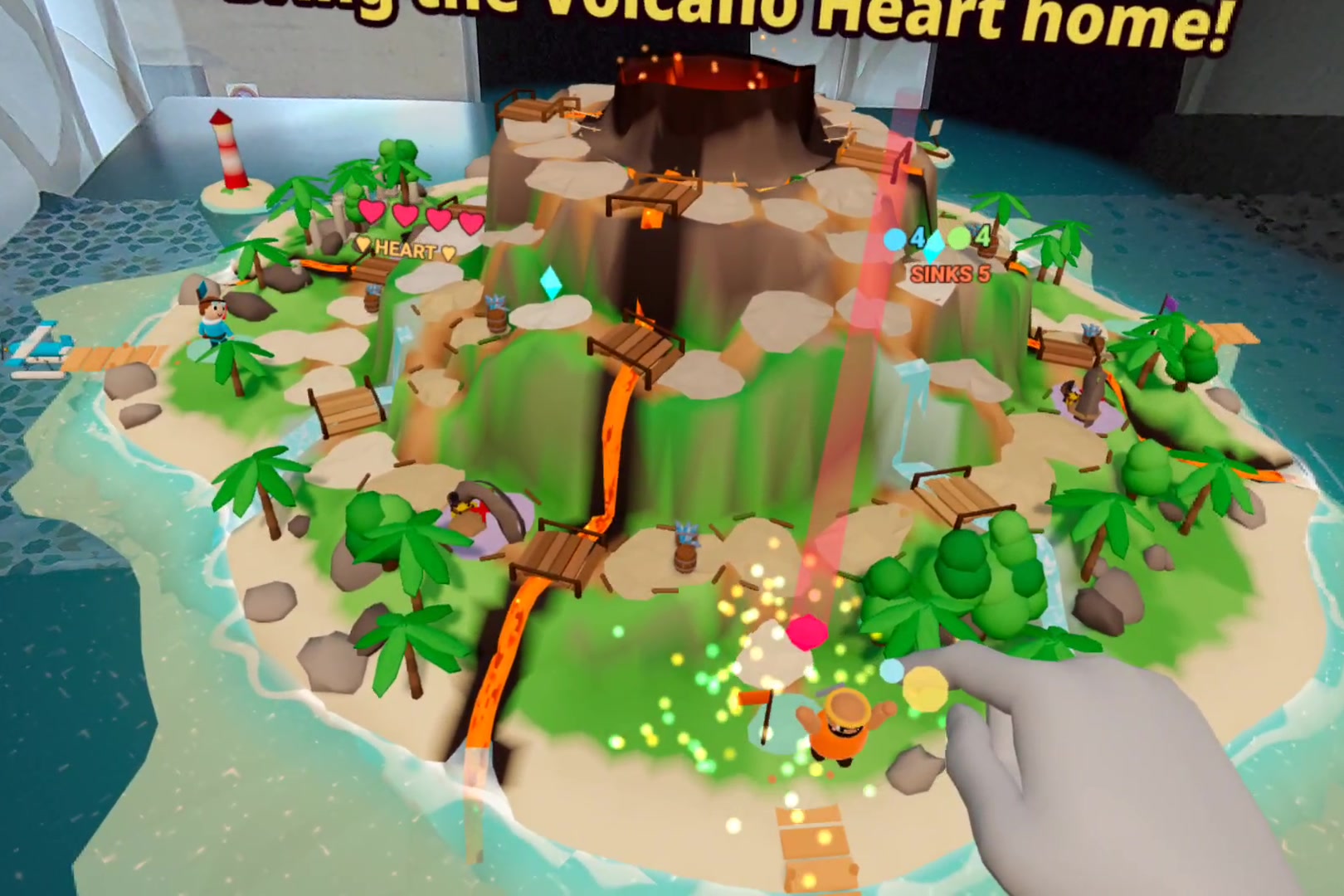
Survivor Island is my tribute to those afternoons. I wanted kids — and not-so-young kids — with a Meta Quest to feel what I felt around that table, but with something I could only dream of back then: the island actually growing on your real table, and the chance to shrink down and stand on it.
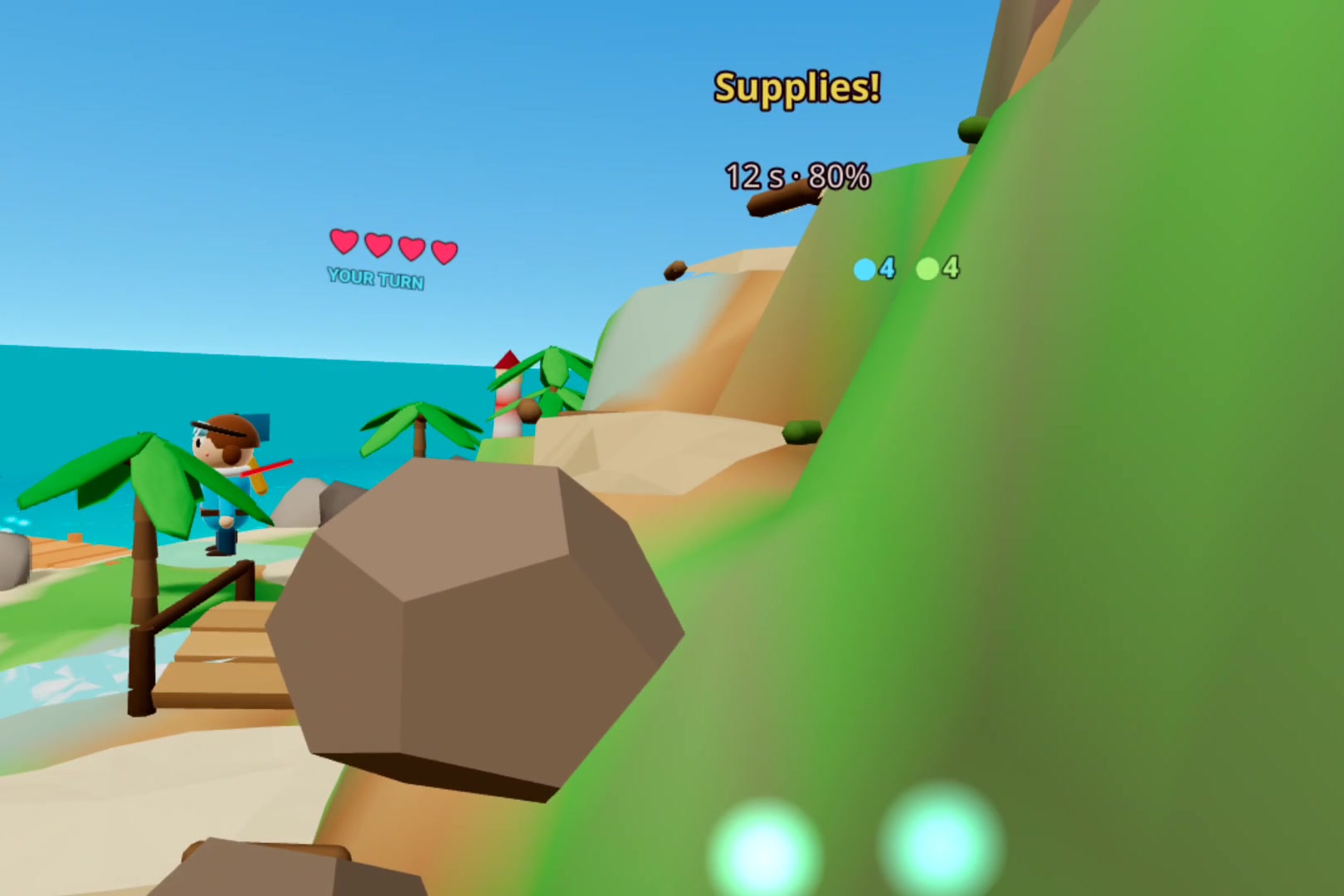
That's the second spark: scale. A board game always makes you wonder what it would be like to stand on that tiny island. On Quest you can actually do it: one moment the island is the size of a pizza on your dining table, the next you are standing on its beach looking up at the volcano.
We also set ourselves a constraint that shaped everything: hands only. Every action had to feel natural with bare hands, so the game is built around gestures people already know — turning a palm, pinching, swatting, gripping.
What it does
Survivor Island is a seated, 12–15 minute board game for up to 4 explorers (you plus AI rivals) on a volcano island that grows on your real table.
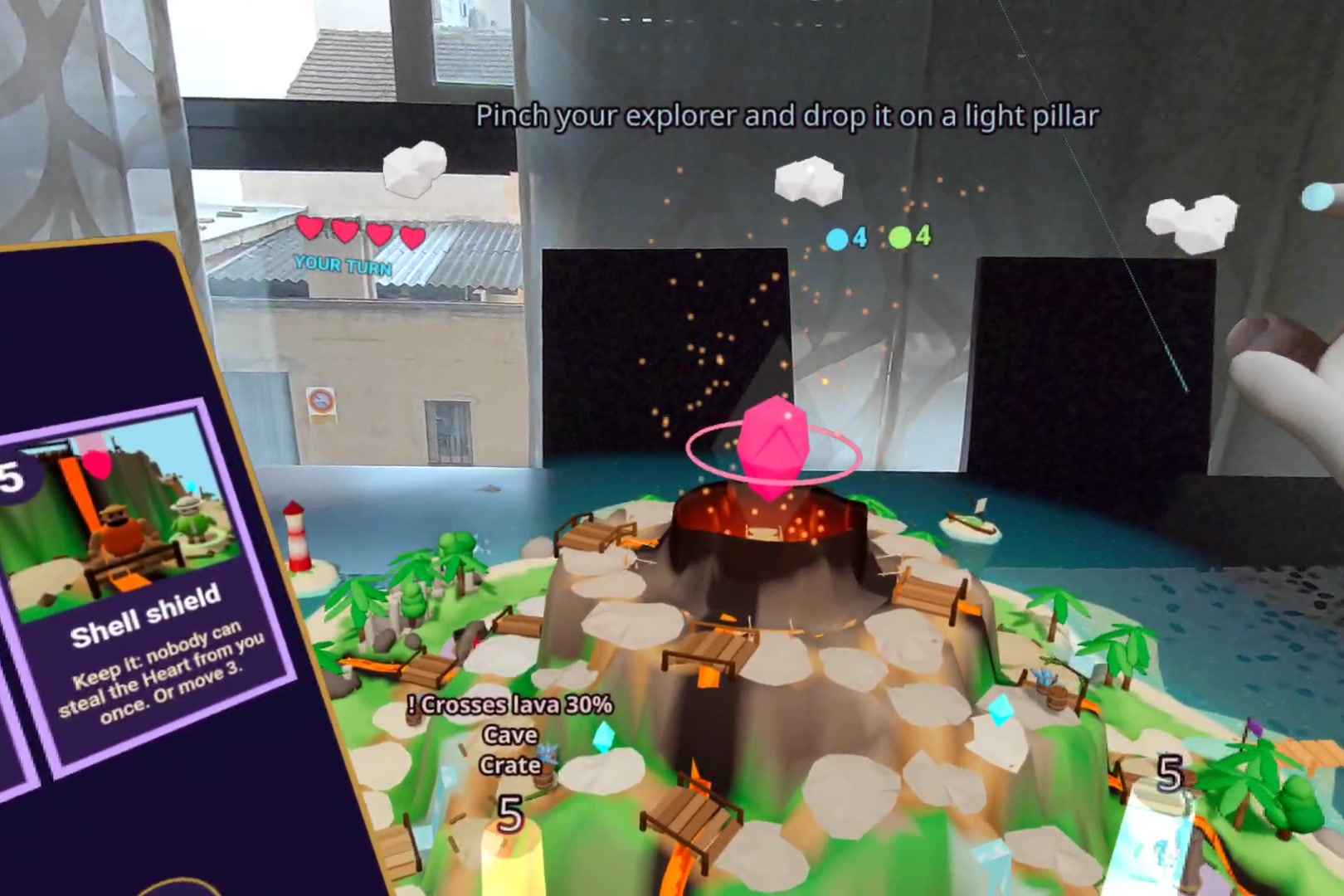
- The island lands on your table. If the headset knows your table (plane detection), the island settles on it. If not, a ghost hand asks you to tap the table and the island bursts out of the surface under your fingers.
- Your hand is your hand of cards. Turn your left palm towards you and your cards appear on it. Pinch one with your right hand, pull it out, and drop your explorer on one of the glowing destinations.
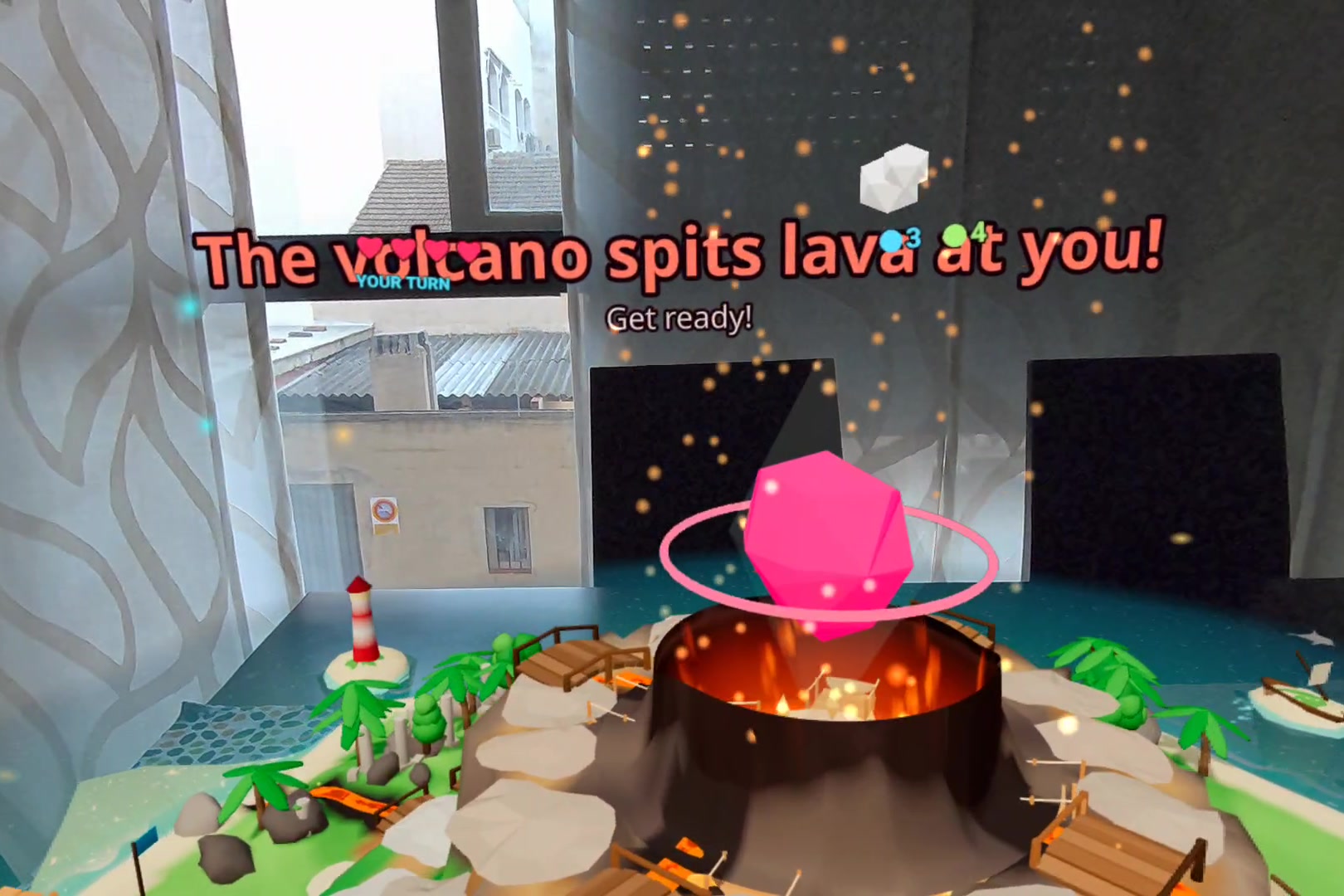
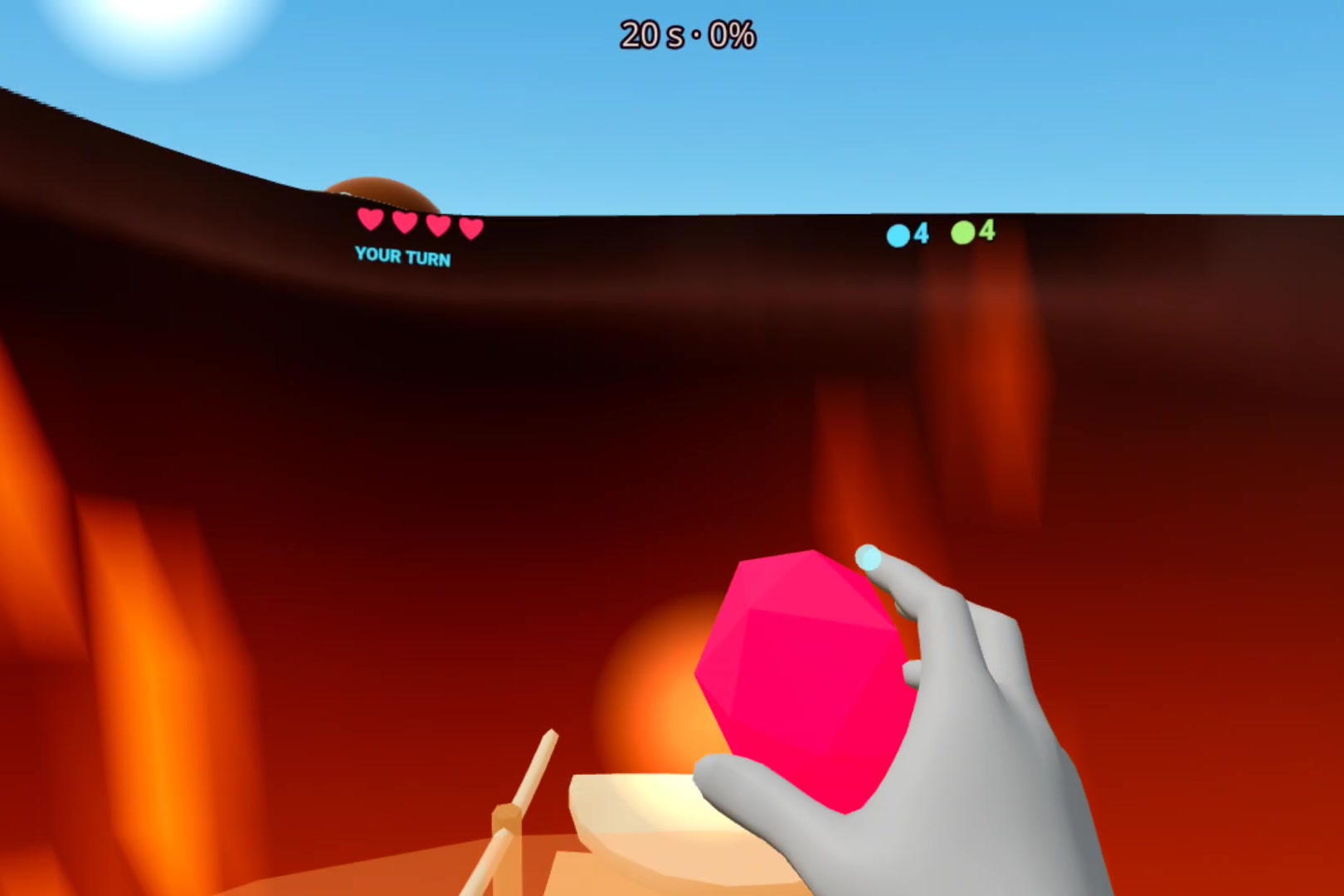
- The volcano fights back. Lava bombs fly at you — swat them away with your real hand.
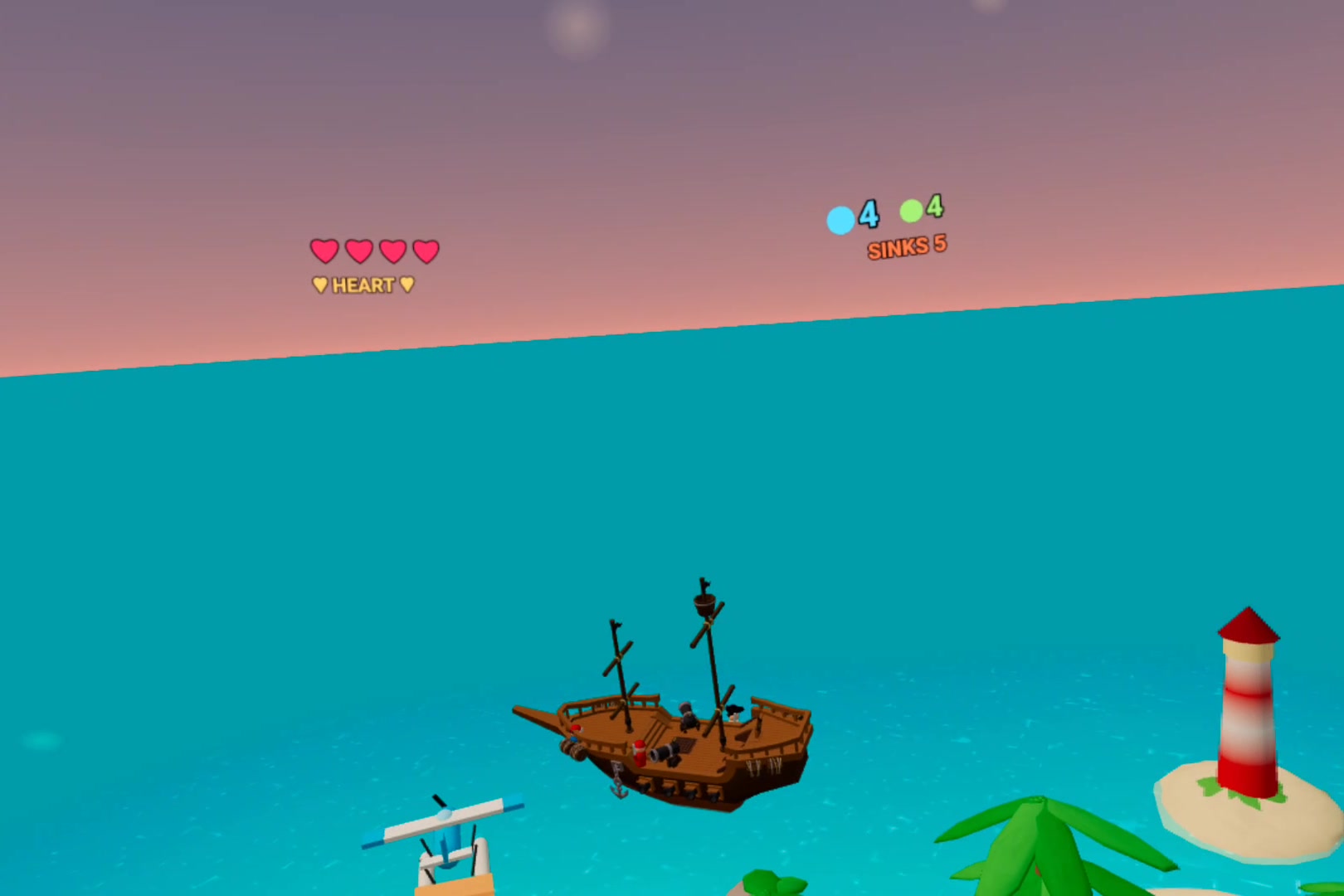
- From tabletop to life-size. At key moments the island scales up around you and you are standing on it: smash rocks in a cave, pull the Volcano Heart out of the crater, face a pirate galleon.
- Grab the Heart and run. Taking the Heart wakes the island: six rounds before it sinks. Rivals can land on you and steal it.
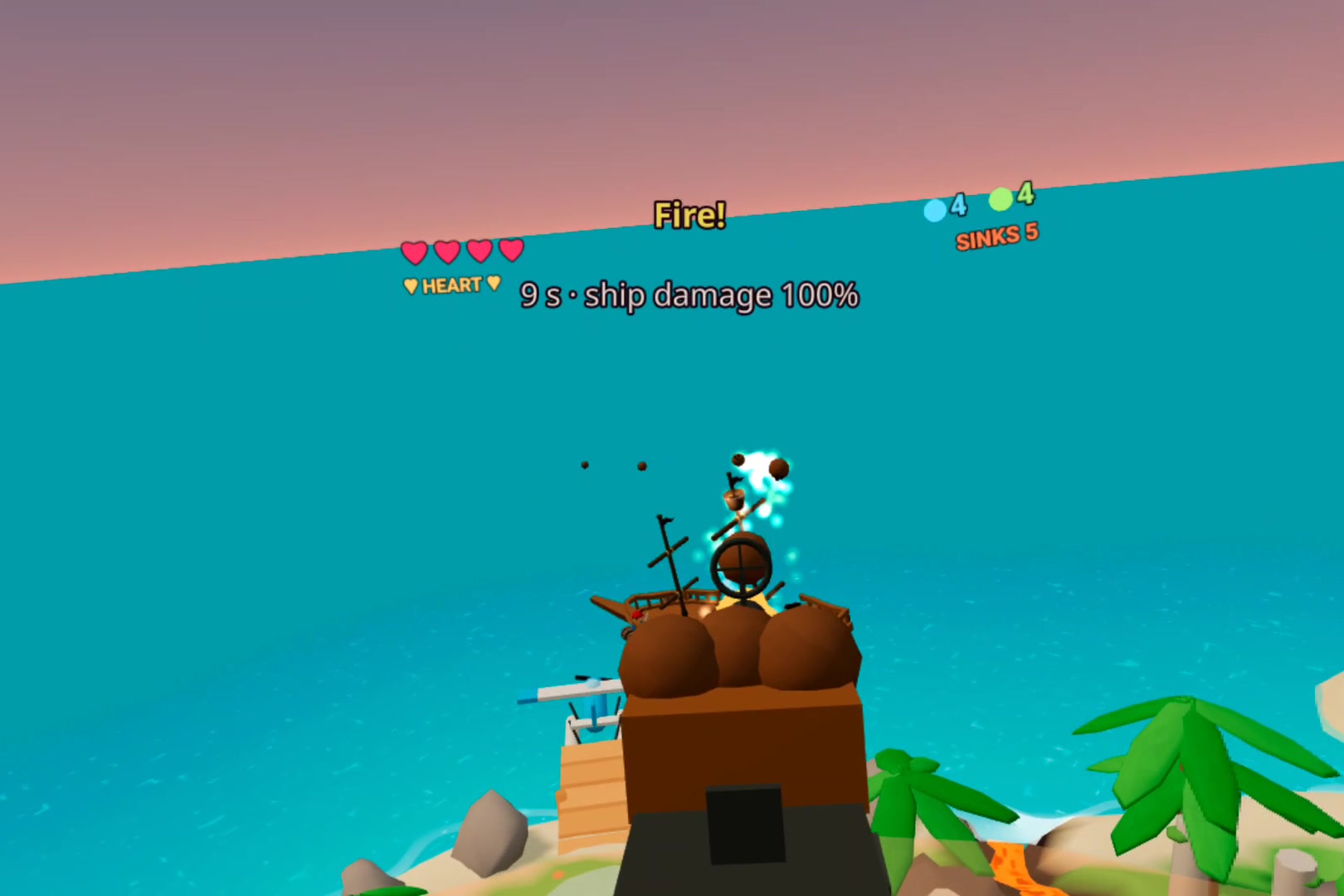
- Sink the galleon, escape. A pirate ship blocks your boat. Grip the handles of a coconut machine gun with both hands, sink it, and sail away with the Heart.
- The explorers feel alive: they look at your head and hands, flinch if your hand rushes at them, wave back if you wave, and cheer or protest in their own wordless voices.
No install, no account: open the link in the Quest browser and play. English and Spanish, picked from the system language.
How we built it
The whole game is a web page: TypeScript, Vite, React 19, React Three Fiber, three.js and @react-three/xr, deployed on Vercel.
- Pure game engine. The rules live in a framework-free TypeScript engine that emits events; a Director turns each event into animation, sound and camera moments. That split let us test the rules headless: a simulator plays thousands of AI matches for balance, and a fuzzer plays thousands of random matches checking invariants (cards never lost or duplicated, the game can never get stuck).
- Hand interaction from raw joints. Pinch, grip, palm direction, swats and two-hand island grabbing are computed from WebXR hand joints. Following Meta's Quest requirements, a pinch that starts with the palm facing you is ignored (it belongs to the system menu), losing focus pauses the game, recentering re-places the island, and picking up a controller shows a prompt to put it down.
- One world, two scales. The island is a single scene that animates between tabletop scale and life-size. At life-size a shader clears a safe area around you so nothing clips through your head.
- Hand-made look. The island, crater, lava, sea and explorers are built procedurally in code: our own low-poly style with custom opaque shaders for animated lava and water. Sea life and the pirate galleon come from Quaternius kits, merged into single meshes.
- Built for Quest performance. Repeated props are instanced, each explorer is one rigid-skinned mesh instead of seven, and UI panels are baked into canvas textures instead of dozens of text meshes. Draw calls at the table went from about 190 to about 100.
- Telemetry from the headset. Every play session uploaded FPS, frame-time percentiles, draw calls and in-headset screenshots, with a crash black box and a hitch watchdog, so each fix was based on real Quest data rather than desktop guesses.
Challenges we ran into
- Frame rate on a phone-class GPU. Our first builds dropped to the mid-50s at the table. Baking, instancing and merging meshes cut draw calls roughly in half, and we even tested halving the triangle count. Inside the island it now runs at ~70 FPS and the tabletop view holds around 60. Headset benchmarks showed why it doesn't go higher: even with an empty scene, mixed reality in WebGL tops out near 71 FPS here, so what's left is per-frame overhead rather than our content.
- Gestures that don't collide. The left palm opens your cards, two pinching hands move the island, and a pinch with the palm towards you is reserved for the Quest system. Getting these to never fight each other took several rounds of play-testing.
- Shrinking a player into the world. The first life-size version flattened and stretched the scenery around your head, so the world seemed to swim as you moved. We rebuilt it around a fixed clearing at your feet, where whole objects shrink away instead of deforming.
- Teaching without a tutorial wall. A separate tutorial level felt slow and killed the excitement. We replaced it with ghost hands that show each gesture once, the first time you need it, inside the real game.
- Finding the real table. Plane detection only works if the room is set up with furniture, so we added a fallback: tap your table and the island grows from under your hand.
Accomplishments that we're proud of
- A complete game, not a demo. A full ruleset with four characters, a card deck, AI rivals, items, weather, sharks, a kraken and pirates — balanced with a simulator, and checked by a fuzzer so a match can never get stuck.
- 100% hand tracking, and it feels natural. Cards on your palm, swatting lava and gripping a machine gun with both hands need no explanation once you see a ghost hand do it once.
- The scale jump. Going from a tabletop board to standing on the same island, in the same match, with no loading screen.
- Characters with personality. Hand-built explorers that react to your hands and head, wave back and talk in their own voices.
- Instant access. It is just a link: no store, no install, no account.
What we learned
- Measure on the headset. Desktop profiling pointed at the wrong things more than once. Logs and benchmarks recorded inside the Quest told us what actually cost frames.
- Measure before optimizing. Several "obvious" fixes — fewer triangles, fewer draw calls — barely moved the frame rate on the headset, and only real-device data told us so.
- Teach a gesture once, in context. Players learn faster from a ghost hand at the right moment than from any up-front tutorial.
- Design hands-only input around comfort. Seated play, short reaches, big targets and gestures that never clash with the system menu.
- Separate rules from presentation. A pure engine made it possible to test thousands of matches automatically while the 3D side kept changing every day.
What's next
- Local multiplayer — several people around the same real table, sharing one island.
- Online play — friends in different homes, each with the island on their own table.
- Unique steal moves per character — a tackle, a long-range snatch, a trick that costs a life, a card thief.
- New hands-only mechanics — a two-handed bow and a giant fire bird (the Roc) that can carry the Heart carrier back to their boat.
- Performance headroom — move to the WebGPU renderer and multiview (each draw call rendered once for both eyes), or to Meta's Immersive Web SDK.
- Accessibility — one-handed mode, brightness and colour-blind options.
- New islands with their own hazards and rules.
Credits
All footage in the video is real gameplay recorded on a Meta Quest 3. Only the trailer voice-over and trailer music were generated with AI (ElevenLabs).
- Inspired by the board game Fireball Island, (Milton Bradley, 1986) wich I loved as a child. Survivor Island's rules, characters and art are original.
- Sea life, shark: Quaternius (CC0)
- Pirate galleon, kraken tentacles, barrels, chests, cannonballs: Quaternius Pirate Kit (Sketchfab Standard licence)
- Ghost hand model: WebXR Input Profiles generic-hand (MIT)
- In-game music: "Jungle Jive" by HiraSePix and "Mission" by Grand_Project (Pixabay Content License)
- Island, explorers, crater, lava, sea, UI, sound effects and character voices: made by the developer, in code
Built With
- hand-tracking
- javascript
- meta-quest
- mixed-reality
- react
- react-three-fiber
- three.js
- typescript
- vercel
- vite
- webgl
- webxr
- zustand
