-
-
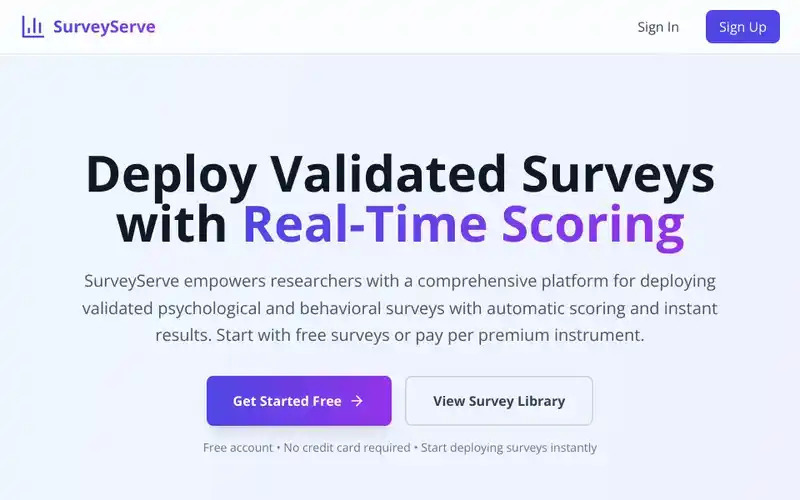
Screenshot
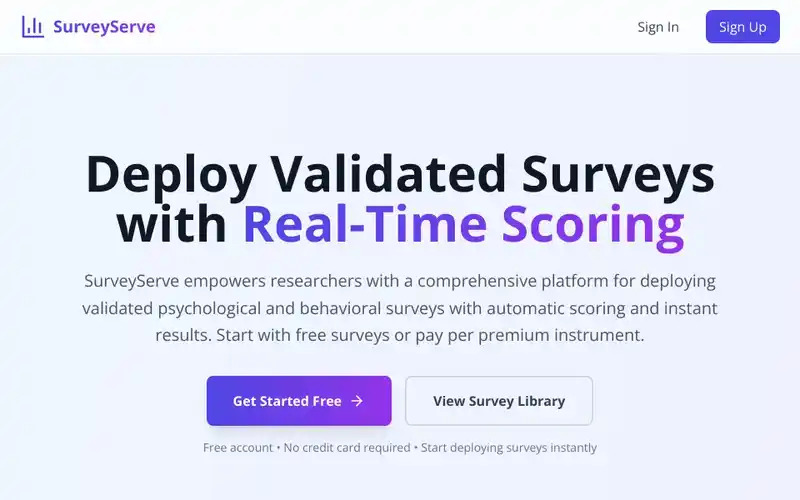
About SurveyServe
Why I Built This
SurveyServe came out of a problem I saw firsthand: researchers spending weeks, sometimes months, trying to implement validated psychological surveys like the PHQ-9 or GAD-7 into digital tools. The process was slow, expensive, and frustrating. Most existing platforms were either built for general-purpose surveys (like customer feedback) or priced far beyond what research budgets could afford.
I wanted to fix that with a tool that could save researchers thousands of dollars and hours by making validated instruments available, usable, and easy to score without compromising on the scientific integrity that makes them valuable in the first place.
What I Learned
Technical Skills
- Built the platform using Bolt.new with: React, TypeScript, Supabase, and Stripe
- Designed a flexible scoring engine to handle everything from raw scores to complex thresholds
- Integrated secure payment with Stripe, including credit-based and freemium pricing models
- Added privacy and consent management in line with research ethics
Domain Knowledge
- Studied the structure and scoring of validated psychological assessments
- Gained insight into psychometric properties and academic publishing norms
- Built workflows and interfaces aligned with real research practices
Business & Product Strategy
- Validated the idea through conversations with real researchers
- Balanced academic accessibility with a sustainable pricing model
- Learned how to design around non-technical users in high-stakes, detail-sensitive environments
How the System Works
SurveyServe runs on a modern, scalable stack:
- Frontend: React + TypeScript, Tailwind CSS, React Router
- Backend: Supabase for auth, database, and real-time data
- Payments: Stripe for credit-based and pay-per-survey billing
- Hosting: Netlify with automatic CI/CD
The platform includes a scoring engine capable of handling:
const scoringRules = {
  depression_score: {
    type: "sum",
    questions: ["q3", "q5", "q11", "q14", "q16", "q19", "q20"]
  },
  depression_severity: {
    type: "threshold",
    input: "depression_score",
    thresholds: [
      { min: 0, max: 9, label: "Normal" },
      { min: 10, max: 13, label: "Mild" },
      { min: 14, max: 20, label: "Moderate" }
    ]
  }
}
This engine supports reverse scoring, subscales, conditional logic, and clinical thresholding, all in a declarative format researchers can understand.
Key Features
- Instrument Library: Validated surveys across mental health, well-being, personality, and workplace stress
- Real-Time Analytics: Live response monitoring, automatic scoring, and trend summaries
- Compliance: Anonymous data collection, and consent management
- Flexible Schema: Surveys stored as JSONB for schema flexibility without losing query performance
- Export Tools: CSV and JSON downloads for research use
Challenges I Faced
Technical
- Building a generalized scoring engine that doesn’t require code changes per instrument
- Designing a flexible database schema to support conditional and multi-part surveys
- Creating secure, resilient billing flows with custom webhook logic
Domain
- Navigating licensing rules for each instrument (attribution, public domain, commercial)
- Avoiding scoring errors with real clinical implications
- Making the UX usable for researchers with limited technical skills
Business
- Pricing for researchers while covering platform costs
- Getting early validation from the academic community
- Supporting both casual users and enterprise-scale research orgs
Highlights & Impact
- Peer-reviewed psychological instruments ready to use
- Built-in scoring and analytics with real-time updates
- Research-grade security and privacy workflows
- Academic-friendly pricing with a freemium model
- Designed for mobile and desktop use
- Easy data export for analysis or publication
Where It’s Going
SurveyServe is just the start. Future plans include:
- Expanding the instrument library to cover more domains
- Adding AI-powered scoring insights and pattern detection
- Supporting team-based research and collaboration features
- Offering deeper integration with research platforms and APIs
This project started as a fast, focused build to solve a clear, high-friction problem. But it’s grown into something that could seriously improve how research gets done. Making rigorous tools accessible shouldn't be hard—and now, it isn’t.
Built With
- bolt
- bolt.new
- netlify
- react
- stripe
- supabase
- typescript


Log in or sign up for Devpost to join the conversation.