Inspiration
As a product manager, I grew frustrated with the time, cost, and expertise barrier of market research—waiting weeks for results, deciphering raw data, or hiring expensive agencies. I wanted to make professional-grade research accessible to every founder, PM, and small business owner—no PhD required. That’s how SurveyAgent was born: to put data-driven decision-making in the hands of anyone who needs it.
What it does
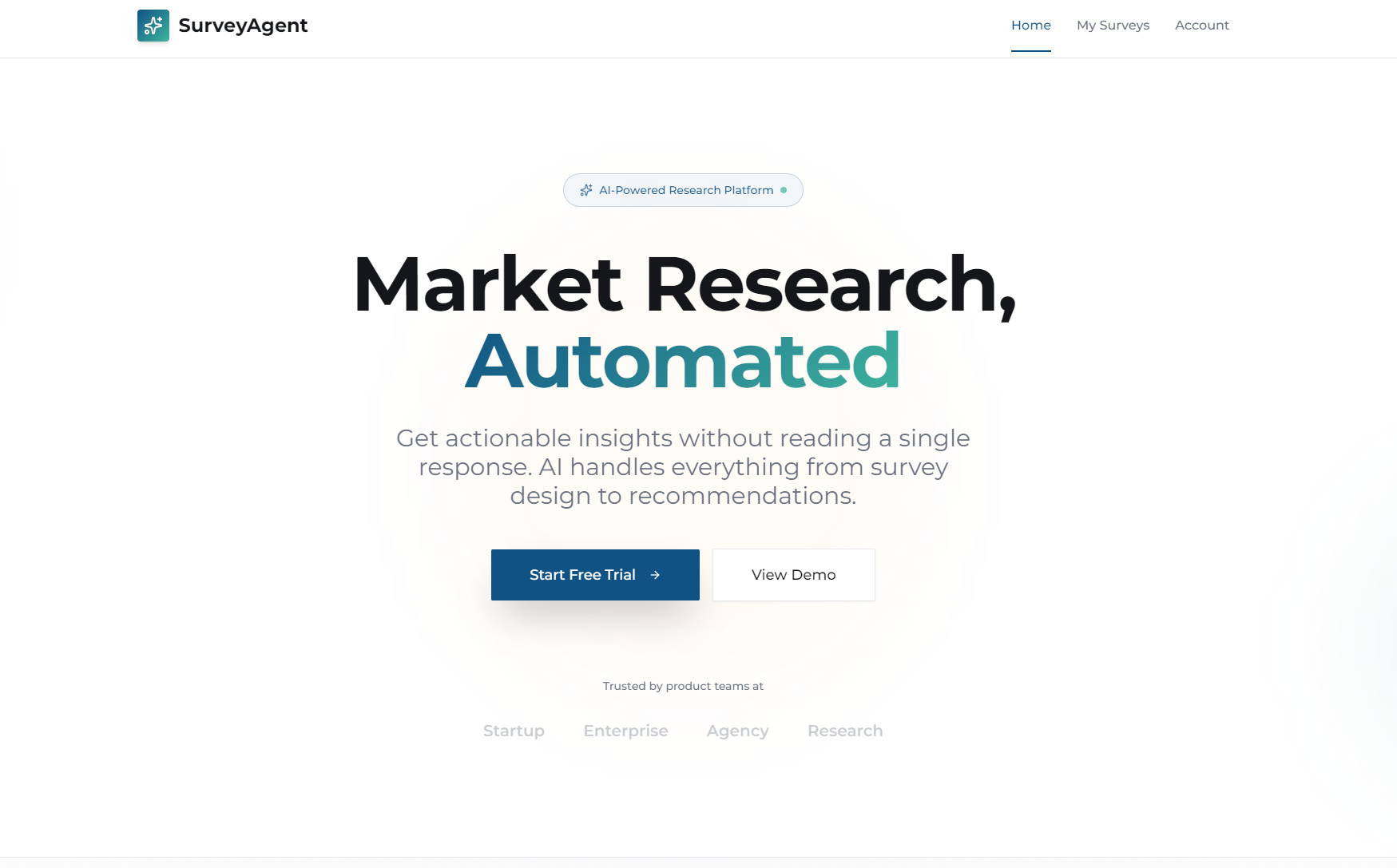
SurveyAgent automates the entire market research lifecycle. Users input their business decision (e.g., “Should I launch a new app feature?”), specify their audience, and AI generates a research-valid survey. After distribution (email/panel), real-time analytics and AI-powered insights deliver actionable recommendations—not just spreadsheets—so users can act fast.
How we built it
We built the core with Python (backend) and React (frontend), hosted on AWS for scalability. PostgreSQL stores user/survey data; OpenAI API powers survey generation and insight synthesis. We integrated SendGrid for email distribution, Stripe for $49/month subscription billing, and Chart.js for real-time data visualizations. Docker containerized the app for consistency, and Firebase handled auth.
Challenges we ran into
The biggest hurdle was ensuring AI-generated surveys were unbiased and research-valid—we iterated extensively on prompt engineering to eliminate leading/double-barreled questions. We also struggled with real-time data aggregation (keeping dashboards updated <5s) and validating email lists at scale; we solved this with optimized database queries and custom validation logic.
Accomplishments that we're proud of
We hit our goal: AI generates a valid survey in <30 seconds, and insights render in <10 seconds. Users with zero research experience can design professional surveys, and our statistical analysis (averages, correlations, significance) is mathematically accurate. Most importantly, beta users reported making confident business decisions 2x faster.
What we learned
We deepened our understanding of market research methodology (critical for AI guardrails) and scaling real-time data systems. We also learned that user-centric design matters most—simplifying the “decision intent” input reduced drop-offs by 40%.
What's next for this project
We’re adding advanced audience segmentation, integrating with popular business tools, and expanding survey analytics (e.g., cross-question trend analysis). We also plan to launch a self-serve premium panel marketplace and optimize mobile responsiveness—making SurveyAgent even more accessible for on-the-go decision-makers.

Log in or sign up for Devpost to join the conversation.