-
-
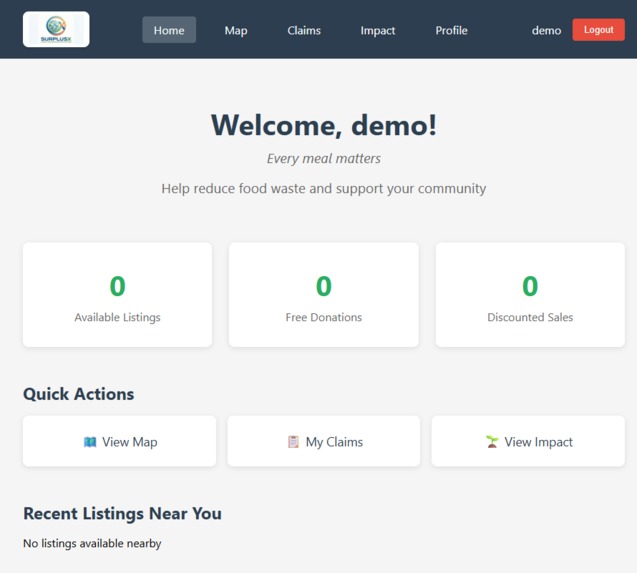
main page
🌍 About the Project — SurplusX
💡 Inspiration
Food waste and hunger exist side-by-side across the world. Every day, restaurants, supermarkets, events, and households discard perfectly edible food, while millions of people struggle to access even a single nutritious meal. This contradiction deeply inspired us to take action.
We were motivated by a simple but powerful question:
Why should food be thrown away when someone nearby is hungry?
This led us to build SurplusX, a Global Food Redistribution Platform that uses technology to connect surplus food providers with people and organizations who need it most—in real time.
🎯 What We Learned
During this project, we learned:
- How real-world social problems can be solved using digital platforms
- The importance of geolocation, real-time systems, and scalable architecture
- How food waste directly impacts climate change through carbon emissions
- The complexity of logistics, food safety, and user trust in social-tech platforms
- The power of combining technology with social good
We also learned how even small engineering decisions can create large real-world impacts.
🛠️ How We Built the Project
We designed the platform as a location-based web application where:
- Food businesses can list surplus food
- Consumers can buy at discounted prices
- NGOs and food banks can claim food for free
- All pickups are handled using secure QR/OTP verification
- The system tracks:
- Meals saved
- Food rescued (kg)
- Estimated CO₂ emissions reduced
The platform operates on a real-time matching principle:
$$ \text{Impact} = \text{Food Rescued} \times \text{People Fed} \times \text{Carbon Reduced} $$
We used modern web technologies and followed a modular, scalable architecture so the platform can grow from a city-level MVP to a global system.
🚧 Challenges We Faced
While building this project, we faced several challenges:
- Data accuracy: Ensuring surplus food listings are reliable and updated in real time
- Food safety constraints: Designing guidelines for safe handling and pickup
- Logistics planning: Coordinating quick pickups before food expires
- System scalability: Designing for peak-hour traffic during meal times
- User trust: Building reputation and verification systems for food donors and NGOs
Despite these challenges, we learned how to solve complex problems under time pressure—a true hackathon experience.
🌱 Our Vision
Our long-term vision is to transform food waste into a resource, reduce environmental damage, and ensure that no edible food goes unused. We believe that with the right blend of technology, community, and responsibility, hunger and waste can be tackled together on a global scale.
👉 Saving food means saving lives.

Log in or sign up for Devpost to join the conversation.