Inspiration
Every day, large amounts of edible food are discarded while organizations and communities nearby may need it. The problem isn't always a lack of food — it's the coordination gap between restaurants, food safety, NGOs, volunteers, timing, and transportation.
We wanted to explore:
What if AI could coordinate the entire food-rescue operation instead of simply telling a human what to do?
That idea became SurplusAI — an AI workforce for food rescue.
Our goal is to turn a surplus-food donation into a coordinated rescue operation while reducing unnecessary food waste and making the process more measurable.
What it does
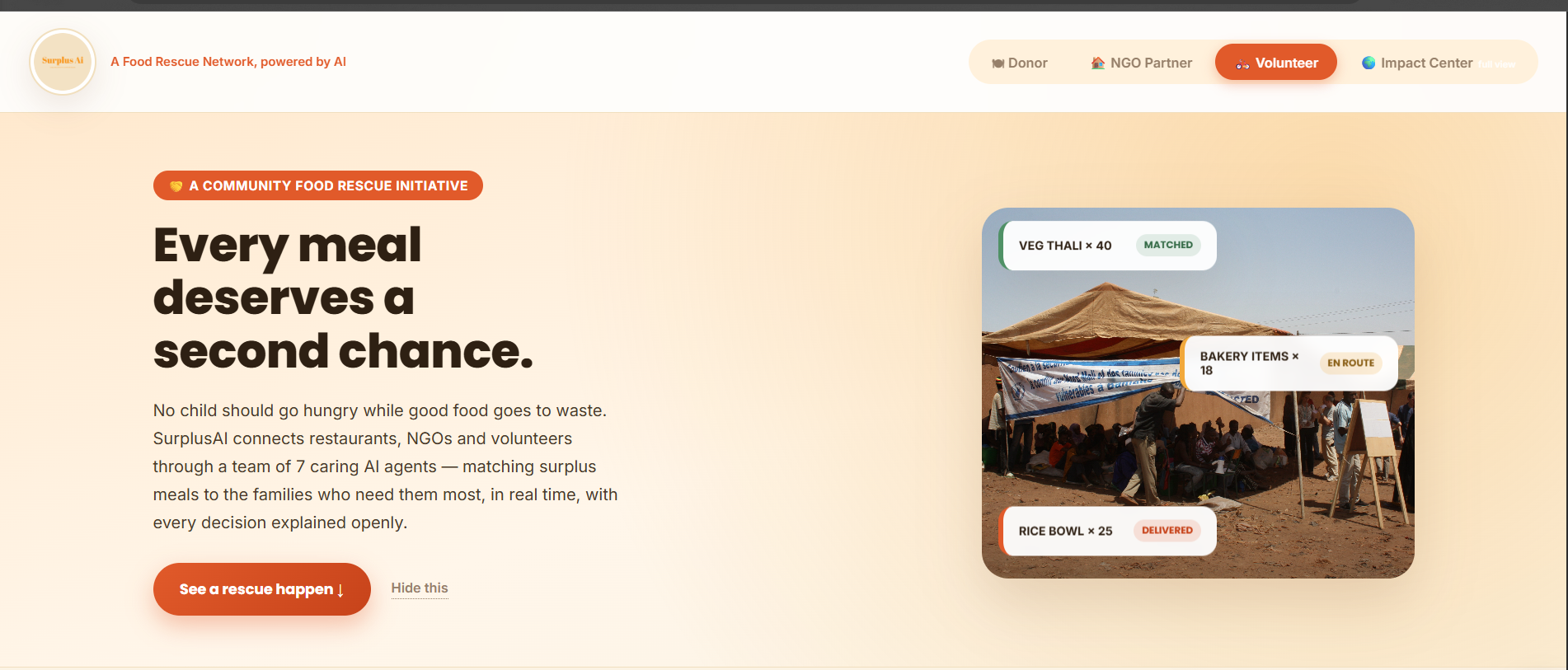
SurplusAI uses specialized agents to coordinate the journey from surplus food to completed rescue.
Restaurant
    ↓
Donation Agent
    ↓
Food Quality Agent
    ↓
Expiry Prediction Agent
    ↓
NGO Matching Agent
    ↓
Route Planning Agent
    ↓
Notification Agent
    ↓
Impact Agent
The AI Workforce
- Donation Agent — structures incoming donation information.
- Food Quality Agent — evaluates food-category risk and available quality information.
- Expiry Prediction Agent — estimates the remaining safe-consumption window and urgency.
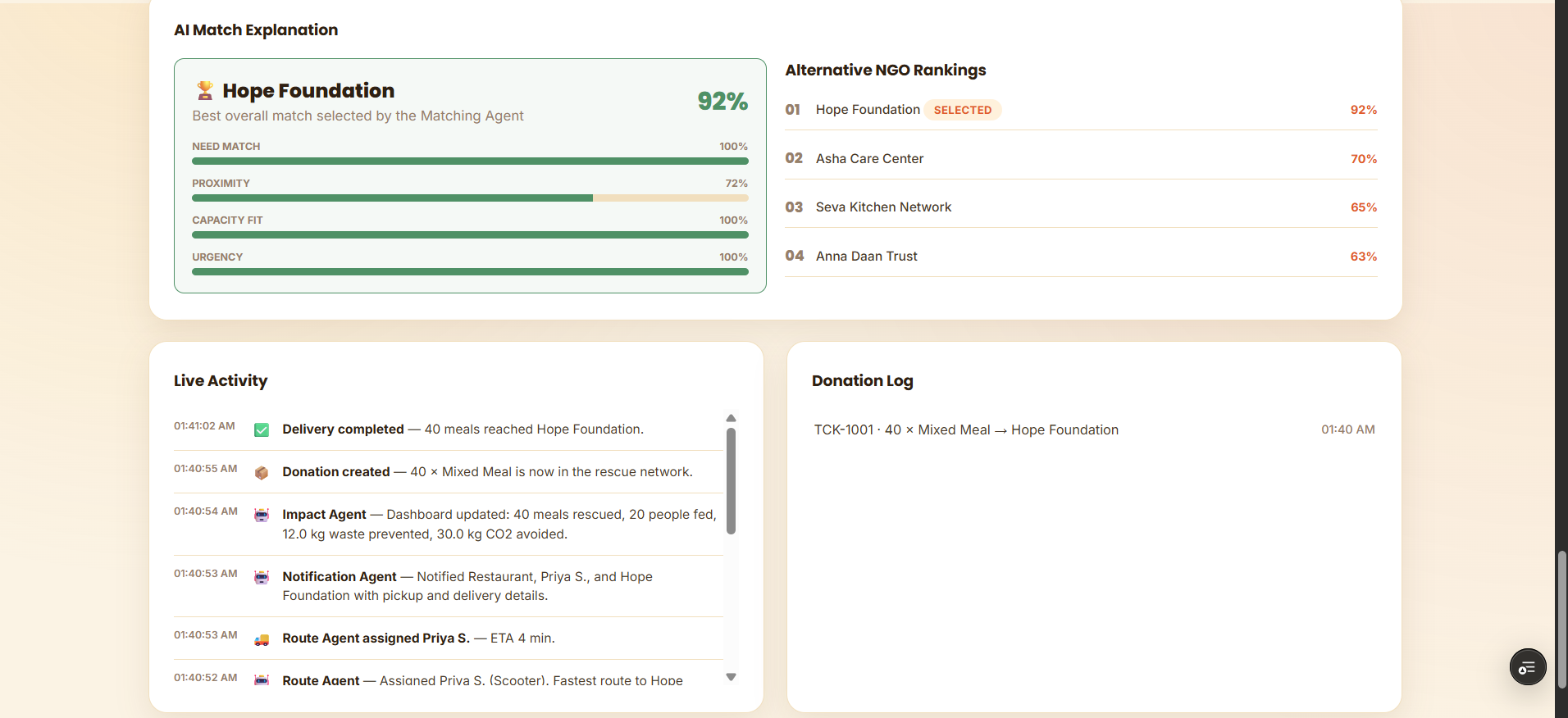
- NGO Matching Agent — finds suitable NGOs using need, proximity, capacity, and urgency.
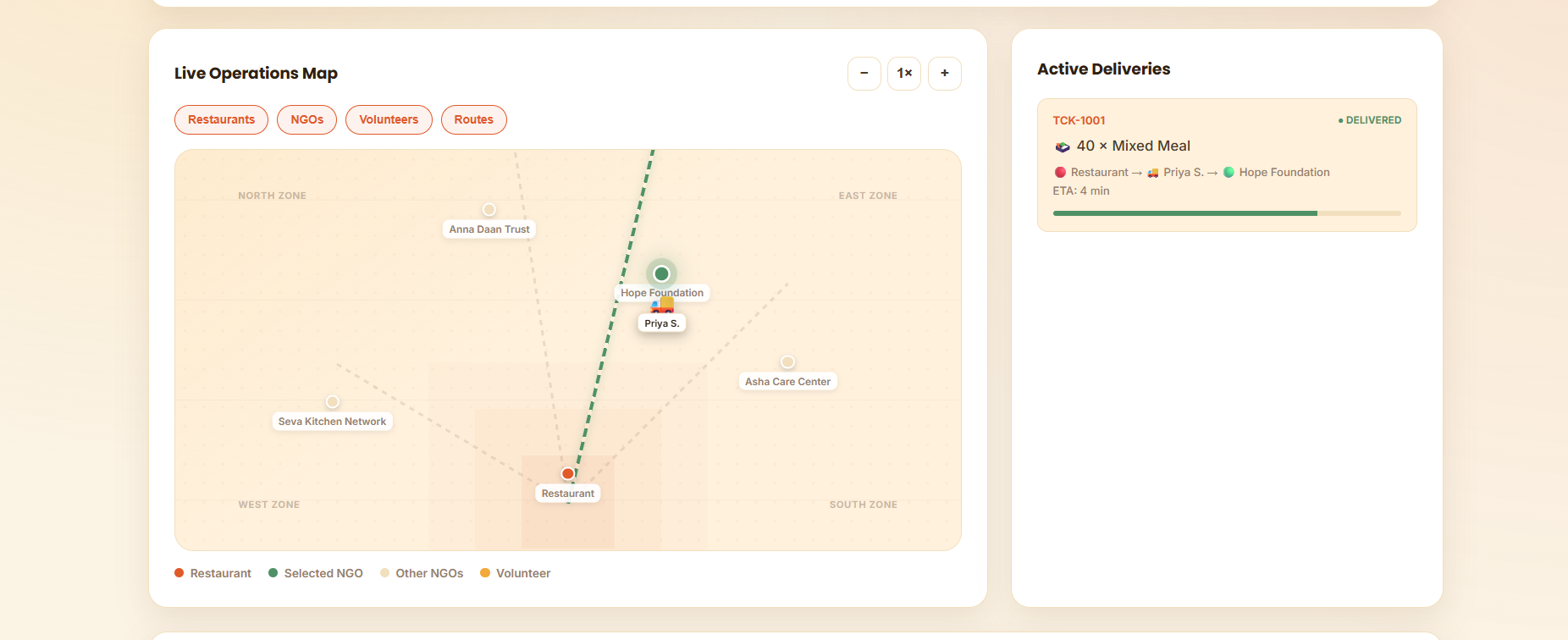
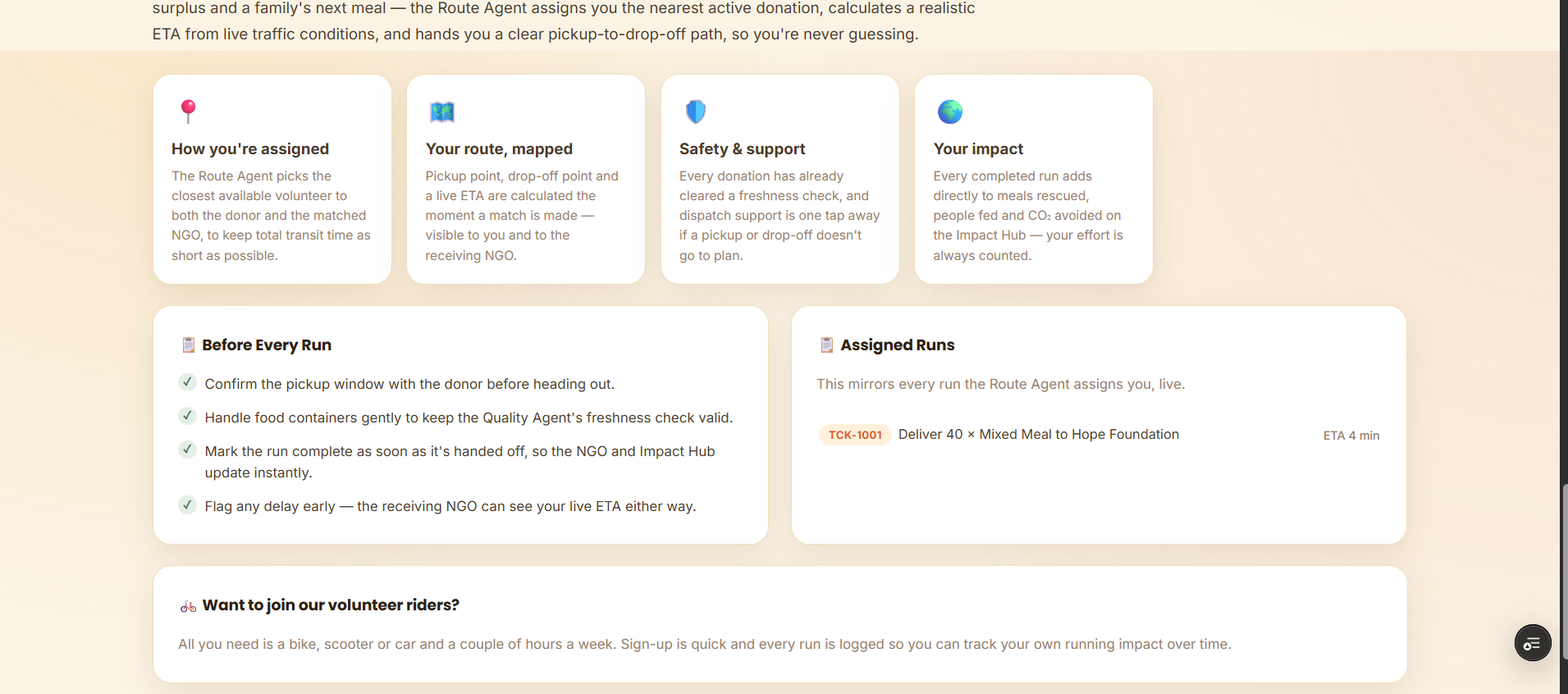
- Route Planning Agent — coordinates pickup logistics and volunteer assignment.
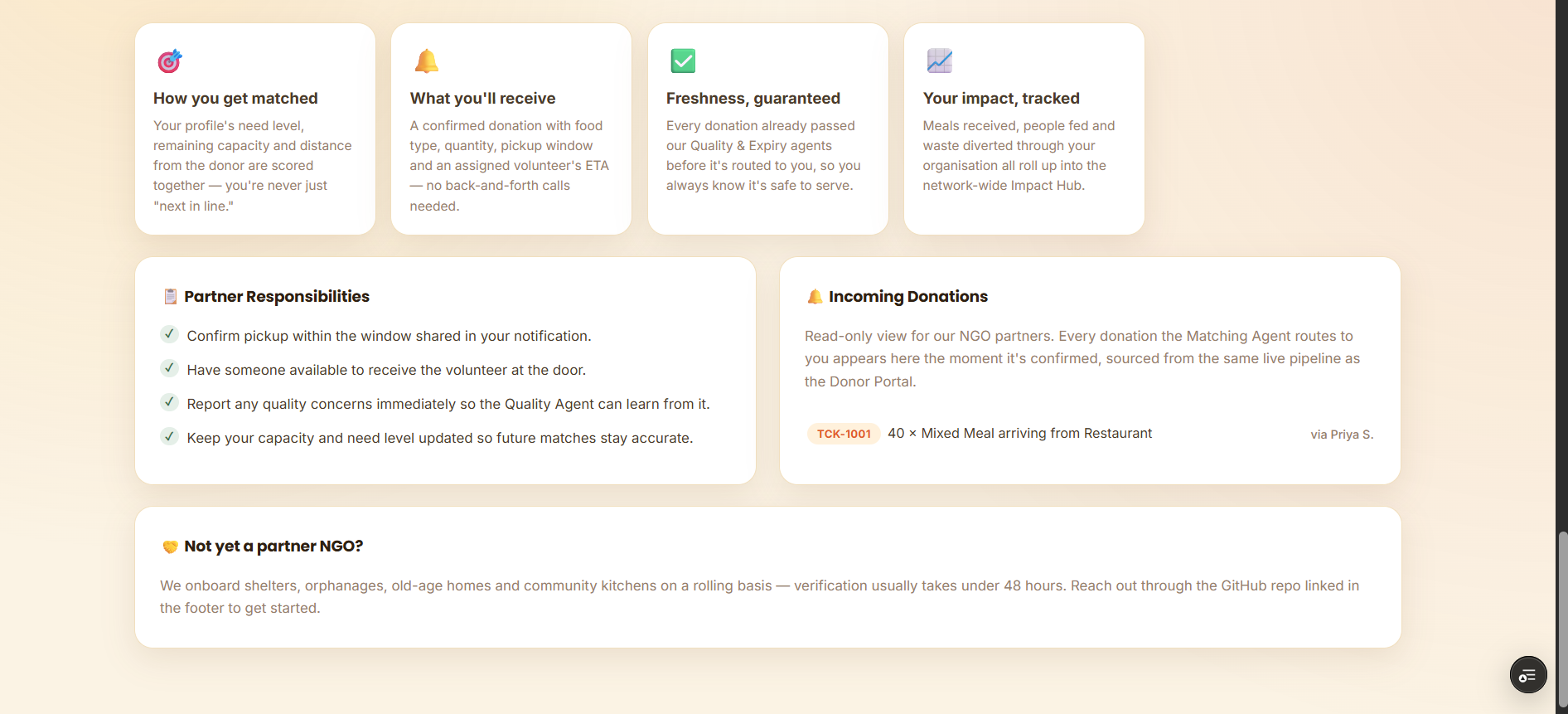
- Notification Agent — prepares updates for restaurants, NGOs, and volunteers.
- Impact Agent — tracks rescued food and environmental impact indicators.
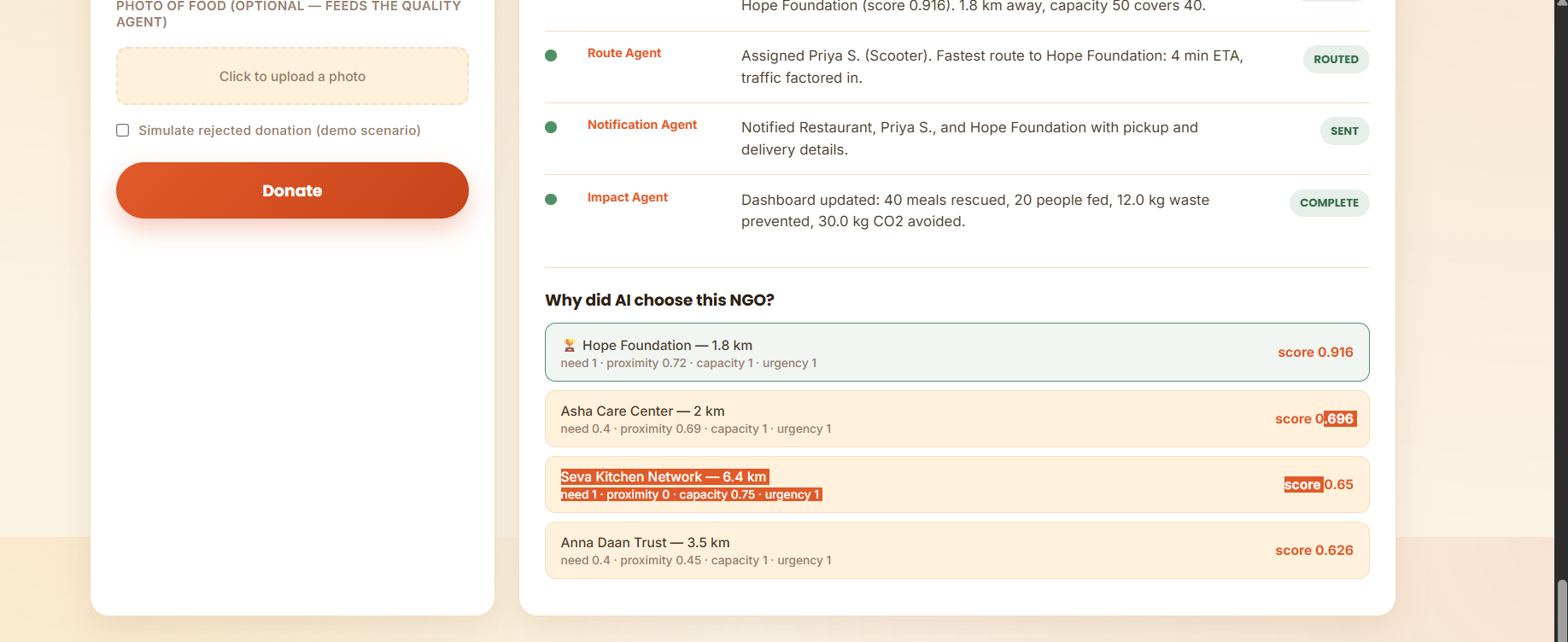
A key feature is explainable NGO matching. Instead of simply saying which NGO was selected, the system exposes the factors behind the recommendation:
$$ Score = 0.35N + 0.30P + 0.20C + 0.15U $$
where (N) = Need Match, (P) = Proximity, (C) = Capacity Fit, and (U) = Urgency.
End-to-End Example
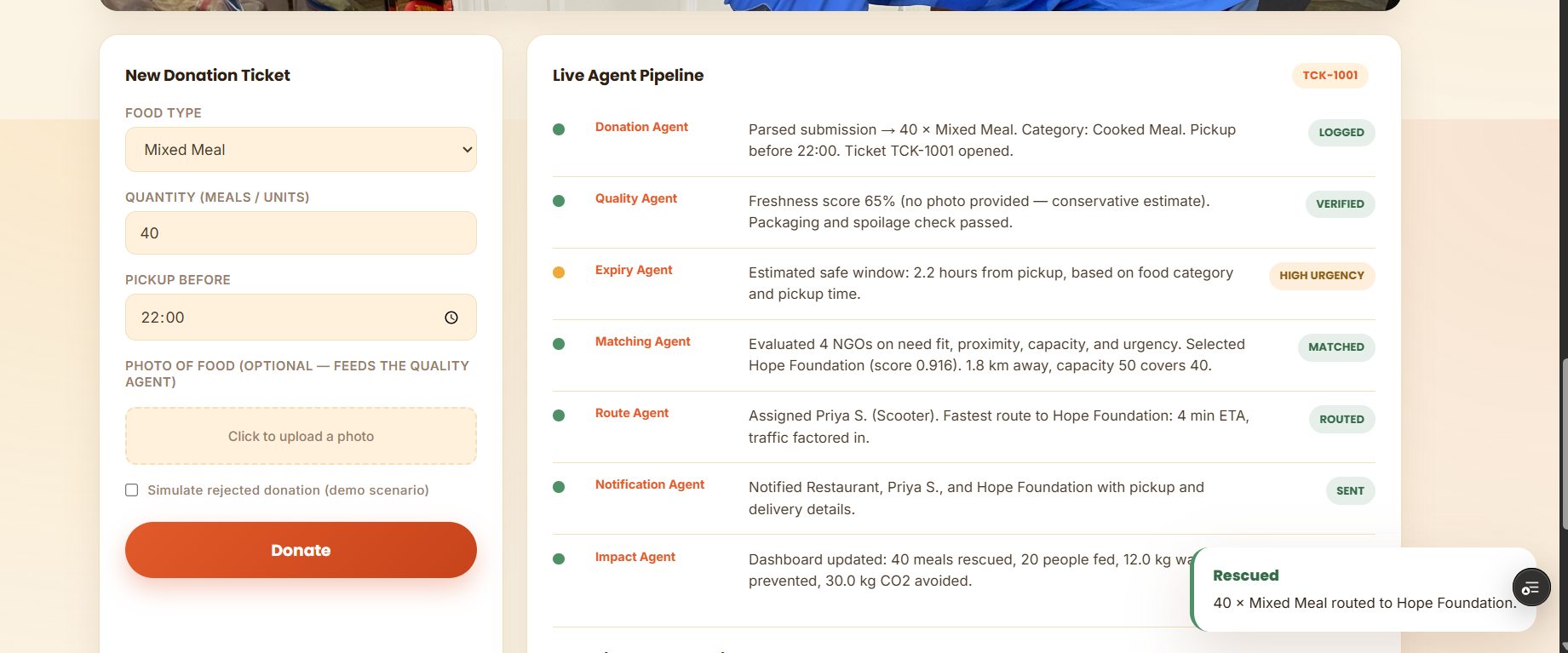
A restaurant submits 40 meals with a pickup deadline.
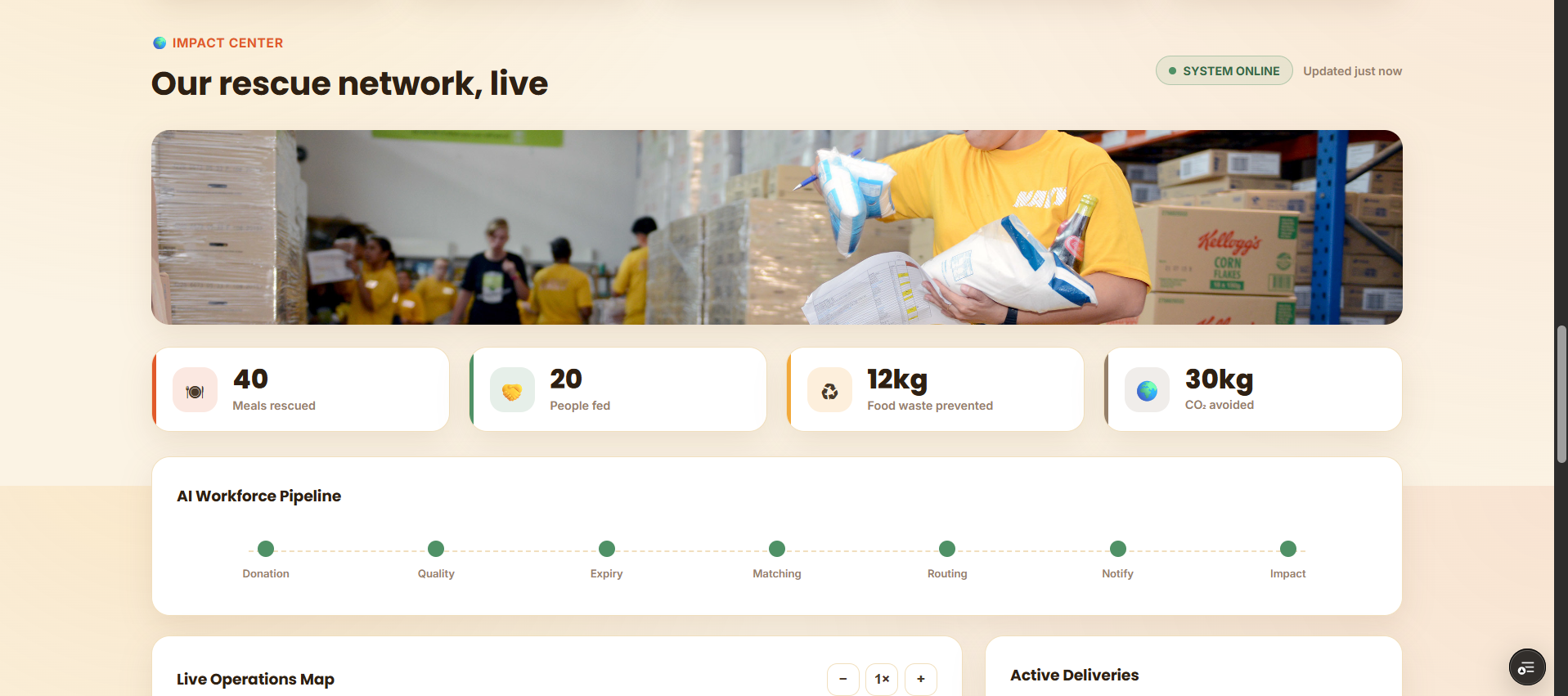
SurplusAI processes the donation, evaluates the food information and urgency, compares nearby NGOs, selects a suitable organization based on multiple factors, coordinates a volunteer pickup, and updates the impact dashboard.
The workflow becomes:
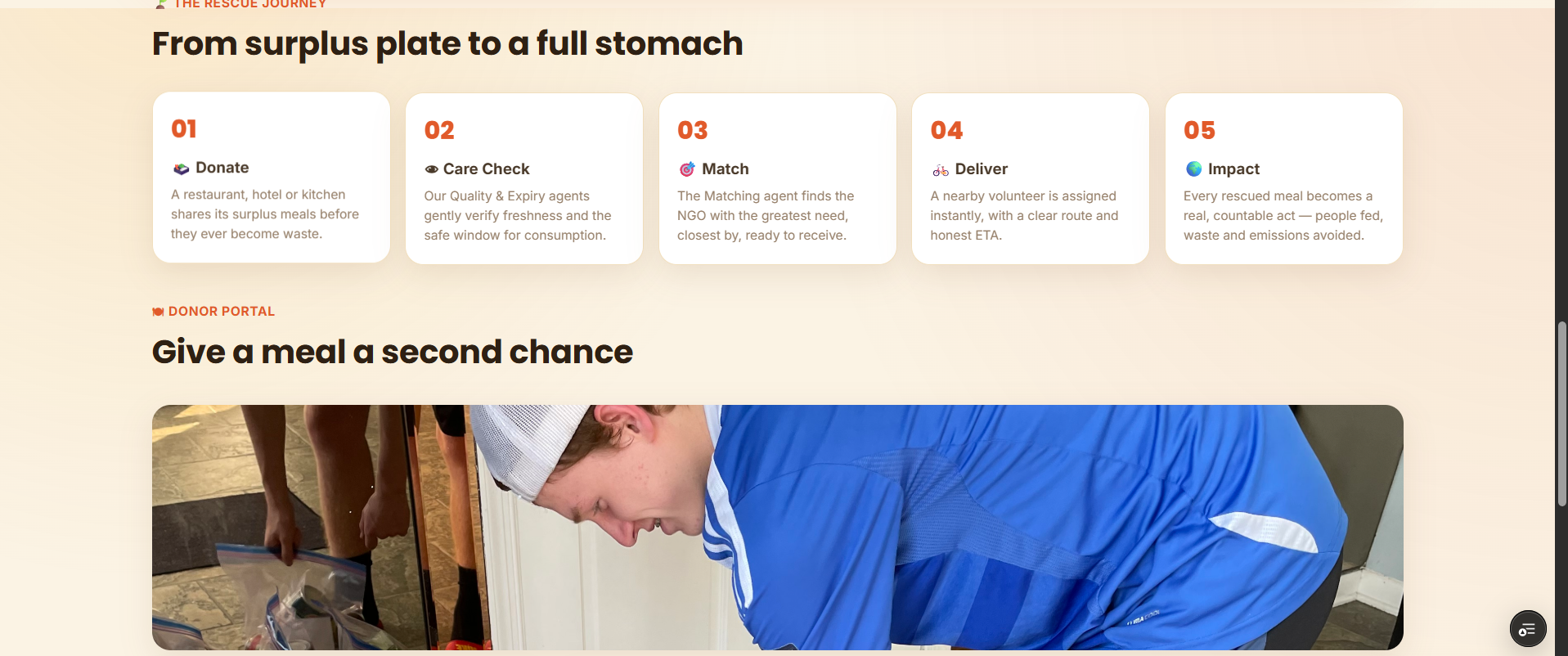
Surplus → AI decisions → NGO → Volunteer → Pickup → Impact
Instead of requiring multiple disconnected manual steps, SurplusAI provides one coordinated workflow.
How we built it
SurplusAI is built with a Python + FastAPI backend and a web-based frontend.
Core technology
- Python
- FastAPI
- Pydantic
- REST APIs
- Modular multi-agent architecture
- Shared workflow state
- NGO and donation datasets
- Interactive operations dashboard
- Explainable matching
- Route and volunteer coordination
- Environmental impact tracking
We designed the agents as modular components so that individual parts of the workflow can be improved without rebuilding the entire application.
The current architecture also provides a foundation for future integrations such as computer vision, persistent databases, real-time maps, messaging services, and richer AI reasoning.
Challenges we ran into
1. Coordinating multiple agents
The biggest challenge wasn't creating individual agents — it was making them work together reliably.
Each stage depends on structured information produced by previous stages, so we had to define clear responsibilities and data flow between agents.
2. Making decisions explainable
An AI recommendation isn't very useful if the user doesn't understand why it happened.
We therefore made NGO matching transparent by exposing factors such as need, proximity, capacity, and urgency.
3. Food safety and uncertainty
Food rescue is not purely a logistics problem. Food category, quality information, and time constraints can affect whether a donation should proceed.
We designed the workflow so that uncertainty can be surfaced for human verification instead of blindly automating every decision.
4. Turning a technical system into a usable product
A multi-agent backend can be difficult to understand from the outside.
We built the interface around the actual rescue workflow so users can follow what is happening from donation to matching, pickup, and impact.
Accomplishments that we're proud of
🤖 Building a complete multi-agent workflow
We went beyond a chatbot and built a system where specialized agents collaborate across an actual real-world workflow.
🌱 Connecting AI to environmental impact
SurplusAI doesn't stop at matching food with an organization. It also tracks the operational outcome and translates rescues into impact indicators.
🔍 Making AI decisions explainable
The NGO matching system exposes its decision factors rather than hiding everything behind a black-box recommendation.
🚀 Turning an idea into a working product
We built a functional web application with a restaurant-facing workflow, agent orchestration, NGO matching, volunteer coordination, and an operations dashboard.
🔗 Creating an extensible architecture
The modular design means individual agents can evolve independently as we add better models, integrations, and real-world data.
What we learned
We learned that multi-agent AI is primarily an orchestration problem.
Creating seven agents is relatively straightforward. Making them communicate correctly, share state, handle uncertainty, and produce a useful end-to-end outcome is much harder.
We also learned that environmental technology needs more than a compelling idea. It needs measurable outcomes and transparent assumptions.
Most importantly, we learned that AI should not necessarily replace humans in every decision.
For real-world problems such as food safety, a better approach is often:
AI handles repetitive coordination → AI explains its decisions → humans remain in control of uncertain or sensitive cases.
What's next for SurplusAI
We want to move SurplusAI from a working prototype toward a system that can operate with richer real-world data.
👁️ Computer Vision for Food Quality
Allow restaurants to upload food images so the system can extract useful visual information and flag potential quality concerns for human verification.
🗺️ Real-Time Routing
Integrate live maps, traffic information, and dynamic volunteer availability to improve pickup coordination.
📱 Real Notifications
Connect the notification agent to SMS, WhatsApp, email, or push notifications so stakeholders can receive updates automatically.
🗄️ Persistent Infrastructure
Move from prototype datasets and in-memory state toward production-grade persistent storage and scalable infrastructure.
📊 Environmental Analytics
Expand the impact dashboard to provide better tracking of food rescued, waste diverted, completed rescues, and other environmental indicators.
🌍 Scale the Rescue Network
Our long-term vision is a network where restaurants, NGOs, volunteers, and community organizations can participate in the same coordinated food-rescue ecosystem.
SurplusAI's next step is simple: move from demonstrating an AI workforce to making that workforce useful in real-world food rescue.
Built With
- agentic
- ai
- machine-learning
- python


Log in or sign up for Devpost to join the conversation.