Surgify AI
Reducing Preventable Surgical Errors Through AI-Powered Practice
About the Project
Every year, over 300 million surgeries are performed worldwide. While surgery saves millions of lives, preventable surgical errors continue to impact patient safety. According to the World Health Organization (WHO), millions of patients experience surgical complications annually, and a significant portion of these complications can be prevented through better preparation, standardized procedures, and improved surgical training.
Surgify AI was born from a simple yet powerful idea:
What if every surgeon could practice a patient's surgery multiple times before entering the operating room?
Instead of relying solely on traditional training methods such as cadavers, observation-based learning, or expensive VR simulators, Surgify AI provides an affordable AI-powered surgical rehearsal platform that enables surgeons to practice procedures inside a realistic virtual environment while receiving intelligent real-time guidance.
Our vision is simple:
Every patient deserves a well-prepared surgeon.
Inspiration
When patients enter an operating room, they place complete trust in the surgical team, believing the procedure will improve or save their lives. Unfortunately, not every surgery ends as planned.
While researching surgical safety, we discovered that many adverse surgical outcomes are preventable. In many cases, complications arise not because surgeons lack expertise, but because of avoidable procedural mistakes made under pressure.
Examples include:
- Missing a critical surgical step.
- Performing steps in the wrong sequence.
- Incorrect incision placement.
- Accidentally damaging nearby nerves or blood vessels.
- Misidentifying anatomical landmarks.
- Inadequate preparation for patient-specific anatomical variations.
- Limited opportunities to rehearse rare or high-risk procedures.
These errors can result in prolonged recovery, permanent disability, increased healthcare costs, or even loss of life.
What inspired us most was realizing that many of these mistakes could be reduced through better preparation.
Yet current surgical training has major limitations:
- Cadaver labs are expensive and difficult to access.
- Advanced VR simulators cost thousands of dollars.
- Most training is performed using generic anatomy rather than the patient's own anatomy.
- Residents often get only limited opportunities to repeatedly practice complex procedures.
We believed there had to be a more accessible way to help surgeons prepare before they operate.
That belief became Surgify AI.
What We Built
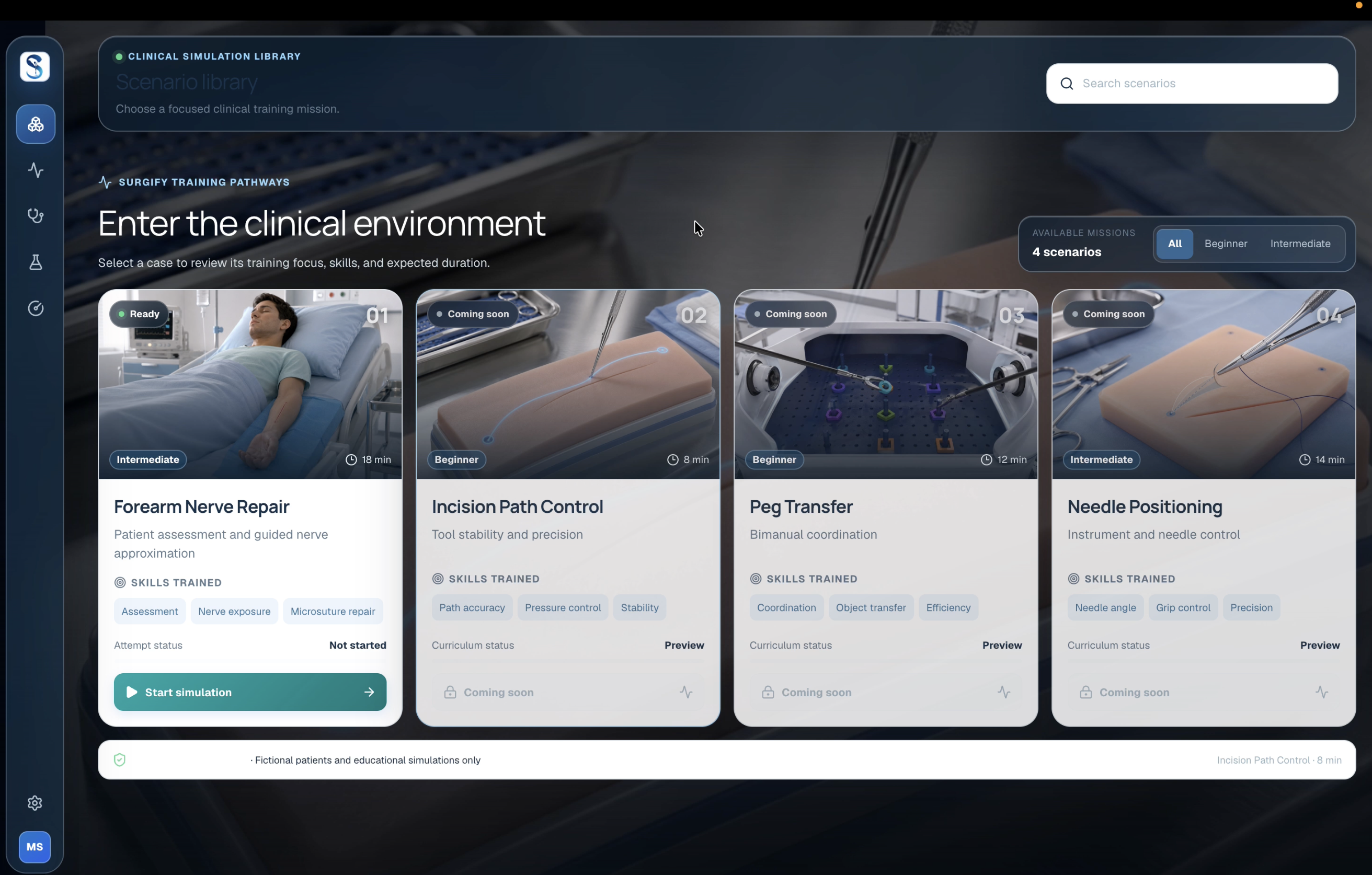
Surgify AI is an AI-powered personalized surgical rehearsal platform that transforms patient information into an interactive virtual surgery simulation.
Rather than practicing on generic anatomical models, surgeons can rehearse procedures inside a browser-based virtual operating room using only a standard webcam.
Our platform combines:
- Artificial Intelligence
- Computer Vision
- Browser-based 3D Simulation
- Real-time Surgical Feedback
to make advanced surgical training more affordable and accessible.
How It Works
Step 1 — Understanding the Patient
The system analyzes patient case files, CT scans, X-rays, MRI reports, and clinical information using MedGemma.
Instead of simply reading reports, the AI understands:
- Diagnosis
- Surgical procedure
- Anatomical region
- Potential risks
- Important structures requiring caution
- Recommended surgical workflow
This information is then used to configure a patient-specific surgical rehearsal environment.
Step 2 — Building the Virtual Surgery
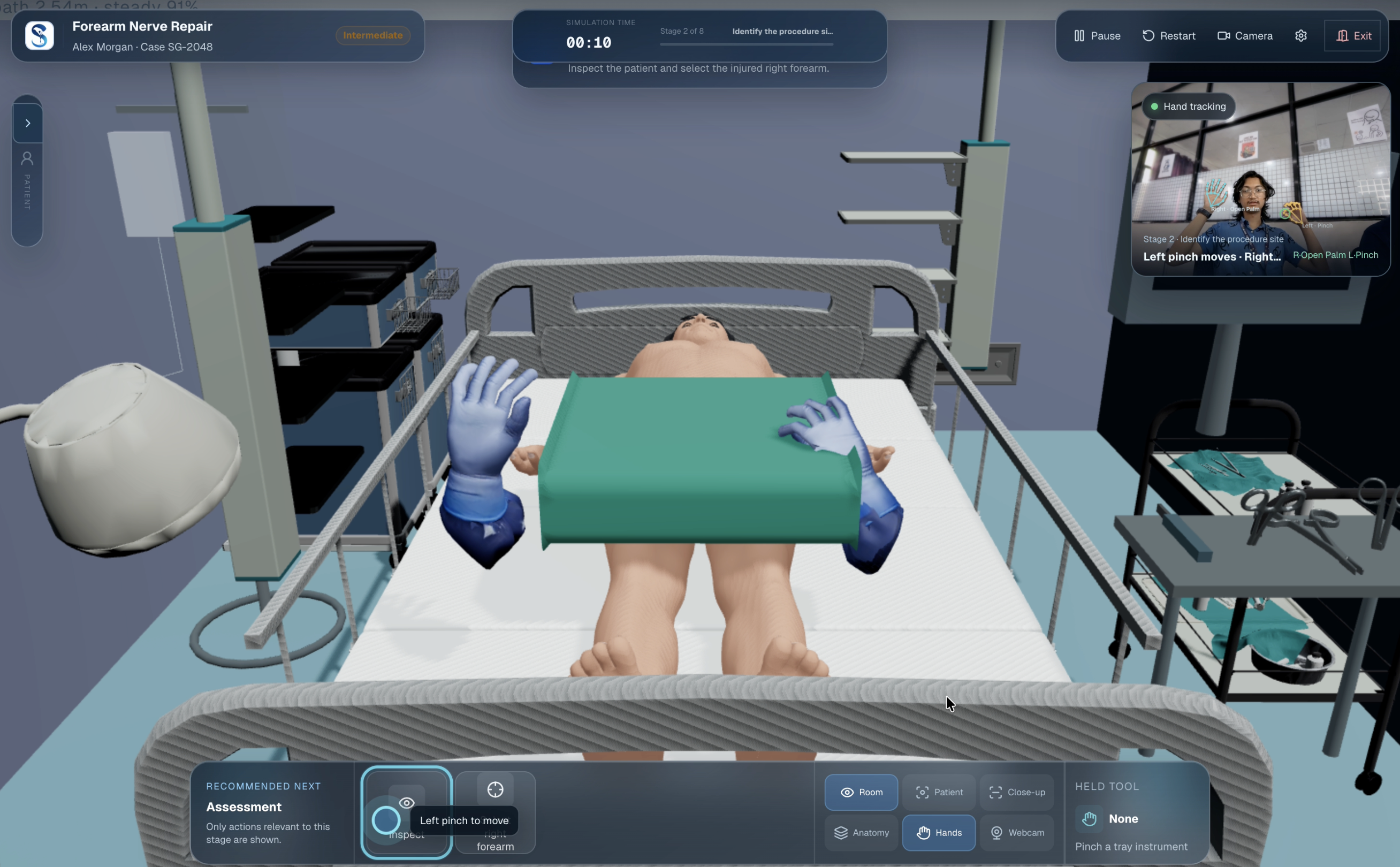
Using Three.js, we developed a lightweight browser-based 3D surgical simulator.
The virtual operating room includes:
- Patient model
- Surgical instruments
- Operating table
- Surgical environment
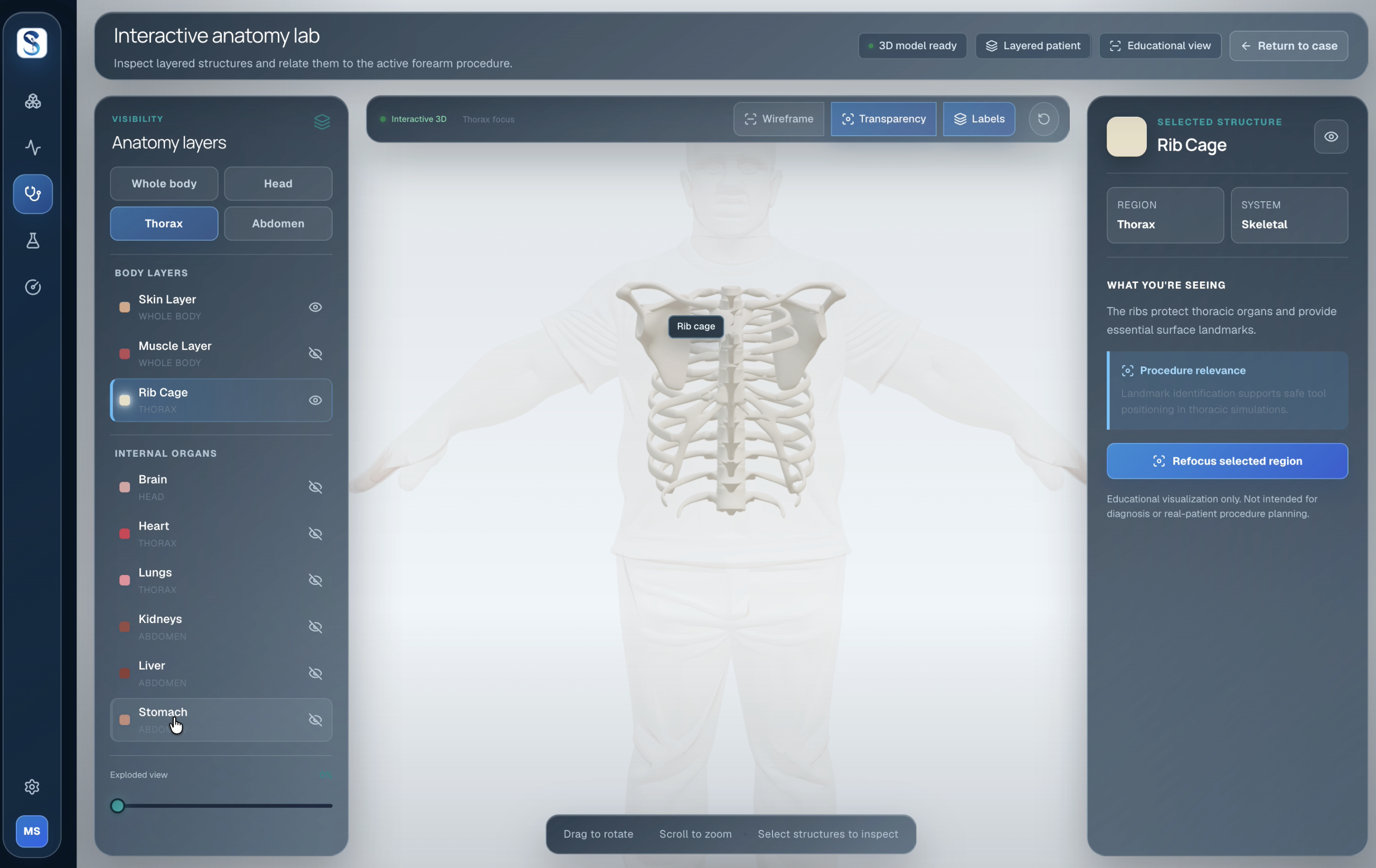
- Interactive anatomical structures
Unlike heavy desktop applications, our simulator runs directly in the browser, making deployment significantly easier.
Step 3 — Computer Vision Interaction
Instead of requiring expensive VR headsets or dedicated controllers, Surgify AI uses MediaPipe-powered computer vision to track the surgeon's hands through a standard webcam.
The user's hands become virtual surgical instruments capable of interacting with the simulation.
This dramatically lowers the cost of deployment while keeping the experience intuitive.
Step 4 — Real-Time AI Surgical Guidance
Throughout the procedure, the AI continuously monitors every interaction.
Examples of feedback include:
- "Incorrect incision location."
- "Critical nerve detected nearby."
- "You skipped vessel isolation."
- "Bleeding risk increasing."
- "Retract tissue before making the incision."
- "Incorrect surgical sequence."
- "Clamp the artery before proceeding."
Instead of discovering mistakes after completing the procedure, surgeons receive immediate guidance and can instantly correct their actions.
Intelligent Hand Stability Analysis
A successful surgery depends not only on procedural knowledge but also on the steadiness and precision of the surgeon's hands.
Surgify AI uses computer vision to analyze hand movement throughout the simulation.
The platform evaluates:
- Hand stability
- Tremor detection
- Motion smoothness
- Precision of movement
- Instrument control
- Consistency during delicate procedures
The AI can provide feedback such as:
- "Excellent hand stability maintained."
- "Noticeable hand tremor detected."
- "Reduce unnecessary hand movement."
- "Maintain a steadier approach during incision."
Future Enhancement
To further improve motion analysis, we plan to integrate data from smartphone inertial sensors such as the accelerometer and gyroscope.
By combining webcam tracking with smartphone sensor data, Surgify AI could measure:
- Micro hand tremors
- Wrist rotation
- Motion smoothness
- Fine motor precision
- Fatigue-induced movement changes
This multimodal approach would significantly improve movement analysis while remaining far more affordable than specialized surgical tracking hardware.
Key Features
- AI-assisted patient case understanding
- Browser-based 3D surgical simulation
- Personalized surgical rehearsal
- Computer vision hand tracking
- No VR headset required
- Real-time AI guidance
- Intelligent procedural feedback
- Hand stability analysis
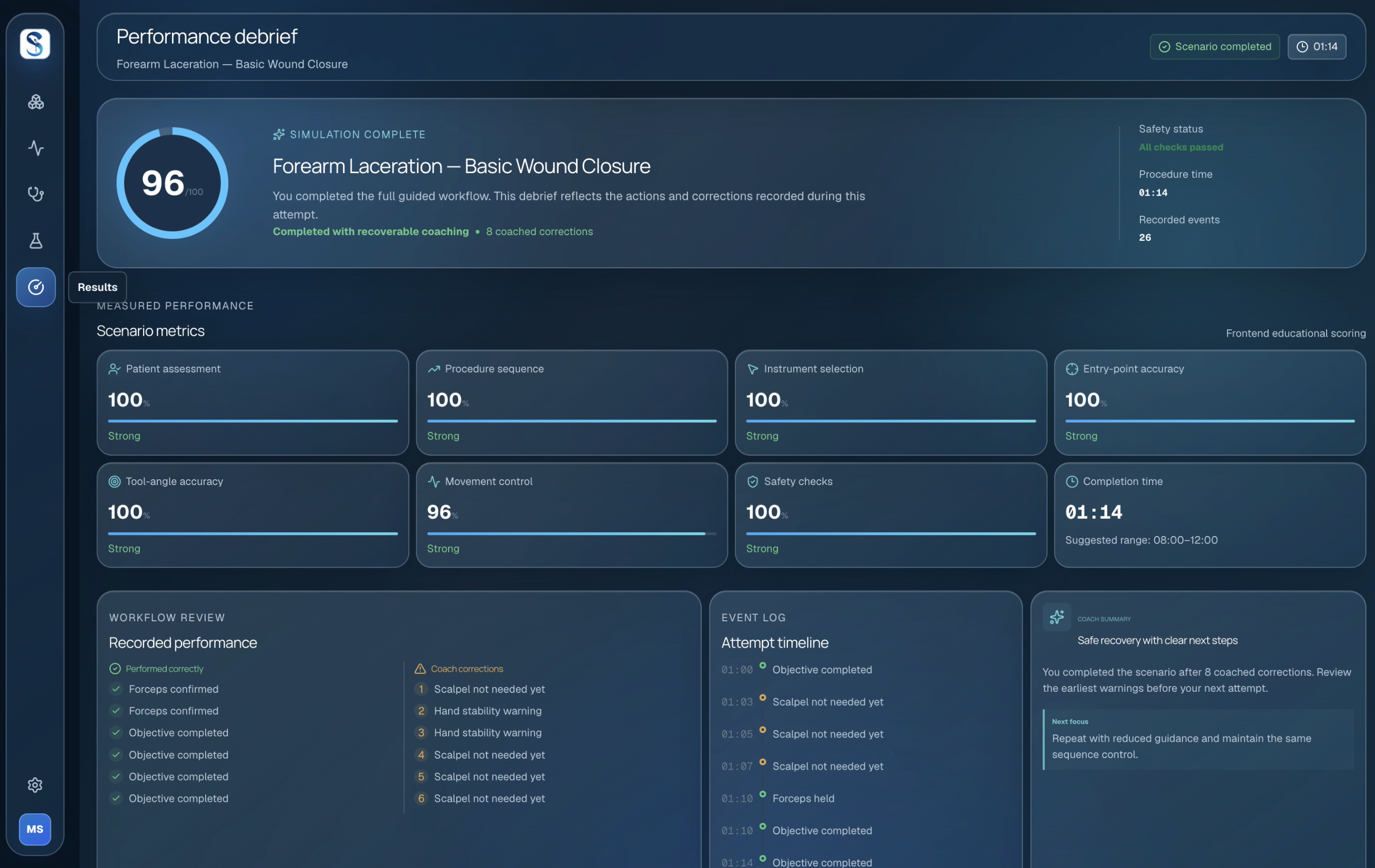
- Surgical performance evaluation
- Low-cost deployment
Technologies Used
Frontend
- Three.js
- HTML5
- CSS3
- JavaScript
Artificial Intelligence
- Google MedGemma
- AI-assisted surgical workflow understanding
- Clinical report interpretation
- Intelligent procedural guidance
Computer Vision
- MediaPipe Hands
- Webcam-based hand tracking
- Gesture recognition
- Motion analysis
3D Graphics
- Browser-based rendering
- Collision detection
- Interactive surgical tools
- Virtual operating room
- Real-time anatomical interaction
What We Learned
Building Surgify AI taught us that healthcare technology is not just about writing software—it is about designing systems that support clinicians in high-stakes environments.
We learned:
- How AI can assist rather than replace medical professionals.
- The importance of translating clinical information into actionable guidance.
- How computer vision enables natural interaction without specialized hardware.
- How browser-based 3D graphics can provide immersive experiences while remaining lightweight.
- The challenges of balancing medical realism with technical performance.
- The importance of designing feedback that improves learning without distracting the user.
Most importantly, we learned that meaningful healthcare innovation requires collaboration between medicine, artificial intelligence, computer graphics, and human-centered design.
Challenges We Faced
Developing Surgify AI came with several technical and design challenges.
1. Finding Accurate Human Anatomy
High-quality anatomical models suitable for surgery are difficult to obtain.
Most medical-grade models are:
- Proprietary
- Extremely expensive
- Too detailed for browser rendering
Finding a balance between realism and performance required extensive optimization.
2. Simulating Realistic Surgery
Creating believable surgical interactions is far more complex than traditional 3D applications.
We had to simulate:
- Instrument interactions
- Collision detection
- Anatomical constraints
- Procedural workflows
while maintaining smooth browser performance.
3. Patient-Specific Simulation
Every patient's anatomy is different.
Generating personalized simulations from medical imaging is a challenging problem involving image interpretation, anatomical reconstruction, and procedural planning.
This remains one of our biggest areas for future development.
4. Accurate Computer Vision
Tracking hand movement with only a webcam while maintaining sufficient precision for delicate surgical interactions required significant experimentation with MediaPipe and gesture mapping.
5. Intelligent AI Feedback
Providing meaningful surgical guidance is much harder than detecting object collisions.
The AI must understand:
- Procedure sequence
- Surgical context
- Anatomy
- Instrument usage
- Safety considerations
before producing useful feedback.
Potential Impact
Surgify AI aims to make advanced surgical rehearsal affordable and accessible.
Potential applications include:
- Medical colleges
- Teaching hospitals
- Surgical residency programs
- Healthcare simulation centers
- Rural hospitals
- Resource-constrained healthcare systems
By allowing surgeons to rehearse procedures repeatedly before entering the operating room, Surgify AI has the potential to improve preparedness, enhance surgical education, and contribute to safer patient care.
Future Roadmap
We envision expanding Surgify AI with:
- Automatic 3D reconstruction from CT and MRI scans
- Patient-specific anatomical digital twins
- Additional surgical specialties
- AI-powered skill scoring
- Voice-enabled AI surgical assistant
- Multi-user collaborative surgical training
- Robotic surgery integration
- Hospital Learning Management System (LMS) integration
- Wearable and smartphone sensor fusion for advanced motion tracking
Conclusion
Surgify AI was built around a simple belief:
Every complex surgery deserves a rehearsal.
We are not building technology to replace surgeons.
We are building technology that helps surgeons prepare better, make safer decisions, and continuously improve their skills before stepping into the operating room.
By combining artificial intelligence, browser-based 3D simulation, computer vision, and intelligent feedback, Surgify AI makes personalized surgical rehearsal more affordable, more accessible, and ultimately more impactful.
As the platform evolves, our vision is to create a future where every surgeon can rehearse every complex procedure on a patient-specific virtual model—reducing preventable errors and improving surgical outcomes for patients worldwide.
Tagline
Practice the Patient. Not Just the Procedure.
Built With
- fastapi
- gemma
- mediapipe
- nextjs
- three.js


Log in or sign up for Devpost to join the conversation.