Inspiration
The inspiration for SurgeGuard-AI stemmed from a critical monitoring paradox in laparoscopic surgery: while surgeons have high-magnification views of the operative field, they are often blind to "silent" internal hemorrhages. Currently, surgical teams rely on physiological signals—like a crashing heart rate or falling blood pressure—which only manifest after a patient has already lost 15-20% of their blood volume. We were driven by a single question: What if we could detect a bleed in the 4-to-8-minute window before the vitals even start to shift?.
How we built it
How We Built It :
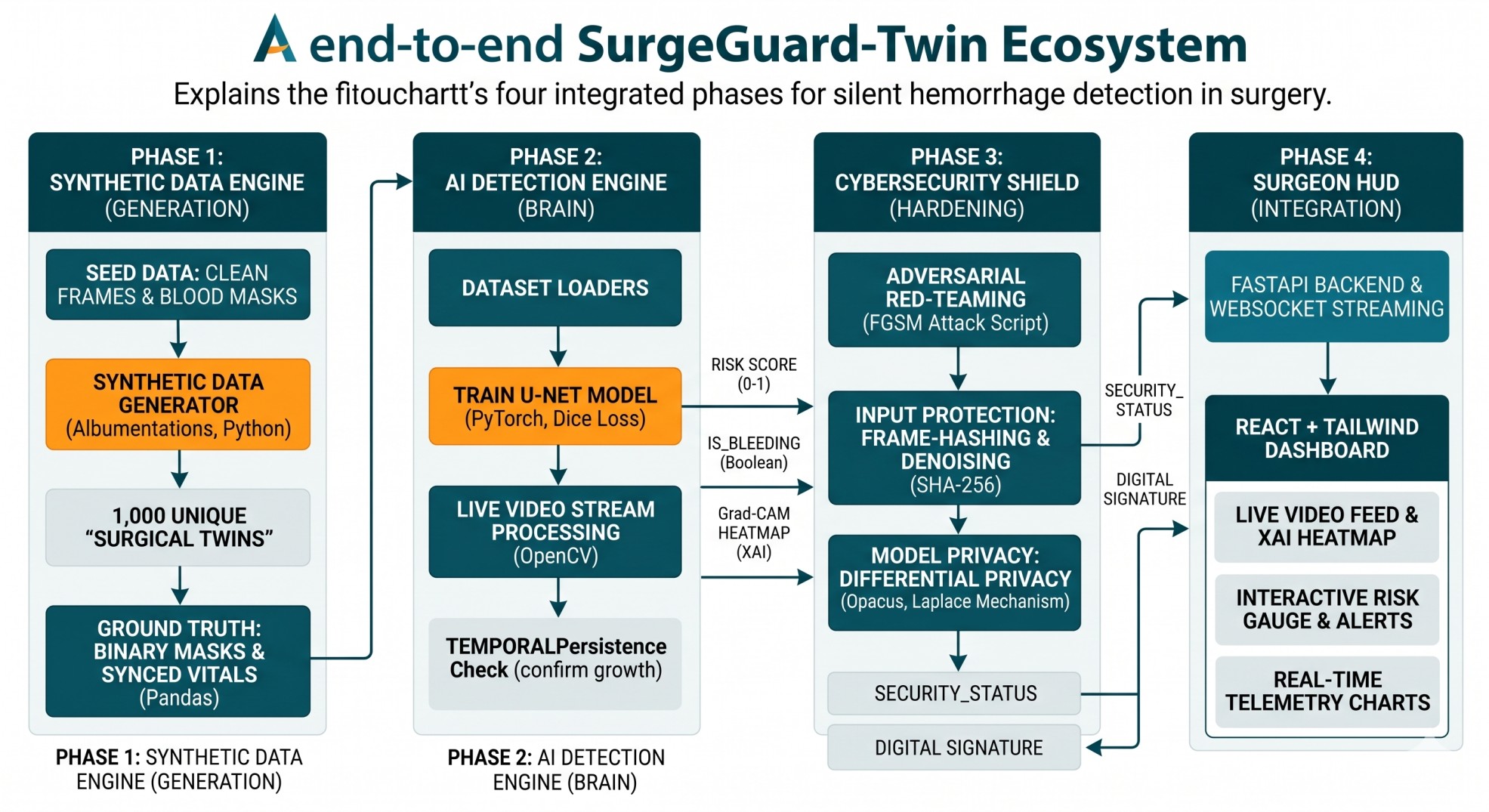
We architected the project as a four-stage ecosystem designed for real-time surgical safety:
Phase 1: Synthetic Data Engine: To overcome the massive hurdle of medical data privacy, we engineered a procedural synthesis pipeline. We generated 1,000+ "Surgical Twins"—pixel-accurate frame pairs that simulate healthy tissue and active hemorrhages without using real patient imagery. Phase 2: The Neural Brain: We implemented a U-Net Convolutional Segmentation model optimized for 30 FPS inference. This engine provides pixel-accurate masks, allowing us to calculate growth rates and track the centroid (X, Y) of a bleed.
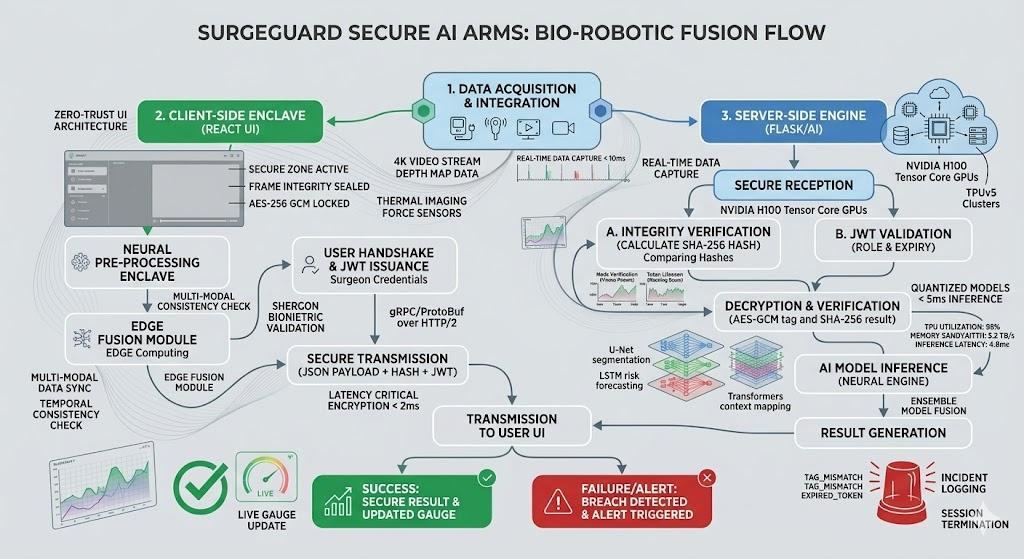
Phase 3: The Cyber-Shield: We hardened the system against "adversarial blinding". We implemented HMAC-SHA256 frame hashing for integrity, adversarial denoising to scrub malicious perturbations, and Differential Privacy (epsilon = 1.0) to protect patient telemetry.
Phase 4: Surgeon's HUD: The project culminates in a unified dashboard built with FastAPI and React. It displays synchronized raw feeds, AI heatmaps, and a BleedMonitor that triggers alerts only after a growth threshold of 15% is met across 30 frames.
Challenges we ran into
The primary technical challenge was the "Red-Organ" Problem: distinguishing active hemorrhage from static red structures like the liver or surgical tools. We solved this by moving beyond single-frame detection and implementing Temporal Growth-Rate Validation.
Accomplishments that we're proud of
Developed a 30 FPS U-Net engine that detects "silent" bleeds with pixel-level precision. Successfully replaced real patient data with a 1,000+ frame Synthetic Twin engine to bypass privacy bottlenecks.
What we learned:
Explainability (via Grad-CAM heatmaps) is vital for clinical trust. We also discovered that Cybersecurity—specifically adversarial denoising—is a non-negotiable requirement for mission-critical medical AI.
What's next for SurgeGuardAI
Scaling the architecture to Robotic Surgery (da Vinci) and Neurosurgery. We are targeting a formal FDA SaMD regulatory pathway to move from a 24-hour hackathon prototype to a deployed clinical tool.
