Inspiration
The idea for SURGE was partly inspired by recent flash flooding in Nepal, where rapidly changing conditions highlighted how critical timely, clear communication is during a disaster. When roads become inaccessible, people become trapped, or evacuation routes change, information from people on the ground can be just as important as the original warning.
During a flood, information changes constantly. A road that was open ten minutes ago can become impassable, a resident may discover someone who needs rescue, and government officials may need to change evacuation instructions immediately.
We wanted to build SURGE, a two-way real-time communication layer between governments and residents during flood emergencies: one that makes official information easier to access while turning information from people on the ground into structured, actionable updates for emergency officials.
What it does
SURGE connects two interfaces: a government emergency dashboard and a resident-facing voice agent.
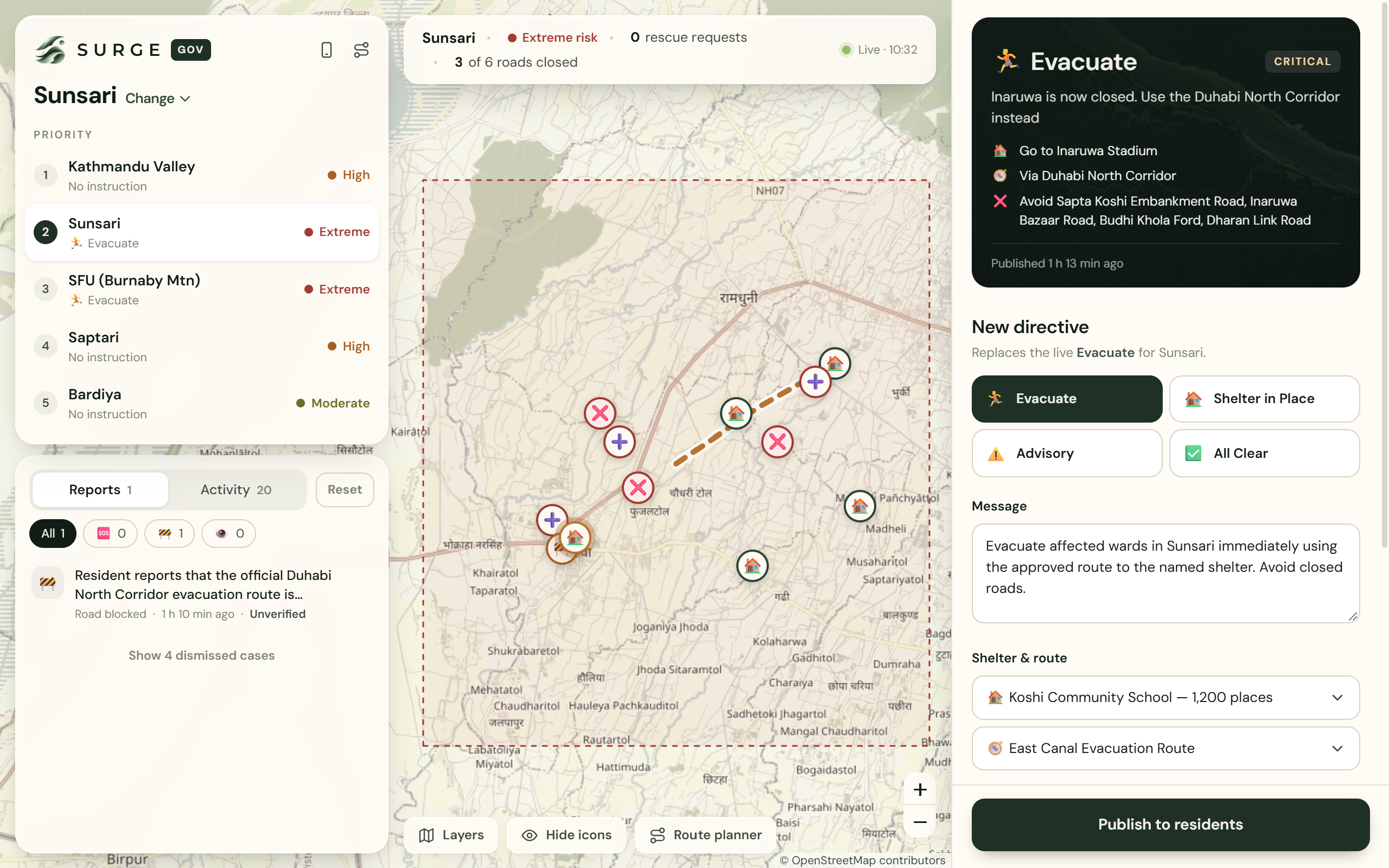
On the government side, officials can publish emergency directives, update evacuation routes, mark blocked roads, and communicate changing conditions to affected areas. These updates immediately propagate to the resident interface.
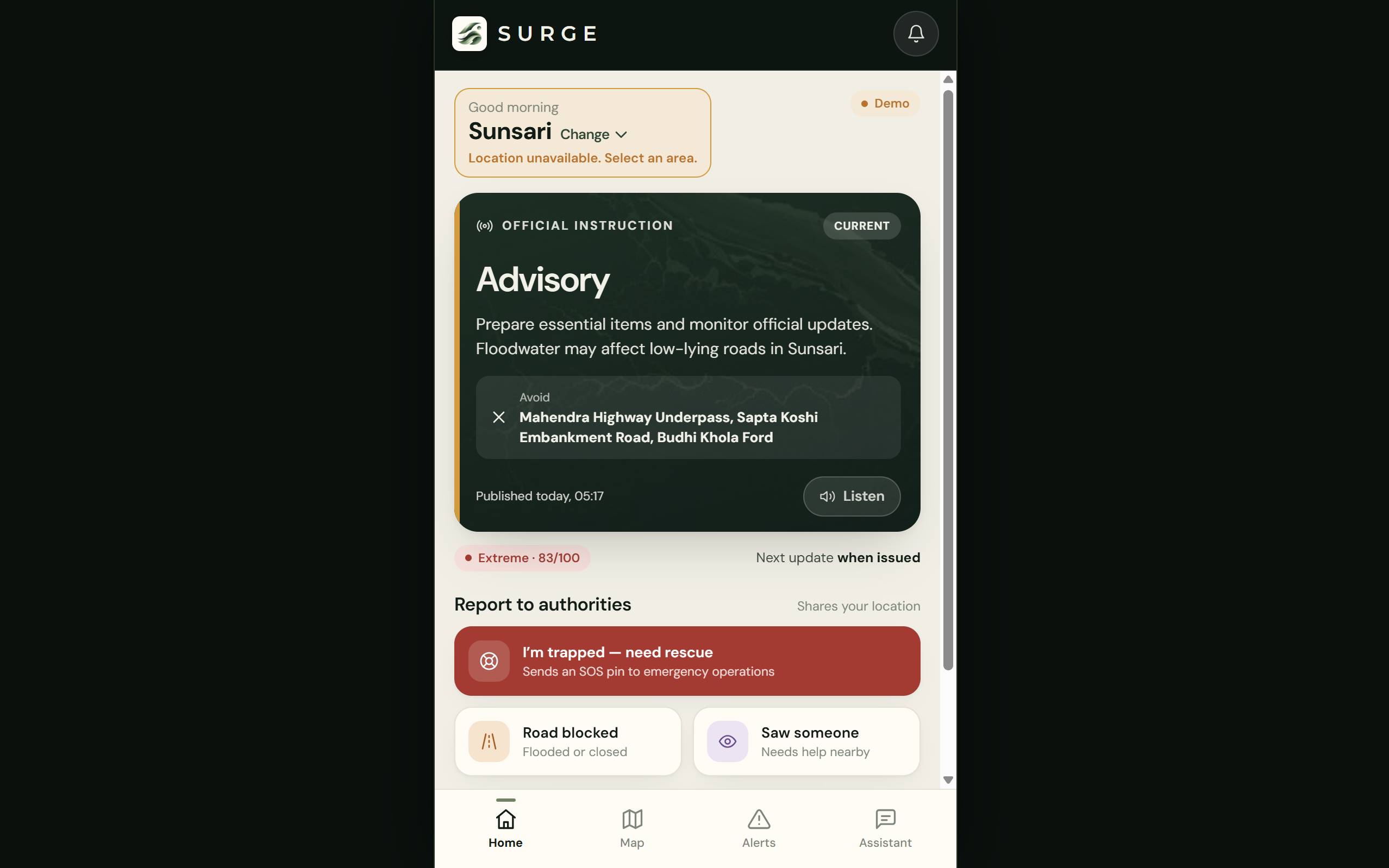
On the resident side, people receive official alerts and can interact with SURGE through voice, rather than needing to type or navigate through an app. This can be especially useful when someone is injured, driving, carrying something, in a stressful situation, or simply needs information as quickly as possible.
Residents can ask questions about the current situation, report blocked roads, identify people who need rescue, or send an SOS. These reports are immediately reflected on the government dashboard as structured, location-based information.
This creates a continuous feedback loop:
Government → Residents → Government → Residents
Instead of emergency communication ending when an alert is sent, SURGE keeps information flowing in both directions as the situation evolves.
How we built it
SURGE is built with a Next.js and React frontend, a backend that connects the government and resident interfaces in real time, and APIs from Snowflake, Gemini, and ElevenLabs.
We use the Snowflake API as the data layer for structured emergency information. Government directives, evacuation routes, road conditions, and resident reports can be stored and retrieved as the situation evolves, allowing both sides of SURGE to work from the same continuously updated source of information.
The government dashboard provides an interactive emergency map where official directives, evacuation routes, blocked roads, SOS reports, and search-and-rescue reports appear in real time.
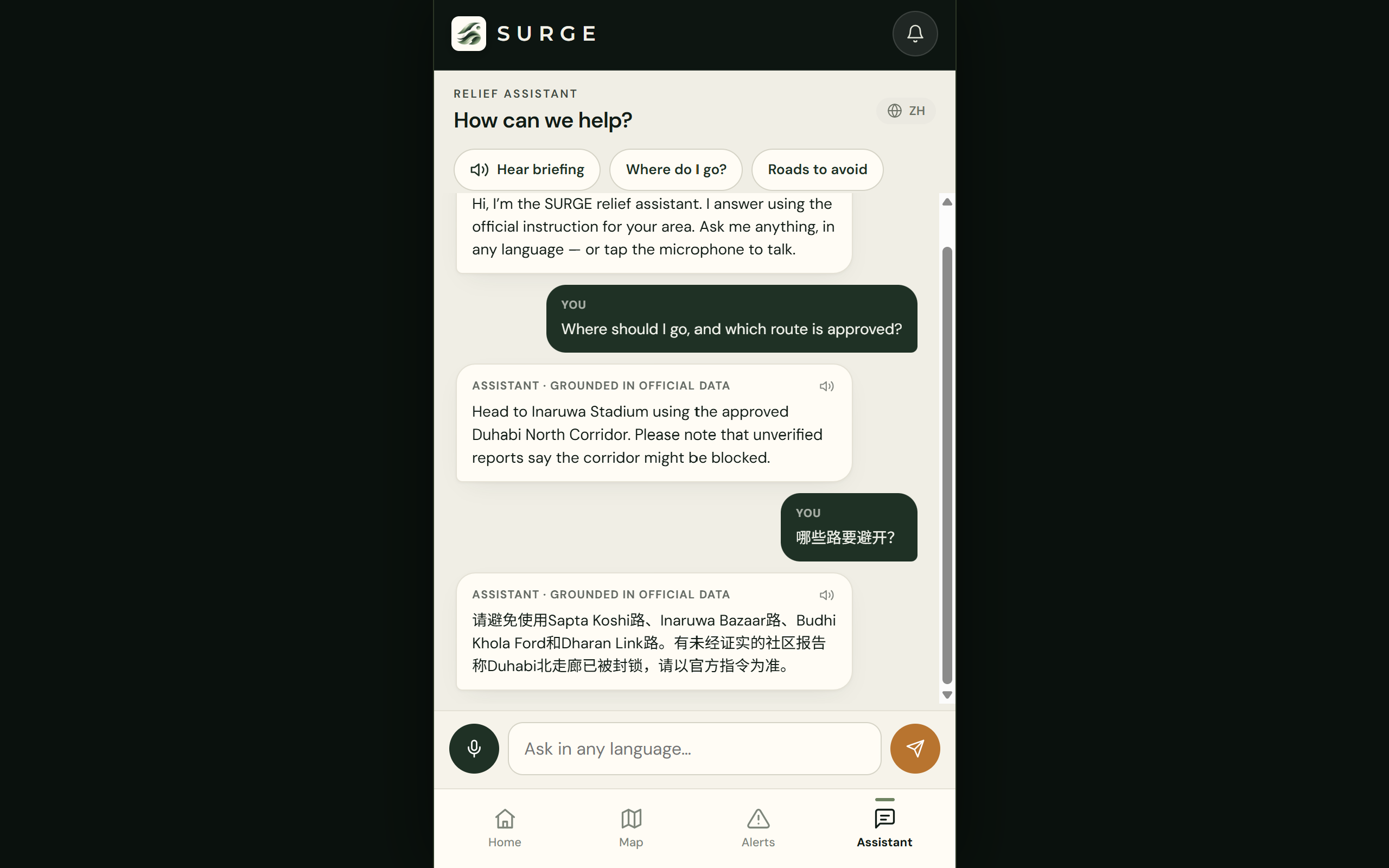
Gemini powers the resident-facing conversational agent. It receives the current emergency context and allows residents to ask questions naturally rather than navigating through menus. When officials publish a new directive, such as closing a road, that updated context can immediately affect the agent's response.
ElevenLabs provides speech-to-text and text-to-speech, allowing residents to communicate with SURGE entirely through voice and hear critical information without needing to type or read their phone.
The core of SURGE is the connection between these components: government actions and resident reports are written into the shared emergency data layer, reflected on the dashboards and maps, and fed into the conversational agent so that everyone is working from the latest available information.
Challenges we ran into
One of our biggest challenges was designing a genuinely two-way real-time system rather than simply building an emergency notification app.
We needed information created on one side of the application to immediately affect the other side. A blocked-road report from a resident needed to become a visible map marker for officials, while a new government directive needed to immediately update what residents could see and what the voice agent could tell them.
We also had to think carefully about how AI should behave in a high-stakes environment. SURGE does not allow an AI agent to issue evacuation orders or make official emergency decisions. Government officials remain responsible for deciding what actions should be taken; the AI helps communicate those decisions and make information easier to understand.
Finally, we had to make voice interaction feel natural enough to be useful during an emergency while keeping the interface simple and accessible.
Accomplishments that we're proud of
We're most proud of creating a working two-way emergency communication loop.
For example, a government official can publish an evacuation directive and see it appear on a resident's phone in real time. The resident can then use their voice to ask SURGE to summarize the situation and explain their next actions.
That same resident can say:
"I see someone who needs help at my location."
and immediately create a location-based report that appears on the government's emergency dashboard.
They can also report a blocked road or request rescue, while officials can update evacuation routes and directives as conditions change.
We are especially proud that these aren't isolated features. The voice agent, government dashboard, alerts, map markers, routes, and emergency reports are all connected into the same real-time system.
What we learned
We learned that effective emergency technology isn't necessarily about replacing existing systems with more AI. Sometimes the biggest opportunity is connecting the information that already exists and making it move faster between the people who need it.
We also learned how powerful voice interfaces can be in situations where traditional interfaces aren't ideal. A person shouldn't have to stop, unlock their phone, type a message, and navigate through multiple screens to ask an emergency question.
Most importantly, we learned how important context is. A conversational agent becomes significantly more useful when it isn't operating in isolation, but is connected to the same live information that emergency officials are using.
What's next for SURGE
The next step for SURGE would be connecting it to real government emergency-management infrastructure and verified data sources.
We would also expand the system to support more sophisticated evacuation routing, automatic translation into additional languages, integration with existing emergency alert systems, richer search-and-rescue coordination, and stronger authentication and verification for official updates.
Long term, we envision SURGE as a real-time communication layer for emergency response, connecting government decisions, information from people on the ground, and accessible AI-powered communication into one continuously updating system.
The goal is simple:
When conditions change, everyone who needs to know should know.
Built With
- elevenlabs
- gemini
- javascript
- next-js
- python
- react
- snowflake


Log in or sign up for Devpost to join the conversation.