-
-
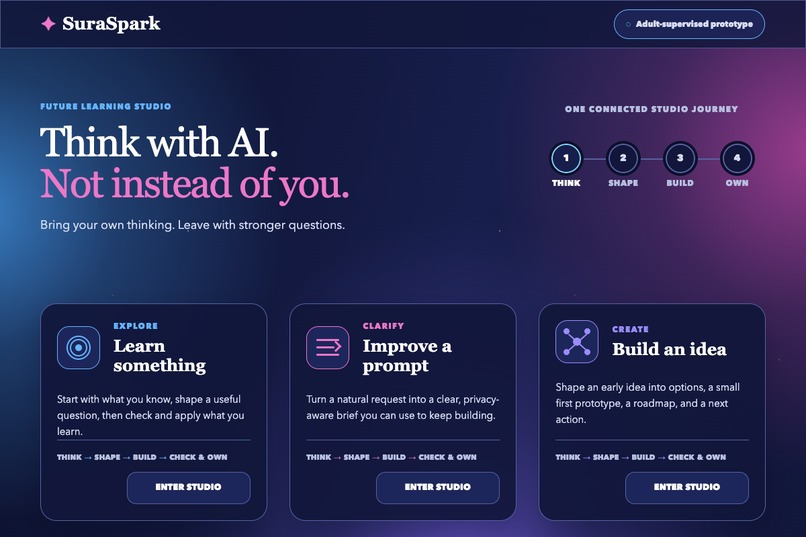
SuraSpark | Think With AI, Not Instead of You
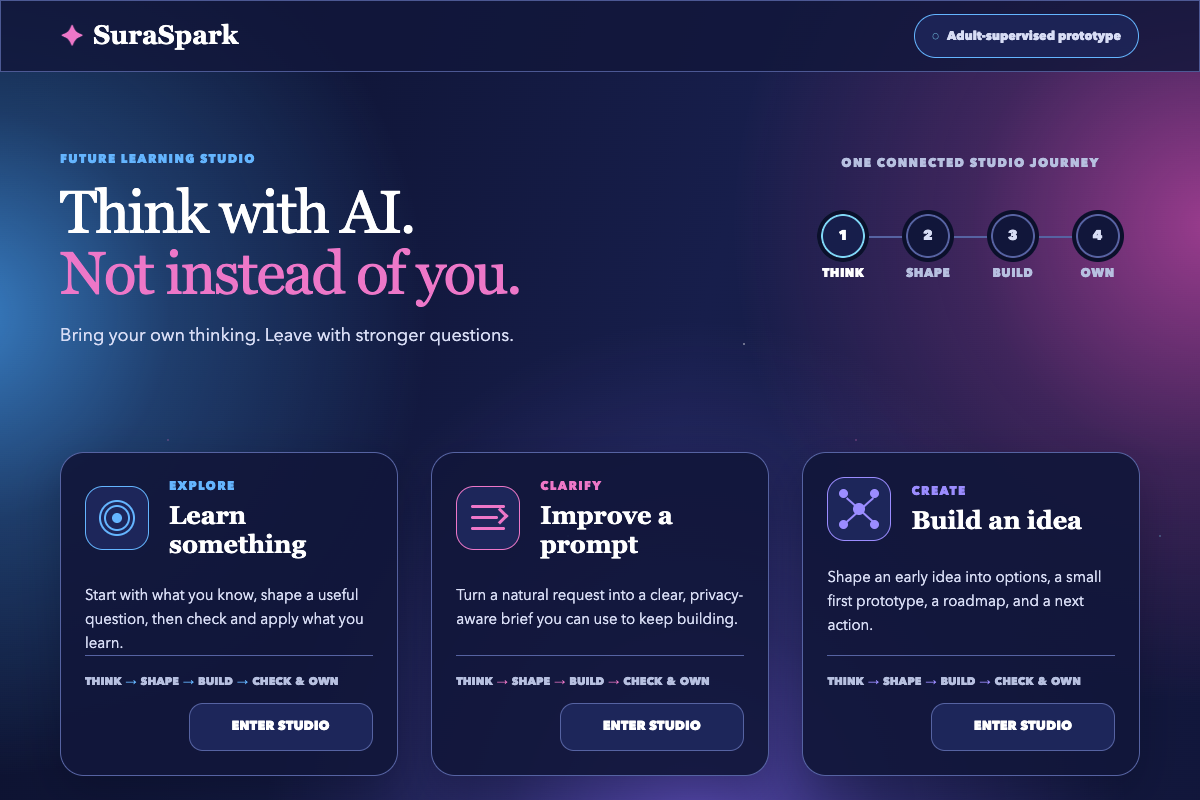
Inspiration
Young people are gaining access to powerful AI, but many tools optimize for instant answers instead of independent thinking. SuraSpark was inspired by a simple question: how can young people learn to use AI while keeping their judgment, privacy, authorship, and human support at the center?
What it does
SuraSpark is an adult-supervised AI-literacy prototype for learners ages 11–14.
It guides learners through THINK → SHAPE THE ASK → BUILD WITH AI → CHECK & OWN. Learners contribute first, approve an editable Working Brief before AI is contacted, check important claims, make their own decisions, and create a learner-authored result. An optional, non-scoring adult summary makes the process transparent.
The prototype includes Learn Something, Improve a Prompt, and Build an Idea pathways.
How we built it
SuraSpark is a TypeScript web application built with Next.js, React, Vite, and the OpenAI Responses API. It uses GPT-5.6 Sol for bounded, pathway-specific guidance through server-side requests with store: false, strict structured output, runtime validation, input limits, and controlled error handling.
Codex accelerated the implementation, testing, documentation, and refinement. Hana M. Al-Batati defined the product purpose, learner journey, governance boundaries, and final decisions.
Challenges we ran into
The central challenge was making AI genuinely useful without allowing it to take over the learner’s work. We designed the workflow so the learner contributes and approves the request before every Build action, while the final decision and artifact remain theirs.
We also had to handle incomplete or invalid model output safely. SuraSpark preserves the learner’s work, avoids fabricating guidance, and shows a controlled message rather than exposing technical details.
Accomplishments that we're proud of
We built a complete, coherent learning experience rather than a generic chatbot. The Prompt-to-Idea handoff carries only learner-approved work through temporary browser memory and makes zero model calls. Each Build action is deliberate, bounded, and validated.
The project has no accounts, database, analytics, long-term memory, or tracking. It includes privacy reminders, deterministic safety checks before model requests, and a transparent adult-review summary.
What we learned
Most AI tools optimize for answers. SuraSpark develops the judgment to question those answers, verify what matters, and create something of your own.
GPT-5.6 Sol mattered because each response must do more than generate text: it must follow a pathway-specific strategy, respect learner agency, surface uncertainty, suggest verification, and return an exact validated structure. Reliability comes from the complete system—not the model alone.
What's next for SuraSpark
SuraSpark remains an adult-supervised prototype. Before any real-world youth use, the next steps are child-safety, privacy, accessibility, legal, and educator review; broader testing with appropriate consent and oversight; and continued refinement based on evidence.
Our goal is to help young people become thoughtful, capable creators who can think with AI—not instead of themselves.
As AI capabilities evolve, SuraWorks will evaluate newer models carefully and adapt SuraSpark when they strengthen learner agency, reliability, privacy, and adult oversight. New capability will never be adopted simply because it is more powerful; it must serve the learning purpose and meet the product’s governance standards.
Built With
- api
- cloudflare
- codex
- css
- figma
- gpt-5.6
- next.js
- node.js
- openai
- sites
- sol
- tailwind
- typescript
- vinext
- vite

Log in or sign up for Devpost to join the conversation.