Inspiration
- That's how many sanitation workers have died entering sewers and septic tanks in India since 2014 — and 92% of them came from marginalized communities. Officially, zero of those deaths have ever been classified as manual scavenging.
In January 2025, India's Supreme Court banned hazardous manual sewer entry in the country's major metros. But workers are still dying, because a ban on paper doesn't change what happens underground. Supervisors find out a worker is in danger after the fact. Families find out never. Enterprise gas monitors are priced for corporate safety budgets. Paper permits leave no trail. Government registration schemes like NAMASTE track who a worker is — not what's happening on-site, right now.
We wanted to build for "the problems nobody else chose" — a population that is large, underserved, and almost entirely invisible to existing safety tech. That's SurakshaNet. What it does
SurakshaNet turns the legal permit-to-work requirement into a live safety system.
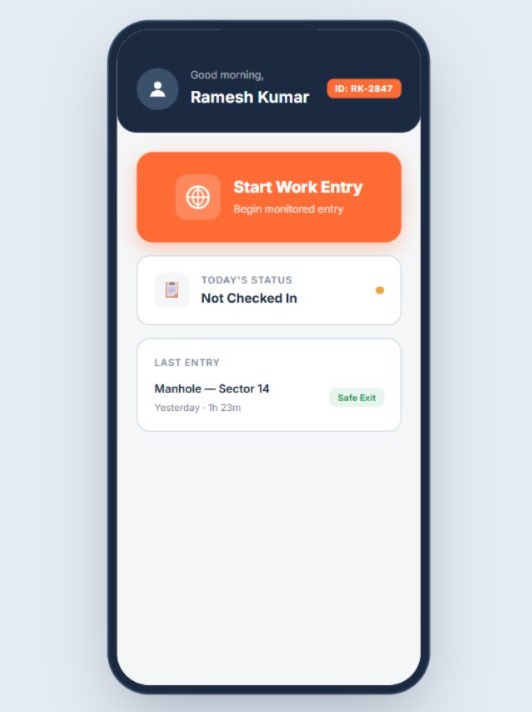
Before entering a manhole, septic tank, or sewer line, a worker checks in through a zero-download interface — WhatsApp or a lightweight app, in Hindi or English — logging the site, space type, and estimated depth. That check-in isn't paperwork; it's what turns protection on.
From the moment they confirm, live telemetry streams to a supervisor dashboard: oxygen, hydrogen sulfide, carbon monoxide. Every second underground is tracked on a map with color-coded worker status.
If a gas threshold is breached or a worker doesn't check out in time, SurakshaNet automatically escalates — alerting the supervisor and an emergency contact with live location, in seconds, with no one needing to notice first.
Every entry, safe or not, becomes a timestamped, auditable record — the same log that protects workers today can support the compensation claims families are so often denied.
How we built it
We scoped the MVP to five things fully buildable in a hackathon sprint: a digital work-permit check-in, a simulated live sensor stream (with a safe-to-danger toggle for the demo), a live supervisor dashboard, automatic SOS escalation, and an exportable compliance log.
The stack centers on a WhatsApp-based worker interface, a React/Tailwind dashboard, and a real-time backend to stream sensor data and trigger alerts — chosen to get to a bulletproof live demo fast, while keeping the underlying data model (workers, sites, entries, sensor readings, alerts) generic enough to swap in real hardware and production infrastructure later.
We split the 48 hours into scoping, a design sprint, parallel builds across backend/worker-app/dashboard/alerts, integration, hardening and multilingual polish, and end-to-end testing — including deliberately triggering an emergency scenario to make sure the SOS flow actually works under pressure.
Challenges we ran into
Designing for low-literacy, first-time smartphone users meant rethinking almost every UI convention we take for granted — large icon-driven tap targets, voice-guided prompts, and color paired with icon and text so nothing depends on reading ability alone.
Simulating realistic gas-sensor behavior (so a live demo feels authentic rather than scripted) while keeping the "danger" trigger reliable enough to fire on cue in front of judges took real tuning.
We also had to be disciplined about scope — real hardware integration, live SMS/WhatsApp delivery, multi-tenant municipal admin accounts, and payment workflows were all explicitly cut for the hackathon, mocked convincingly, and documented openly rather than quietly ignored.
Accomplishments that we're proud of
We're proud that SurakshaNet isn't just another safety dashboard bolted onto compliance paperwork — it makes the compliance paperwork itself the safety mechanism, so there's a genuine incentive to use it instead of a mandate to skip it.
We're proud of designing for the actual conditions of informal municipal work — shared phones, no dedicated safety officer, no budget for enterprise gas monitors — instead of assuming an enterprise buyer.
And we're proud that the same audit trail built for real-time safety doubles as evidence for the ₹30 lakh compensation claims that currently go unconfirmed for large numbers of reported deaths.
What we learned
We learned how much of "safety tech" is actually access design — the hardest part of this problem isn't sensors or alerts, it's building something a migrant, low-literacy worker with a shared phone will actually use every single time, without friction.
We also learned how powerful it is to reframe a compliance obligation as the safety mechanism itself, rather than treating compliance and protection as two separate systems fighting for the same worker's attention.
What's next for SurakshaNet
In the next three months, we want to integrate real low-cost H₂S/O₂ sensors and live SMS/WhatsApp delivery in place of our simulated versions. At six months, we're targeting a pilot with a municipal corporation under the NAMASTE scheme, alongside predictive risk scoring that factors in site depth, time of day, and historical incident density before a supervisor approves entry.
Longer term, the check-in → sensor-stream → escalation pattern isn't specific to sewage work — it generalizes directly to any confined-space labor, including mining and industrial tank cleaning. We see a path to multi-city rollout and expansion well beyond the original use case, because a supervisor should never learn a worker was in danger too late.

Log in or sign up for Devpost to join the conversation.