-
-
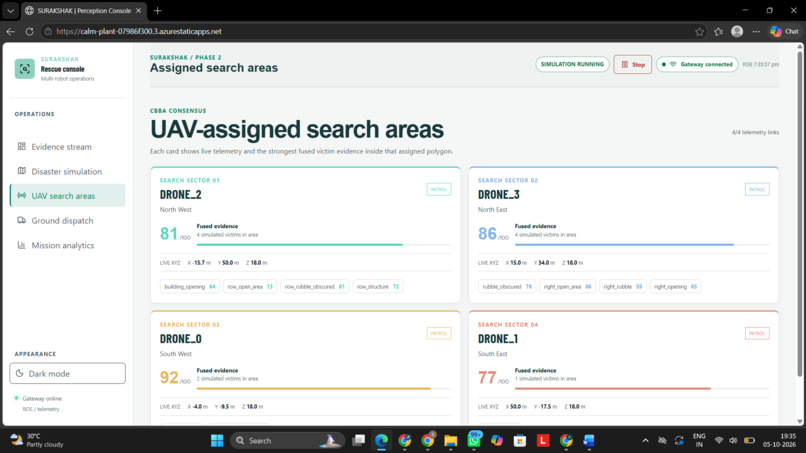
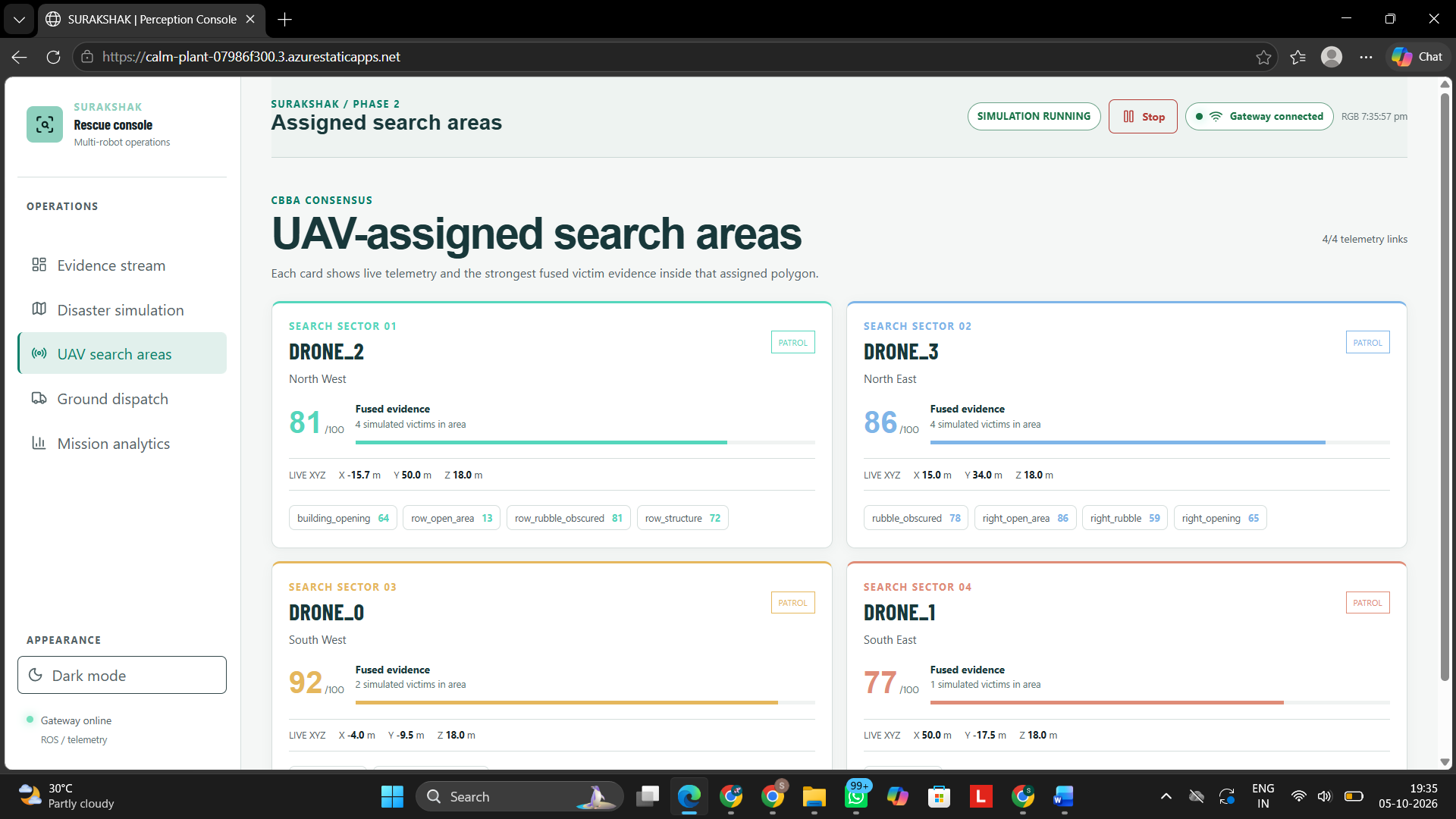
UAV search areas: CBBA-assigned sectors, UAV telemetry, and area-level candidate counts.
-
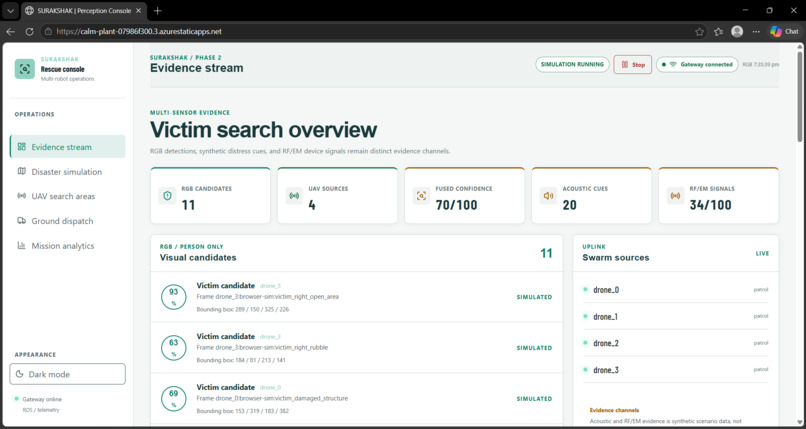
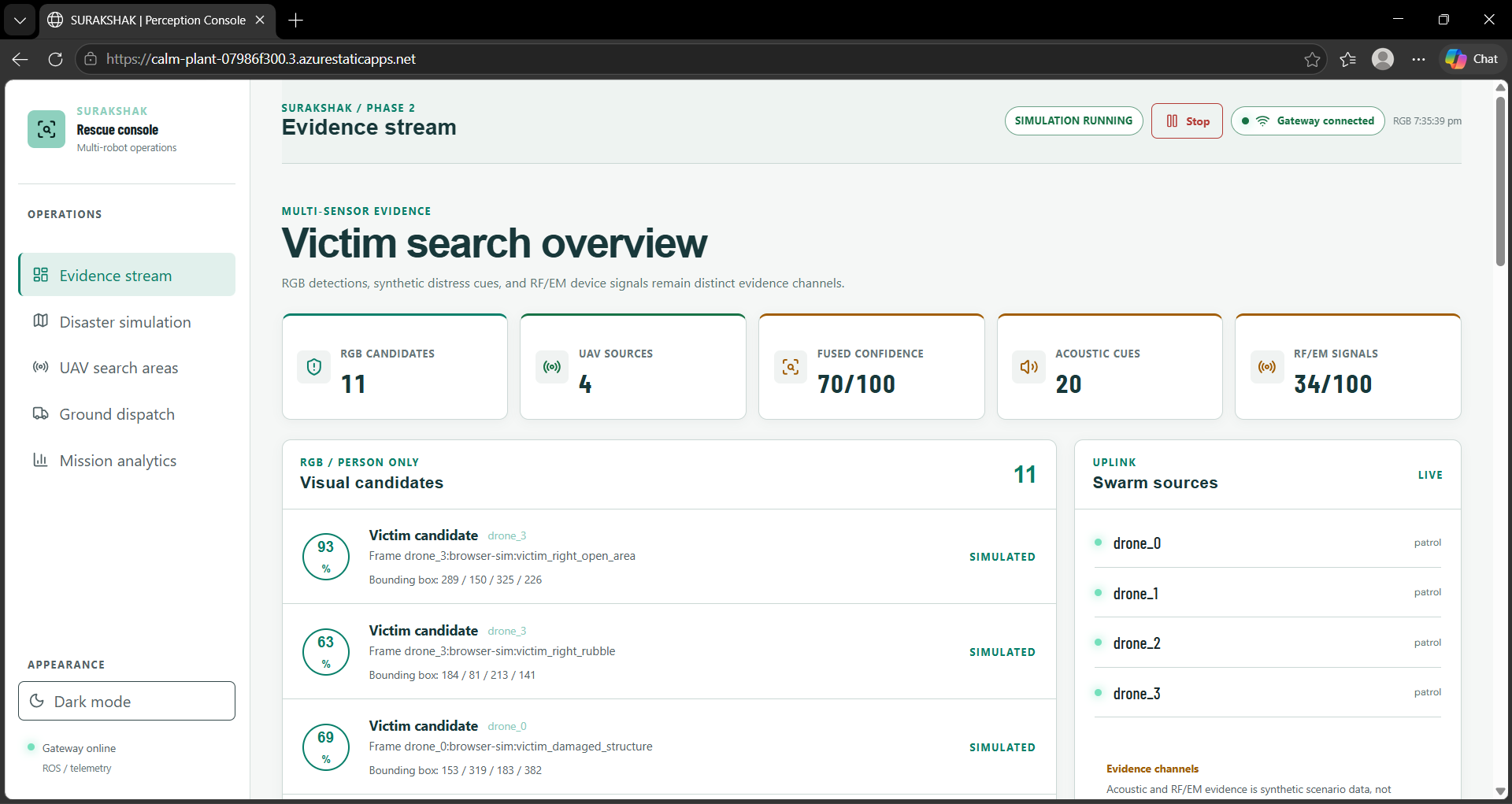
Operations console :Mission Overview, live evidence, fleet state, and operator actions.
-
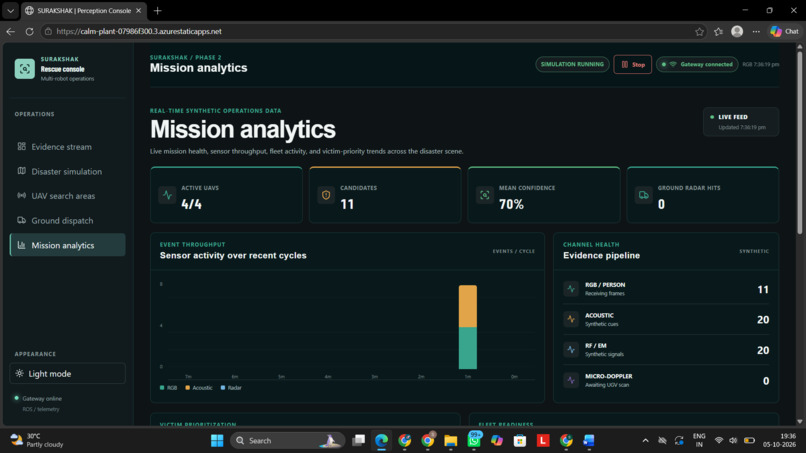
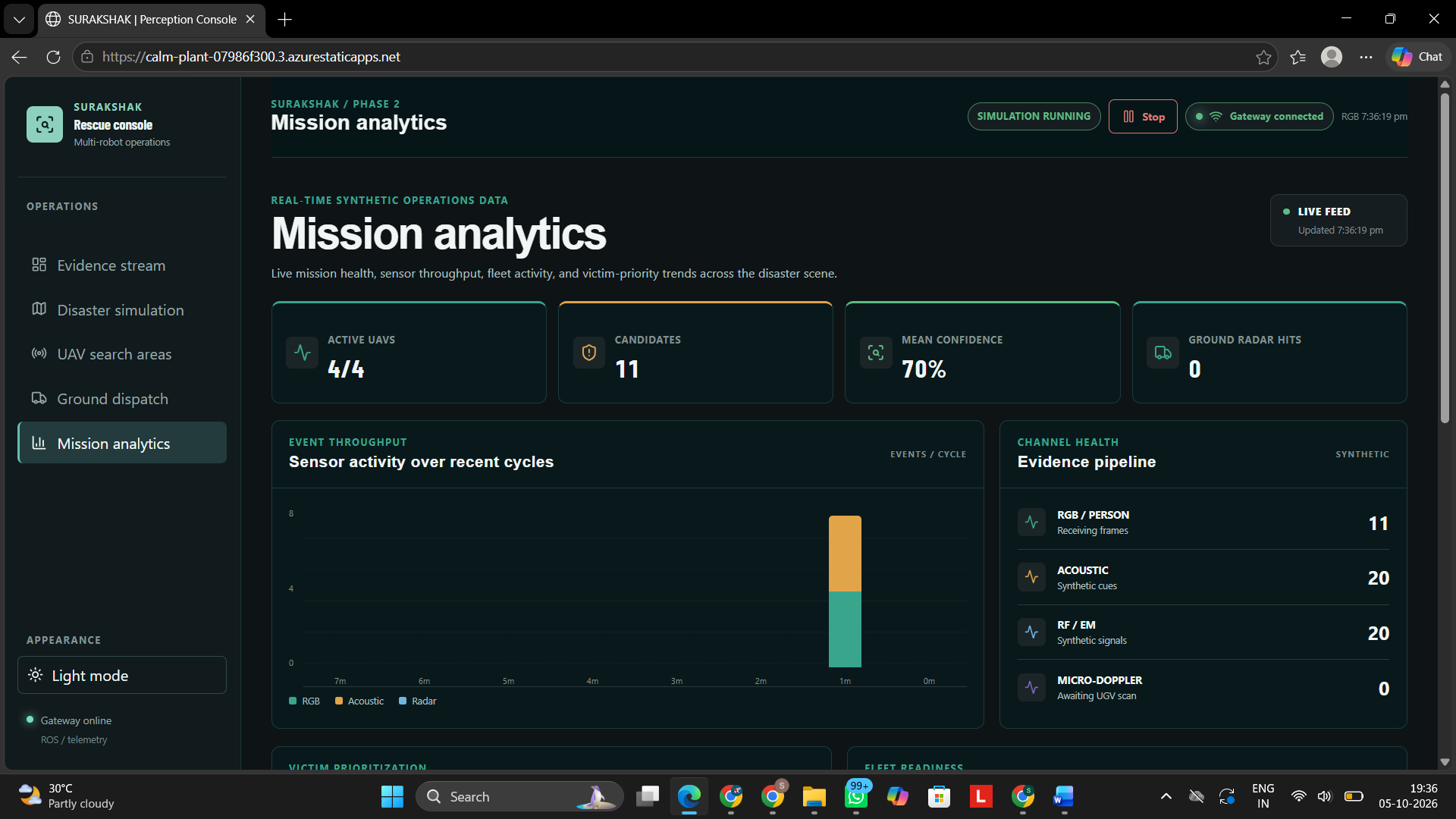
Mission analytics : Event throughput, sensor health, fleet readiness, and mission timeline.
-
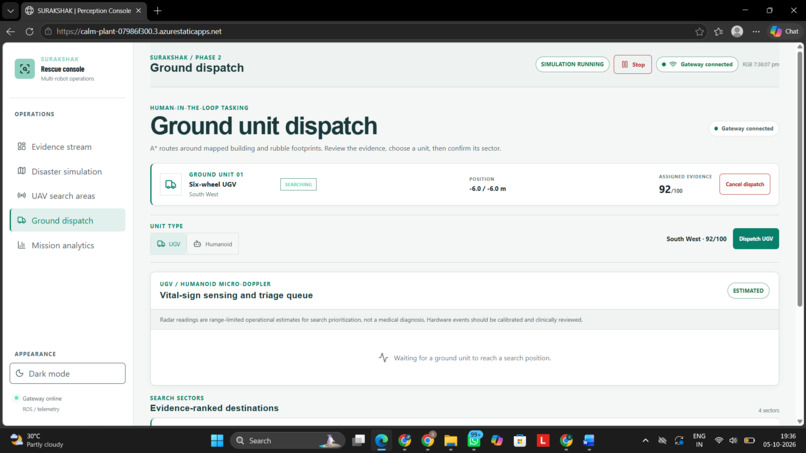
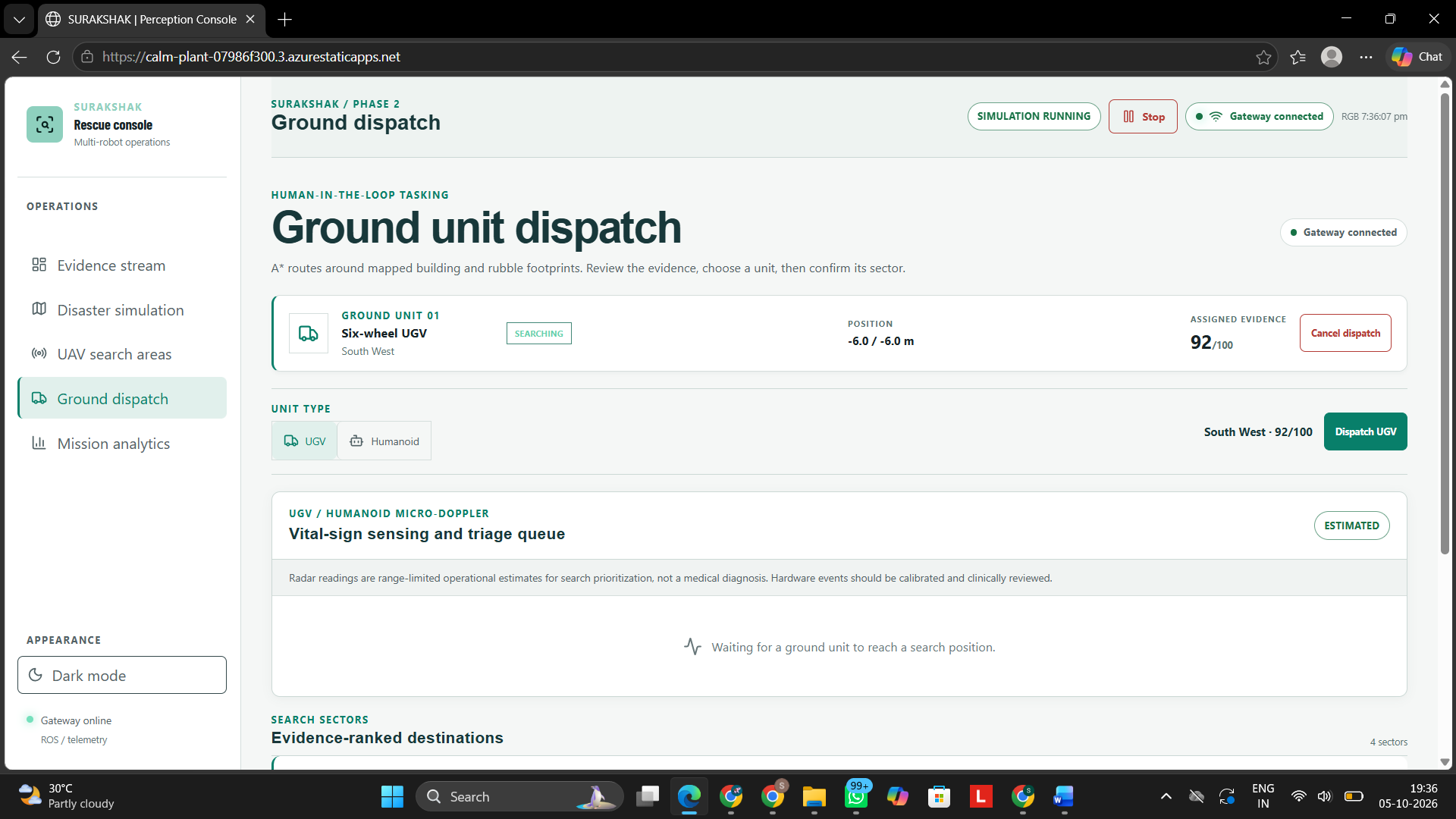
Ground dispatch and radar triage : UGV or humanoid dispatch, A* routing, radar estimates, and triage priority.
-
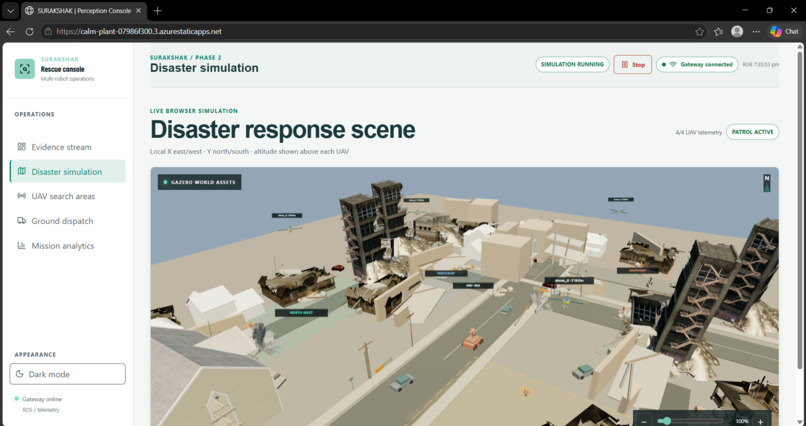
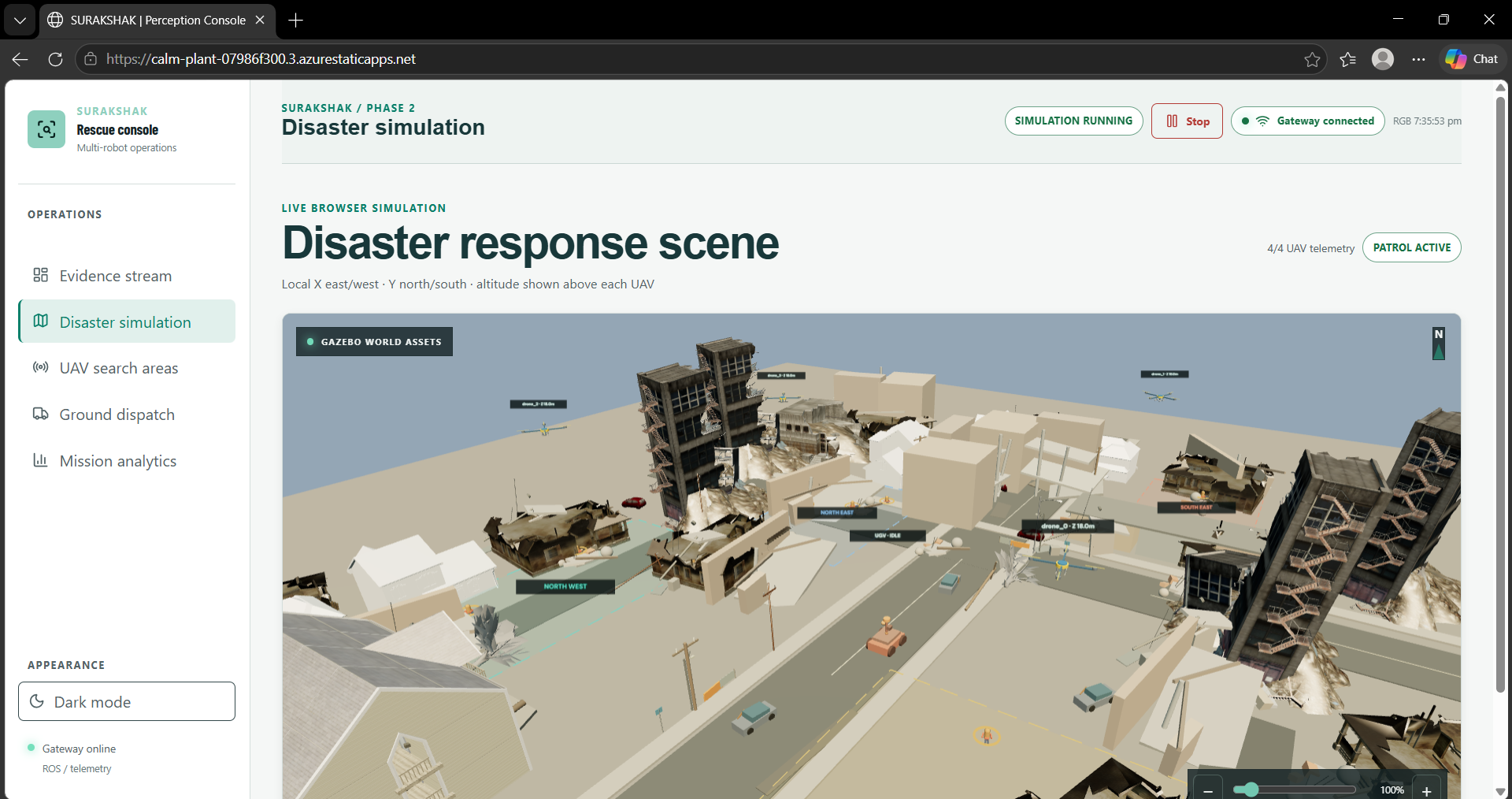
Disaster simulation: UAVs, ground units, search sectors, candidates, and scene overlays.
-
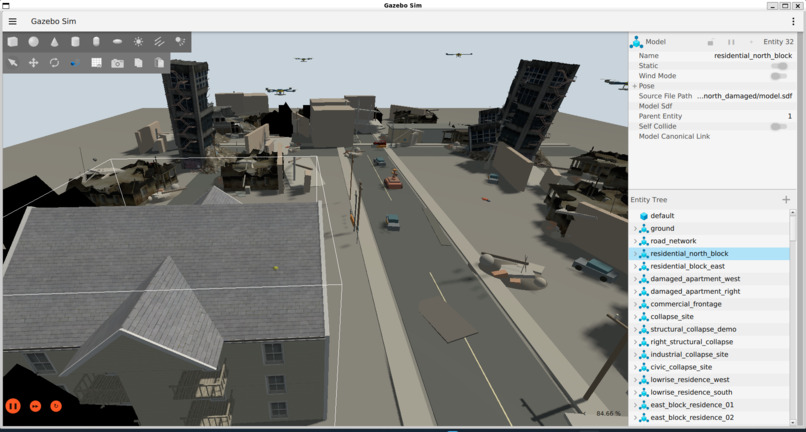
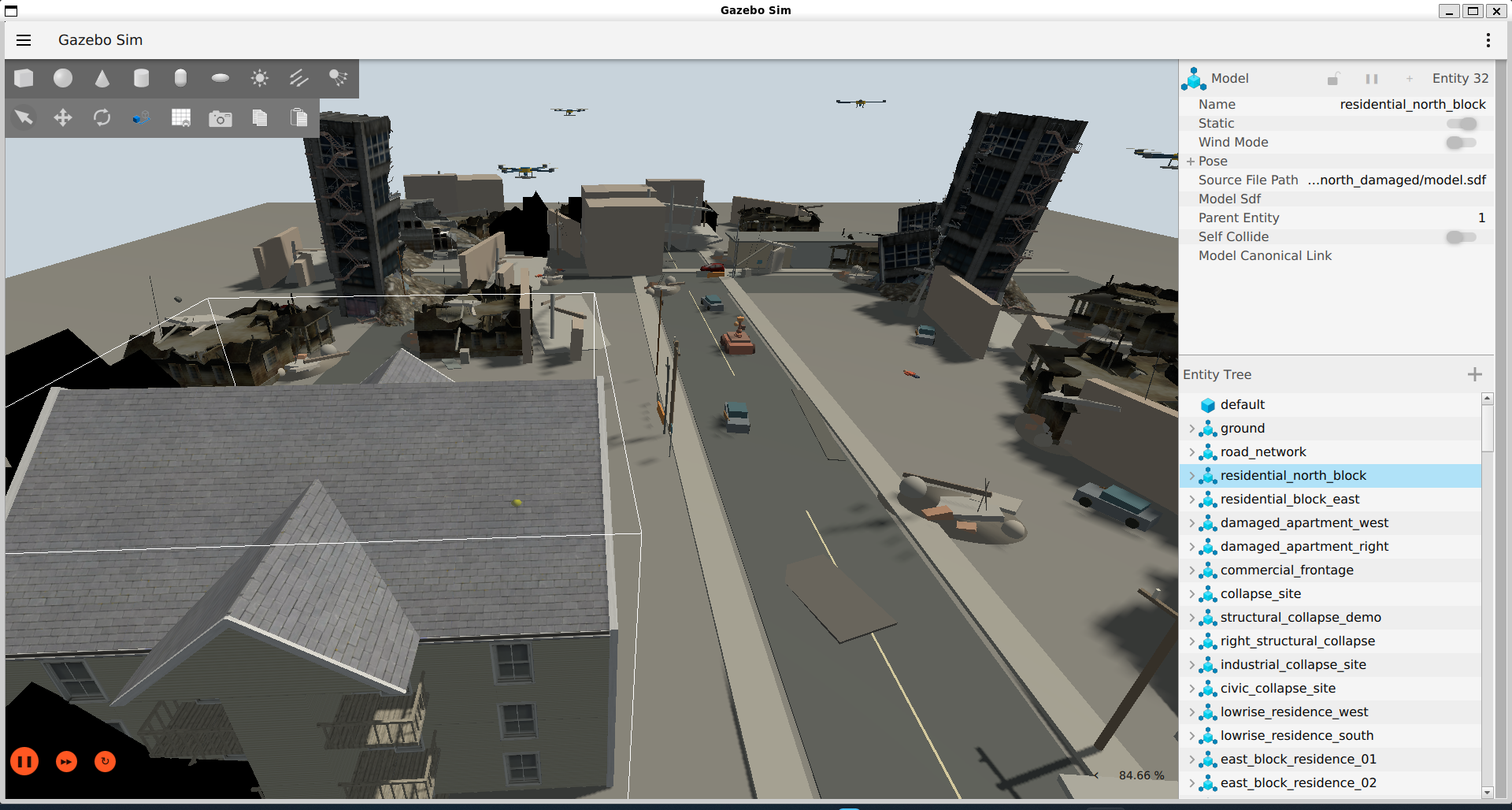
Gazebo disaster world : The simulated urban environment with structures, roads, rubble, and vehicles.
Inspiration
After a disaster such as an earthquake, rescue teams face a difficult combination of collapsed structures, inaccessible areas, uncertain survivor locations, and limited time. Deploying drones can accelerate aerial reconnaissance, but detecting a potential survivor is only the beginning. That information must be assessed, verified, and converted into an actionable rescue decision.
This inspired us to build SURAKSHAK, a multi-robot search-and-rescue system that connects UAV swarm coordination with unmanned ground vehicle (UGV) verification. We wanted to explore how multiple robots could work together as a coordinated system instead of operating as isolated units.
What it does
SURAKSHAK follows a Search → Detect → Review → Verify → Respond workflow.
- UAV swarm coordination: Divides the affected region into hexagonal search cells and sectors, then uses the Consensus-Based Bundle Algorithm (CBBA) to allocate search tasks according to priority, position, battery, workload, and availability.
- Systematic coverage: Plans lawnmower-style search trajectories and supports task reassignment when a UAV becomes unavailable or leaves a task incomplete.
- Multimodal perception: Combines potential evidence from RGB, thermal, acoustic, and RF/EM sensing to identify candidate survivor locations.
- Uncertainty-aware fusion: Combines modality-specific confidence and signal quality to estimate candidate confidence without treating a single sensor detection as confirmation.
- Human-supervised verification: Presents candidate locations and supporting evidence through an operator dashboard. Selected candidates can be handed off to UGVs for ground-level assessment.
- Ground-robot verification: Uses ROS 2, SLAM, Nav2, and path planning for navigation, with simulated radar range-Doppler and micro-Doppler processing providing additional human-motion evidence.
The current simulation uses four UAVs and one UGV as a representative fleet configuration; the intended architecture supports configurable fleet sizes.
How we built it
We designed SURAKSHAK as a layered software architecture connecting robot simulation, mission intelligence, perception, and operator control.
- Simulation and robotics: Gazebo Harmonic and ROS 2 Jazzy provide the environment for multi-robot simulation and communication.
- Mission intelligence: Python implements search-space decomposition, task allocation, coverage planning, candidate management, and evidence fusion.
- Perception: YOLO and OpenCV support visual processing, while acoustic, RF/EM, and radar components are modeled as separate evidence-processing pipelines.
- Backend and dashboard: FastAPI and WebSocket connect the intelligence layer to a React and Leaflet operator interface for mission state, robot telemetry, search sectors, and candidate review.
- Evaluation and deployment planning: The architecture incorporates mission logging, performance analysis, fault testing, and a planned progression from simulation to software- and hardware-in-the-loop testing.
We focused on connecting these components into a coherent end-to-end workflow rather than presenting each technology as a standalone feature.
Challenges we ran into
One of our biggest challenges was coordinating multiple subsystems with different responsibilities. Task allocation determines which UAV searches a sector, while coverage planning determines how it searches that sector. Keeping these operations separate is essential for a maintainable architecture.
Another challenge was handling uncertain sensor evidence. A thermal anomaly, acoustic cue, or RF/EM signal does not automatically indicate a survivor. We therefore designed the workflow around evidence fusion, candidate confidence, operator review, and subsequent ground verification.
We also had to account for failures that a straightforward demonstration might overlook, including UAV unavailability, communication loss, incomplete search tasks, and navigation obstacles. These cases require explicit mission-state handling and task reassignment.
Finally, integrating simulation, robotics middleware, backend communication, and the dashboard required careful synchronization of robot states, sensor observations, and mission events.
Accomplishments that we're proud of
- Designed an end-to-end architecture connecting aerial search, multimodal evidence processing, human review, ground verification, and rescue prioritization.
- Incorporated CBBA-based task allocation and systematic search coverage into the mission workflow.
- Designed a human-in-the-loop approach that avoids treating automated detections as confirmed survivors.
- Connected the robotics and mission-control concepts to a web-based operator interface.
- Established a scalable architecture in which the four-UAV, one-UGV configuration is a prototype fleet rather than a fixed system limit.
- Identified measurable evaluation criteria, including search coverage, detection metrics, localization error, task-allocation performance, and navigation success.
Our focus is not just on detecting a possible survivor, but on connecting that evidence to a verification and response workflow.
What we learned
SURAKSHAK taught us that disaster-response robotics is as much a coordination and decision-making problem as it is a perception problem.
We learned the importance of separating mission planning, task allocation, coverage execution, sensor fusion, and ground verification. We also learned that uncertainty must remain visible throughout the pipeline, particularly when decisions could affect human safety.
Equally important, we learned to distinguish simulated capabilities from field-proven results. Simulated radar observations and modeled vital-sign evidence can help evaluate system logic, but they do not establish real-world detection accuracy. Reliable deployment requires controlled experiments, measured performance, robust fault handling, and hardware validation.
What's next for Surakshak
Our next steps are to strengthen the implementation and validate the architecture under increasingly realistic conditions.
- Complete the simulation pipeline: Integrate UAV coordination, search coverage, multimodal evidence generation, UGV navigation, and mission-state synchronization.
- Evaluate task allocation: Compare CBBA with suitable baseline allocation strategies under different fleet sizes, battery constraints, and communication failures.
- Improve perception and fusion: Test detection models using appropriate public datasets and evaluate candidate confidence, localization accuracy, and false-positive rates.
- Validate UGV verification: Develop reproducible simulated radar experiments and assess human-motion classification under different noise and occlusion conditions.
- Test resilience: Measure the effects of robot failures, communication loss, sensor degradation, and blocked routes on overall mission performance.
- Progress toward deployment: Move through software-in-the-loop and hardware-in-the-loop testing before controlled trials with real robots and sensors.
- Strengthen production infrastructure: Add persistent mission data, analytics, monitoring, secure communication, and deployment automation as the system matures.
Our long-term goal is to develop SURAKSHAK into a reliable, extensible coordination layer that can help heterogeneous robotic fleets support safer and more informed search-and-rescue operations.
SURAKSHAK — Coordinate. Detect. Verify. Respond.
Built With
- autonomous-navigation
- cbba
- computer-vision
- data-analytics
- disaster-response
- docker
- fastapi
- gazebo
- human-in-the-loop-ai
- leaflet.js
- multi-robot-systems
- nav2
- opencv
- postgresql
- python
- radar-signal-processing
- react
- redis
- ros-2
- sensor-fusion
- slam
- swarm-robotics
- websocket
- yolo


Log in or sign up for Devpost to join the conversation.