-
-

Bold, urgent design built for Indian citizens
-
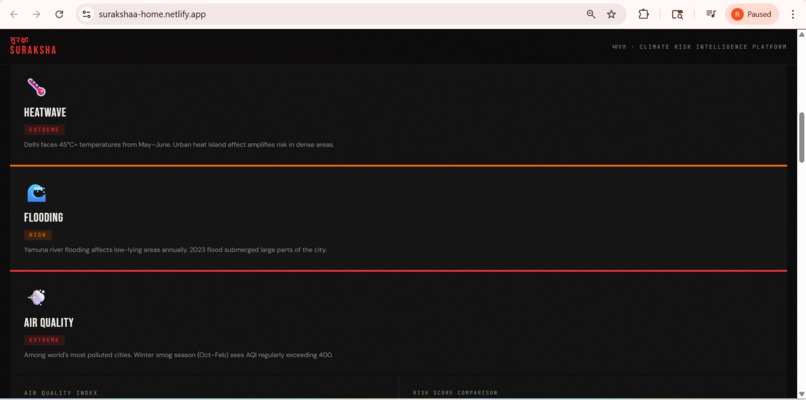
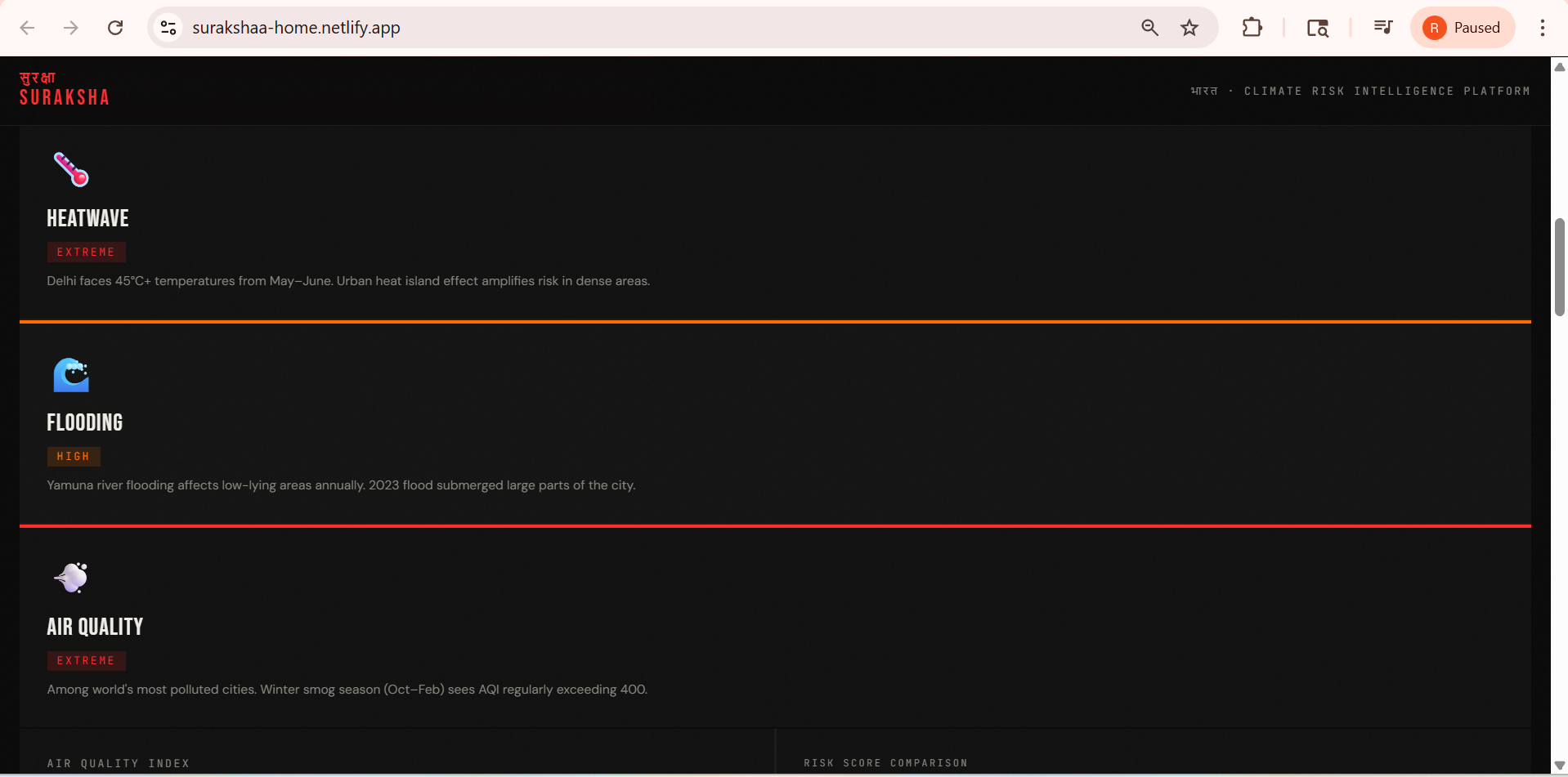
Suraksha — India's climate risk intelligence platform
-
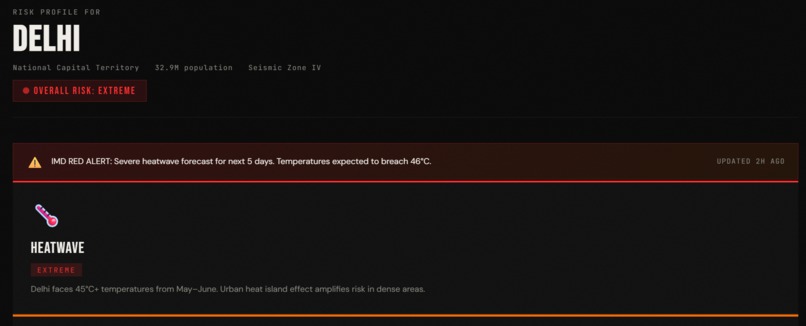
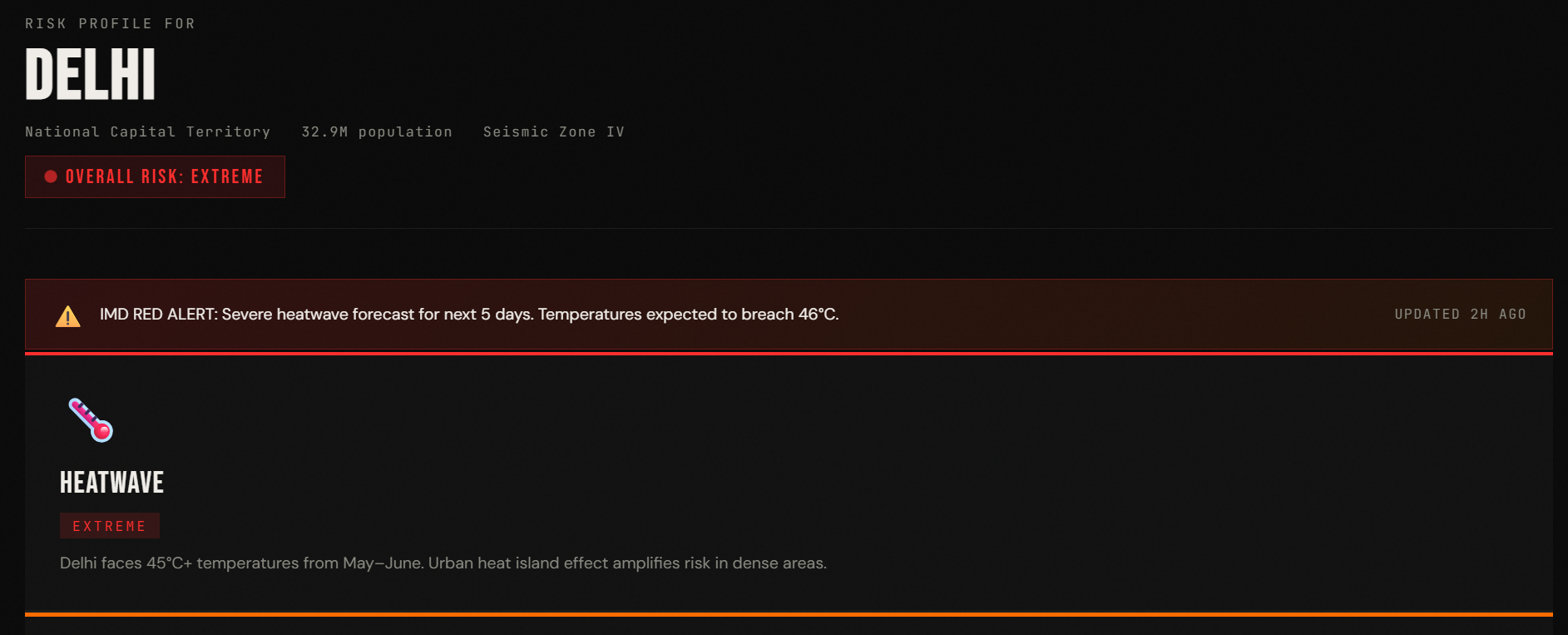
City risk profile — Delhi showing EXTREME overall risk with live alerts
-
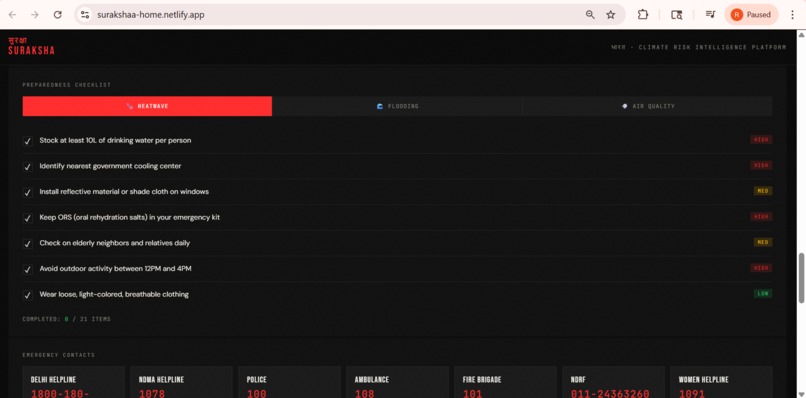
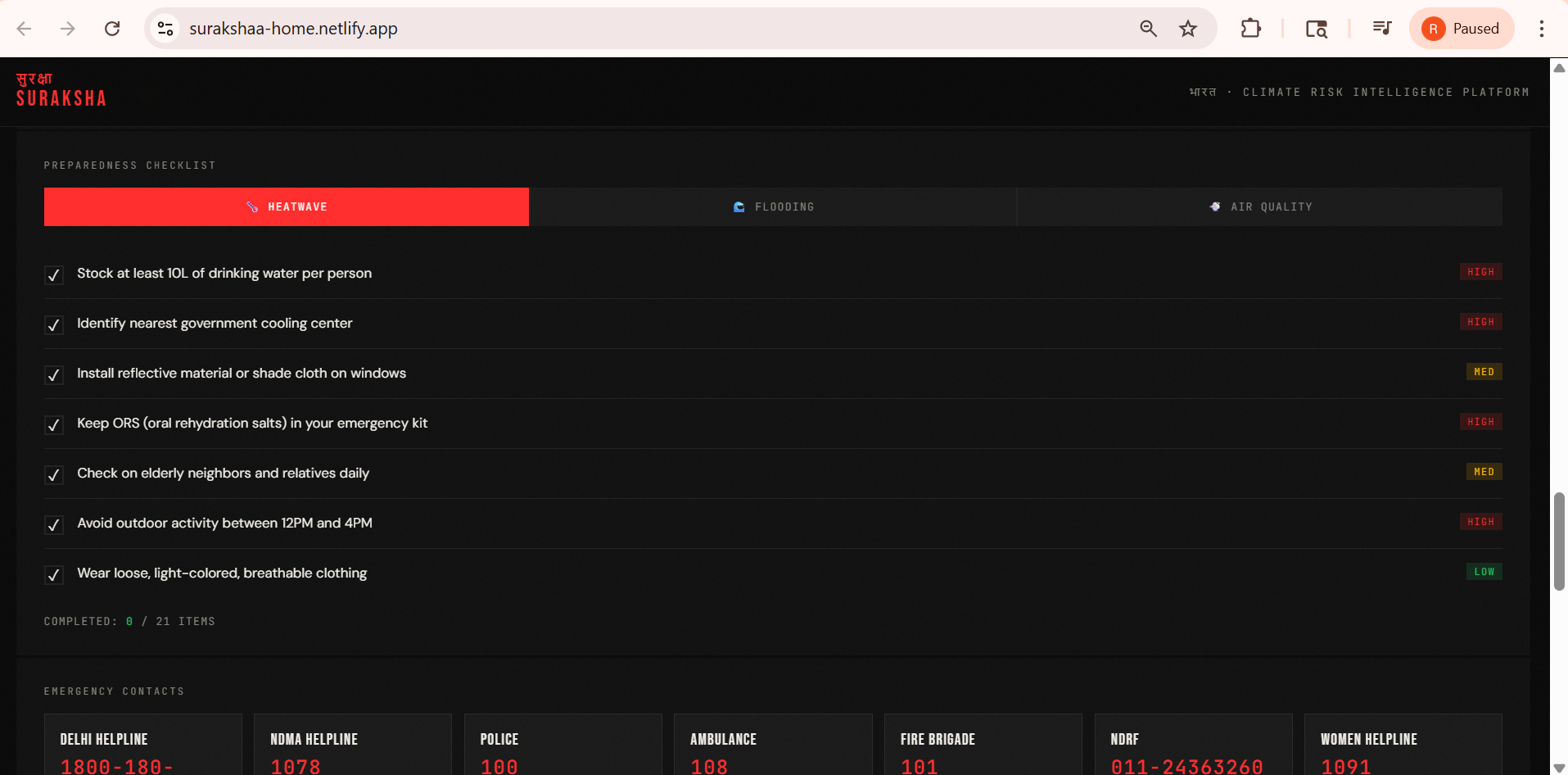
Preparedness checklists with priority ratings for each risk type
-
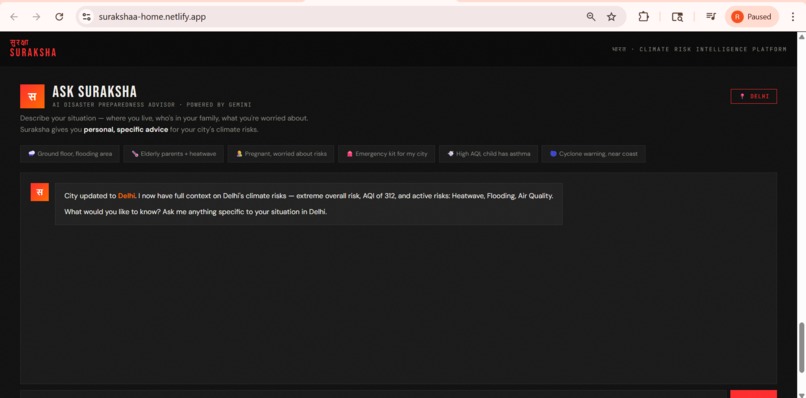
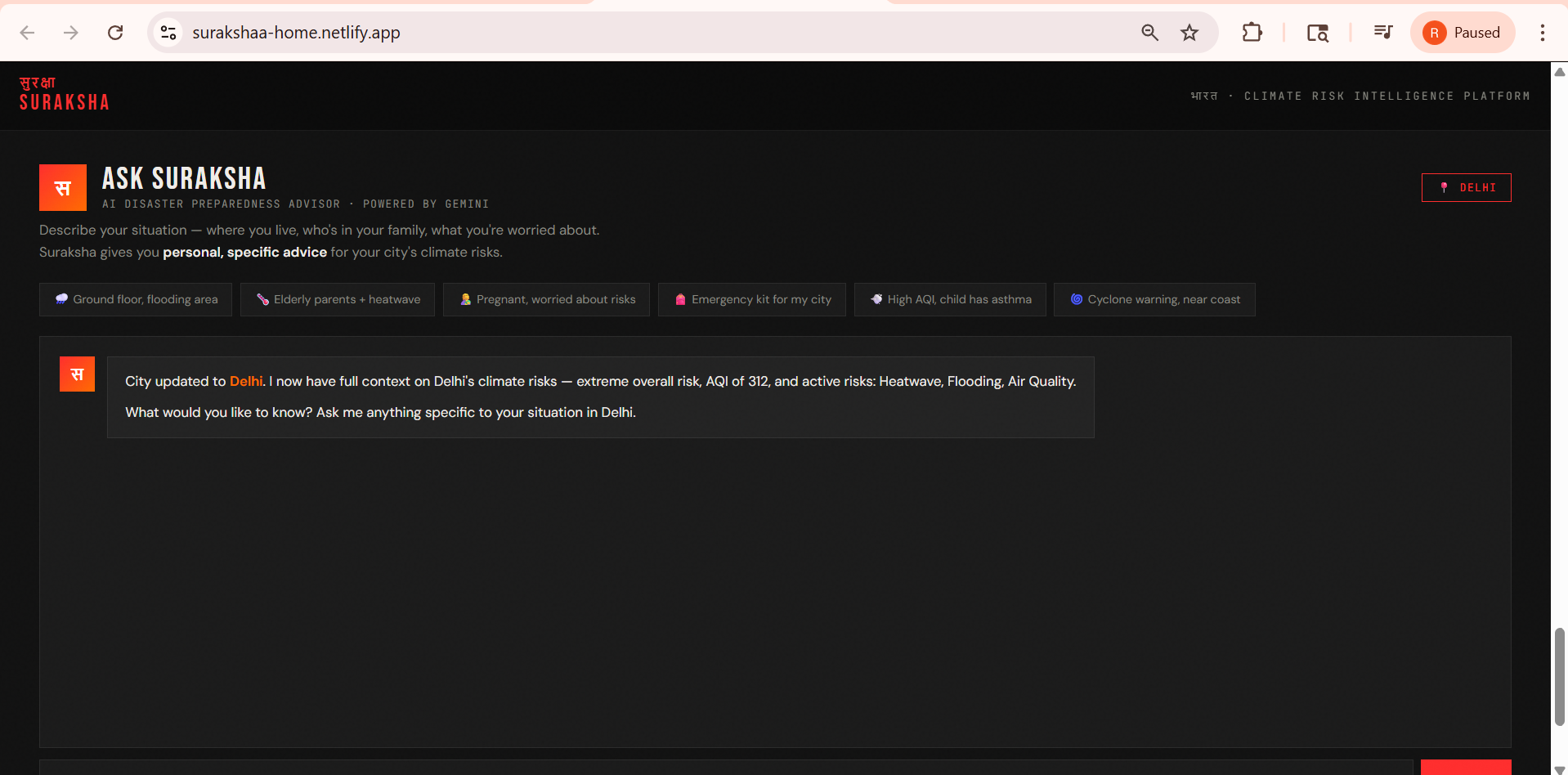
Ask Suraksha — AI advisor powered by Gemini gives personal advice

Inspiration
I live in Delhi. Every May, my family stocks water before the taps run dry. Every monsoon, we watch the news, wondering if our street will flood. Every winter, we wake up to air so thick you can taste it.
India experienced extreme weather on 331 out of 334 days in 2025, killing over 4,400 people. Yet when I looked for a tool that could tell me — personally — what risks my city faces and what I should do, I found nothing built for ordinary citizens.
The government's SACHET app sends alerts during disasters. But by then it's often too late. Nobody tells you what's coming for your city or what you specifically should do before it happens. That gap is what Suraksha fills.
What it does
Suraksha is a climate risk intelligence platform for Indian cities with five core features:
Risk Dashboard — Each city gets a full risk profile: top threats colour-coded by severity, an active alert system modelled on IMD warnings, and a risk score for each hazard type.
Live AQI Monitor — Real-time air quality index with a visual gauge, health guidance, and specific advice based on the AQI level.
India Risk Map — An interactive SVG map of India showing risk levels across 8 major cities. Click any city to instantly load its profile.
Preparedness Checklists — Per-hazard checklists with HIGH/MEDIUM/LOW priority ratings. Tick items off as you prepare. Built from real NDMA and IMD guidance.
Ask Suraksha (AI Advisor) — The core feature. You describe your personal situation — your family, your home, your neighbourhood — and the AI gives you advice specific to you and your city. Not an FAQ. A real conversation. Powered by Gemini AI.
How I built it
I built Suraksha as a single-file web app — HTML, CSS, and vanilla JavaScript with no frameworks and no backend. This was a deliberate choice: a single file means it runs anywhere, deploys in seconds, and can be opened on any device without installation.
The AI advisor sends the city's full risk context — AQI, active alerts, risk levels, hazard descriptions — with every API call to Gemini. This means the AI always knows exactly what risks are relevant to the user's city and gives location-aware advice instead of generic tips.
Chart.js handles the AQI gauge and risk comparison charts. City risk Data was manually researched from IMD publications, the NDMA disaster reports, and CEEW's Climate Vulnerability Index.
Challenges we ran into
Making AI advice genuinely personal, not generic. Early versions gave the same flood advice to someone on the 5th floor as someone in a ground-floor room near the Yamuna. The fix was injecting the full city risk profile into every API call — AQI levels, active alerts, specific hazard descriptions — so the model had real context to reason from.
API rate limits on the free tier. During development I exhausted Gemini's free quota multiple times while testing. I learned to batch test carefully and structure prompts efficiently to minimize token usage.
Keeping it accessible. Most disaster apps are built for developers. I kept the language plain, the UI bold and readable, and the prompts conversational — so a 60-year-old in Chennai can use it as easily as a student in Delhi.
Accomplishments that we're proud of
Built a complete, deployed, AI-powered disaster preparedness platform as a solo first-time developer in under 5 days. The app covers 8 cities, handles 8 different hazard types, and produces a genuinely useful AI conversation about personal safety.
Proposed this idea to the state government of Delhi and awaiting a good response as we met CM of Delhi Mrs. Rekha Gupta
Built a complete, deployable disaster preparedness platform as a solo beginner developer in under 5 days. The app looks and feels like a real government product.
What I learned
The gap in India's disaster preparedness isn't data — it's accessibility. IMD publishes detailed hazard data. NDMA has district risk scores. CEEW has climate vulnerability indices. None of it reaches the citizen who needs it.
Suraksha taught me that the most impactful technology isn't always the most complex. A well-designed single HTML file with the right data and a good AI prompt can do more than a sophisticated app that nobody uses .
What's next for Suraksha
- Expand to 50+ Indian cities using district-level NDMA data
- Integrate live IMD API for real-time alerts and forecasts
- Add Hindi and 6 regional language support
- Mobile-first version optimized for low-bandwidth areas
- Crowdsourced citizen reporting for live flood and hazard conditions
- Partner with municipal corporations for official data feeds
Built With
- chart.js
- css
- gemini-api
- html
- javascript


Log in or sign up for Devpost to join the conversation.