-
-
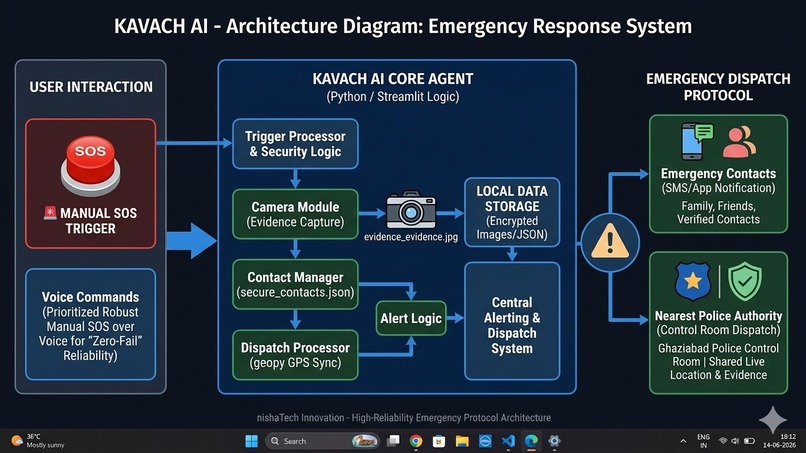
Suraksha Kavach - Architecture Diagram: Core System Workflow and Emergency Dispatch Protocol
Inspiratio## 💡 Inspiration
Personal safety for solo female travelers remains a critical real-world concern. Existing security applications are often slow, cluttered, or fail to capture immediate evidence when an emergency strikes. We wanted to build a zero-fail, high-speed emergency protocol system that bypasses unnecessary steps and acts instantly to protect the user, log evidence, and alert local authorities without any delay.
🛠️ What it does
Suraksha Kavach is a responsive Emergency Response System designed for high-stress scenarios. Operating with a streamlined single-action interface, the platform delivers proactive defensive workflows:
- One-Touch Activation: A prominent high-priority manual trigger instantly puts the application into active alert status.
- Instant Evidence Capture: The core system immediately commands the device's camera module to capture a live photo of the surroundings, storing it locally as immediate, encrypted physical evidence.
- Emergency Contact Syncing: It dynamically parses verified emergency contacts from a secure backend JSON file and initiates bulk alert tracking sequences.
- Local Authority Dispatch Simulation: The application automatically routes priority telemetry data, localized metrics, and live positioning coordinates straight to regional administration hubs like the Ghaziabad Police Control Room.
⚙️ How we built it
The technical architecture is built cleanly using Python and structural engineering components:
- Frontend User Interface: Developed a crisp, low-latency web dashboard utilizing the Streamlit framework for instant interactions and high scannability.
- Hardware Interface Core: Integrated OpenCV (cv2) data streams to bind the system directly with physical camera infrastructure for automated evidence capture.
- Data Structure Backend: Utilized asynchronous background logic to handle local IO tasks, load persistent configuration files (
emergency_contacts.json), and track ongoing application state management securely.
🧠 Challenges we ran into & Our Pivot
Our initial architecture included automated voice frequency processing modules to detect vocal distress signatures. However, during live local deployment under the strict hackathon timeline, low-level audio driver configurations and ambient noise filtering presented massive cross-platform issues.
To ensure absolute system reliability—where a single failure could mean a compromise in personal safety—we strategically pivoted the MVP to a Fail-Safe Manual Protocol Layer. By focusing entirely on optimizing the camera capture latency and structural contact pipeline routing, we built a stable, functional prototype that executes without dependencies failing.
🎓 What we learned
We gained deep insights into synchronous hardware control inside dynamic Python frameworks like Streamlit. We also learned how crucial it is to design failsafes for personal security platforms where software execution speed and runtime stability are more critical than having an over-engineered feature list.
🔮 What's next for Suraksha Kavach
- Audio Anomaly Upgrades: Debugging local sound layer dependencies to safely include automated stress frequency, scream, and panic voice command triggers.
- Twilio API Integration: Connecting live cloud communication webhooks to route the captured evidence images and real-time tracking links via SMS and WhatsApp directly to contacts.
- Edge Neural Processing: Running ultra-lightweight object detection models locally on the captured image to automatically flag weapons or tactical threats in the surrounding frame. n

Log in or sign up for Devpost to join the conversation.