-
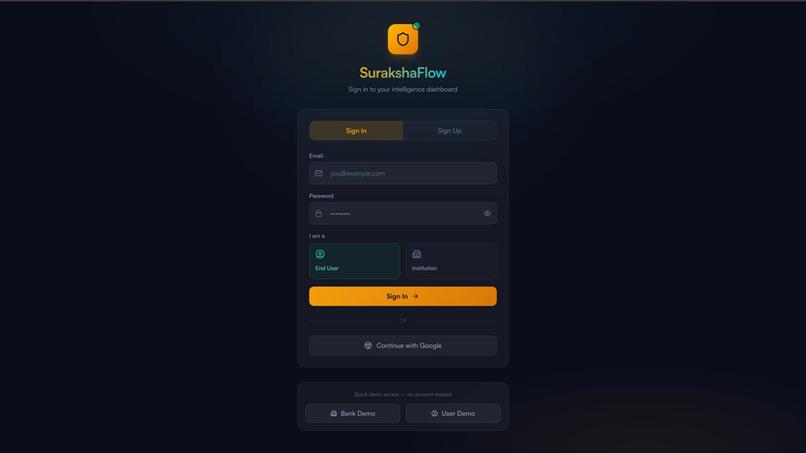
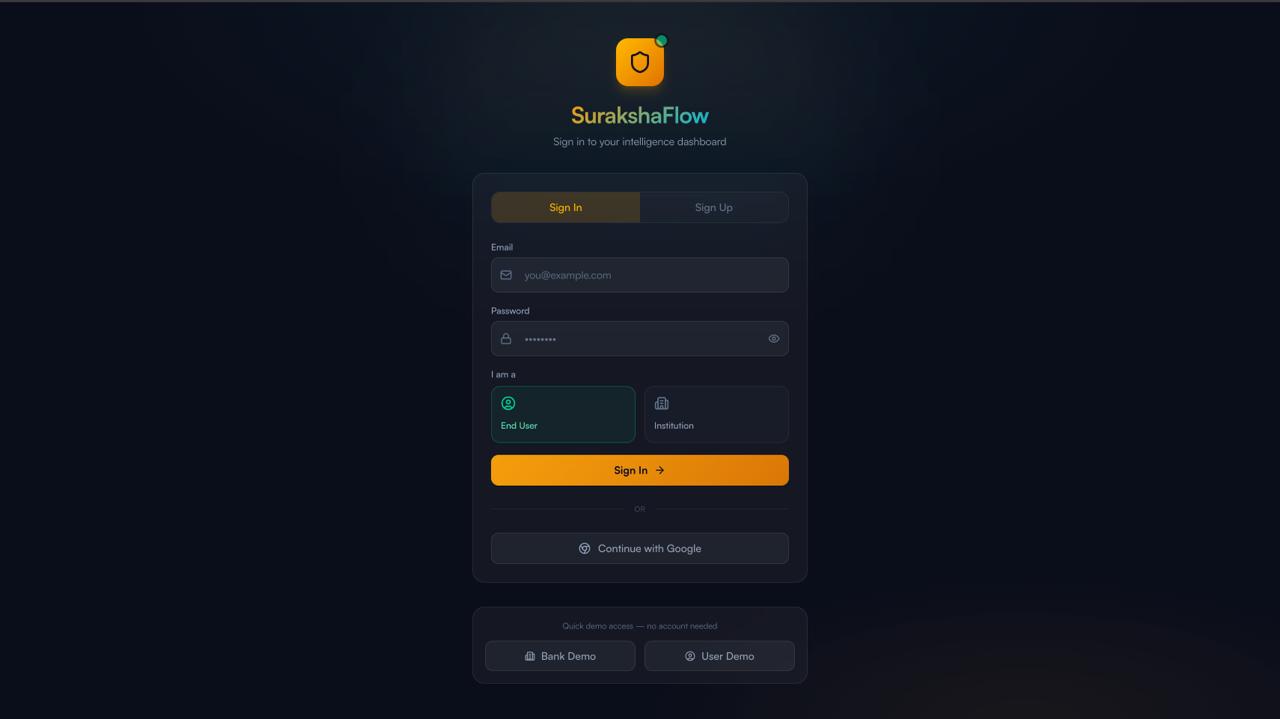
authentication
-
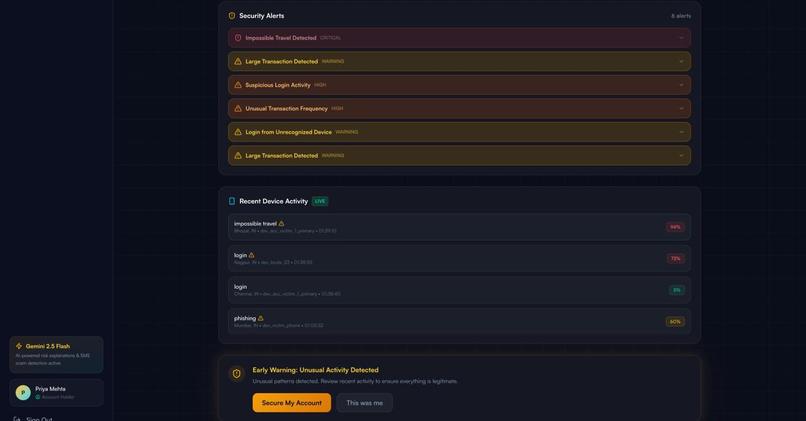
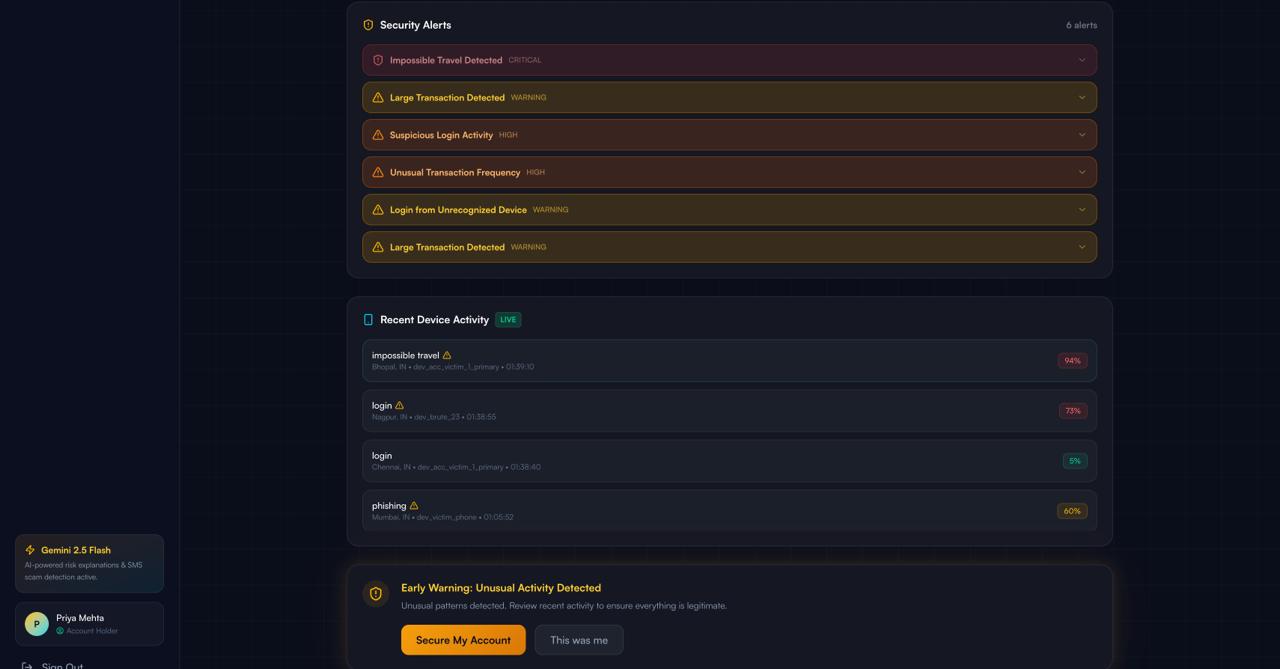
user-dashboard_3
-
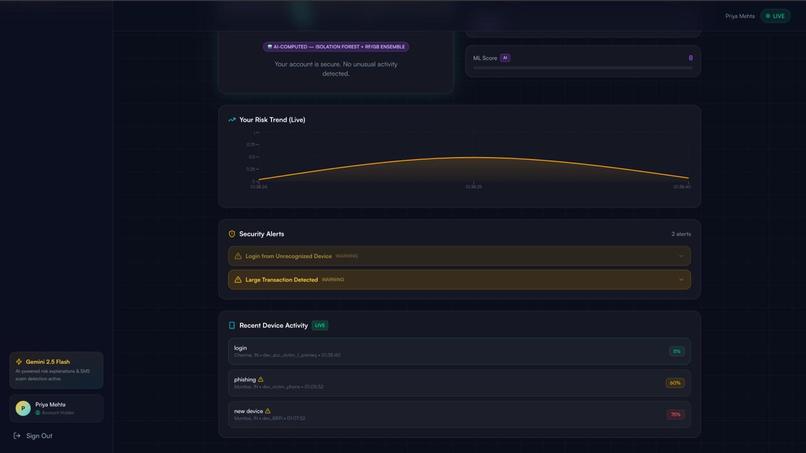
user-dashboard_2
-
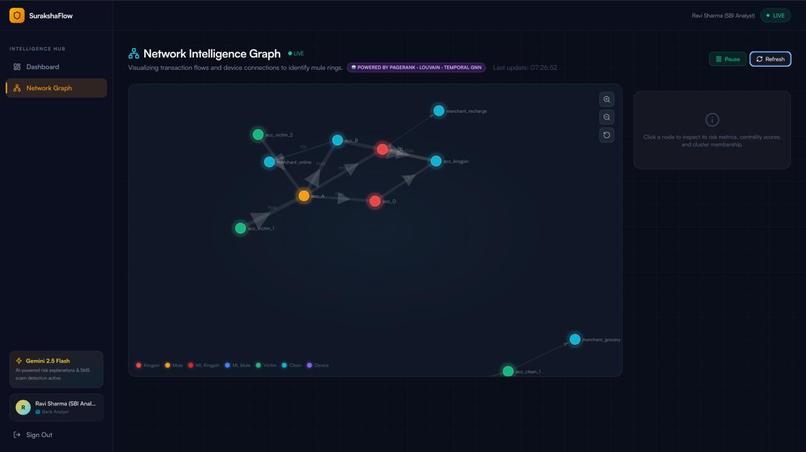
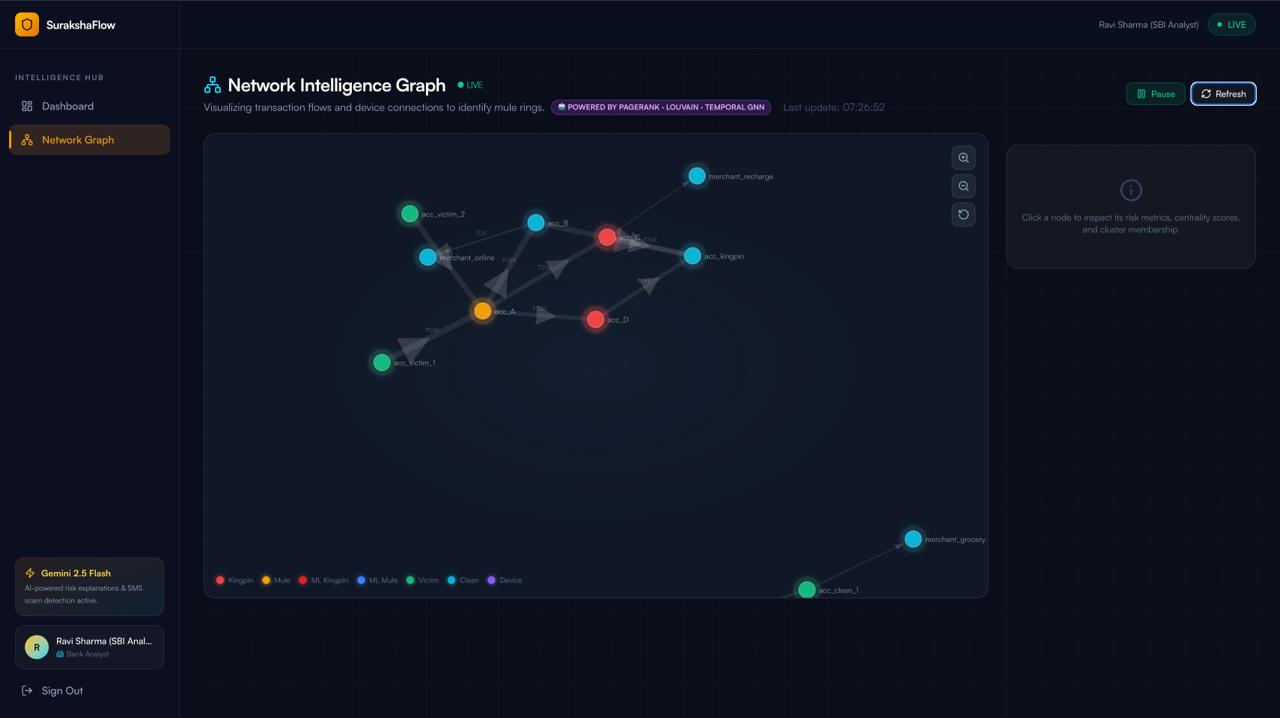
institution-network-page
-
institution-dashbord-page
-
institution-dashbord-page_2
-
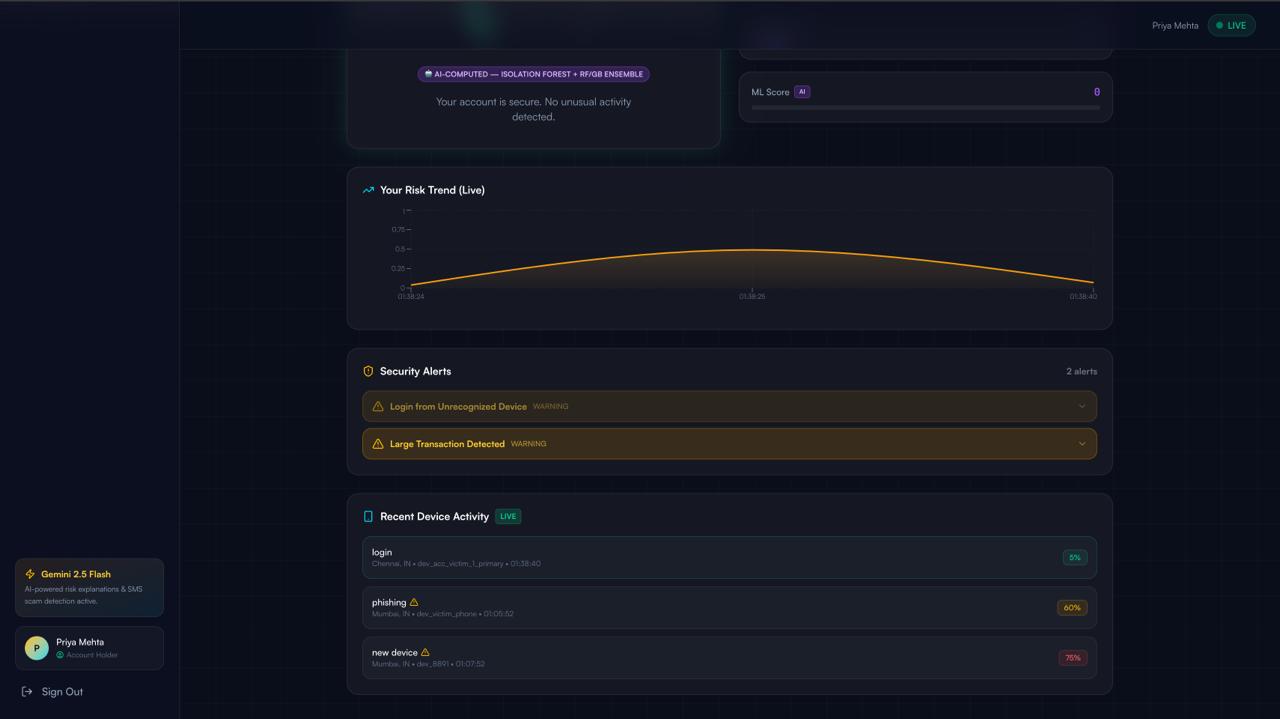
user-dashboard
-
database-setup
SurakshaFlow — Project Story
About the Project
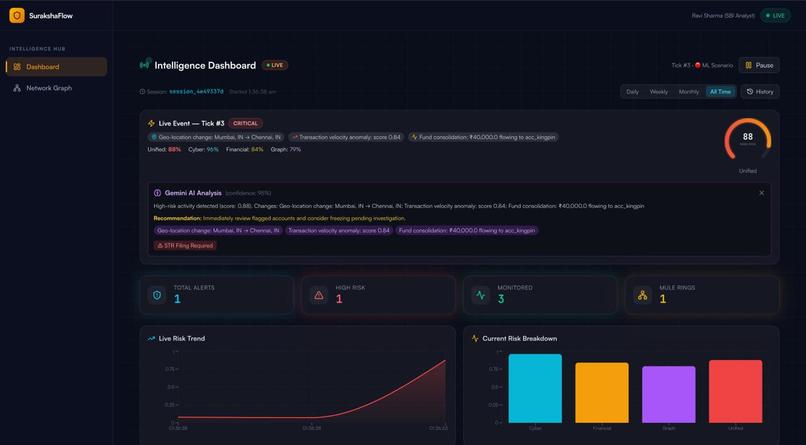
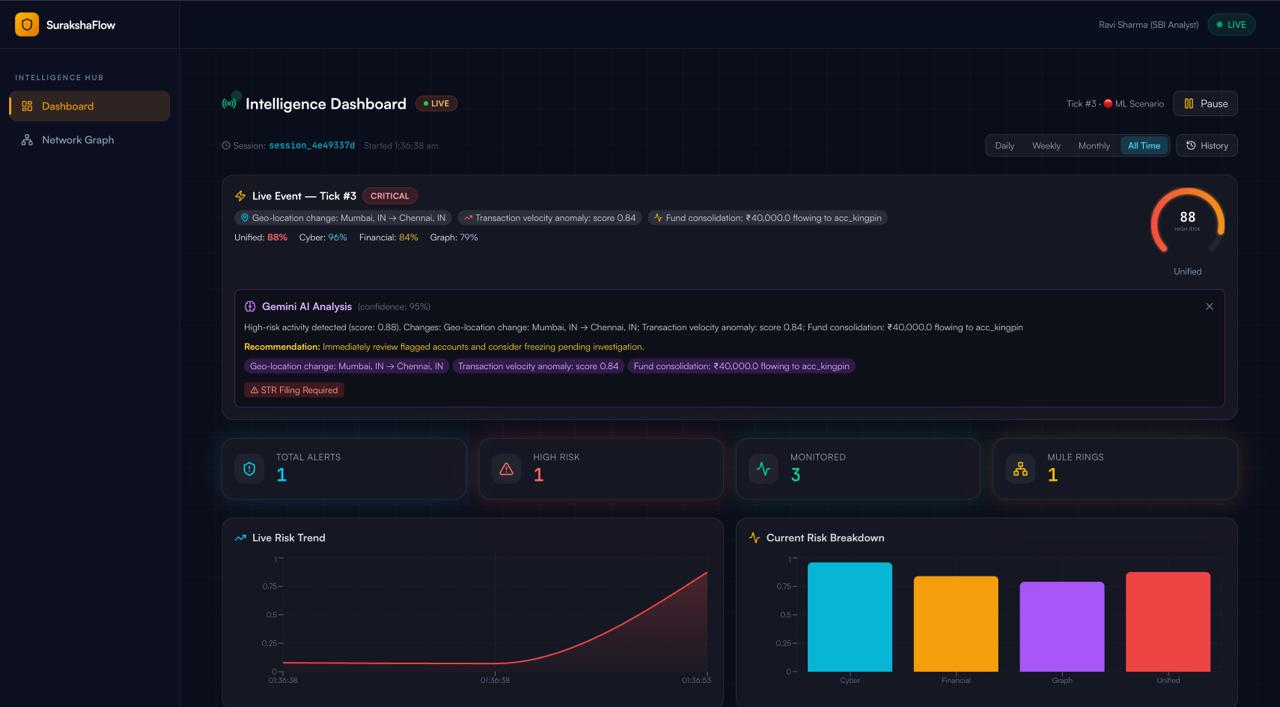
SurakshaFlow is a real-time intelligence platform that fuses Security Operations Center (SOC) signals with Anti-Money Laundering (AML) monitoring to detect and disrupt money mule networks and financial scams. The name "SurakshaFlow" combines the Hindi word "Suraksha" (security) with "Flow" (representing transaction flows), embodying our mission to secure financial transactions through intelligent monitoring.
What Inspired Us
The inspiration came from the alarming rise in digital financial fraud in India and globally. With the rapid adoption of UPI, digital wallets, and online banking, cybercriminals have evolved sophisticated money mule networks that exploit the gap between traditional cybersecurity monitoring and financial fraud detection systems.
Key Motivating Factors
Fragmented detection systems: Banks typically monitor financial transactions separately from cyber signals (logins, device fingerprints, IP geolocation), missing the correlation that reveals mule networks
Delayed response times: Traditional fraud detection often acts post-facto, after funds have already been laundered through multiple accounts
Lack of explainability: Compliance officers receive alerts without clear explanations, leading to investigation delays
The human cost: Behind every fraud statistic are real victims—elderly individuals scammed out of life savings, small business owners deceived by phishing attacks
What We Learned
Building SurakshaFlow taught us invaluable lessons across multiple domains:
1. Graph Theory & Network Analysis
- How to model financial transactions as directed graphs using NetworkX
- Applying centrality metrics (PageRank, betweenness, degree centrality) to identify key nodes in mule networks
- Community detection using the Louvain algorithm to uncover organized fraud rings
2. Machine Learning for Fraud Detection
- Feature engineering for temporal graph data (extracting 20+ node-level features)
- Training gradient boosting classifiers on synthetic graph topologies (star graphs for kingpins, chain structures for mules)
- The challenge of achieving realistic accuracy—intentionally adding label noise (~3%) to avoid overfitting
3. Multi-Modal Risk Scoring
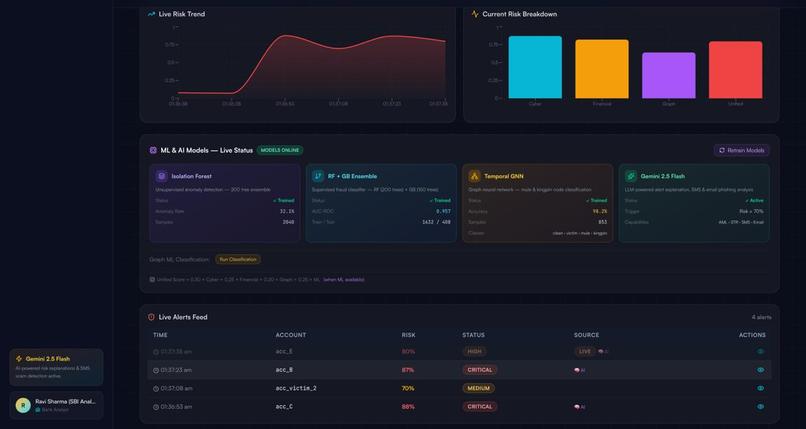
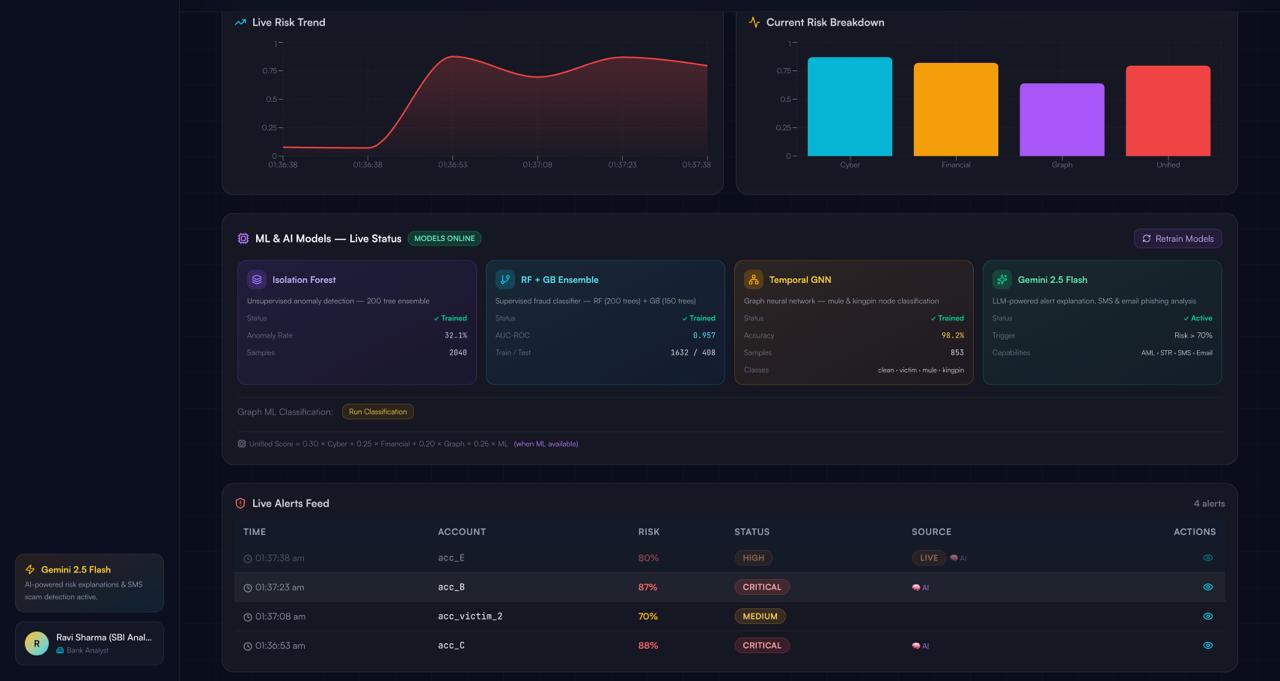
$$\text{Unified Score} = 0.30 \times \text{Cyber} + 0.25 \times \text{Financial} + 0.20 \times \text{Graph} + 0.25 \times \text{ML}$$
This weighted fusion formula balances traditional rule-based scoring with modern ML predictions.
4. Explainable AI
- Prompt engineering for Gemini AI to generate actionable compliance explanations
- Building fallback rule-based systems when AI APIs are unavailable
- Rate limiting strategies (5 calls/minute) to manage API quotas
5. Real-Time Systems
- Implementing live simulation with 5-second polling intervals
- Managing in-memory state for dynamic graph updates
- Structured logging with timing metrics for all API calls
How We Built the Project
Architecture Overview
┌─────────────────┐       /api proxy        ┌──────────────────┐
│  React Frontend │ ──────────────────────── │  FastAPI Backend  │
│  localhost:3000  │                          │  localhost:8000   │
└─────────────────┘                          └──────────────────┘
        │                                            │
        │                                   ┌────────┴────────┐
        │                                   │  Risk Engines   │
        ▼                                   │  • Cyber        │
   Firebase Auth                            │  • Financial    │
   Firebase Firestore                       │  • Graph (NX)   │
   Gemini AI (client)                       │  • Unified      │
                                            └─────────────────┘
Development Journey
Phase 1: Foundation (Backend Core)
- Set up FastAPI with structured logging middleware
- Built the data generator with realistic attack chain scenarios
- Implemented the three risk engines:
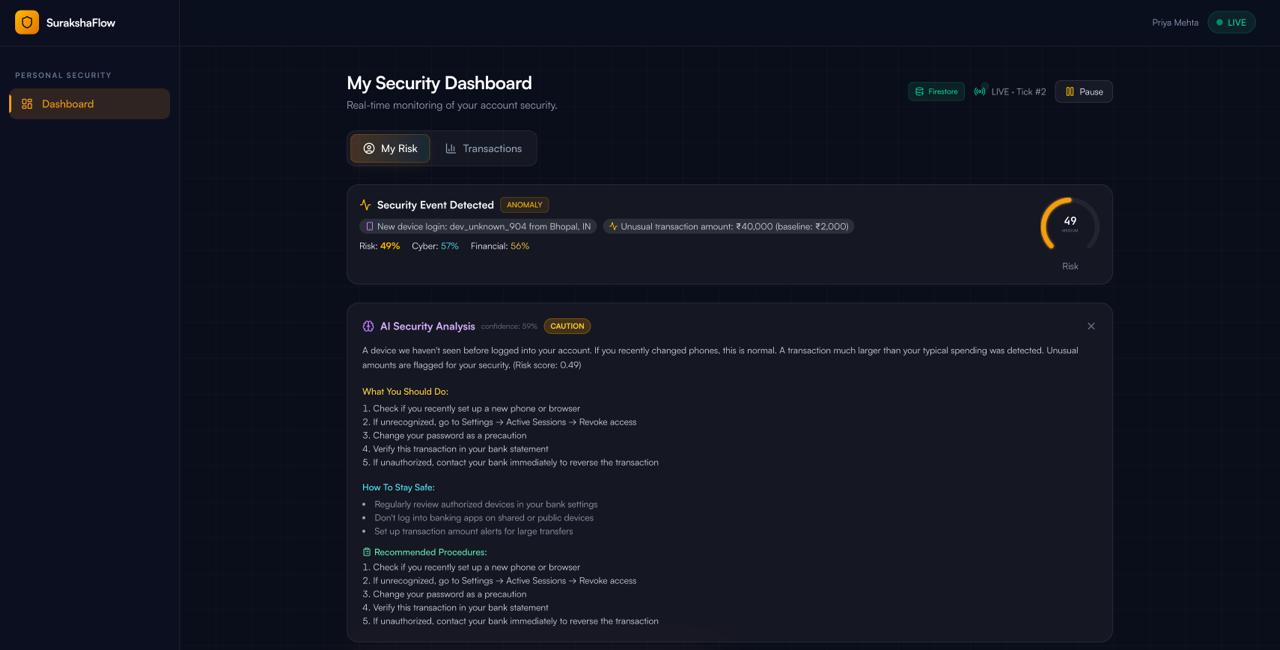
- Cyber Engine: Detects impossible travel, phishing, new device logins, device reuse across accounts
- Financial Engine: Flags rapid layering, high-velocity transactions, circular fund flows
- Graph Engine: Constructs transaction graphs, labels nodes (victim/mule/kingpin), computes risk scores
Phase 2: ML Integration
- Created
TemporalGraphFeatureExtractorwith 20 features per node - Generated synthetic training data simulating different fraud topologies
- Built
TemporalGNNClassifierusing Gradient Boosting as a practical GNN equivalent - Implemented incremental retraining with graph hash-based deduplication
Phase 3: Frontend Development
- React 19 with TypeScript for type safety
- Tailwind CSS 4 for the dark-themed cyber-aesthetic UI
- D3.js for interactive network graph visualization
- Recharts for risk trend visualization
- Real-time simulation hook polling every 5 seconds
Phase 4: AI & Explainability
- Gemini AI integration for natural language explanations
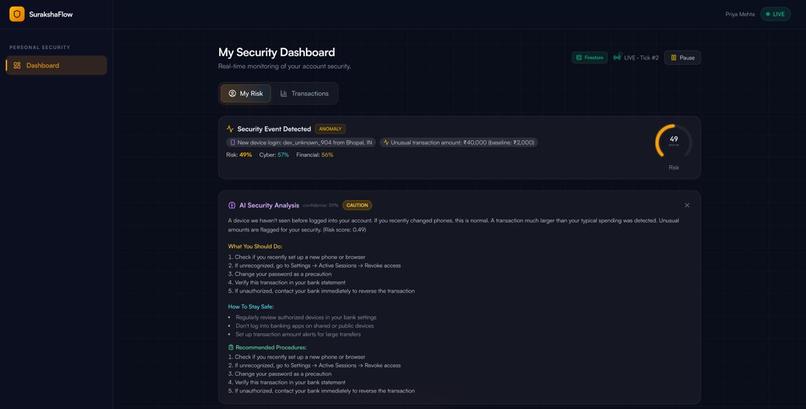
- SMS scam detection for end-user protection
- Email phishing analysis with urgency detection, link analysis, and impersonation patterns
- STR (Suspicious Transaction Report) PDF generation using fpdf2
Phase 5: Digital Twin Simulation
- "What-if" freeze scenarios to find optimal intervention points
- BFS-based downstream exposure calculation
- Prevention metrics showing money saved by SurakshaFlow
Challenges We Faced
1. Balancing ML Complexity with Practicality
| Aspect | Description |
|---|---|
| Initial Plan | Full PyTorch Geometric GNN with message passing |
| Reality | Heavy dependencies, complex deployment |
| Solution | Graph-aware classifier using NetworkX features + sklearn GradientBoosting—equivalent detection with simpler deployment |
2. Achieving Realistic Model Accuracy
| Aspect | Description |
|---|---|
| Problem | Synthetic data produced near-perfect training accuracy (>99%) |
| Solution | Added Gaussian noise (5% scale) and flipped ~3% of labels to simulate real-world uncertainty |
| Result | Honest test accuracy of ~85-92% |
3. Managing Gemini API Rate Limits
| Aspect | Description |
|---|---|
| Constraint | 5 calls per minute on free tier |
| Solutions | • Implemented sliding window rate limiter • Cached explanations by SHA-256 hash of prompt • Built comprehensive rule-based fallbacks |
4. Dynamic Graph Updates
| Aspect | Description |
|---|---|
| Challenge | Rebuilding the transaction graph on every live event without performance degradation |
| Solution | Bounded transaction lists (keep last 400), hash-based deduplication for retraining |
5. Type Safety Across Full Stack
| Aspect | Description |
|---|---|
| Challenge | Maintaining consistent types between Python backend and TypeScript frontend |
| Solution | Pydantic models with model_dump(mode="json") for serialization, mirrored TypeScript interfaces |
6. Firebase Configuration Graceful Degradation
| Aspect | Description |
|---|---|
| Challenge | Application should work in demo mode without Firebase credentials |
| Solution | Demo-mode fallback with generated profiles, conditional Firebase initialization |
Key Technical Achievements
| Component | Technology | Innovation |
|---|---|---|
| Graph Analysis | NetworkX + Louvain | Automatic mule/kingpin labeling via structural heuristics |
| ML Classifier | sklearn GradientBoosting | 20-feature node embedding with synthetic augmentation |
| Unified Scoring | Custom weighted fusion | Dynamic ML weight adjustment (25% when available) |
| Live Simulation | 5-second polling | Real-time dashboard updates with ML/non-ML scenarios |
| Explainability | Gemini 2.5 Flash Lite | JSON-structured AI explanations with confidence scores |
| STR Generation | fpdf2 | Auto-generated compliance reports with risk breakdowns |
Technologies Used
Languages
- TypeScript — Frontend application logic
- Python — Backend API and ML models
Frontend Frameworks & Libraries
- React 19 — UI component framework
- React Router DOM 7 — Client-side routing
- Tailwind CSS 4 — Utility-first styling
- Lucide Icons — Icon library
- Motion — Animation library
- D3.js 7 — Network graph visualization
- Recharts 3 — Charts and data visualization
Backend Frameworks
- FastAPI — REST API framework
- Uvicorn — ASGI server
Database & Cloud Services
- Firebase Authentication — User authentication
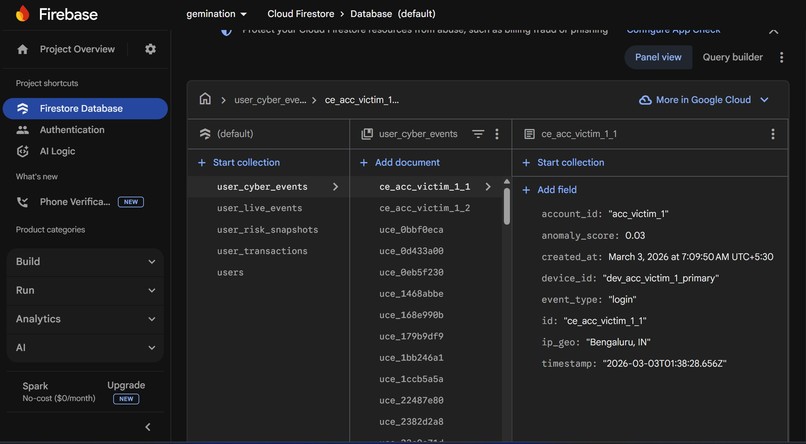
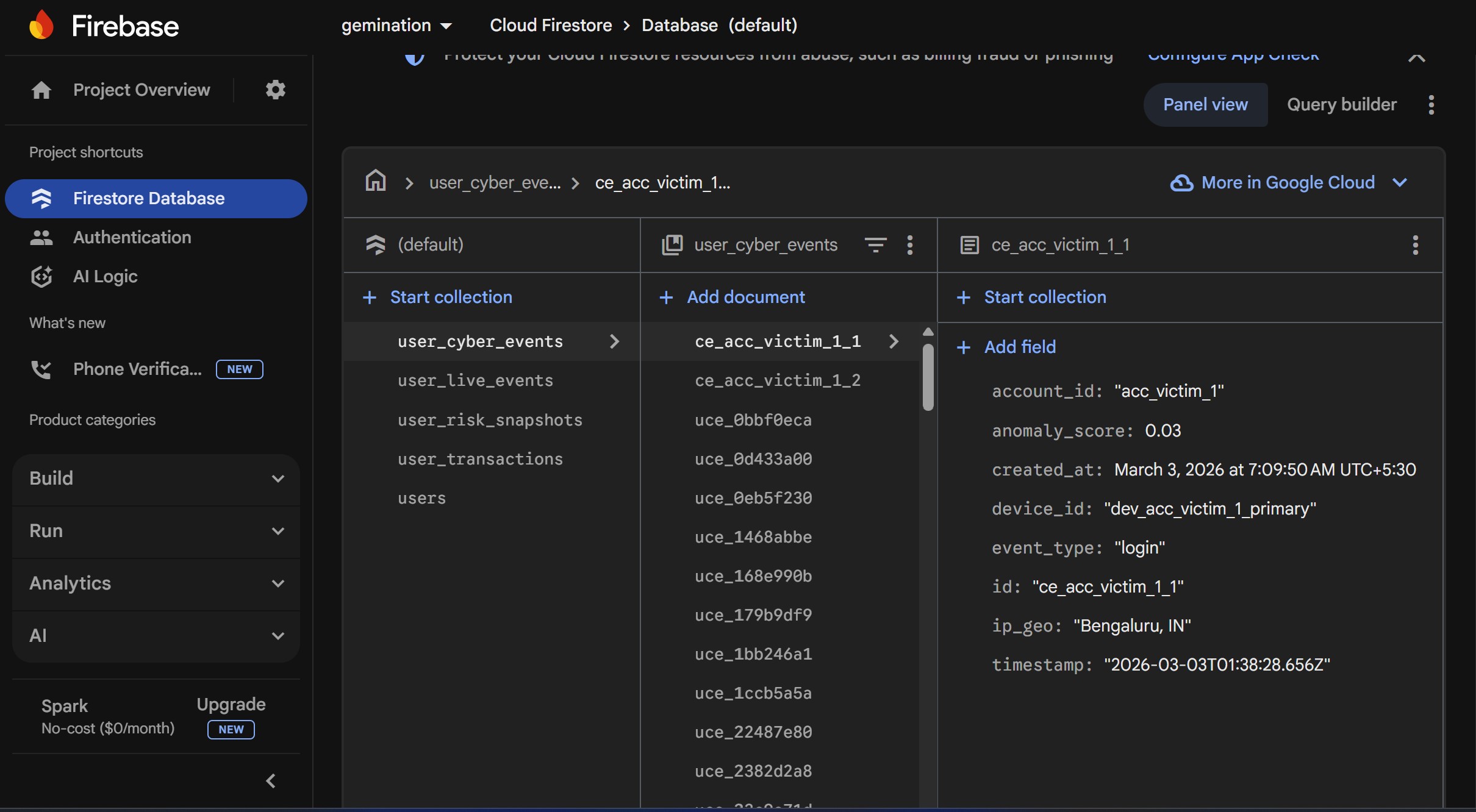
- Firebase Firestore — NoSQL database
- Firebase Storage — File storage
AI & Machine Learning
- Google Gemini API (gemini-2.5-flash-lite) — Explainable AI, SMS/email scam detection
- scikit-learn — GradientBoostingClassifier, StandardScaler
- NetworkX 3.4.2 — Graph construction and analysis
- python-louvain 0.16 — Community detection
Data Processing & Utilities
- NumPy 1.26.4 — Numerical computations
- Pydantic 2.10.4 — Data validation and serialization
- fpdf2 2.8.3 — PDF report generation
- httpx 0.28.1 — HTTP client
- python-dotenv 1.0.1 — Environment configuration
Build & Development Tools
- Vite 6 — Frontend build tool
- TypeScript 5.8 — Type safety
- @vitejs/plugin-react — React HMR
- @tailwindcss/vite — Tailwind integration
API Endpoints
| Method | Endpoint | Description |
|---|---|---|
GET |
/api/health |
Health check |
GET |
/api/dashboard/bank/summary |
Bank dashboard summary stats |
GET |
/api/dashboard/bank/alerts |
List alerts (filterable) |
GET |
/api/dashboard/bank/alert/{id} |
Single alert detail |
POST |
/api/dashboard/bank/alert/{id}/action |
Act on alert (freeze/monitor/escalate) |
GET |
/api/dashboard/user/{uid}/risk |
User risk score breakdown |
GET |
/api/dashboard/user/{uid}/events |
User cyber + financial events |
GET |
/api/graph/network |
Full transaction graph |
GET |
/api/graph/cluster/{id} |
Subgraph around account |
POST |
/api/gemini/explain |
AI explanation for alert |
POST |
/api/gemini/analyze-sms |
SMS scam detection |
POST |
/api/str/generate/{id} |
Generate STR report PDF |
GET |
/api/str/download/{id} |
Download STR report |
POST |
/api/simulation/digital-twin |
Run digital twin simulation |
POST |
/api/demo/seed |
Re-seed demo data |
POST |
/api/demo/run-scenario |
Load attack chain scenario |
Project Impact
SurakshaFlow demonstrates how unified cyber-financial intelligence can proactively detect and disrupt fraud networks before victims suffer irreversible losses. By combining graph analytics, machine learning, and explainable AI, we bridge the gap between traditional SOC monitoring and AML compliance—creating a platform that is both powerful and actionable for financial institutions.
Money saved by SurakshaFlow = Prevented loss through early detection + Optimal freeze target selection + Real-time intervention
Built with ❤️ for a safer digital financial ecosystem


Log in or sign up for Devpost to join the conversation.