-
-

Dataset
-

"""
SupportSync: AI-Powered Customer Support Orchestrator
Inspiration
The inspiration for SupportSync came from the need to streamline customer support in e-commerce, where users expect quick, accurate, and empathetic responses. I aimed to leverage Google Cloud’s AI and data tools to build a multi-agent system that automates query handling, inspired by real-world support systems like those in online retail. The Agent Development Kit Hackathon was the perfect opportunity to explore Google Cloud’s capabilities and create a scalable, AI-driven solution.
What it does
SupportSync is an AI-powered customer support orchestrator that processes user queries using a multi-agent architecture:
- Query Classification: Identifies if a query is about product info, order status, refunds, or other.
- Data Retrieval: Fetches product or order details from BigQuery using parameterized queries.
- Sentiment Analysis: Analyzes user sentiment (positive, neutral, negative) to tailor responses, offering discounts for negative queries.
- Orchestration: Coordinates sub-agents to deliver accurate, context-aware responses.
- UI: Provides a Streamlit interface for user interaction, designed for Cloud Run deployment.
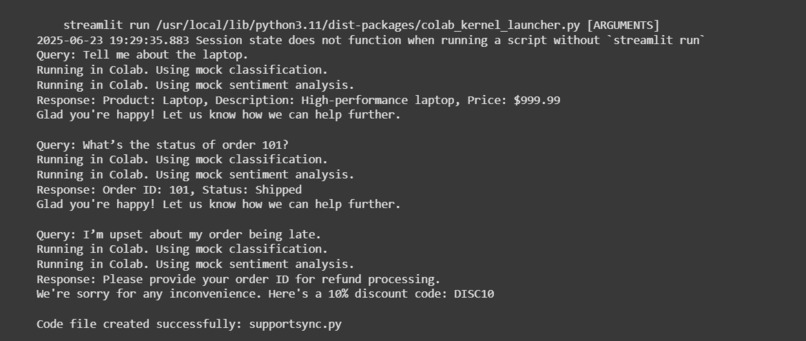
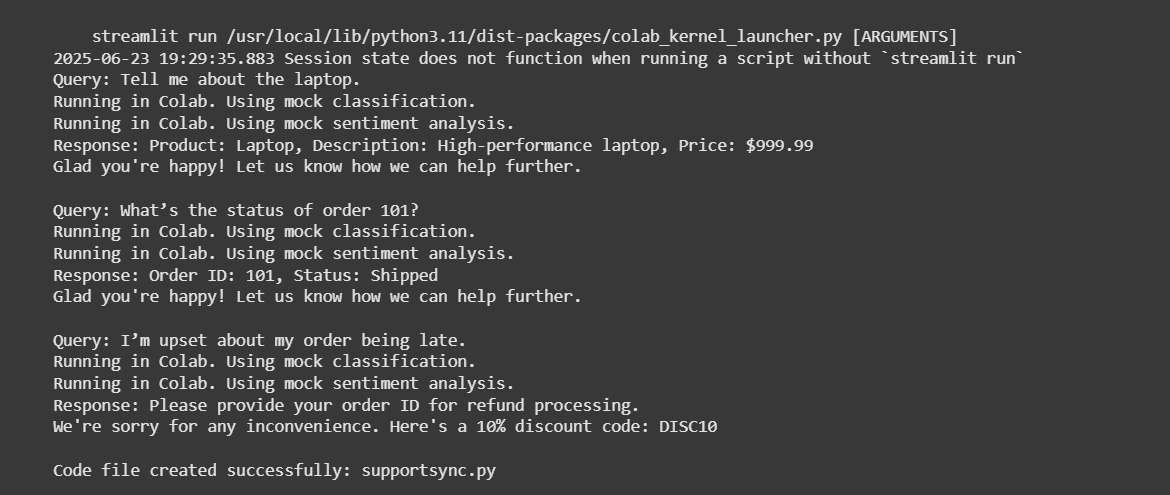
Users can ask questions like “Tell me about the laptop” or “What’s the status of order 101?”, and SupportSync responds with relevant details and sentiment-based messages (e.g., discounts for upset customers).
How we built it
SupportSync was built in Google Colab using Python and Google Cloud services:
- Tech Stack:
- Google Cloud BigQuery: Stores product and order data, queried using parameterized SQL for security and efficiency.
- Google Cloud Vertex AI: Planned for query classification and sentiment analysis, with mock logic as a fallback due to billing restrictions.
- Streamlit: Provides a web-based UI for user queries.
- Python Libraries:
google-cloud-aiplatform==1.58.0,google-cloud-bigquery==3.25.0,streamlit==1.36.0,requests==2.32.3.
- Architecture:
- Classifier Agent: Categorizes queries (e.g., product_info, order_status, refund).
- Product Expert Agent: Retrieves product details from BigQuery.
- Order Tracker Agent: Fetches order status using order IDs.
- Sentiment Analyzer Agent: Uses keyword-based mock logic to assess sentiment.
- Coordinator Agent: Orchestrates sub-agents and generates final responses.
- Development Process:
- Wrote and tested code in Colab, using mock responses to simulate Vertex AI.
- Pushed code to GitHub (
https://github.com/Tarunjit45/supportsync-hackathon) using a Personal Access Token. - Prepared a Dockerfile and
requirements.txtfor Cloud Run deployment, though blocked by billing. - Documented the project in
README.md.
Challenges we ran into
- Billing Restrictions: Encountered a
403 BILLING_DISABLEDerror (project202997942828orhelpful-binder-463805-e3) when enabling APIs (run.googleapis.com,artifactregistry.googleapis.com,cloudbuild.googleapis.com,containerregistry.googleapis.com) and deploying to Cloud Run. Contacted organizers with help tokens but couldn’t resolve in time. - Authentication Issues: Initial Git push failures due to Colab’s non-interactive environment required a GitHub PAT and careful Git configuration.
- Slow Execution: BigQuery queries and repeated client initialization caused delays in Colab, mitigated by using a global BigQuery client.
- Project Mismatch: Errors referenced project
202997942828instead ofhelpful-binder-463805-e3, requiring repeatedgcloudconfiguration. - Vertex AI Limitations: Billing restrictions forced reliance on mock classification and sentiment analysis, reducing AI capabilities.
Accomplishments that we're proud of
- Successfully built and tested a multi-agent system in Colab, handling diverse queries with accurate BigQuery retrievals.
- Pushed functional code to
https://github.com/Tarunjit45/supportsync-hackathon, includingsupportsync.pyandREADME.md. - Implemented robust mock logic for classification and sentiment analysis, ensuring functionality without Vertex AI.
- Created a deployable Streamlit app with
Dockerfileandrequirements.txt, ready for Cloud Run if billing is enabled. - Documented challenges (billing, authentication) transparently for the hackathon submission.
What we learned
- Google Cloud Integration: Gained hands-on experience with BigQuery for data retrieval and the Google Cloud SDK for authentication and deployment.
- Multi-Agent Systems: Learned to design and coordinate multiple agents for query processing and response generation.
- Colab Limitations: Understood Colab’s constraints (e.g., temporary environment, slow execution) and workarounds like global clients and PATs.
- Git in Colab: Mastered Git configuration and authentication in a non-interactive environment.
- Hackathon Resilience: Developed problem-solving skills under time pressure, especially for billing and authentication issues.
What’s next for SupportSync - AI-Powered Customer Support Orchestrator
- Enable Billing: Secure Google Cloud credits to deploy on Cloud Run and integrate Vertex AI for real-time AI capabilities.
- Enhance AI: Use Vertex AI’s full potential for advanced query classification and sentiment analysis.
- Expand Features: Add support for more query types (e.g., inventory checks, customer feedback) and multi-language support.
- Optimize Performance: Cache BigQuery results and optimize Streamlit for faster responses.
- Production Deployment: Deploy to Cloud Run or Kubernetes for a production-ready support system.
- User Testing: Validate with real users to refine the UI and response accuracy.
Repository
https://github.com/Tarunjit45/supportsync-hackathon
Notes
Deployment was blocked by billing restrictions (Error: FAILED_PRECONDITION: Billing account for project '202997942828' not found). Local functionality was verified in Colab with test queries and BigQuery integration. Help tokens were shared with organizers for resolution.
"""


Log in or sign up for Devpost to join the conversation.