Inspiration
Customer support systems are reactive by design. Engineers manually triage tickets, rely on memory to detect recurring patterns, and often miss early warning signals when the same issue affects multiple users.
We asked: What if triage behaved like an intelligent operations system instead of an inbox?
SupportSense AI was built to ground AI reasoning in real search data — using Elasticsearch as the intelligence backbone.
What it does
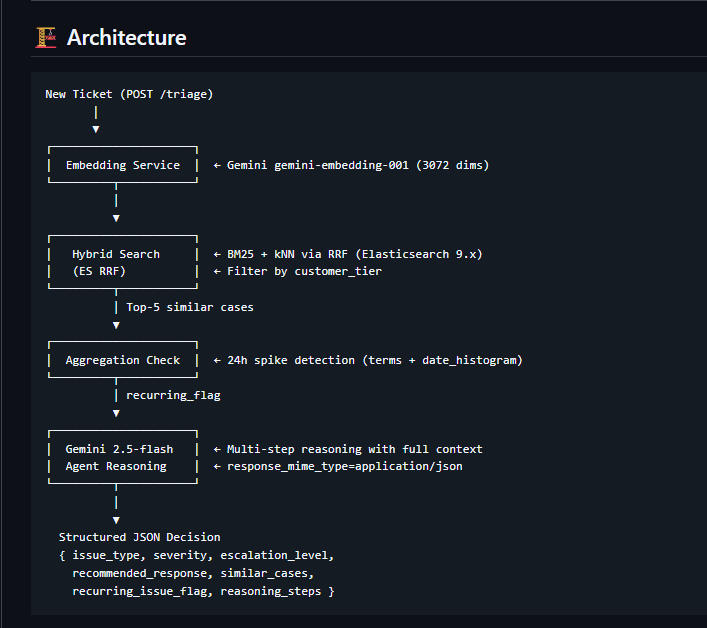
SupportSense AI is an AI-powered triage agent that automatically classifies, prioritizes, and routes incoming support tickets.
For every new ticket, the system:
- Performs hybrid search (BM25 + vector kNN)
- Retrieves top historical cases
- Detects issue spikes within a 24-hour window
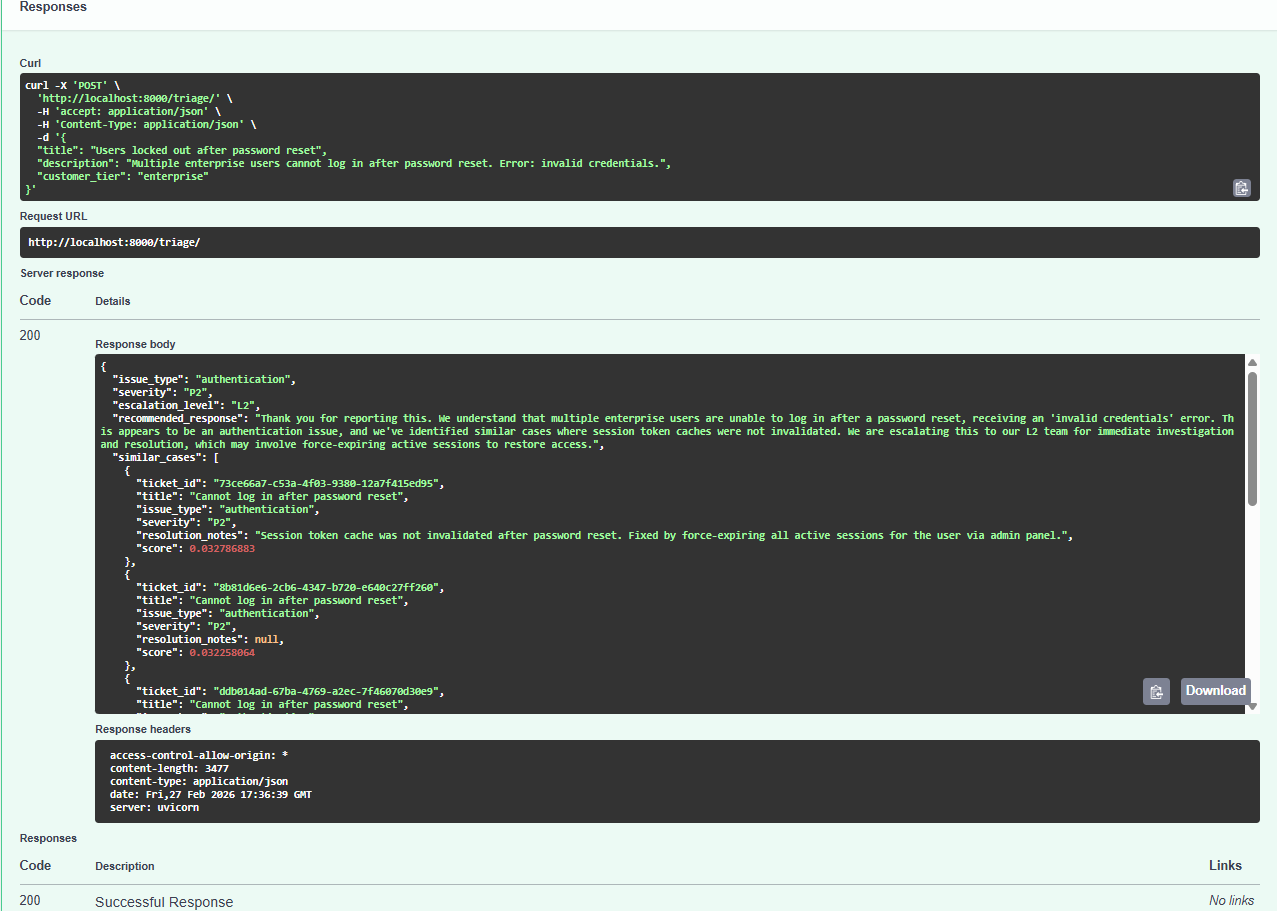
- Generates a structured decision:
- Issue type
- Severity (P1–P4)
- Escalation level
- Recommended response
- Recurring issue flag
- Full reasoning trace
This converts unstructured text into operational intelligence with a single API call.
How we built it
Hybrid Retrieval with RRF
We combine lexical and semantic relevance using Elasticsearch's native Reciprocal Rank Fusion (RRF).
For a document \(d\) across retrievers \(R\):
$$\text{RRF}(d) = \sum_{r \in R} \frac{1}{k + \text{rank}_r(d)}$$
where \(k\) is a rank constant (typically 60).
This allows documents that rank highly in both BM25 and kNN search to naturally surface without manual score normalization.
Vector Search
Tickets are embedded using gemini-embedding-001 (3072 dimensions) and indexed using HNSW with cosine similarity.
Trend Detection
A 24-hour filtered aggregation flags spikes when:
$$\text{count}(\text{issue_type}) \geq 3$$
This enables real-time recurring issue detection without external monitoring systems.
Agent Reasoning
Retrieved cases and trend signals are passed to Gemini 2.5 Flash in structured JSON mode (low temperature), producing deterministic triage decisions with an audit trail.
Challenges we ran into
- Embedding dimension mismatch between model output and index mapping
- Correct filter scoping inside RRF retrievers
- Handling embedding API rate limits during dataset seeding
- Enforcing strict JSON output from the LLM
Accomplishments that we're proud of
- True native hybrid search via Elasticsearch RRF
- Real-time spike detection powered entirely by aggregations
- A fully explainable reasoning pipeline with audit logs
- A production-style modular architecture delivered within hackathon constraints
What we learned
- Hybrid retrieval significantly outperforms standalone lexical or semantic search
- Grounding LLM reasoning in structured retrieval context dramatically improves reliability and explainability
- Elasticsearch 9.x can function as both a search engine and vector database — simplifying AI system design
What's next for SupportSense AI
- Asynchronous triage processing
- Resolution-quality weighted retrieval
- Cross-tier anomaly detection
- Real-time operational dashboard
SupportSense AI moves customer support from reactive workflows to proactive operational intelligence.
Built With
- elasticsearch
- fastapi
- google-gemini-(gemini-embedding-001
- hnsw
- pydantic
- python
- rrf
- uvicorn

Log in or sign up for Devpost to join the conversation.