-
-
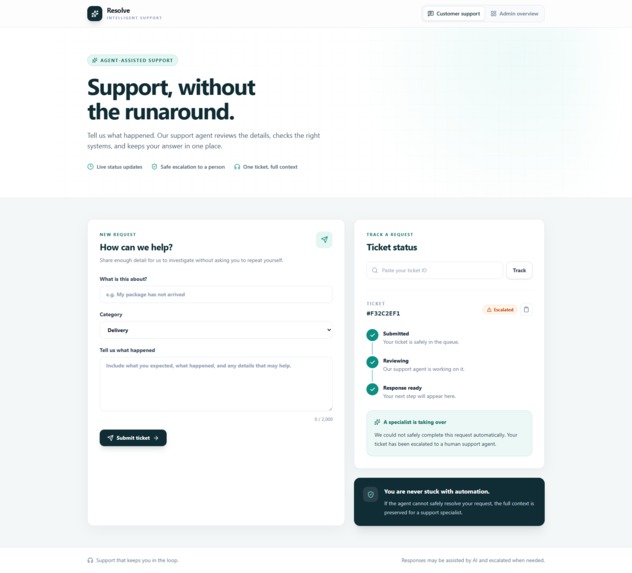
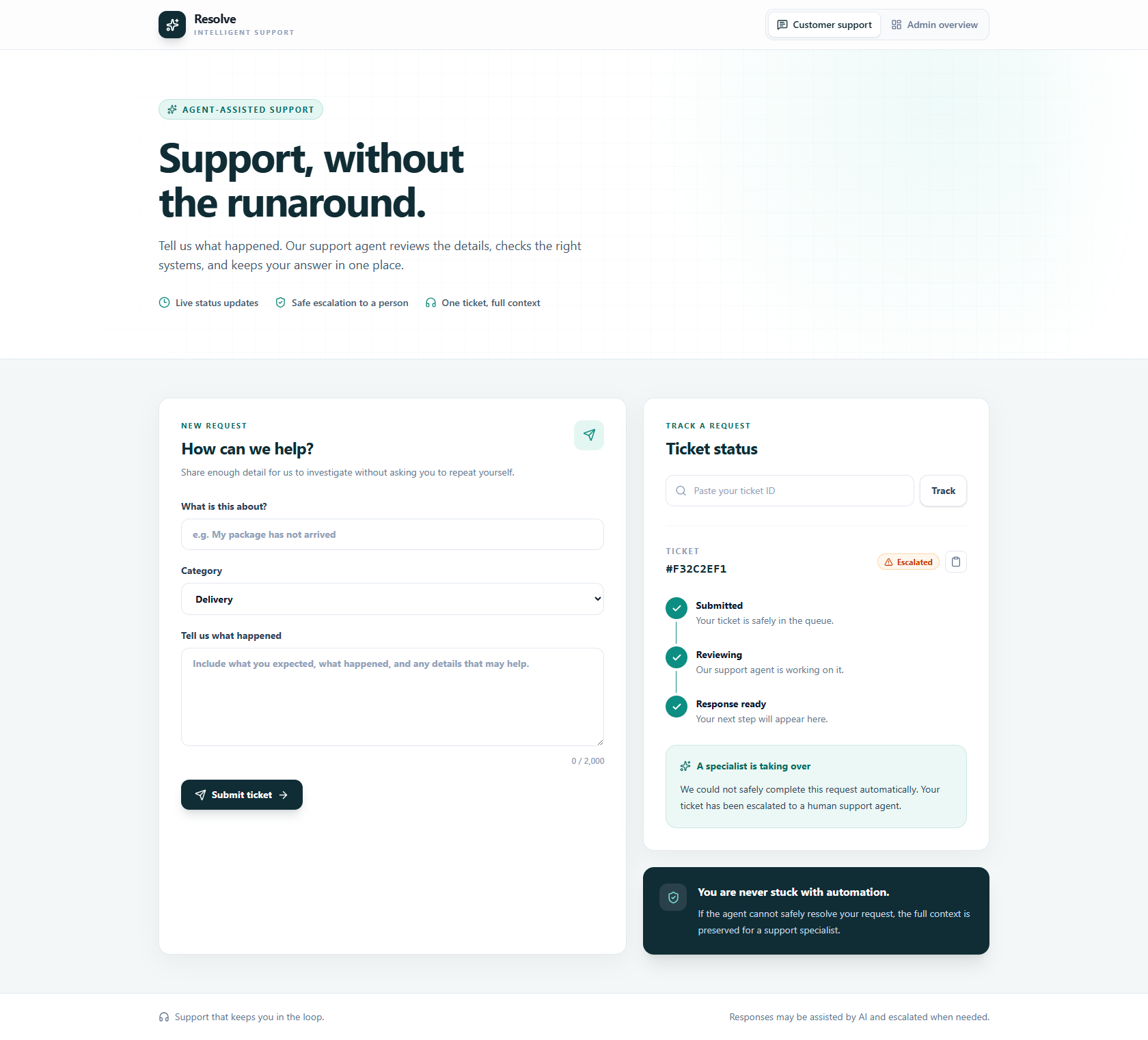
User submitted ticket
-
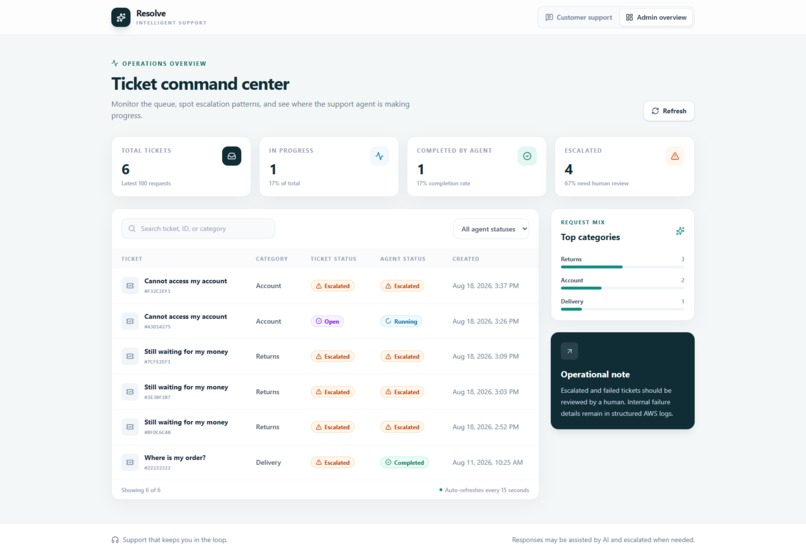
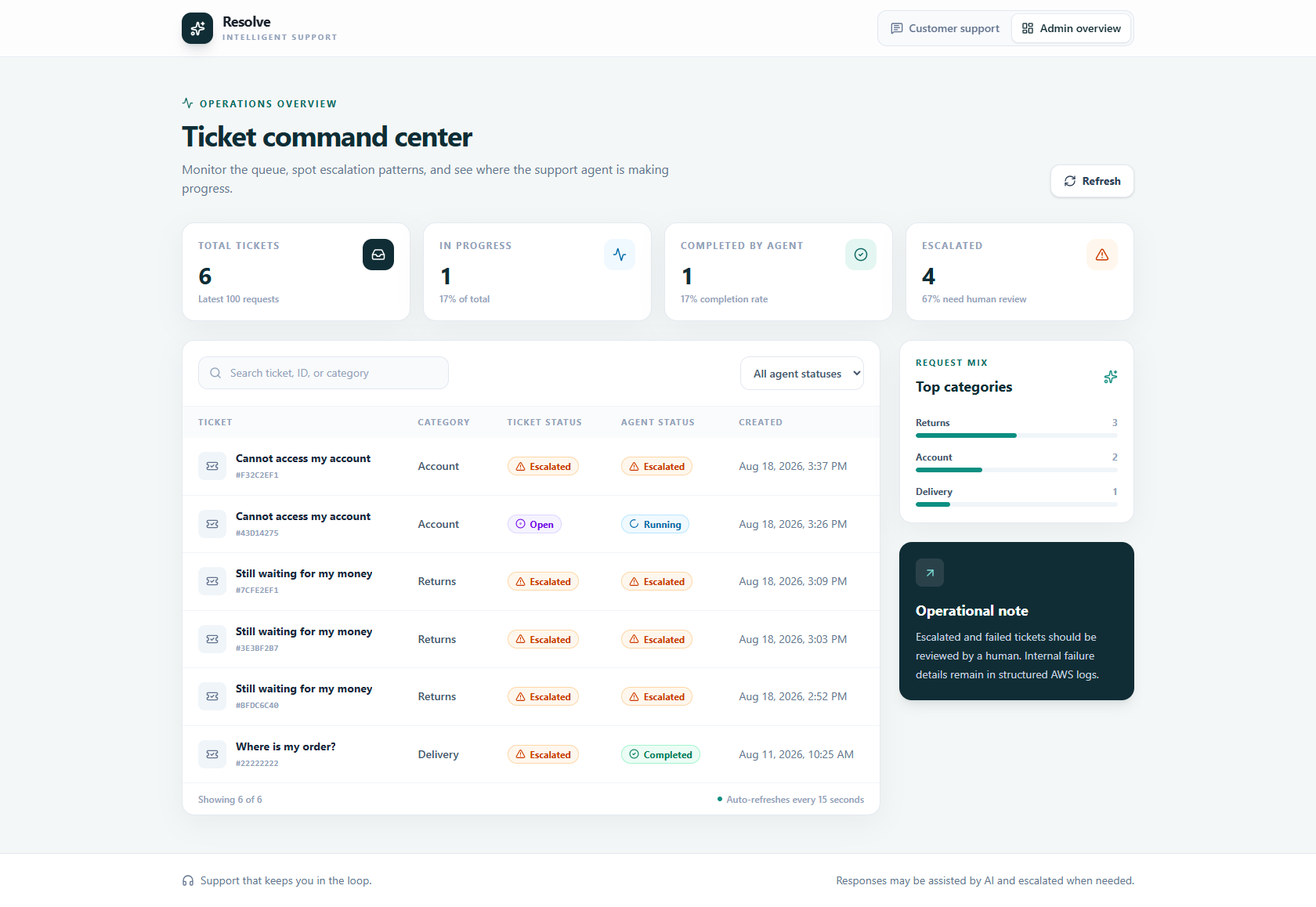
Admin panel with tickets logs
Inspiration
Customer support teams spend countless hours triaging repetitive tickets, searching documentation, assigning owners, and manually responding to common issues. While generative AI can answer questions, real support workflows require reasoning, context, and actions across multiple systems. We wanted to build an Agentic Ticket Support System where specialized AI agents collaborate like an experienced support team—understanding customer intent, retrieving knowledge, executing actions, and escalating to humans only when necessary.
What it does
The Agentic Ticket Support System automates the end-to-end support lifecycle.
- Accepts tickets from email, chat, Slack, Teams, or web portals.
- Understands customer intent and extracts key information.
- Classifies tickets by category, product, and severity.
- Prioritizes requests based on SLA and business impact.
- Searches internal documentation, runbooks, and historical tickets using Retrieval-Augmented Generation (RAG).
- Executes actions such as creating Jira issues, updating ServiceNow tickets, checking CRM information, or calling internal APIs.
- Generates personalized customer responses.
- Escalates complex cases to human agents with an AI-generated investigation summary and recommended next steps.
The result is faster response times, higher first-contact resolution rates, and reduced workload for support engineers.
How we built it
Our solution follows a multi-agent architecture coordinated by an orchestration layer.
Core AI Components:
- Orchestrator Agent for planning and coordination
- Intent Detection Agent
- Classification & Routing Agent
- Priority/SLA Agent
- Knowledge Retrieval Agent (RAG)
- Resolution Agent
- Tool Execution Agent
- Human Escalation Agent
- Response Generation Agent
Technology Stack:
- Frontend: React + Next.js
- Backend: Lambda Functions (Steps flow)
- LLM: OpenAI GPT-5.5
- Database: cockroachdb
- Workflow Orchestration: Strands
- Observability: CloudWatch
- Deployment: AWS lambda + AWS amplify
The agents communicate through structured workflows, share conversation memory, and use tool calling to interact with enterprise systems securely
Challenges we ran into
- Designing reliable orchestration between multiple AI agents without creating unnecessary loops.
- Reducing hallucinations by grounding every response with enterprise knowledge and previous ticket history.
- Balancing automation with human oversight to maintain customer trust.
- Integrating diverse enterprise systems that expose different APIs and authentication mechanisms.
- Maintaining context across long, multi-turn support conversations.
- Ensuring responses remain consistent while keeping latency low.
Accomplishments that we're proud of
- Built a modular multi-agent architecture that can easily support new domains and workflows.
- Automated the complete support lifecycle instead of limiting AI to chat responses.
- Enabled seamless integration with enterprise tools through a unified Tool Execution Agent.
- Implemented intelligent human escalation with AI-generated summaries, reducing engineer onboarding time.
- Created an extensible platform where new specialized agents can be added with minimal changes.
What we learned
- Specialized AI agents consistently outperform a single monolithic prompt for complex workflows.
- High-quality enterprise knowledge is more valuable than simply using a larger language model.
- Human-in-the-loop remains essential for high-impact decisions and exceptional customer experiences.
- Tool integrations are just as important as language understanding in real-world enterprise AI applications.
- Observability, evaluation, and prompt versioning are critical for operating AI systems in production.
What's next for Agentic Ticket Support System
We're planning to evolve the platform into an autonomous enterprise support ecosystem by adding:
- Predictive issue detection before customers submit tickets.
- Voice support agents for call centers.
- Root cause analysis using infrastructure logs and monitoring data.
- Automated remediation for common incidents.
- Customer sentiment analysis and proactive outreach.
- Continuous learning from resolved tickets and human feedback.
- Multi-modal support for screenshots, PDFs, and screen recordings.
- Role-specific agents for IT, HR, Finance, and Customer Success.
- Enterprise analytics dashboards for SLA compliance, agent performance, and AI effectiveness.
- Support for Model Context Protocol (MCP) servers to dynamically connect with enterprise tools and knowledge sources without custom integrations.
Ultimately, our vision is an AI-powered support platform where autonomous agents collaborate with human experts, resolving routine issues independently while empowering support teams to focus on the problems that require creativity, judgment, and empathy.
Built With
- amazon-web-services
- cockroachdb
- react

Log in or sign up for Devpost to join the conversation.