Inspiration
Every enterprise support team faces the same coordination nightmare: a customer opens a ticket that touches Returns, Finance, Legal, and needs an SLA escalation — and nobody coordinates between departments. Tickets bounce. Legal gets looped in too late. SLA breaches happen before anyone notices. We built this at Cato Networks to show what genuinely fixing all of that looks like in a single governed case.
What it does
Customer Support Case Management is a Maestro Case-powered system that handles every inbound customer request — hardware returns, access issues, product bugs, POP outages, RFEs — in one governed case with a full audit trail.
The case activates departments automatically based on what the ticket actually needs:
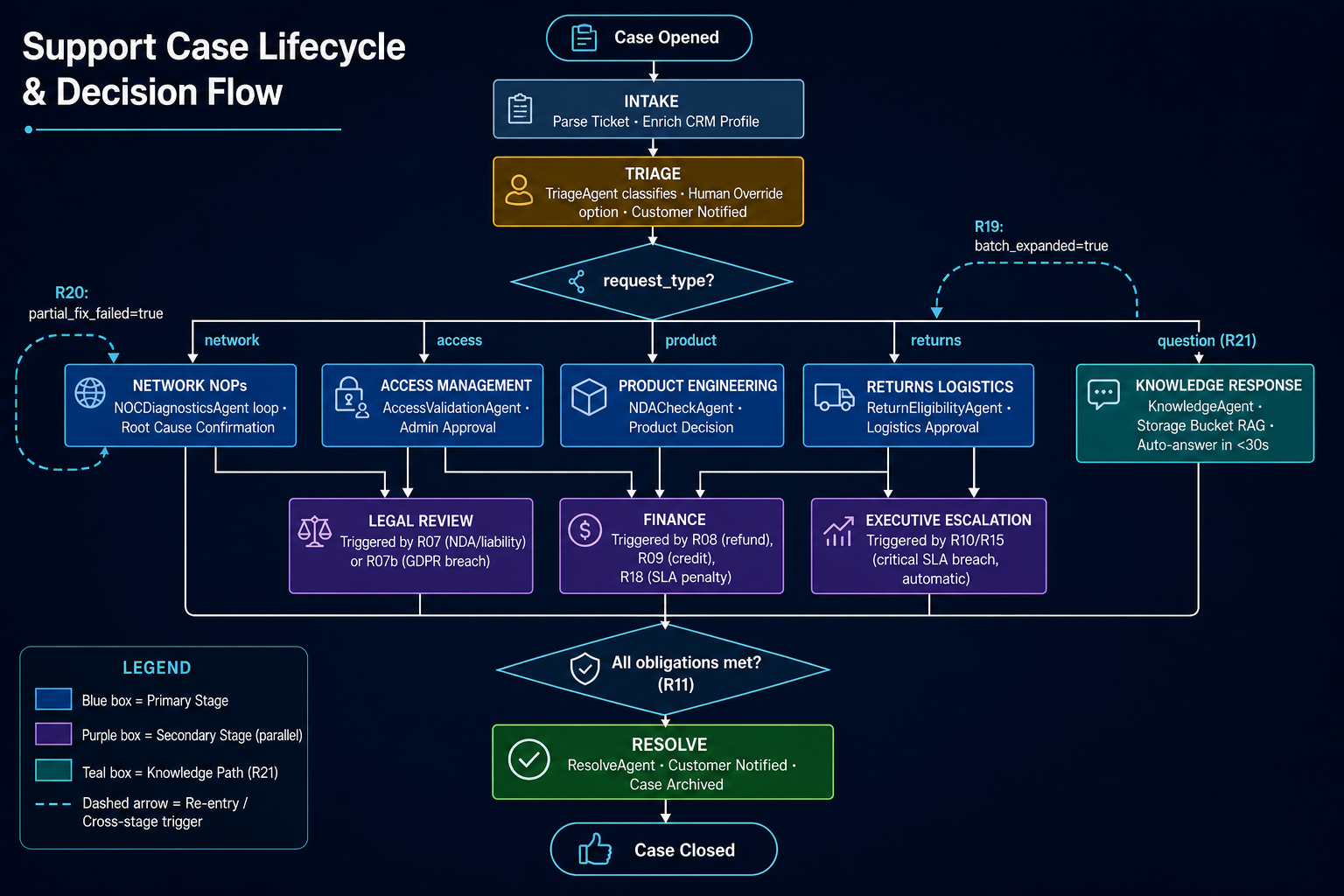
Returns + Finance run in parallel — no waiting for Finance to "come back around" Legal fires mid-case the moment any stage sets needs_legal=true — contract clause, NDA risk, elevated privilege — regardless of which department triggered it SLA breach auto-fires Executive escalation — VP Customer Success gets full case context in under 5 minutes with zero human trigger Stage re-entry — when Finance approves a refund, the Returns stage re-opens to ship the replacement without creating a new case
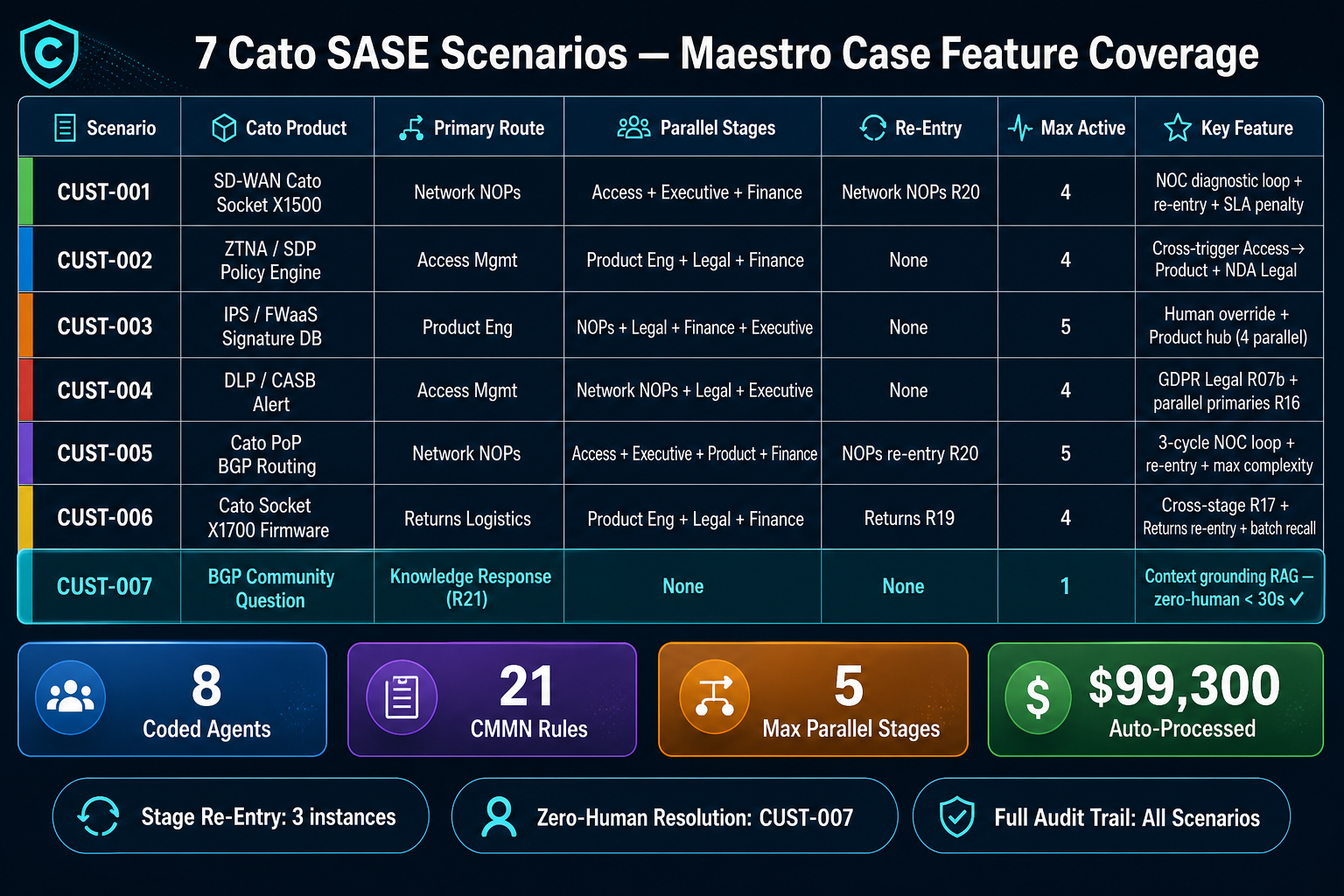
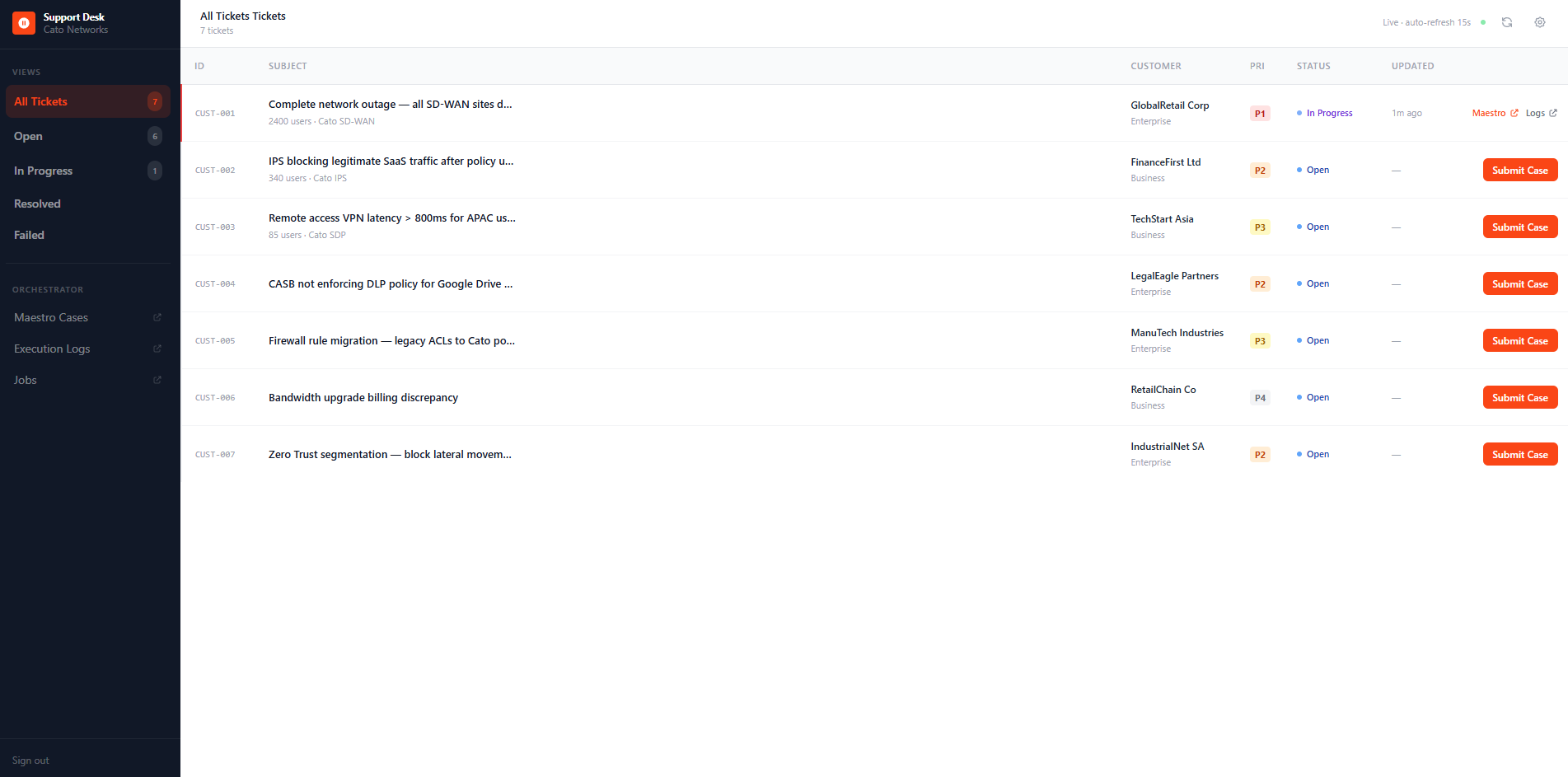
4 demo tickets show 4 completely different paths through the same case plan:
CUST-001 — Defective hardware return → Returns + Finance (parallel) + Legal (mid-case ad-hoc) + stage re-entry on Finance clearance CUST-002 — Enterprise tenant locked out post-migration → Access + NOPs (two primary stages simultaneously) + Legal blocking then unblocking Access CUST-003 — RFE that's actually a bug → TriageAgent low confidence → CS human override → NDA check fires Legal via R-09 → Product resumes after Legal clears CUST-004 — P1 POP outage, 3 Enterprise tenants → SLA breach auto-activates Executive → NOC resolves → Finance auto-calculates $9,000 in SLA credits for 3 tenants → Case App shows 3 stages active simultaneously
How we built it
Maestro Case (Studio Web):
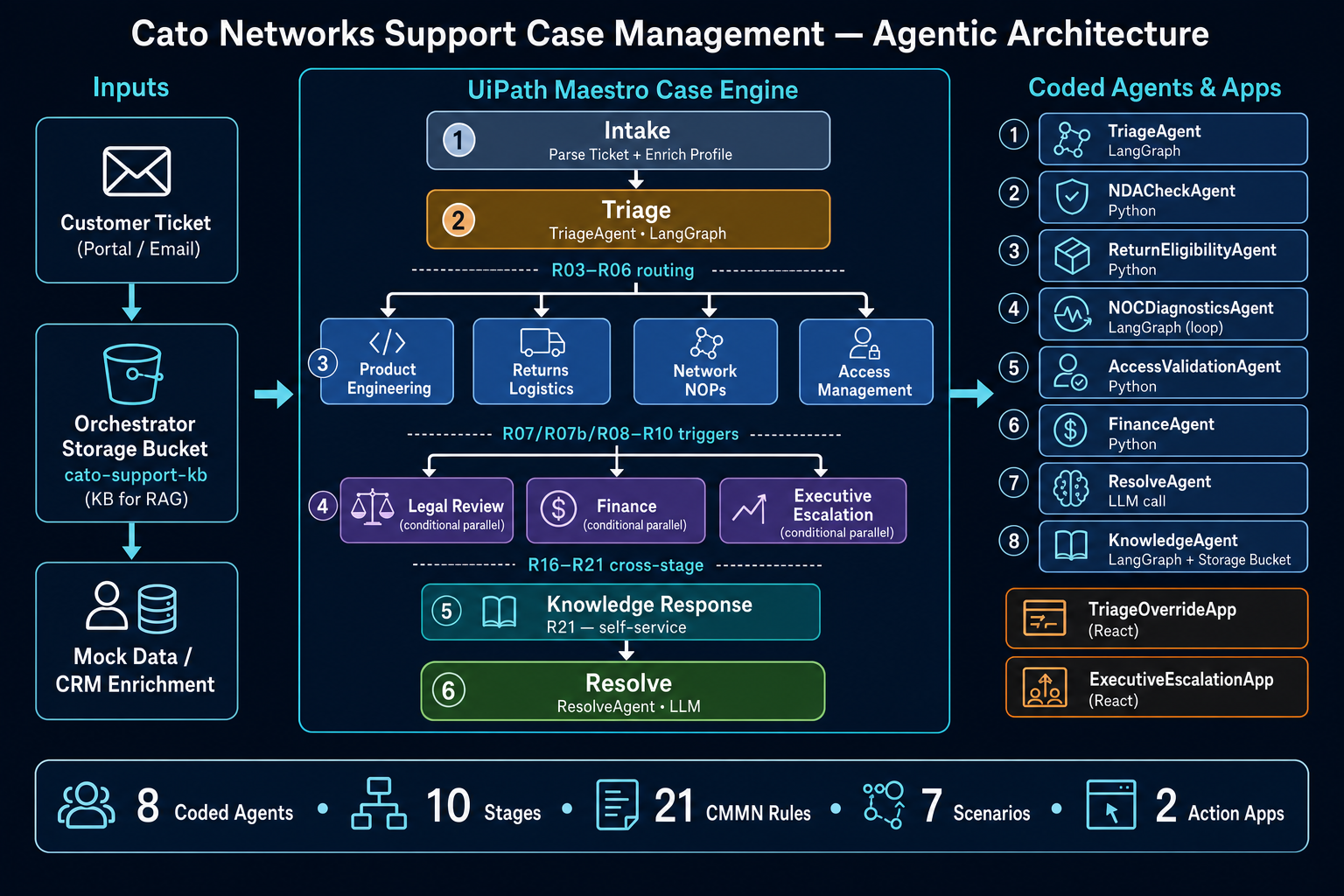
10 stages: 6 primary department stages + Legal, Finance, Executive as floating secondary stages 15 CMMN rules driving all routing — no hardcoded flow logic, no if/else sequences Secondary stages configured to activate on FieldChanged events from any primary stage — Legal and Finance have no fixed position in the flow SLA breach rule (R-10) wired to auto-activate Executive Escalation with zero human trigger Stage re-entry on Returns stage via R-13 (Finance clears → run-once=false shipment task re-runs)
6 Coded Agents (Python, AWS Bedrock Claude Haiku 4.5):
TriageAgent — keyword prefilter + Bedrock classification, sets routing flags including needs_legal / needs_finance NDACheckAgent — conditional on Enterprise tier + confirmed bug; assesses IP/legal risk ReturnEligibilityAgent — warranty and return window check, RMA generation NOCDiagnosticsAgent — repeating event-driven POP health simulation (run-once=false) FinanceAgent — rules-based credit calculation ($2,400 return / $3,000/tenant P1 SLA breach) ResolveAgent — synthesizes all stage outputs into customer-facing resolution summary
Case App:
8 department personas with role-filtered task views (CS Agent, Product Manager, NOC Engineer, Logistics, IT Admin, Legal Counsel, Finance Analyst, VP Customer Success) Native HITL — no external Action Center queues, no Adaptive Cards, no external tooling Built-in case timeline shows every task, agent call, and rule event with full timestamps Live stage indicator shows simultaneous active stages — the key visual for the demo
Challenges we ran into
Case Entity is Coming Soon — the persistent case entity as a design-time schema object isn't fully GA yet in Maestro Case. We designed all field contracts through task I/O output arguments, which is actually the correct CMMN pattern and has no functional impact on the demo. Stage re-entry timing — getting R-13 (Finance clears → Returns re-entry) to fire reliably required careful ordering of the run-once=false flag and precise rule dependency sequencing. SLA demo timing — production SLAs (1 hour for P1) make live demos impractical. We set P1 SLA to 5 minutes for recording while documenting production values separately. Parallel stage convergence — ensuring Stage 9 (Resolve) only activates after ALL active parallel stages complete required careful rule R-15 configuration.
Accomplishments that we're proud of
CUST-004 shows 3 active stages simultaneously in the Case App — NOPs, Executive, and Finance all running at once after a P1 SLA breach. This is not expressible in BPMN. Legal and Finance activate from ANY stage via field-change events — truly floating secondary stages with no fixed predecessor in the case plan. The entire CUST-004 escalation to VP Customer Success happens with zero human trigger. A CMMN rule fires, the FinanceAgent calculates $9,000 in credits, and the VP task lands in the Case App inbox — fully automated. 15 CMMN rules drive all routing — every stage transition, parallel activation, re-entry, and escalation is governed by a rule, not hardcoded flow logic.
What we learned
Maestro Case is genuinely different from BPMN. The secondary stage pattern — Legal and Finance as floating stages activated by field-change events from any primary stage — is not expressible in sequential workflow tools. Once you internalize CMMN thinking (events and rules, not sequences), the architecture handles complexity that would require dozens of sub-processes in BPMN.
The Case App as the native HITL surface was also a key insight: no need for external Action Center queues, no Adaptive Cards, no custom dashboards. The platform provides monitoring, task routing, SLA timers, and audit trail out of the box.
What's next
Connect to real Zendesk via our existing MCP server for live ticket ingestion Replace mock agents with production Bedrock agents using real CRM and IAM data Extend to cover billing disputes and partner onboarding tracks Roll out to Cato Networks Customer Success as the primary case management system
Built with
UiPath Maestro Case · Studio Web · Case App · Case Manager Agent · Orchestrator · Python Coded Agents · AWS Bedrock · Claude Haiku 4.5 · CMMN · Cato Networks SASE platform
Built With
- aws-bedrock
- case
- case-app
- claude-haiku-4.5
- cmmn
- coded-agents
- maestro
- orchestrator
- python
- studio-web
- uipath


Log in or sign up for Devpost to join the conversation.