-
-
SupplyWatch
Inspiration
Global shipping is one of the most fragile critical systems in the world. A single disruption at a port can trigger delays across entire supply chains. We were inspired by the gap between data visibility and decision speed — teams often have data, but not a fast, actionable way to reroute operations.
So we built SupplyWatch to answer one core question:
Can we detect route risk early, explain it clearly, and recommend a safer route before the disruption escalates?
What it does
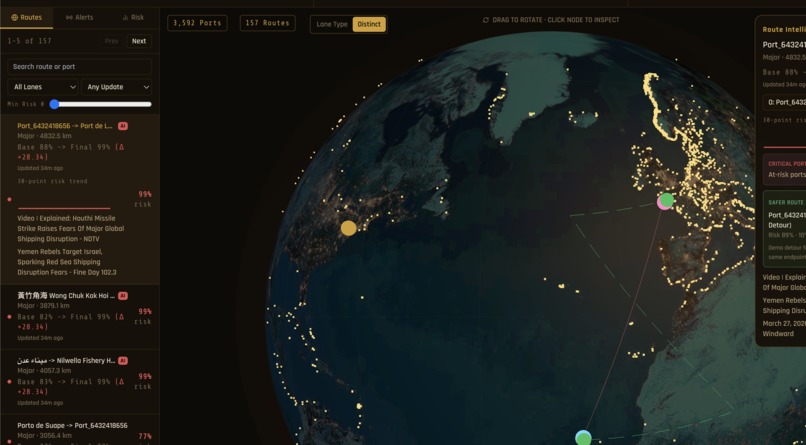
SupplyWatch is an AI-powered route intelligence platform for maritime logistics. It lets operators:
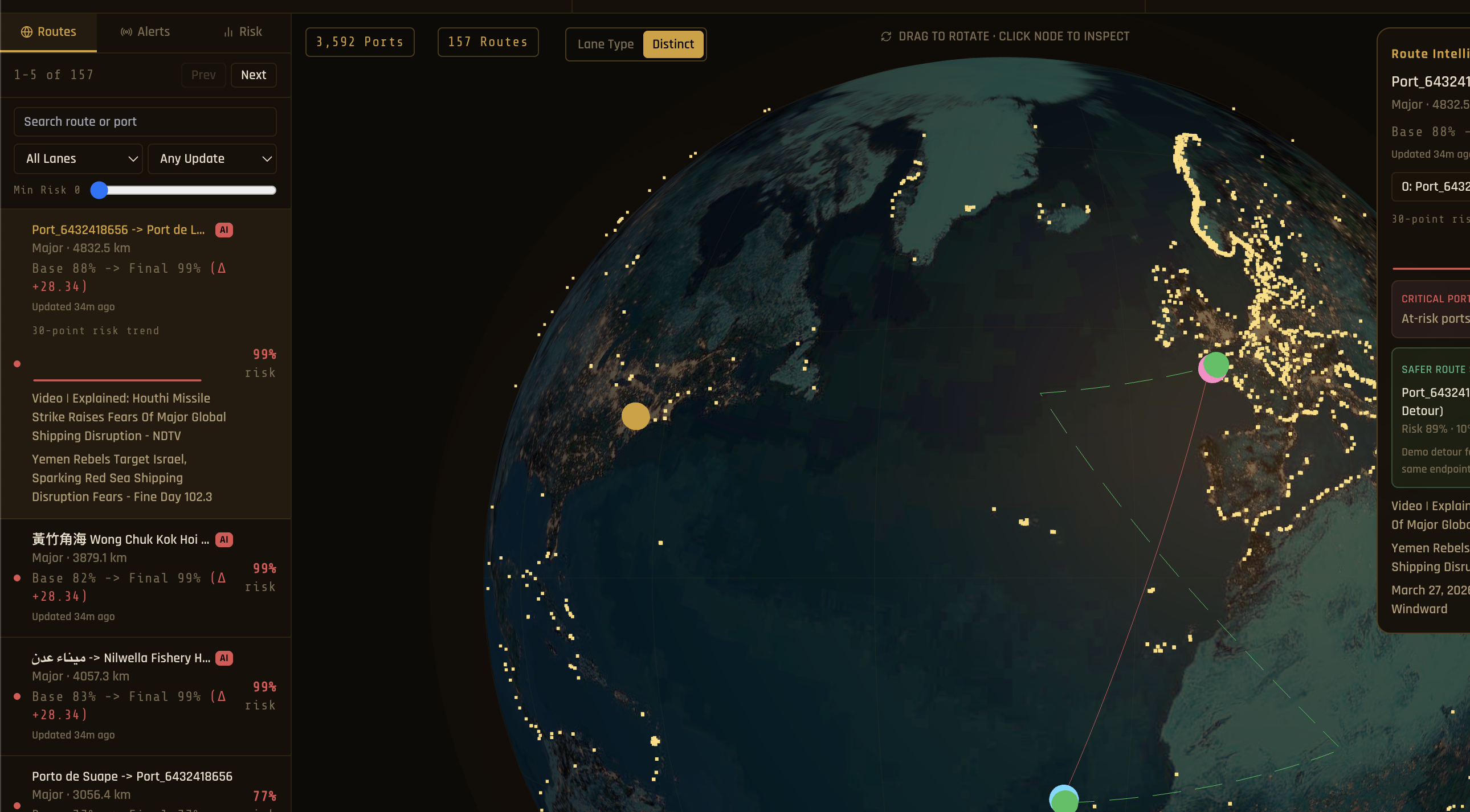
- View a live global network of ports and routes
- Monitor route-level risk in real time
- See whether risk changed due to AI/news signals or stayed stable
- Understand risk drivers through explainable route intelligence
- Highlight safer route alternatives between the same origin and destination ports In short: Detect risk. Explain change. Recommend action.
How we built it
We built SupplyWatch as a full-stack application:
- Frontend: React + TypeScript + Vite + Three.js for an interactive globe UI
- Backend: Node.js + Express REST API
- Database: Supabase (PostgreSQL) for routes, ports, and risk snapshots
- Risk pipeline: News ingestion + scoring logic + snapshot generation
- Optimization layer: AI-assisted safer-route selection with explainable outputs
- UX features: Route filtering, pagination, alerts, trend sparklines, route intelligence panel, port focus interactions, and highlighted detours
Challenges we ran into
- Geospatial normalization: Route coordinates needed careful conversion and validation for accurate globe rendering.
- Visual clarity at scale: Thousands of points and overlapping lines required iterative tuning of color, opacity, altitude, and render ordering.
- Operational reliability: We handled process conflicts, stale server states, and local environment issues while keeping the demo stable.
- Explainable recommendations: We wanted route recommendations to feel trustworthy, so we emphasized clear risk deltas, source context, and explicit fallback states.
Accomplishments that we're proud of
- Built an end-to-end system from ingestion to action-oriented visualization
- Added explainable AI-style route risk adjustments
- Implemented safer-route highlighting that keeps endpoints consistent
- Designed a polished interface that balances density with usability
- Created a demo-ready workflow that communicates technical depth clearly
What we learned
- Explainability is essential for operational AI tools.
- UX details can make or break trust in technical systems.
- Reliability and observability matter as much as model logic.
- Building under hackathon constraints requires tight iteration loops and ruthless prioritization.
What's next for SupplyWatch
- Integrate richer real-time maritime feeds (AIS, congestion, weather, port ops)
- Improve optimization with multi-objective routing (risk, time, cost, reliability)
- Add collaboration workflows (assignment, acknowledgement, escalation)
- Expand historical analytics and forecasting for proactive planning
- Productionize deployment, monitoring, and alerting for real enterprise use SupplyWatch is our step toward a true mission control layer for global supply chains.
Built With
- css
- express.js
- gemini
- github
- javascript
- node.js
- postgis
- postgresql
- react
- rest
- rss
- supabase
- tailwind
- three.js
- typescript
- vite


Log in or sign up for Devpost to join the conversation.