SupplyTact: The Supply-Chain Agent That Shows Its Work
Inspiration
I did not begin this hackathon by asking:
What can I build with GPT-5.6?
I started with a much more personal question:
What would actually help me do my own job better?
I have spent about 15 years working in pharmaceutical supply chain and operations. My background is not traditional software engineering. My everyday world is demand, inventory, purchase orders, lead times, safety stock, expiry, quality release, customer allocation, replenishment, and the difficult decisions connecting all of them.
Like many supply-chain professionals, I still manage a large part of that work through Excel.
I am an Excel person. I understand how powerful it is. But as the planning problem grows, so do the workbooks. One file becomes several files. More formulas are added. More tabs appear. Assumptions become harder to trace.
Then something changes.
A purchase order is delayed. Demand suddenly increases. Inventory is held by quality. A batch approaches expiry. A hospital customer needs priority.
Excel recalculates the numbers, but the planner still has to investigate the real problem:
- What is going to fail?
- When will it happen?
- What caused it?
- Which customers will be affected?
- What actions are still possible?
- Which solution creates the least service, cost, or expiry risk?
That investigation can take much longer than the calculation itself.
I did not need another chatbot giving me general supply-chain advice. I needed an AI agent that could work inside the planning process: inspect structured data, call analytical tools, run controlled scenarios, compare possible futures, and show me the evidence behind its recommendation.
That became SupplyTact.
What it does
SupplyTact is an agentic supply-and-inventory planning system.
Inside it is ReplenAgent, a specialized planning agent powered by GPT-5.6 Luna.
ReplenAgent does not invent inventory calculations or provide unsupported recommendations. It works through validated tools connected to a deterministic planning engine.
A planner can ask:
Which product is facing the most serious supply risk, and why?
ReplenAgent can then:
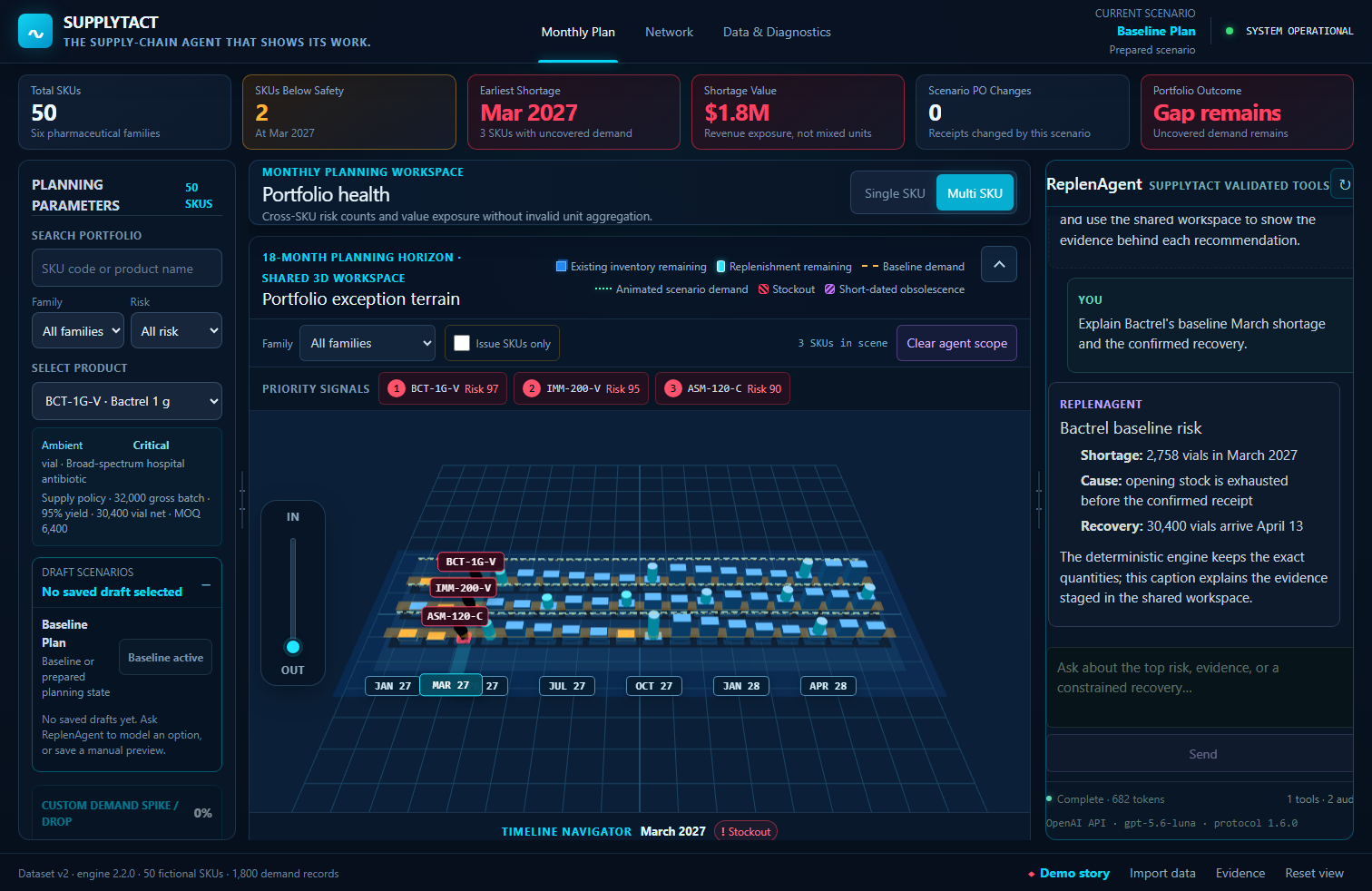
- Inspect the portfolio and rank current risks.
- Select the affected product and time period.
- Retrieve the exact inventory projection.
- Identify the supply, demand, expiry, or quality events contributing to the issue.
- Move the shared visual workspace to the relevant evidence.
- Create a reversible recovery scenario.
- Run the deterministic simulation again.
- Compare the original future with the proposed future.
- Explain the recommendation and remaining trade-offs.
The human planner still provides context, priorities, constraints, judgment, and final approval.
ReplenAgent investigates and tests possibilities.
The deterministic engine remains the numerical authority.
That is what I mean by:
The supply-chain agent that shows its work.
A pharmaceutical supply crisis, investigated
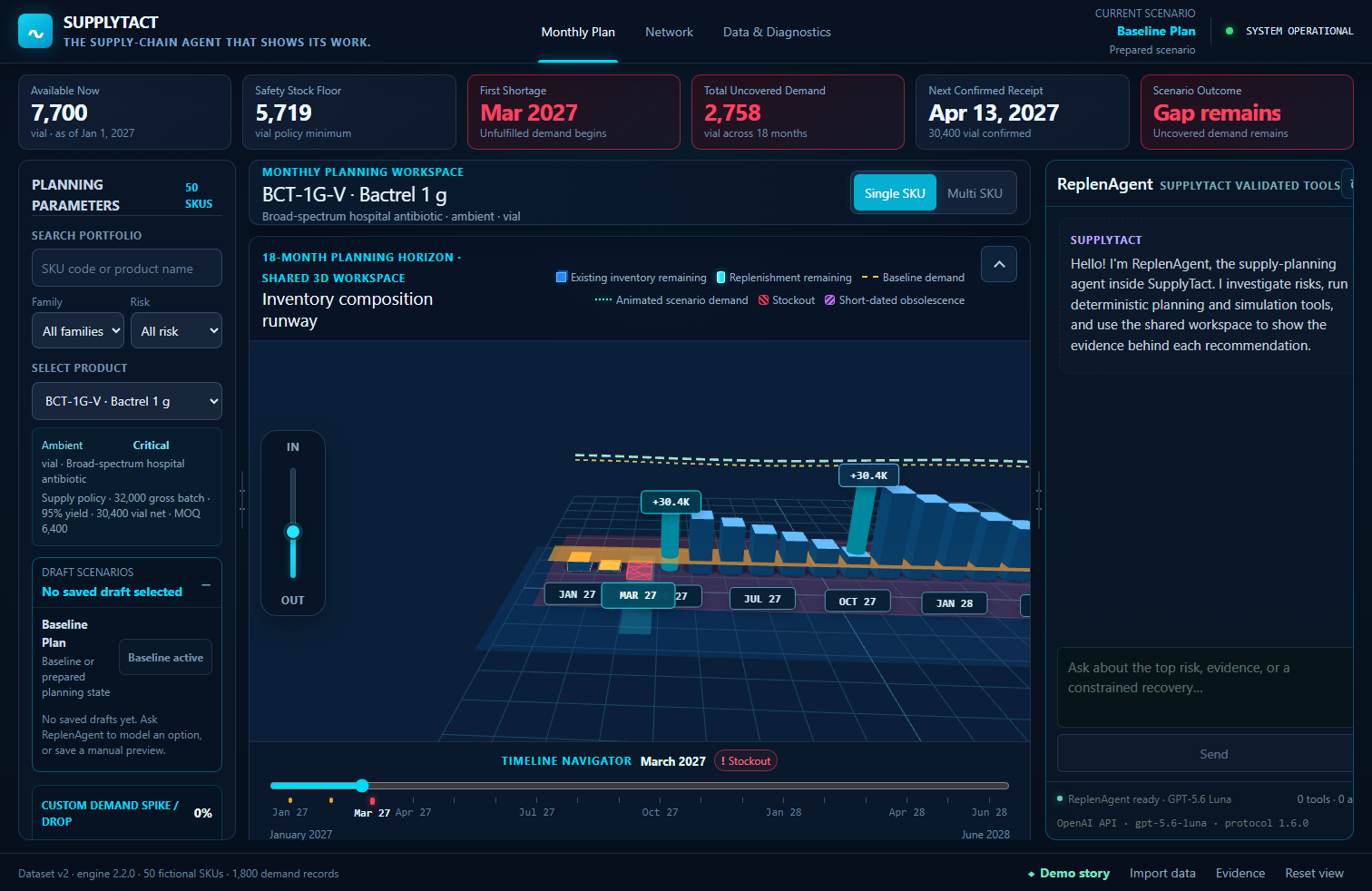
The central demonstration uses BCT-1G-V · Bactrel 1 g, a fictional critical-care pharmaceutical product.
In the Baseline Plan, Bactrel begins with 7,700 vials available.
January demand consumes 3,597 vials, leaving 4,103. February demand consumes another 3,512, leaving only 591 vials entering March.
March demand is 3,349 vials, creating an uncovered shortage of exactly 2,758 vials.
SupplyTact calculates the result:
- The first safety-stock breach occurs in January 2027.
- Bactrel first stocks out in March 2027.
- The cumulative shortage is 2,758 vials.
- The maximum monthly shortage is also 2,758 vials.
- The affected demand includes 1,880 hospital vials and 878 retail vials.
- A confirmed 30,400-vial receipt on April 13 restores supply.
A planner can ask ReplenAgent:
Why does Bactrel 1 g stock out in March? Show me the evidence.
ReplenAgent investigates the deterministic projection, focuses the shared workspace on Bactrel and March 2027, and opens the causal evidence.
The KPI, inventory runway, monthly matrix, and evidence view all remain aligned around the same calculated state.
The planner can then test a more severe possibility:
Model retail demand 50% higher from January through May 2027. What changes?
SupplyTact recalculates the future.
The first stockout moves forward from March to February. Cumulative uncovered demand increases to 4,054 vials, and the largest monthly shortage reaches 3,788 vials.
The planner can then ask:
Find the lowest-cost feasible recovery you can validate, create it, and compare it with the retail-upside scenario.
ReplenAgent creates a named, reversible child scenario using typed, policy-valid changes.
It runs the deterministic simulation, stages the comparison in the shared workspace, and confirms that the created recovery plan eliminates both cumulative and monthly shortages while leaving the immutable Baseline Plan unchanged.
Importantly, SupplyTact describes this as the lowest-cost feasible recovery actually evaluated—not as a mathematically proven global optimum.
That distinction matters.
Real supply-chain planning is not about receiving a confident answer from a chatbot. It is about understanding the numbers, testing realistic actions, preserving the original plan, and making the trade-offs visible before a human approves the decision.
How I built it: from conversation to working product
I brought the pharmaceutical supply-chain experience.
I understood the day-to-day problem, the planning rules, the operational constraints, and the kinds of decisions the system needed to support.
But before asking Codex to write any code, I spent significant time inside ChatGPT using GPT-5.6 Sol to develop the idea properly.
We started with the problem, not the technology.
Through that conversation, I worked through:
- What a supply-chain planner actually needs from an AI agent
- Why a chatbot attached to a spreadsheet would not be enough
- Which calculations should remain deterministic
- What actions an agent should and should not be allowed to take
- How scenarios should remain reversible
- How the agent and planner could share the same visual evidence
- How fictional pharmaceutical data could demonstrate realistic planning challenges safely
- The product architecture, user experience, agent workflow, and demo scenario
That planning process produced the core product documents that guided the build, including the product requirements, architecture, agent behavior, deterministic planning principles, interface direction, and implementation plan.
Only after those foundations were clear did I move into Codex.
Codex became my engineering collaborator. It worked from the product documents and helped transform the idea into a functioning application:
- Typed supply-chain data models
- A deterministic monthly planning engine
- Demand, receipt, expiry, quality-release, and allocation logic
- Reversible and versioned scenarios
- A validated ReplenAgent tool protocol
- Portfolio and SKU-level risk analysis
- A synchronized 3D inventory runway and exact planning matrix
- Causal evidence views
- CSV and XLSX import workflows
- Browser-local SQLite persistence
- Automated tests
- Documentation
- GitHub and Vercel deployment
This was not a one-shot prompt followed by a finished application.
I continuously reviewed the output using my own professional experience. I challenged assumptions, corrected planning logic, rejected approaches that would not be useful in a real workflow, tested scenarios, and changed the product direction as I learned from the implementation.
The earliest concept was mainly a panoramic visualization of the supply chain. It was first called SupplyScape, then Planorama.
But during the build, I realized that the visualization was not the real product.
The planning agent was.
That realization changed both the architecture and the name:
- SupplyTact became the complete planning system.
- ReplenAgent became the specialized agent working inside it.
- The visual environment became a tool used by both the human and the AI to investigate and communicate.
The finished project therefore uses OpenAI technology in three different ways:
- GPT-5.6 Sol in ChatGPT helped me reason through and design the product before development began.
- GPT-5.6 Sol in Codex helped me implement, test, debug, document, and deploy the application.
- GPT-5.6 Luna powers ReplenAgent inside the deployed product.
I did not ask AI to invent a supply-chain problem for me.
I brought a problem I have lived with for about 15 years, and used GPT-5.6 and Codex to help turn that experience into a working product.
Why GPT-5.6 Luna
ReplenAgent runs on GPT-5.6 Luna.
I chose Luna intentionally.
The goal was not to ask the largest possible model to perform every task itself. I wanted to demonstrate what an efficient model could accomplish when the surrounding agent environment was designed correctly.
GPT-5.6 Luna is responsible for:
- Understanding the planner’s request
- Selecting the correct tools
- Following a multi-step investigation
- Interpreting validated results
- Explaining the recommendation clearly
It is not responsible for inventing shortage quantities, modifying baseline data without approval, or performing hidden inventory arithmetic.
SupplyTact gives Luna:
- Structured planning context
- Typed and validated tools
- Deterministic calculations
- Reversible actions
- Visible evidence
- Explicit operating boundaries
To me, that is one of the most important lessons of agentic AI:
Intelligence does not come only from selecting a larger model. It also comes from building the right environment in which the model can work.
Challenges I faced
Keeping AI reasoning separate from numerical truth
Generative AI is valuable for deciding what to investigate and explaining why a result matters.
It should not be the authority for inventory arithmetic.
I therefore built a deterministic planning engine. The same calculated projection powers the portfolio KPIs, inventory runway, exact matrix, risk evidence, and scenario comparison.
ReplenAgent must use validated tool results whenever it makes a numerical claim.
This separation was essential for trust.
Making the agent perform real work
It would have been much easier to place a chat panel beside a dashboard and call it an agent.
I wanted ReplenAgent to participate in the planning workflow itself.
It needed to:
- Discover risks
- Navigate the workspace
- Retrieve projections
- Trace causal evidence
- Create typed scenario drafts
- Run simulations
- Compare saved versions
- Explain the outcome
Designing those tools, permissions, schemas, and interactions was much more difficult than adding chat—but it is also what makes SupplyTact meaningful.
Representing complex planning information clearly
Supply-chain planning contains many products, locations, time periods, orders, lots, policies, units, and customers.
I wanted a user to move from a portfolio-wide warning to the exact product, month, and event causing the problem without becoming lost in another dense enterprise dashboard.
SupplyTact combines:
- Portfolio risk analysis
- A 3D inventory runway
- An exact monthly planning matrix
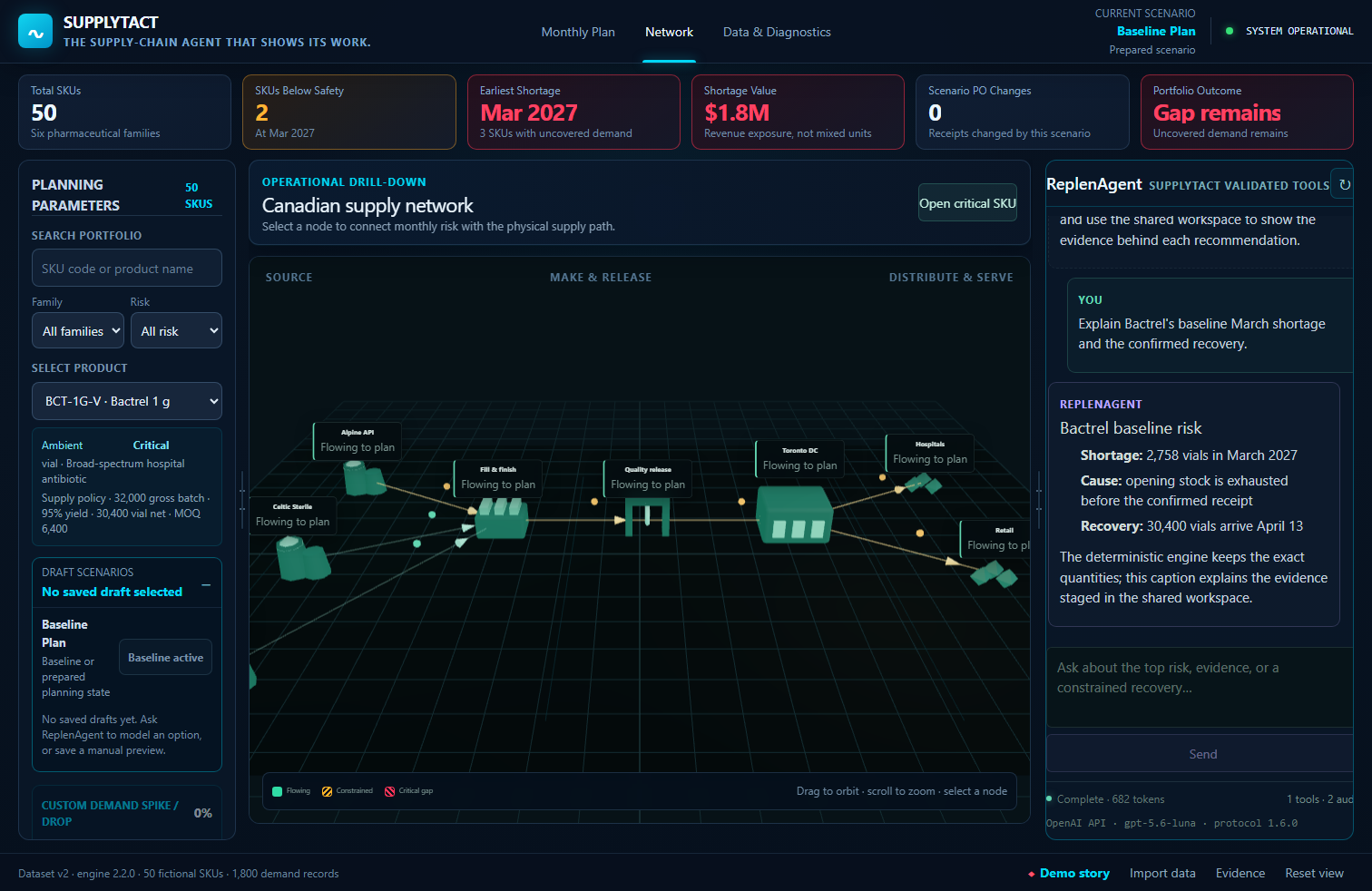
- Network and causal evidence
- Scenario comparison
- Visible agent activity
The challenge was making those views behave like one shared planning workspace rather than several disconnected screens.
Building a realistic demo without exposing real data
I wanted the system to reflect real pharmaceutical planning problems, but I could not use confidential employer, customer, supplier, patient, or commercial data.
I created a fictional pharmaceutical portfolio with 50 active SKUs, realistic demand, supply, expiry, quality-release, storage, lead-time, batch, and MOQ characteristics.
This allowed the product to demonstrate realistic behaviour without exposing private information.
What I learned
The biggest lesson was that a useful AI agent is not simply a model with a chat interface.
The quality of the tools matters.
The quality of the context matters.
The safety boundaries matter.
The visibility of the evidence matters.
And the role of the human matters.
I do not see SupplyTact as AI replacing the supply-chain planner.
The human understands business reality, priorities, relationships, exceptions, and consequences.
The agent can rapidly inspect structured information, test scenarios, trace evidence, and organize possible decisions.
Together, they can investigate, simulate, and decide more effectively than either could alone.
I also learned that deterministic software and generative AI are not competing approaches.
They are complementary.
The deterministic engine provides repeatable numerical truth. GPT-5.6 provides flexible investigation, orchestration, and explanation.
That combination is much more useful than asking a language model to do everything.
What I am most proud of
What I am most proud of is not the number of features I built.
It is the level of work ReplenAgent can already perform.
At the beginning of this hackathon, this was an idea for a tool I wished existed.
Now I can ask ReplenAgent to investigate a supply risk, trace the cause, move through the supporting evidence, create a recovery scenario, simulate the result, and explain the trade-offs back to me.
It does not feel like a chatbot giving me suggestions.
It feels like the beginning of an actual planning partner.
SupplyTact is designed to accept approved operational data through its import workflow. The system will still need continued testing, refinement, and validation, especially before it could be used as a formal pharmaceutical decision system.
But I can already see myself using it in my own day-to-day planning work: investigating shortages, understanding why inventory is changing, comparing recovery options, and preparing better decisions.
That is a very different outcome from simply finishing a hackathon demo.
I now have an AI agent designed around the real challenges I face professionally.
I am also proud of the confidence this build has given me.
Before tools like GPT-5.6 and Codex, an idea at this level could easily have remained inside an Excel workbook, a sketch, or a document.
I understand pharmaceutical supply chain deeply, but I am not a traditional software engineer.
Building a complete planning application with a deterministic engine, structured agent tools, data imports, scenario management, synchronized visualizations, persistence, testing, and deployment would once have felt far outside what I could realistically create myself.
Now I know that when I identify something ReplenAgent needs—a new business rule, another planning tool, a better visualization, a different scenario policy, or a connection to another data source—I have a way to turn that requirement into working software.
GPT-5.6 helps me reason through what should be built.
Codex helps me implement, test, and improve it.
My professional experience tells me whether the result is actually useful.
I am sure SupplyTact will continue to change as I use it. I will find limitations. I will discover new workflows. I will refine ReplenAgent’s tools and add rules that reflect more real-world situations.
But I no longer see those changes as barriers.
I see them as the next instructions I will give my AI engineering collaborator.
The technical implementation matters, and I am proud of how much is already working.
But the biggest accomplishment is that SupplyTact no longer feels like an idea I am waiting for someone else to build.
It is now a tool I can continue shaping around the work I actually do.
What's next
SupplyTact is a working hackathon implementation, not yet a validated commercial pharmaceutical or GxP decision system.
The public deployment uses fictional data. It does not currently connect directly to an ERP, warehouse, supplier, or customer system.
My next step is practical:
Test SupplyTact in my own planning workflow using approved, non-confidential data.
From there, it could expand toward:
- Company-specific workbook imports
- ERP and warehouse connectors
- Multi-location inventory allocation
- Additional pharmaceutical planning policies
- Approval workflows
- Enterprise audit and governance
- Supplier and customer collaboration
- Configurable specialized planning agents
I began this project because I was tired of solving every new planning problem by adding another worksheet, formula, and manual investigation.
Excel will remain an important part of supply-chain work.
But Excel gives me the numbers.
SupplyTact helps me investigate what those numbers mean, test what could happen next, and decide what to do.
That is the tool I needed.
So I built it.
Try SupplyTact
Live demo: https://supplytact.vercel.app/
Tagline: The supply-chain agent that shows its work.


Log in or sign up for Devpost to join the conversation.