-
Home
-
Crisis Alert
-
Overview
SupplyShield: Edge-Based Machine Intelligence & Supply Chain Optimization
Inspiration
The recent LPG shortage and supply disruptions made us realize how vulnerable critical supply chains can be. A disruption in one essential commodity can quickly affect transportation, industries, households, and the broader economy.
This inspired us to ask: What if supply-chain risks could be detected before they become major disruptions?
SupplyShield was born from this idea. Instead of waiting for a disruption to happen, we wanted to build an intelligent system that can continuously monitor supply conditions, identify early warning signals, forecast risks, and support faster decision-making at the edge.
What it does
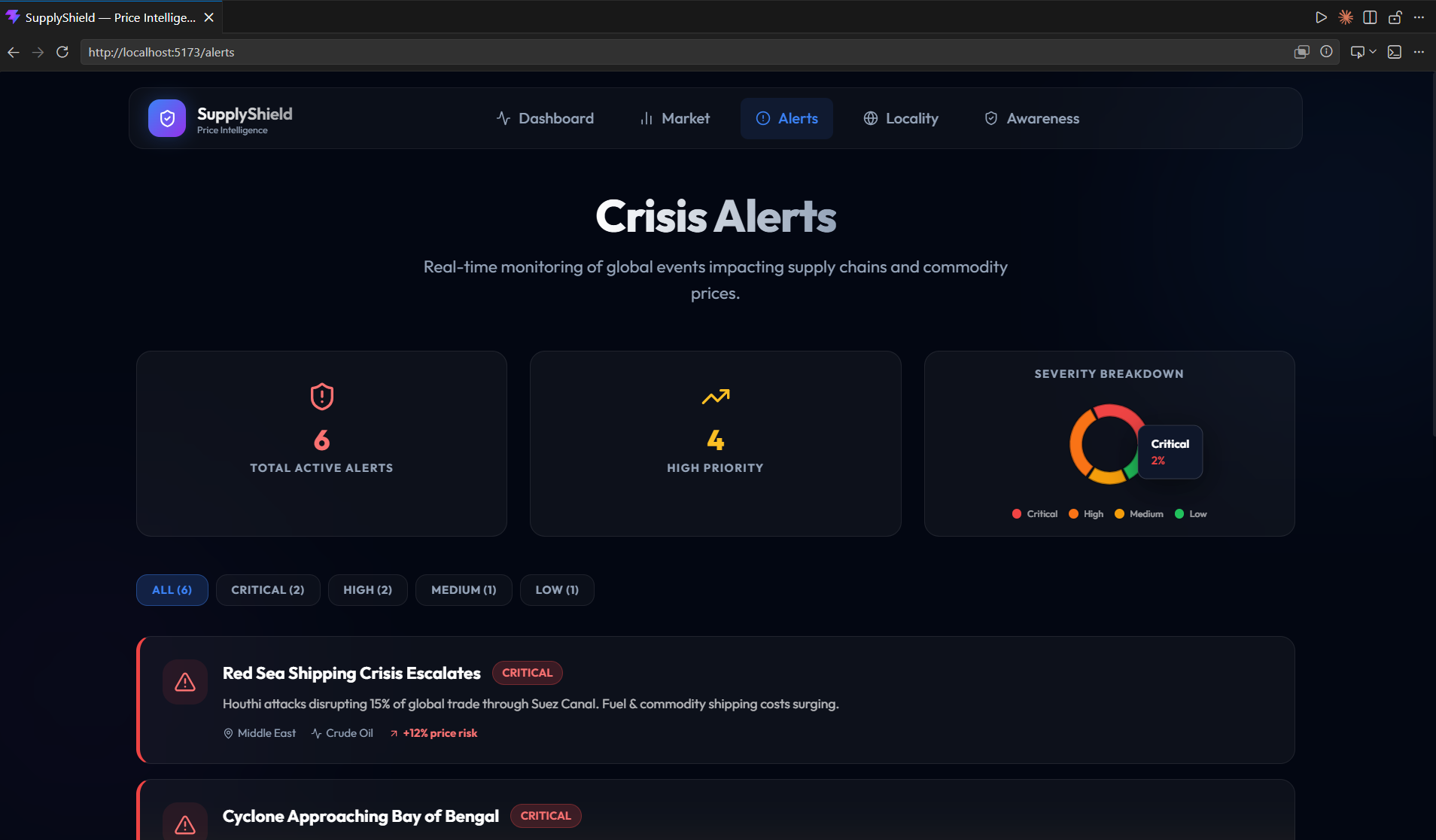
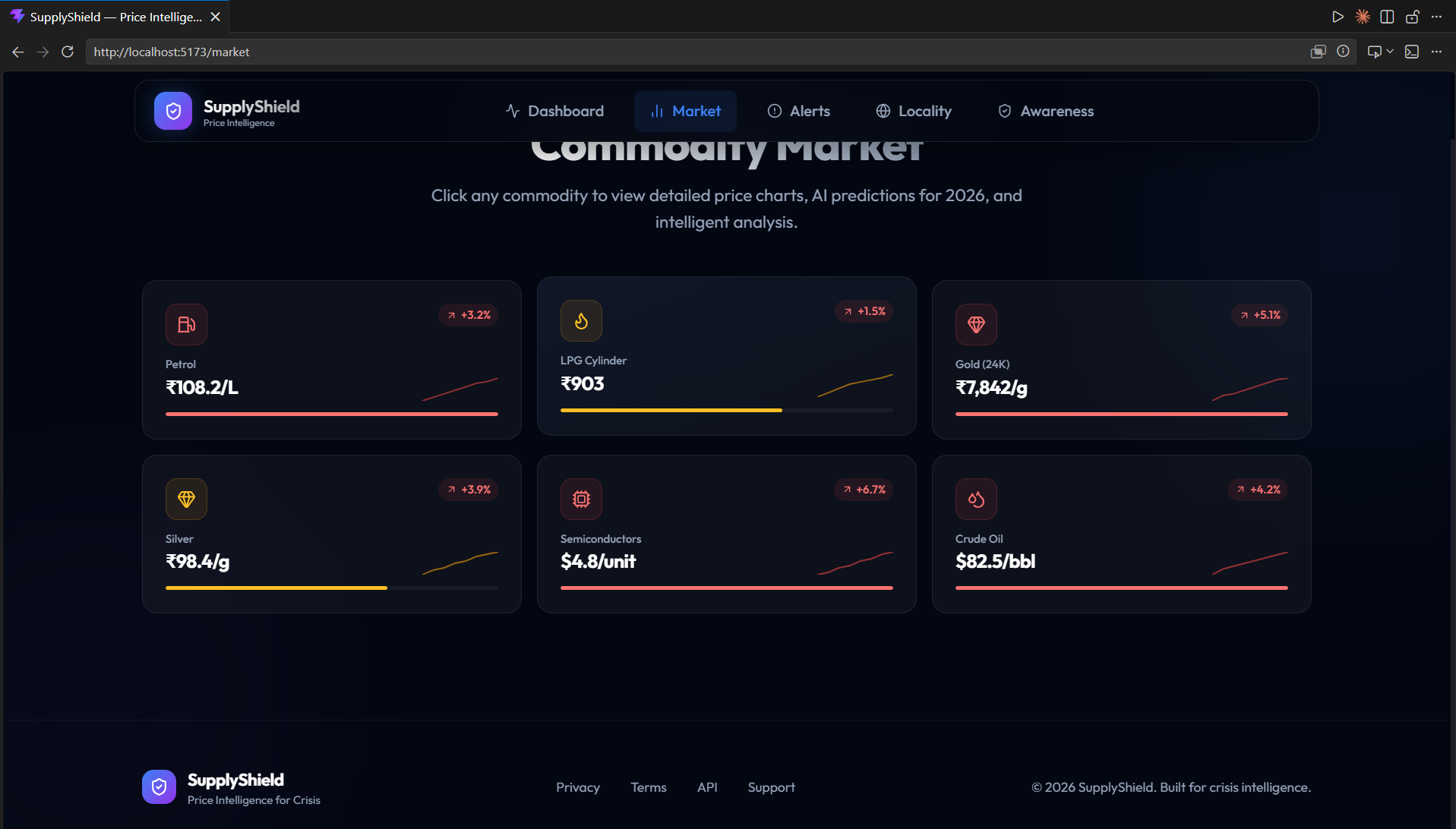
SupplyShield is an Edge AI-powered supply-chain intelligence platform designed to predict and respond to commodity and supply-chain risks.
The platform combines real-time telemetry, historical data, machine learning, and edge computing to:
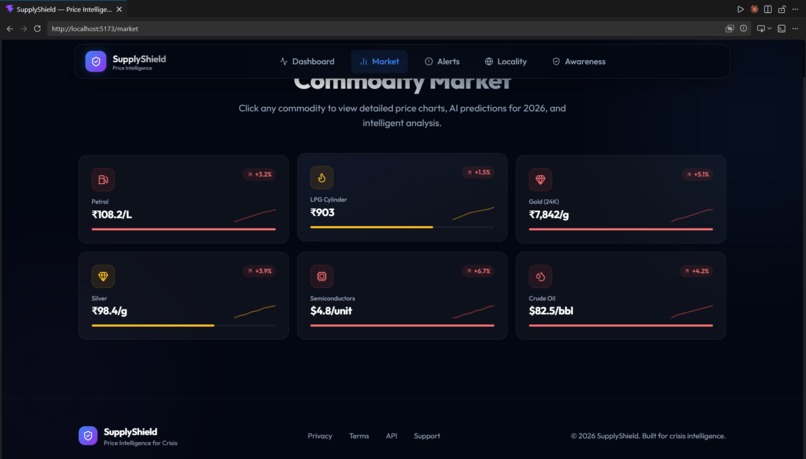
- Monitor critical commodities and supply-chain conditions
- Detect abnormal patterns and potential disruptions
- Forecast commodity trends and supply risks
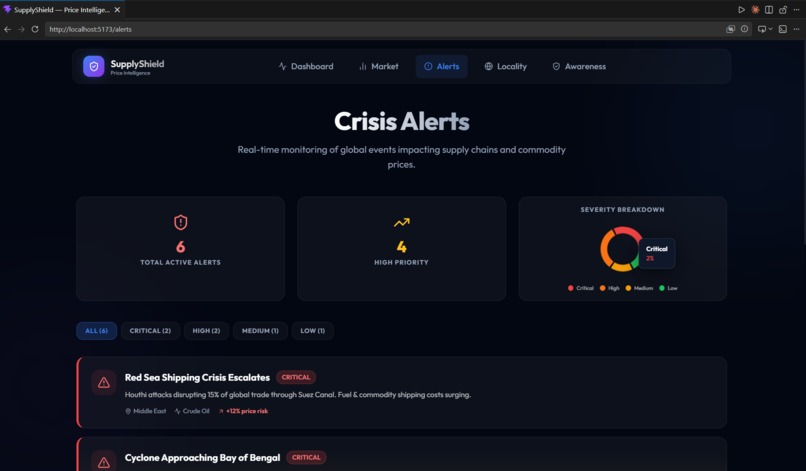
- Generate early-warning alerts
- Process intelligence locally at the edge where possible
- Help organizations make faster and more informed supply decisions
Our goal is to move supply-chain management from reactive decision-making to proactive intelligence.
How we built it
Frontend
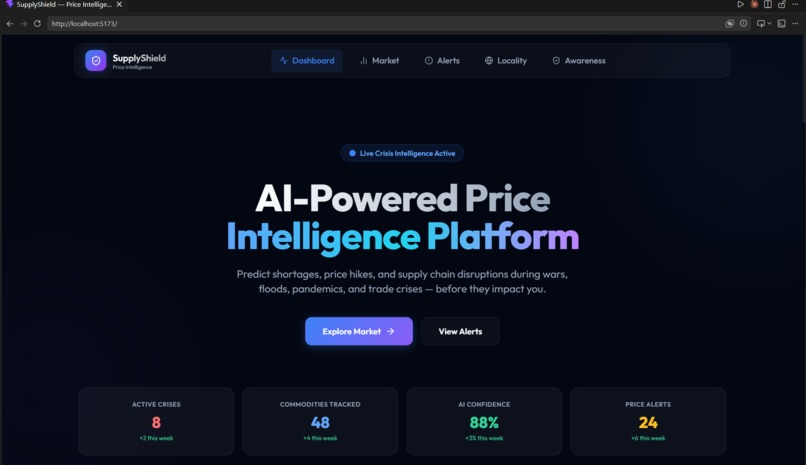
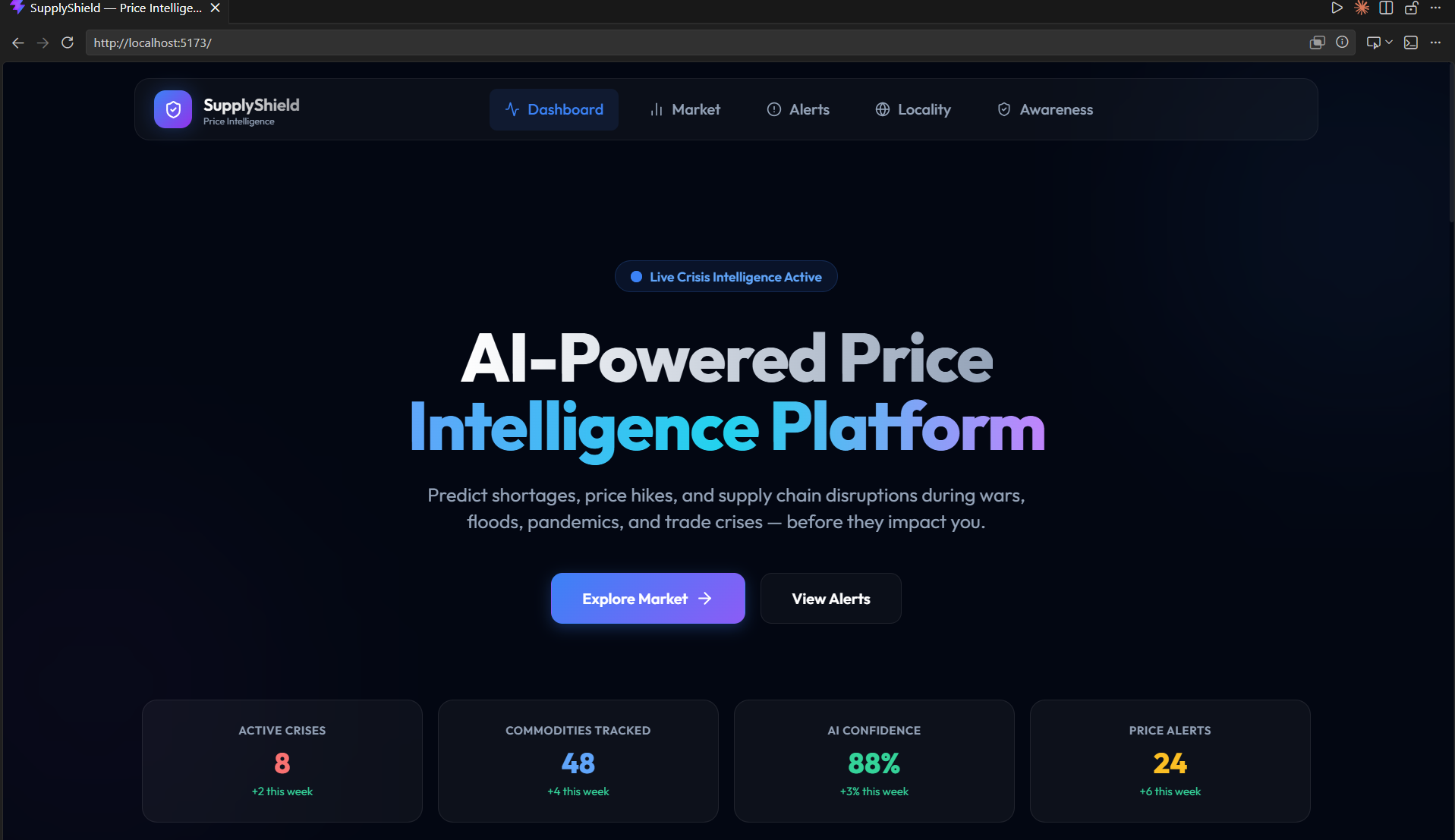
React.js dashboard for visualizing commodity intelligence, risk indicators, forecasts, telemetry, and alerts.
Backend
FastAPI + PostgreSQL for APIs, structured telemetry, historical data, system logs, and communication between the intelligence layer and dashboard.
AI / ML
Python, TensorFlow, Scikit-learn, MQTT, model quantization, and pruning are used to develop and deploy lightweight machine-learning models capable of operating in resource-constrained environments.
Edge Hardware
NVIDIA Jetson Nano / Raspberry Pi are used as edge-computing platforms for on-site inference, reducing the dependency on continuous cloud processing and enabling faster local intelligence.
The overall architecture is designed around the principle:
[ \text{Telemetry} \rightarrow \text{Edge Intelligence} \rightarrow \text{Risk Detection} \rightarrow \text{Prediction} \rightarrow \text{Decision Support} ]
Challenges we ran into
One of our biggest challenges was designing an AI system that could work with limited edge-computing resources while still providing useful predictions.
We also faced challenges around collecting and structuring supply-chain data, connecting real-time telemetry with machine-learning models, reducing model size through quantization and pruning, and integrating multiple technologies into a single working prototype.
Another challenge was moving beyond simply predicting commodity values. We wanted SupplyShield to provide meaningful risk intelligence and early warnings, which required thinking about the complete supply-chain problem rather than treating it as a simple forecasting task.
Accomplishments that we're proud of
We successfully developed a working SupplyShield prototype that brings together a web dashboard, backend infrastructure, machine-learning components, telemetry, and edge-computing concepts into a single platform.
More importantly, we transformed an idea inspired by a real-world supply disruption into a technical prototype demonstrating how AI can potentially be brought closer to where supply-chain decisions actually happen.
What we learned
Building SupplyShield taught us that solving real-world supply-chain problems requires more than just an accurate ML model.
We learned about edge AI, lightweight model deployment, real-time telemetry, backend architecture, data pipelines, and the challenges of connecting machine intelligence with operational decision-making.
We also learned that the concept has significant potential, but turning the prototype into a reliable industrial-grade system will require real-world datasets, domain expertise, hardware testing, validation, and industry support.
What's next for SupplyShield
Our long-term vision is to evolve SupplyShield into Edge AI-powered industrial intelligence.
We want to move from a prototype toward a system capable of supporting real industrial environments, with stronger forecasting, multimodal data integration, autonomous anomaly detection, more efficient edge models, and real-time decision support.
The ultimate goal is to create a distributed intelligence layer for critical supply chains — one that can sense risks early, understand what they mean, and help organizations act before disruptions become crises.
Built With
- fastapi
- jetson
- mqtt
- pi
- postgresql
- postgresql-for-structured-telemetry-and-logs-ai-/-ml-:-python
- python
- raspberry
- react.js
- scikit-learn
- tensorflow

