Inspiration
The idea for SupplyPilot AI comes from a real problem encountered when looking into industrial supply chain procurement and vendor vetting during my technical and academic journey.
In industrial environments, engineering and procurement teams routinely lose valuable days cross-referencing suppliers across scattered web directories, manually verifying compliance certifications, and trying to parse complex pricing structures. During my work on software architectures, I realized that most current AI tools in this space fall short because they are built merely as conversational chatbot wrappers. While a chatbot can summarize text, it lacks the systemic capabilities to independently investigate an engineering problem or execute a structured business decision.
This inspired me to build SupplyPilot AI: a tool that moves past simple text responses and transforms fragmented supply chain data into clear, autonomous, and explainable AI-assisted procurement decisions.
What the project does
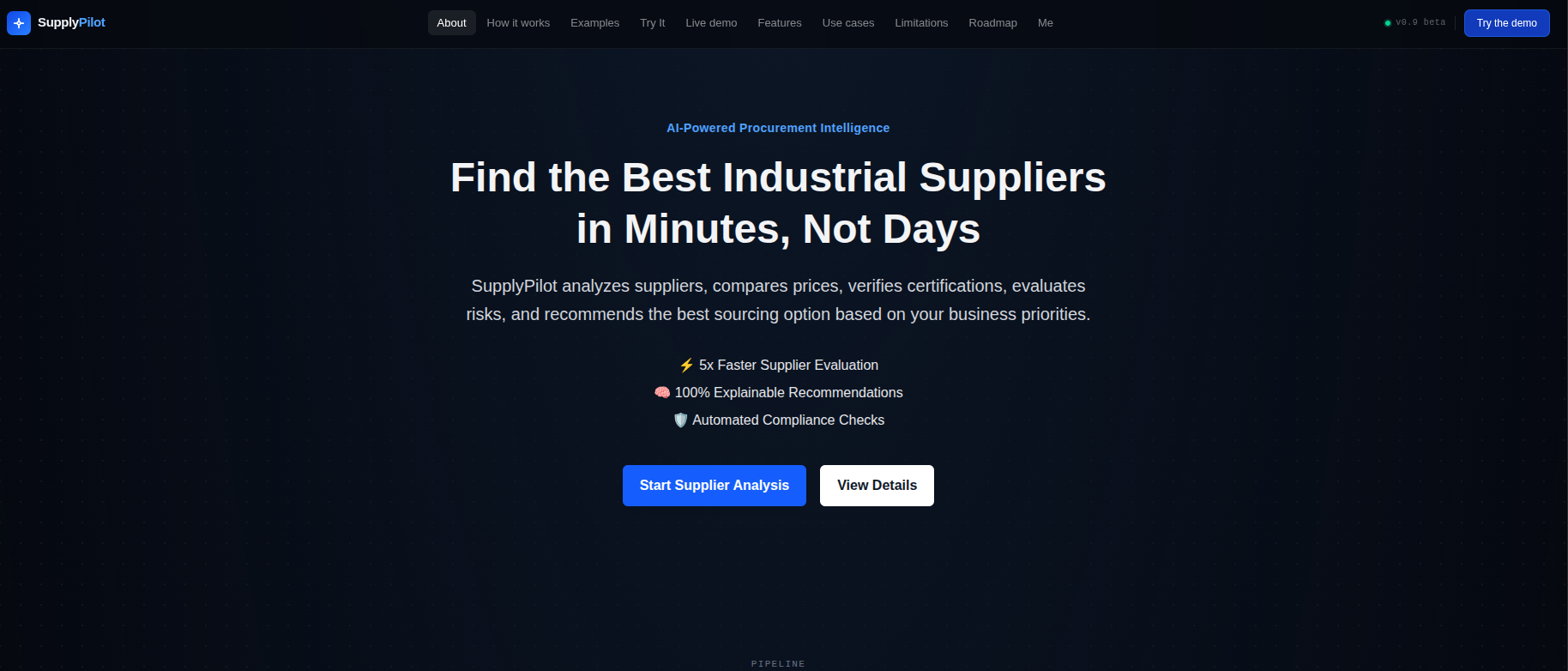
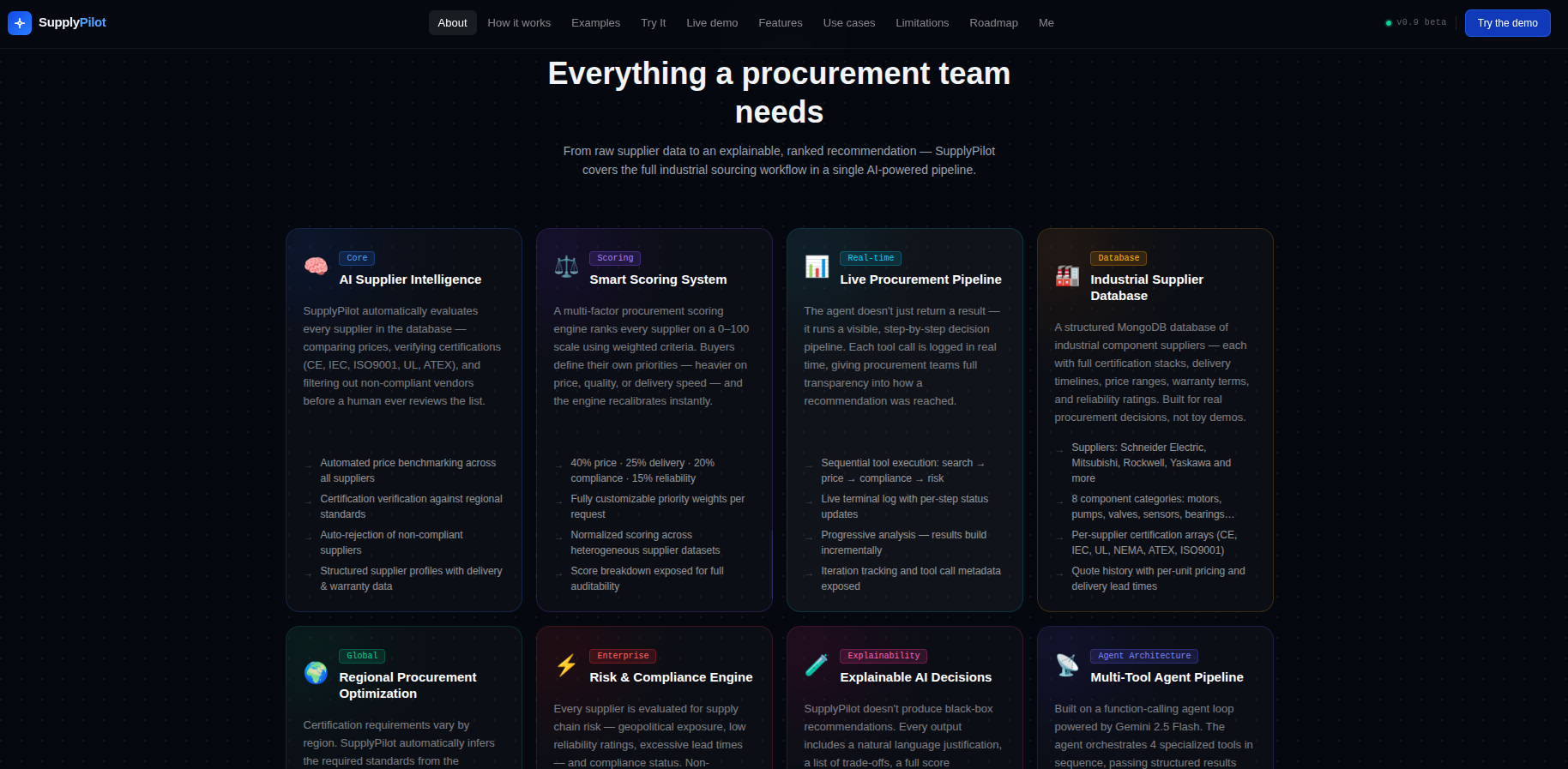
SupplyPilot AI is an AI-powered autonomous sourcing and procurement orchestration agent.
Users provide:
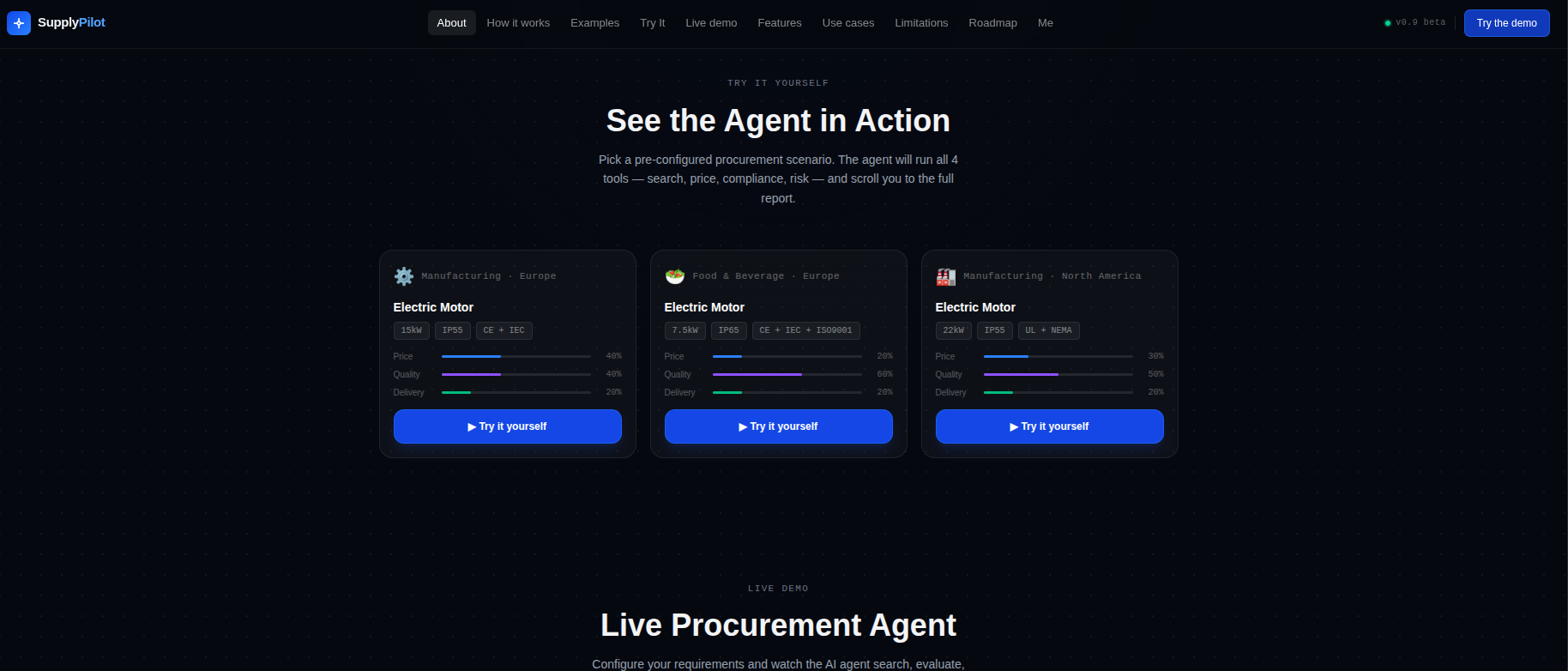
- A specific industrial component or technical raw material request
- Required safety or industrial compliance standards (e.g., ISO, CE, ATEX)
- Target budget, quantity, and timeline constraints
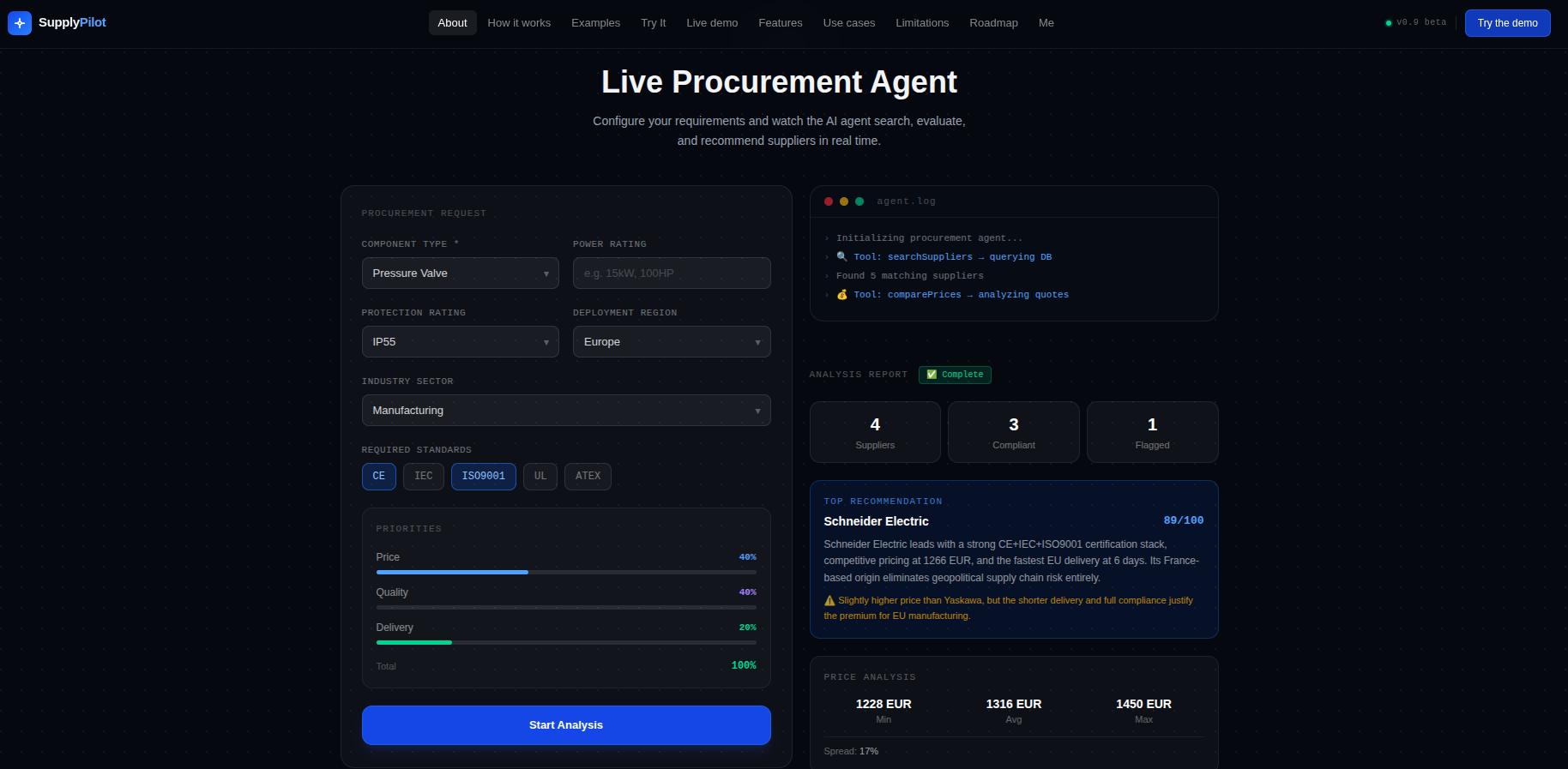
Using Gemini AI coupled with a custom execution pipeline, the system delivers:
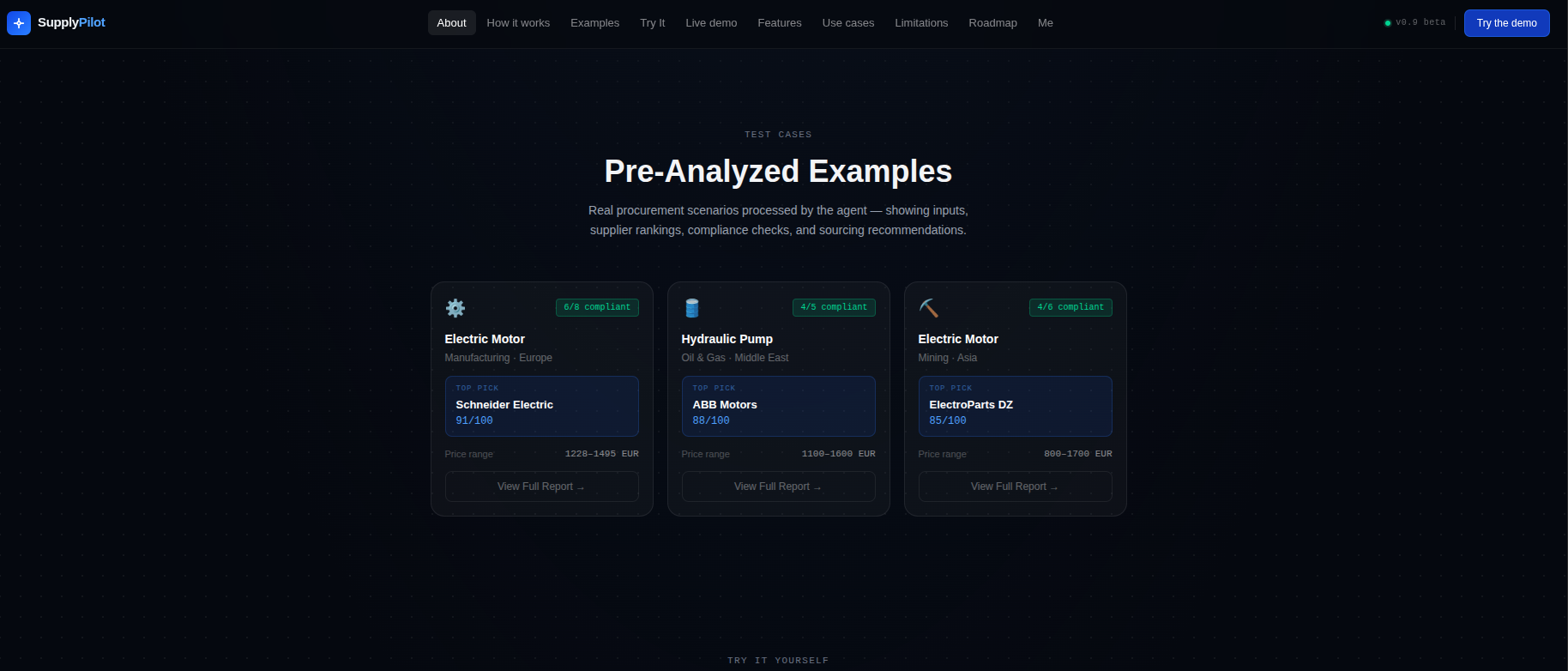
- A structured procurement recommendation with an optimal supplier selection
- A complete compliance audit verifying target industry standards
- A quantitative risk index and pricing matrix evaluation
- Fully validated, machine-readable JSON decision payloads
The goal is to move beyond simple chatbots and provide a true decision-making system that ensures faster, safer, and data-driven industrial sourcing.
How I built it
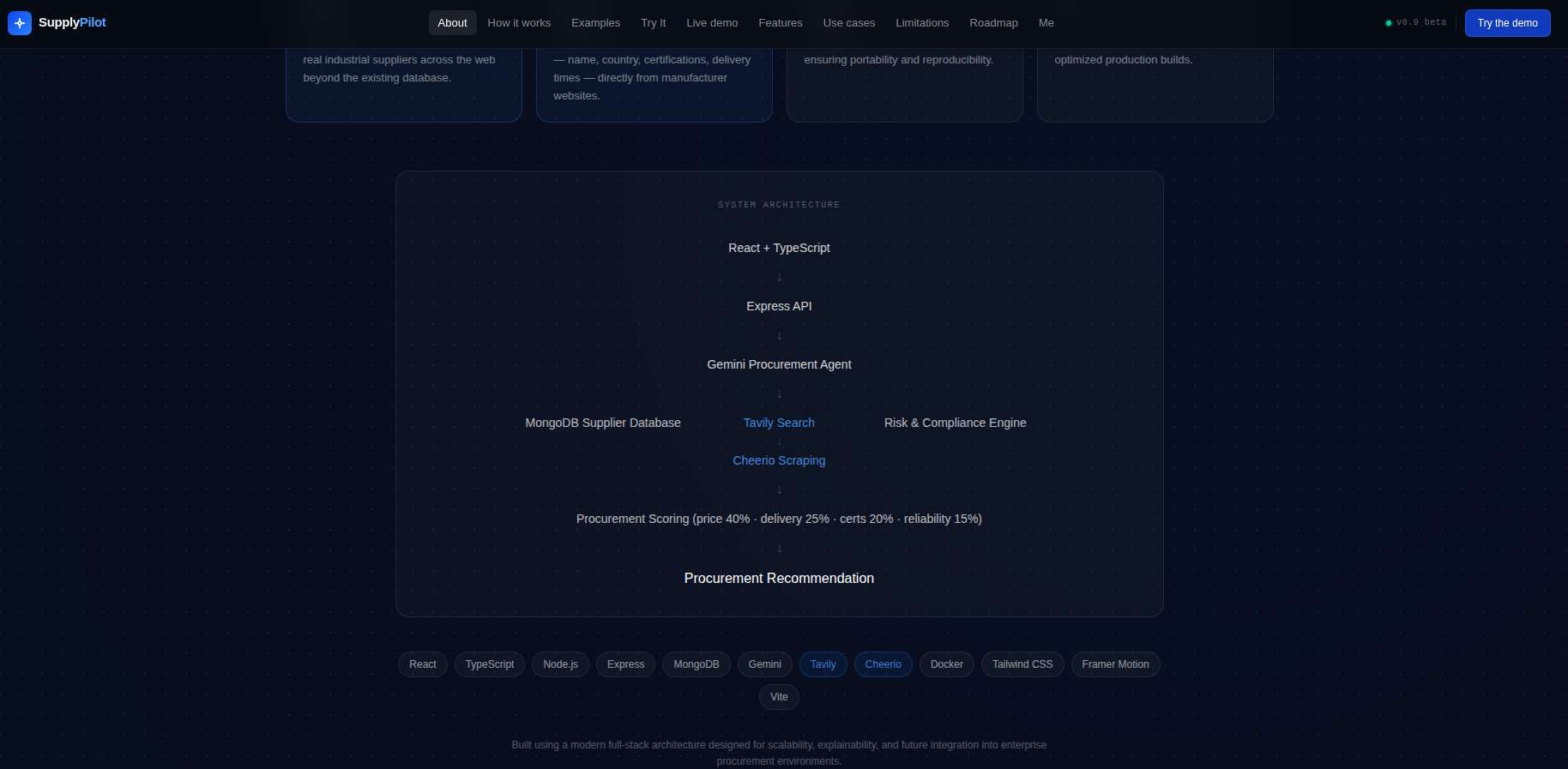
For this system, I focused on building a robust, deterministic full-stack architecture capable of controlling and guiding non-deterministic AI models.
- Backend Runtime: Powered by Node.js and Express to handle asynchronous workflows, API routing, and orchestration.
- Database Layer: Implemented MongoDB to store trusted internal supplier records, active quote metrics, and historical decision reports.
- AI Core & Tool Orchestration: Integrated Google Gemini models via native function calling to handle advanced reasoning, planning, and dynamic tool routing.
- Web Intelligence Layer: Combined Tavily Search with custom web scrapers and a data-normalization matrix to extract live structured entities from supplier web pages.
- Data Validation: Enforced strict JSON schemas to ensure the AI's outputs can be directly digested by the system without breaking.
Challenges I faced
One of the main challenges was managing agentic behavioral drift, where autonomous LLMs given free rein of tools would deviate from instructions, skip verification steps, or get trapped in infinite loops. I solved this by building a stateful loop in the backend that bounds the agent to a maximum of five iterations.
Another challenge was web data reliability. Industrial website formatting varies wildly, which regularly produced noisy or fragmented text extractions. I mitigated this by establishing an isolation layer with a custom confidence scoring threshold to automatically filter out low-quality data.
Finally, preventing hallucinations regarding critical safety certifications was essential. I strictly enforced a tool-bound prompting policy where any missing web data is programmatically handled as a null value, making it impossible for the agent to invent supplier capabilities.
What I learned
This project helped me deepen my understanding of:
- System engineering over simple prompt engineering, focusing on orchestrating models around strict execution guardrails
- Product thinking: building a deterministic and reliable workflow for real users rather than a simple conversational demo
- Practical decision theory, translating abstract qualitative human business demands into structured mathematical equations
- Dynamic mathematical scoring, using a weighted matrix formula to score and rank alternatives contextually:
$$S_j = \sum_{i=1}^{n} w_i \cdot x_{ij}$$
Most importantly, I learned how to build deterministic boundaries around AI agents to ensure enterprise-grade reliability in high-stakes operational environments.
What’s next
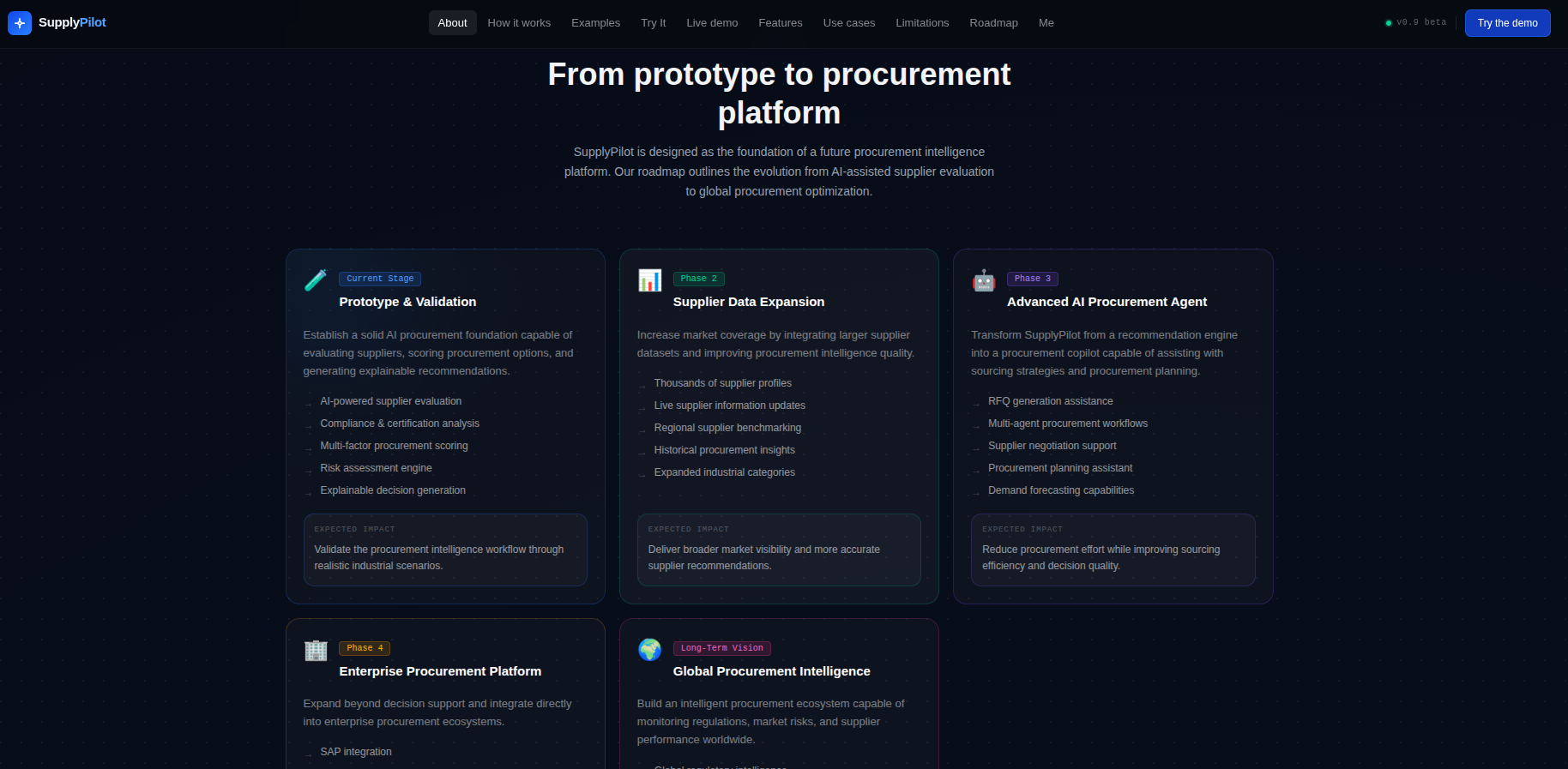
SupplyPilot AI is designed as a foundation for a production-scale enterprise procurement SaaS. Planned improvements include:
- MCP Integration: Implementing the Model Context Protocol to seamlessly connect the agent with legacy corporate ERP systems
- Real-Time Logistics APIs: Integrating direct live feeds from international shipping and supplier inventory networks
- Advanced ML Ranking: Deploying specialized machine learning models for finer multi-criteria procurement optimization
- Multi-Agent Collaboration: Evolving the system into an architecture where specialized sourcing, risk, and negotiation agents collaborate autonomously
Built With
- api
- cheerio
- express.js
- gemini
- javascript
- mongodb
- node.js
- react
- scraping
- search)
- tavily
- typescript
- web

Log in or sign up for Devpost to join the conversation.