Inspiration
Manufacturing procurement involves more than finding the cheapest supplier. Teams must protect existing inventory reservations, identify shortages, compare delivery commitments, and handle situations where suppliers change their terms after an order is placed.
We wanted to turn this fragmented process into one guided conversation, with agents handling the coordination while people remain in control of consequential decisions.
What it does
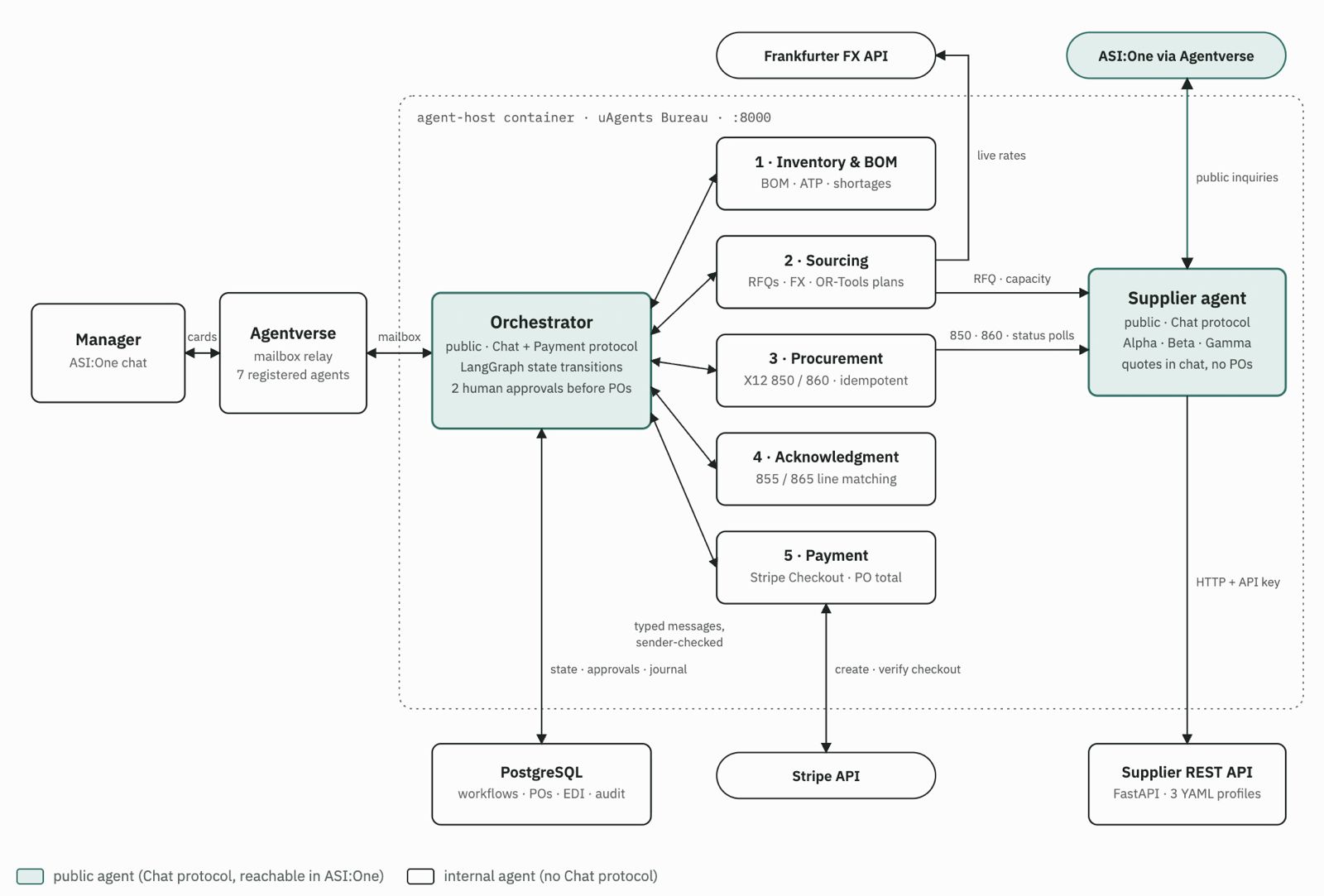
SupplyMesh turns manufacturing demand into confirmed supplier orders through seven collaborating Fetch.ai agents.
Inside ASI:One, users can:
- Enter a product, quantity, deadline, and budget.
- Review inventory availability and component shortages.
- Compare cheapest, fastest, balanced, risk-aware, and split procurement plans.
- Select a plan, review purchase orders, and approve supplier submission.
- Review acknowledgment discrepancies involving prices, quantities, or delivery dates.
- Accept revised terms, negotiate counterproposals, or cancel an affected order and source replacements.
- Complete Stripe checkout and ask the Supplier Agent for structured order history.
Interactive cards guide the entire workflow without requiring a custom frontend.
How we built it
We built seven specialized agents using Fetch.ai's uAgents framework and registered them on Agentverse:
- Orchestrator Agent — Coordinates the workflow and user decisions.
- Inventory Agent — Expands the bill of materials and calculates shortages.
- Sourcing Agent — Collects quotations and optimizes procurement plans.
- Procurement Agent — Submits approved orders and counterproposals.
- Acknowledgment Agent — Compares supplier responses against approved terms.
- Supplier Agent — Invokes backend tools for three simulated suppliers.
- Payment Agent — Creates Stripe checkout sessions and verifies payment status.
The Orchestrator Agent and Supplier Agent expose the Agent Chat Protocol, while internal specialist agents communicate through typed agent messages.
We also use:
- LangGraph to manage workflow transitions.
- OR-Tools to calculate procurement plans.
- PostgreSQL to preserve approvals, orders, inventory state, and transaction evidence.
- X12 850, 855, 860, and 865 document subsets for purchase orders, acknowledgments, change requests, and change responses.
- FastAPI to simulate supplier backend services.
- Stripe for payment collection and verification in test mode.
Challenges we ran into
The hardest problems appeared between individual workflow steps: preserving approvals across asynchronous messages, preventing duplicate orders after retries, and ensuring supplier exceptions reached the correct human decision point.
We also worked through ASI:One card rendering and callback behavior, Stripe API compatibility, and cancellation recovery.
Replacement sourcing was particularly challenging because the system needed to preserve unaffected orders while excluding cancelled commitments from the final payable total.
Accomplishments that we're proud of
- Demonstrated the complete procurement workflow inside ASI:One.
- Connected seven agents with clearly separated responsibilities.
- Built deterministic inventory calculations and procurement optimization.
- Implemented supplier counterproposals and cancellation followed by replacement sourcing.
- Integrated Stripe payment collection and payment verification.
- Added persistent supplier order history.
- Reached 196 passing automated tests, including failure and recovery scenarios.
What we learned
Useful agents need more than conversational ability. They need precise contracts, durable state, reliable tools, and clear boundaries around human approval.
We learned to keep quantities, prices, and optimization deterministic while treating retries, supplier disagreements, timeouts, and missing responses as normal workflow conditions rather than exceptional cases.
We also learned that human-in-the-loop approval is especially important when agents can create purchase orders, accept changed supplier terms, or trigger payments.
What's next for SupplyMesh
Our next steps are to connect SupplyMesh with real supplier and ERP systems, support partial-order changes, add supplier payouts and settlement reconciliation, and improve natural-language demand intake.
We also want to incorporate live supplier performance data into sourcing decisions, expand payment workflows beyond test mode, and validate the system with real manufacturing teams.
AgentVerse Agent profile Links
Main chat link: https://asi1.ai/shared-chat/0ccaf833-acd3-4879-977b-b2725e62238a
Orchestrator: https://agentverse.ai/agents/details/agent1qtfzla78vr2uznva9twcsz5xseyzs4z9paxk3zu8p49mdh5h72g92u5r6wk/profile
Inventory Agent: https://agentverse.ai/agents/details/agent1qv78af3vcpfs8h6pzcejdwh9m7ngv3am8sffxex9h0wx9c0ym032zsjqaju/profile
Sourcing agent: https://agentverse.ai/agents/details/agent1qv3yeapk5geq08cjy26fulegzkaaptwcerlwkdpmzxmd6rjttujcvxa6dck/profile
Procurement Agent: https://agentverse.ai/agents/details/agent1qd2pyy575l0j28c5kyeg983vwu05zt3rcwdc8l7hy0vwl2drn8g4qrnhnu0/profile
Acknowledgement Agent: https://agentverse.ai/agents/details/agent1qfuvuuuet7ln6hnqr2lwcyfth98jawsn9kk8nje34ll7n82wkzzcwrvre9d/profile
Payment Agent: https://agentverse.ai/agents/details/agent1qfwnq0vzswz78u8agrzf6w03ta8jnfn3g37pwsdl6uzylkw60dde5wjfp5d/profile
Supplier Agent: https://agentverse.ai/agents/details/agent1qthxr3f0nanzd0378r3slchtxj0rl6tlv3qpxma37jsc938p9crw54sgphk/profile
Built With
- agentpaymentprotocol
- asi:one
- asiinteractivecards
- fetch.ai
- langgraph
- postgressql
- python
- uagents


Log in or sign up for Devpost to join the conversation.