Inspiration
Modern enterprise supply chains are incredibly fragile. When a disruption hits—like a delivery truck breaking down or a supplier unexpectedly running out of stock—it triggers a slow, manual cascade. Procurement teams spend hours scraping backup vendors, compliance teams scramble to verify new certifications, and managers blindly dig through analytics trying to assess the financial damage.
We realized the problem isn't a lack of software; it's a lack of orchestration. Enterprises aren't reactive because their tools are siloed. We were inspired to build SupplyGraph: an orchestration layer that turns siloed enterprise software into an autonomous, self-healing ecosystem.
What it does
SupplyGraph is an autonomous enterprise demo platform that handles supply chain disruptions instantly without human intervention.
Instead of humans reacting to a crisis, our AI agents handle it. When our platform detects a truck breakdown, a Dify AI agent is automatically dispatched to find a backup supplier. It then uses Zero-Knowledge Proofs (ZKPs) to instantly verify the new supplier's organic certifications without exposing private data. Once verified, it executes an emergency reorder through our MedusaJS B2B storefront.
Most importantly, because enterprise buyers demand security, every single action the AI makes—from querying metrics to resolving disruptions—is captured and logged in a live, real-time SOC2-compliant PostHog Audit Ledger. SupplyGraph doesn't just show you data on a dashboard; it takes action, fixes the problem, and leaves an immutable audit trail.
How we built it
We architected SupplyGraph around the Model Context Protocol (MCP), treating every enterprise department as a programmable tool for our agents.
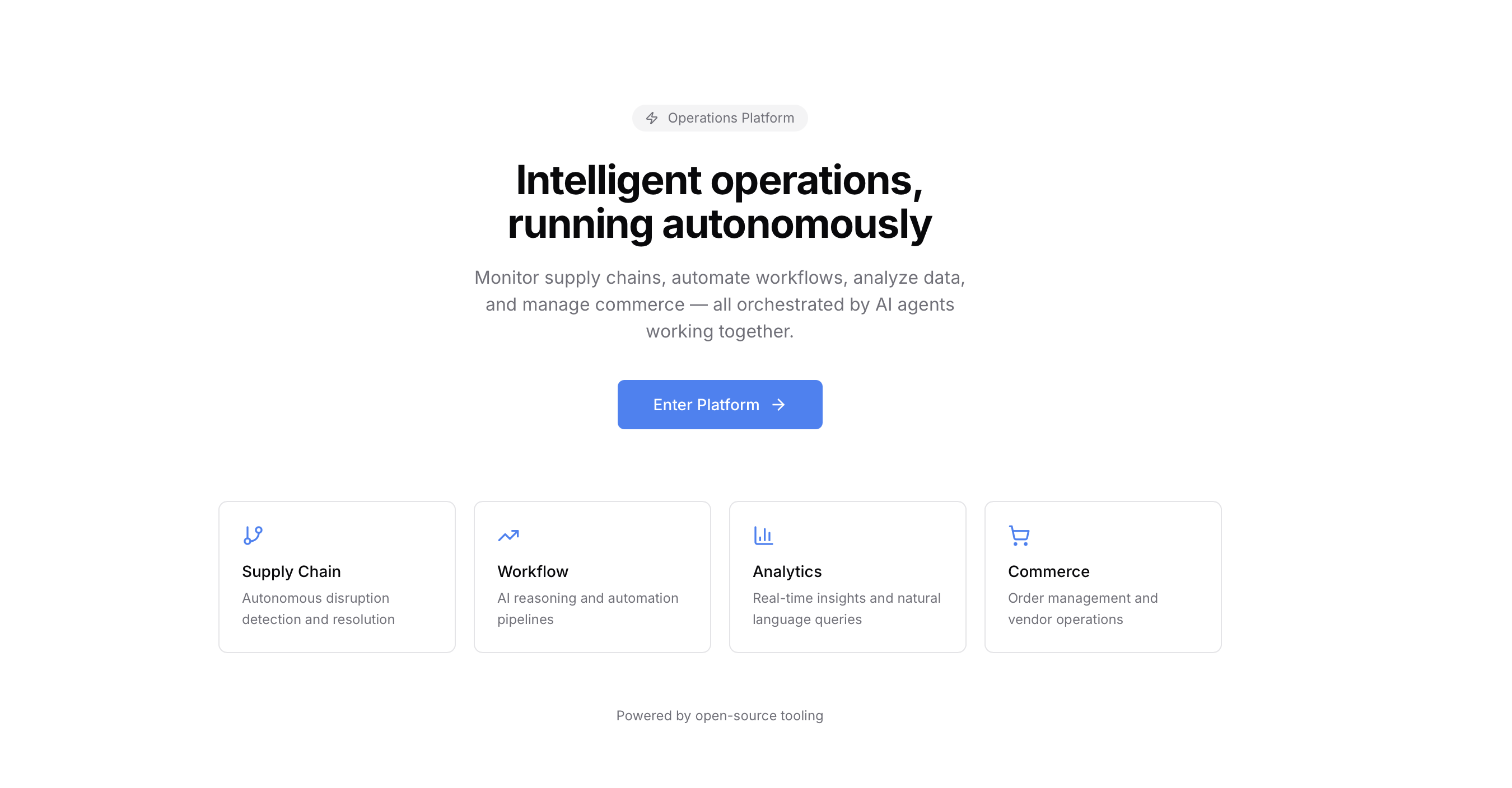
- Frontend: Built with React 18, Vite, TypeScript, Recharts, and Framer Motion. We designed a premium "glassmorphism" dashboard that visualizes the autonomous actions occurring across the supply chain, workflow, commerce, and analytics modules in real-time.
- Backend: Powered by Python 3.11 and FastAPI. We utilized Server-Sent Events (SSE) and WebSockets to stream the live, multi-step agent resolution pipelines directly to the client.
- The AI Engine: We used Dify to power the episodic memory and decision-making logic of our agents.
- Compliance & Audit: We integrated
snarkjsto simulate the cryptographic ZKP verification of vendor certifications. For the enterprise audit trail, we integrated the PostHog Python and JS SDKs to capture live events and surface them in a secure JSON ledger.
Challenges we ran into
Building a unified narrative across 4 distinct enterprise modules (Fleet operations, Agentic Workflows, Analytics, and B2B Commerce) in under 36 hours was a massive architectural challenge.
Furthermore, simulating a live, real-time AI agent environment required us to heavily optimize our backend. Managing the WebSocket connections for the live MCP dispatch stream, alongside the SSE (Server-Sent Events) pipeline for the truck breakdown scenario, caused initial race conditions and UI desyncs that we had to carefully untangle using React .current refs and strict state management.
Accomplishments that we're proud of
We are incredibly proud of the Enterprise Audit Trail feature. In enterprise SaaS, simply saying "we use AI" isn't enough; compliance teams need exact proof of what the agent did. Wiring up a live, real-time PostHog ledger that captures every autonomous action (down to the microsecond) and allows users to inspect the exact JSON payload the AI sent bridges the gap between "cool hackathon AI" and "production-ready enterprise software."
What we learned
We learned the sheer power of the Model Context Protocol (MCP) as a standard for enterprise middleware. By wrapping complex, domain-specific systems (like MedusaJS e-commerce or Fleetbase logistics) into standardized MCP tools, AI agents can orchestrate mind-bogglingly complex procedures—like autonomous re-ordering and compliance verification—in fractions of a second.
What's next for SupplyGraph
Our immediate next step is integrating TinyFish autonomous web agents into our workflow. Currently, finding a backup supplier relies on assumed internal databases. With TinyFish, if a primary supplier fails, SupplyGraph could dispatch an autonomous web agent to browse live third-party vendor websites, verify their actual stock levels and pricing in real-time natively, and execute the purchase entirely outside of formal APIs.
Built With
- dify
- fastapi
- mcp
- python
- tinyfish
- typescript


Log in or sign up for Devpost to join the conversation.