-
-
Welcome
-
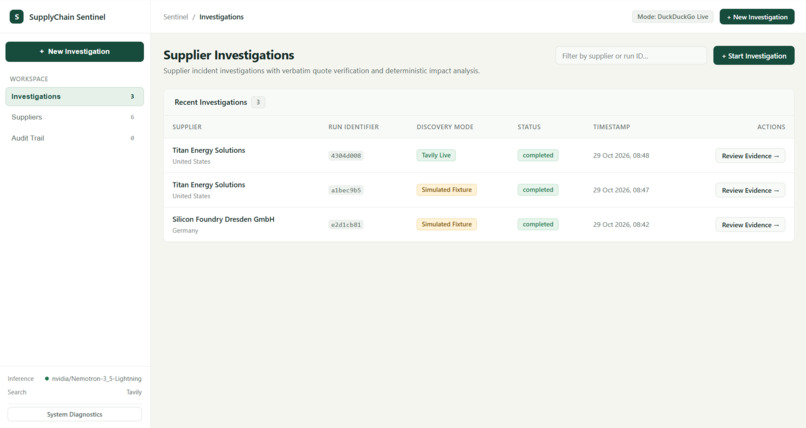
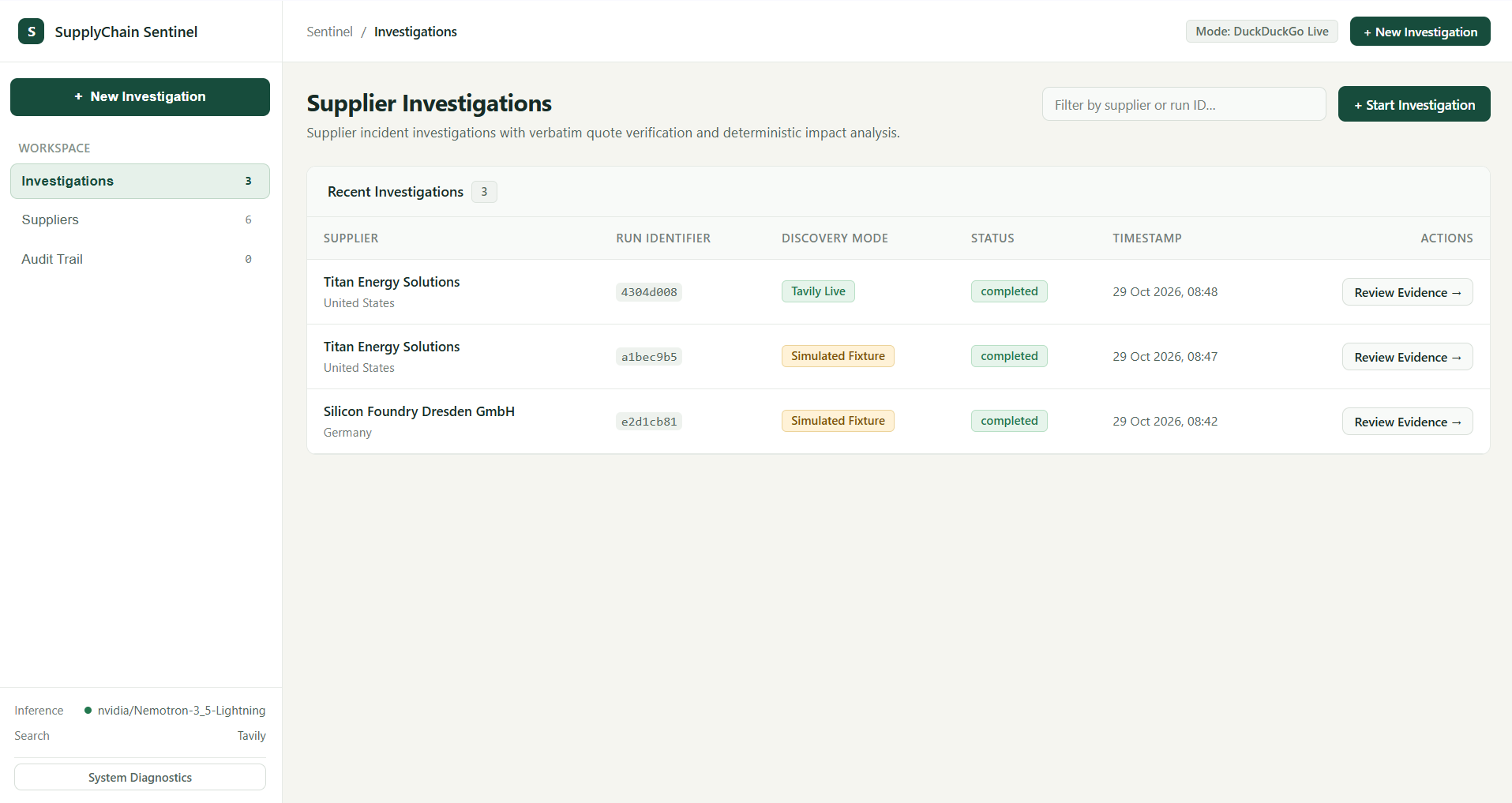
Interface and UI
-
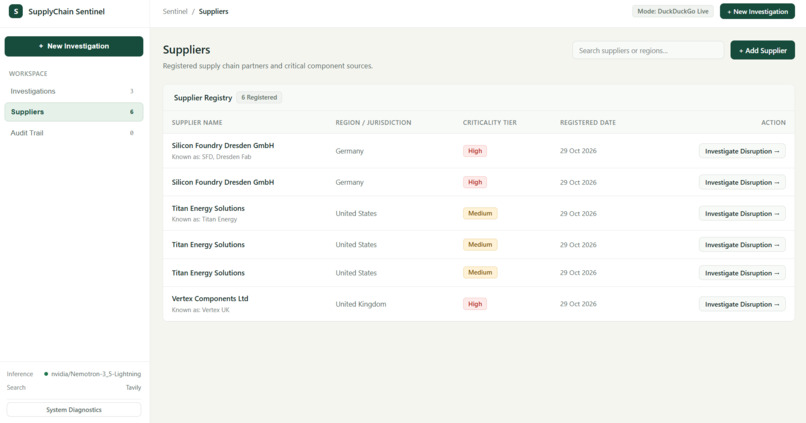
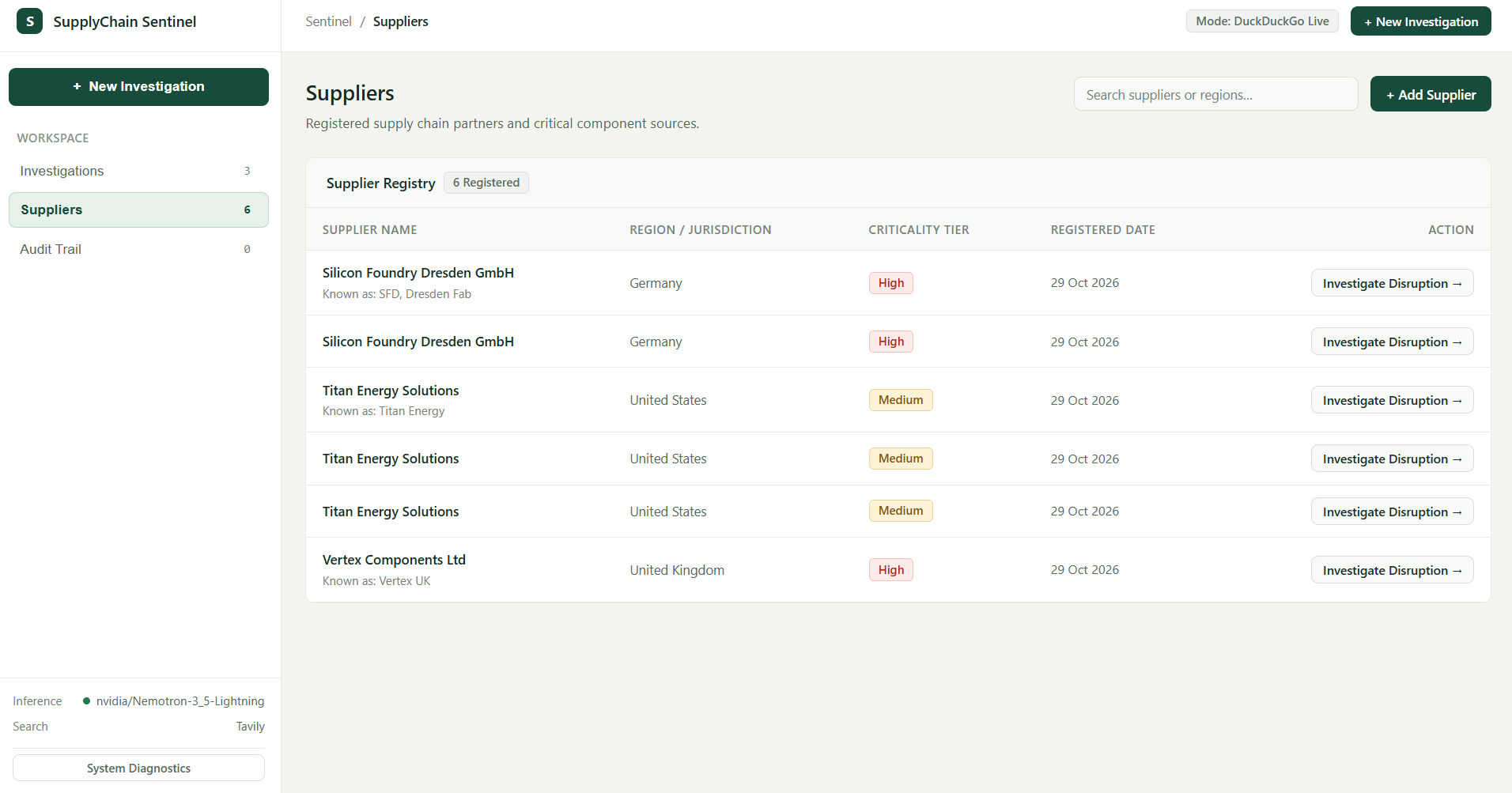
Supplier Data base
-
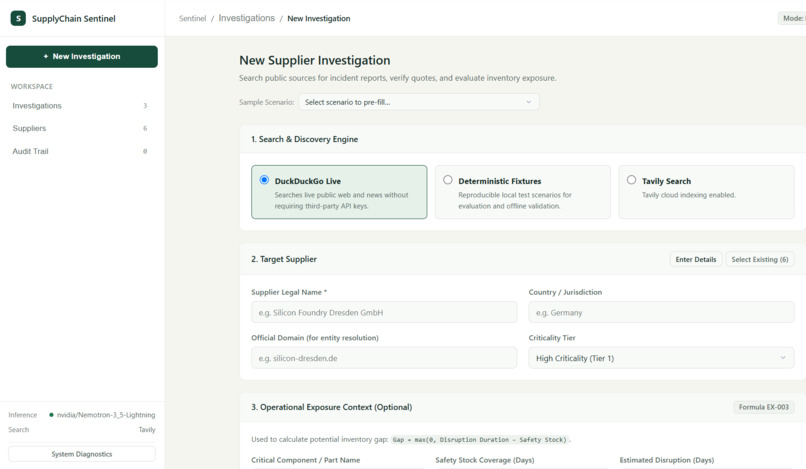
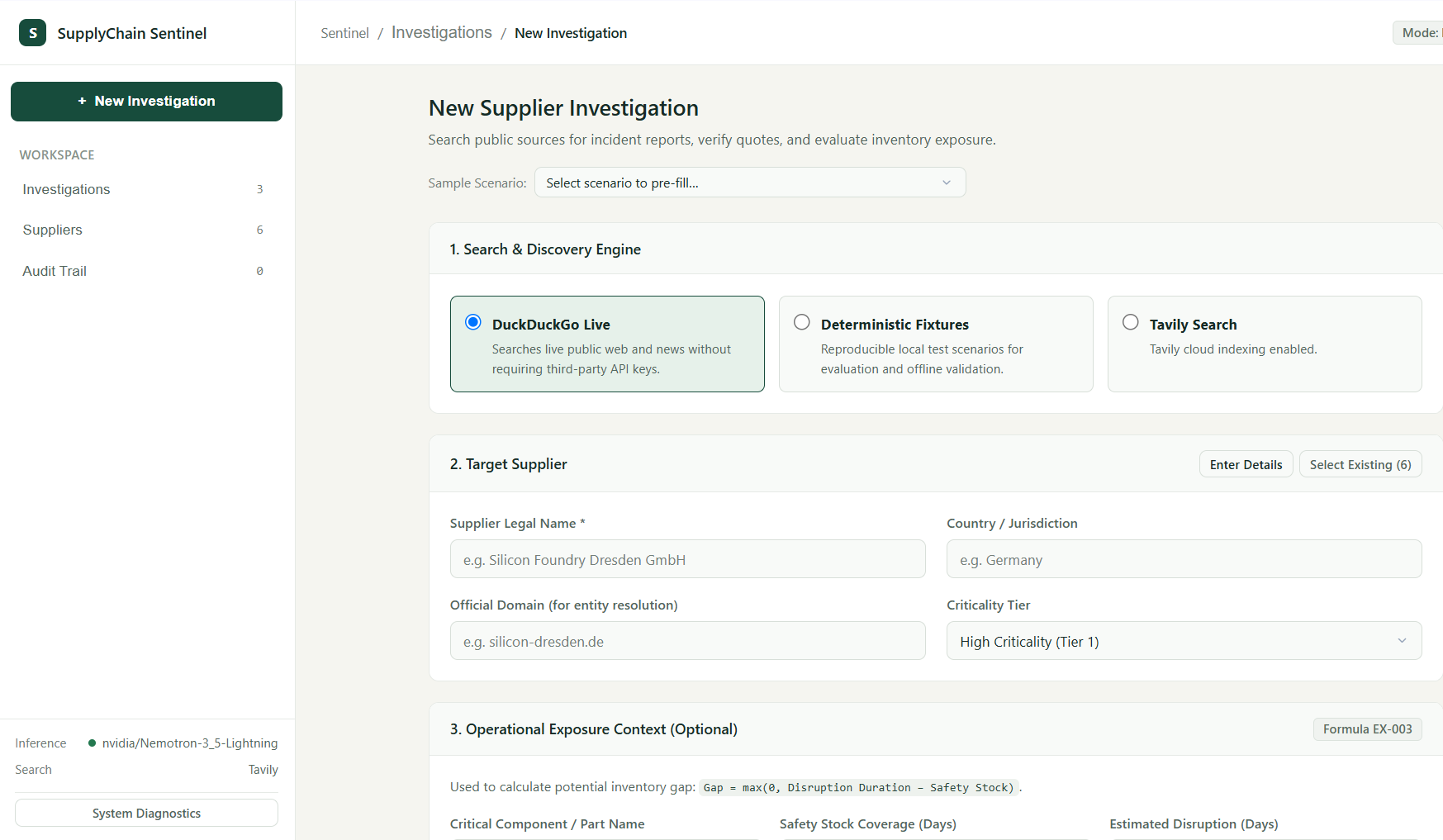
Investigation Module
-
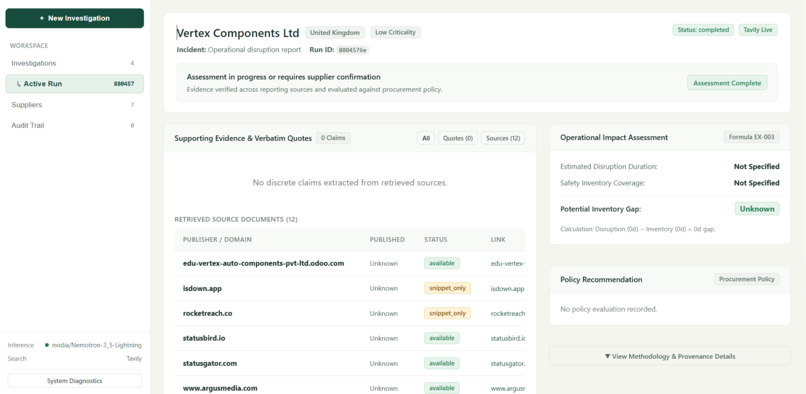
Sample Case Scenario
-
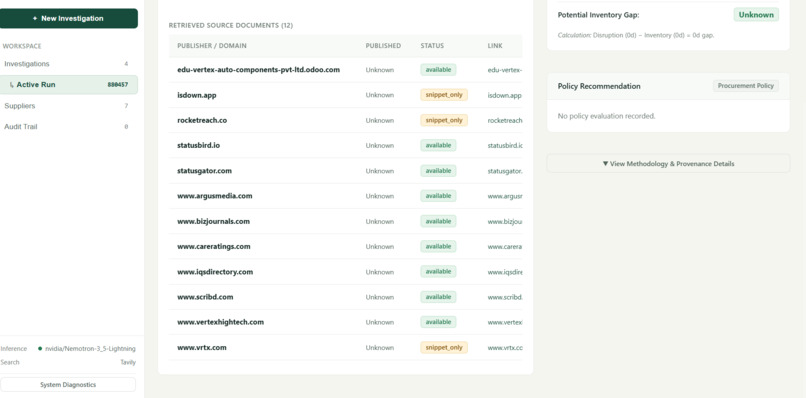
Retrieved Score Document
-
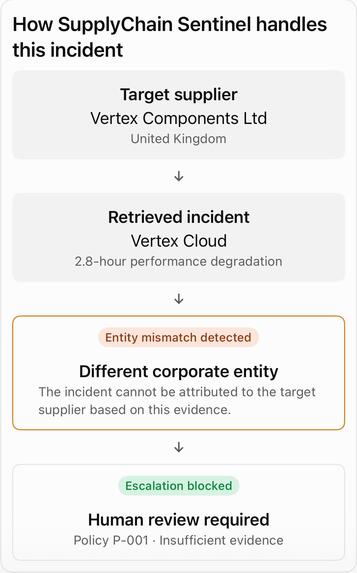
How We handle this efficiently
-
Thank You (from Aditya and Akshat)
Inspiration
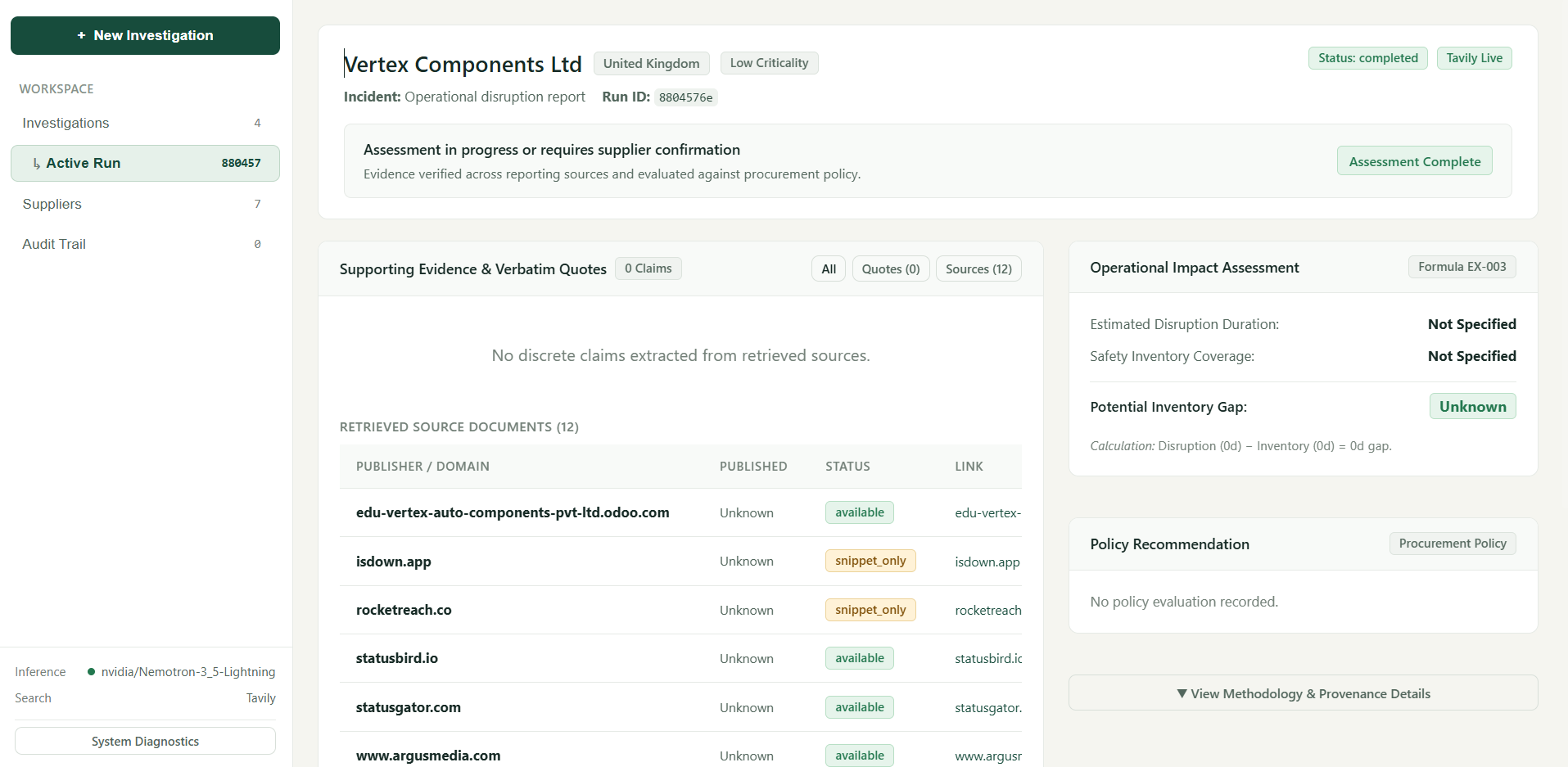
Modern businesses depend on complex supplier networks for raw materials, manufacturing, logistics, and essential services. A supplier-related incident—whether an environmental violation, a labor concern, a safety issue, or a regulatory breach—can create serious risks for the companies that depend on them.
However, identifying these risks is not as simple as searching the internet. Information can be outdated, duplicated across news outlets, associated with a similarly named company, or presented without reliable supporting evidence. An AI-generated conclusion may sound convincing while still being incorrect.
We wanted to address this gap by building SupplyChain Sentinel, an AI-powered supplier risk intelligence platform that helps procurement teams investigate supplier-related incidents, evaluate evidence, and make better-informed decisions.
Our central idea was simple: verify the evidence before recommending action. Instead of treating every search result or AI-generated statement as fact, the system is designed to distinguish between verified findings, uncertain information, and claims that require human review.
What We Built
SupplyChain Sentinel brings supplier investigation and evidence assessment into a single workflow. Its architecture combines AI-assisted information processing with deterministic rules and human oversight.
The system is designed around several key capabilities:
- Multi-source information gathering: Collect potentially relevant information about supplier incidents from web sources.
- Evidence extraction and verification: Examine claims against their supporting information rather than relying solely on generated summaries.
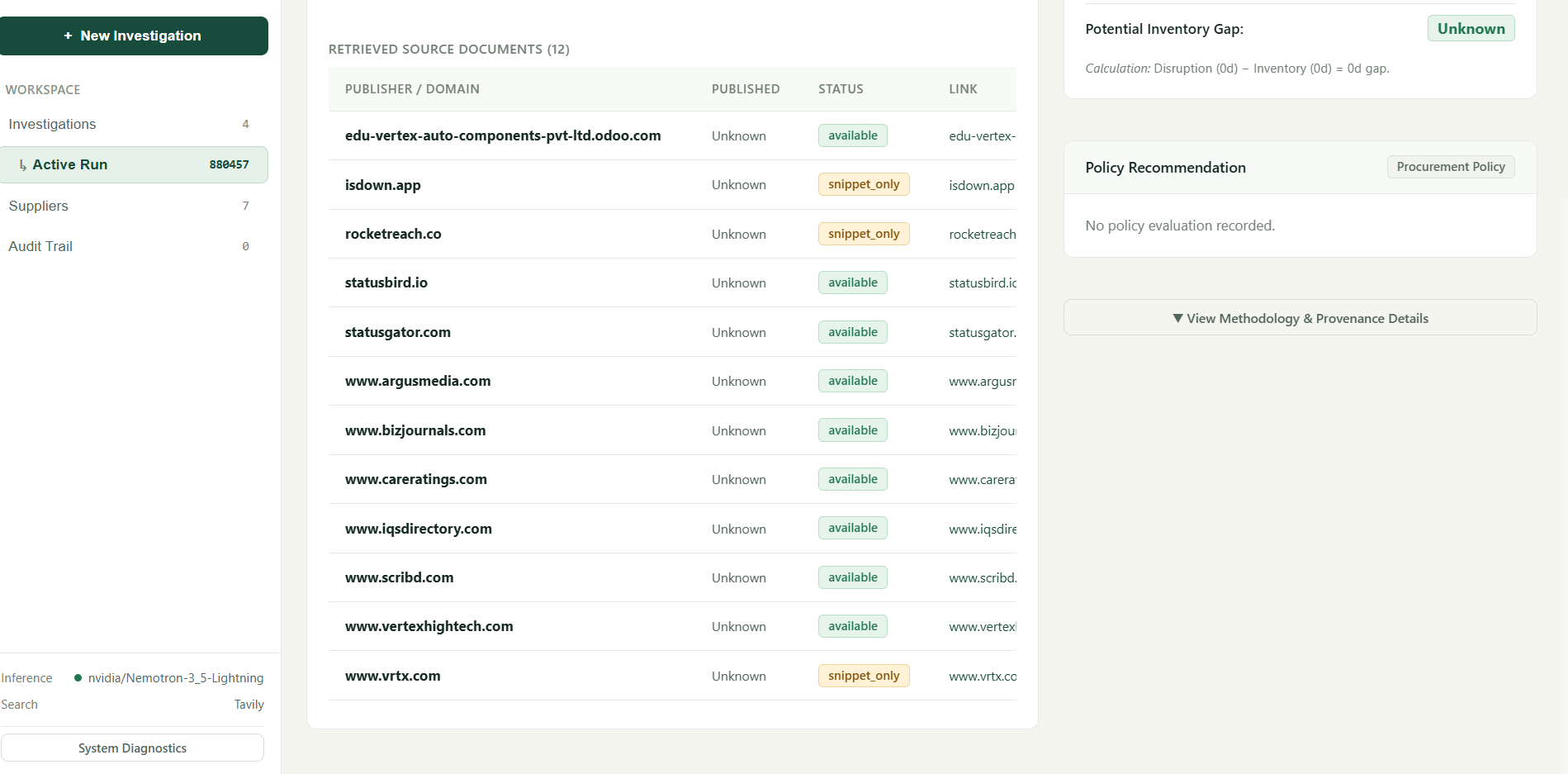
- Duplicate detection: Identify syndicated or repeated news reports so that the same incident is not mistakenly treated as multiple independent signals.
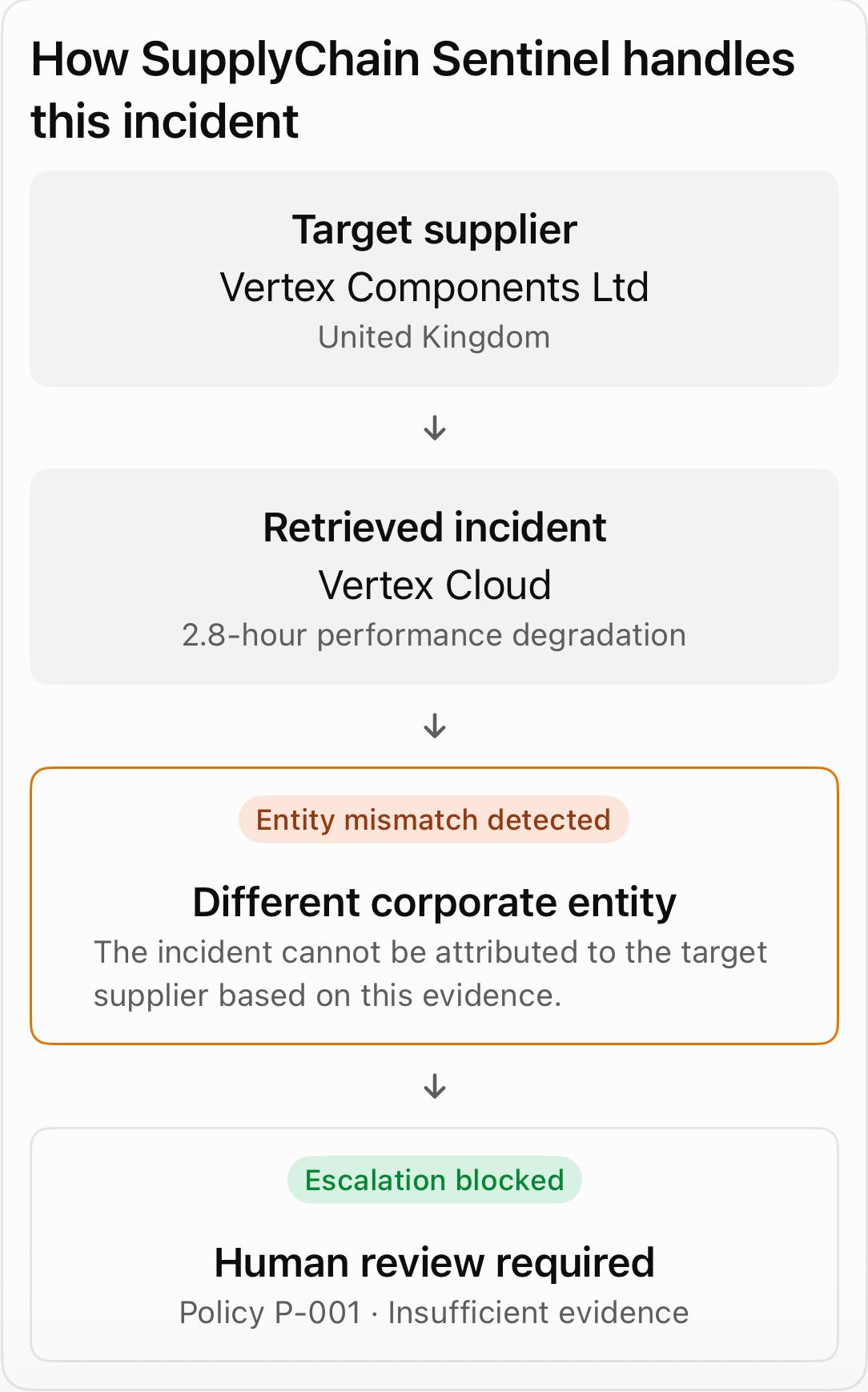
- Entity resolution: Help distinguish the intended supplier from other organizations with similar names.
- Policy-based risk assessment: Apply explicit rules to investigation findings rather than allowing an AI model to make every decision on its own.
- Human review: Flag uncertain or conflicting findings for review instead of automatically turning them into definitive conclusions.
The project follows a modular architecture so that the language-model provider can be configured independently of the rest of the investigation pipeline.
How We Built It
We approached SupplyChain Sentinel as an engineering problem, not simply a chatbot that answers questions about suppliers.
We organized the system into components responsible for gathering information, processing evidence, evaluating claims, applying policy rules, and presenting investigation results through a web interface.
The backend handles the investigation workflow, while the frontend provides a dashboard for exploring investigations and their results. We also developed test scenarios to evaluate how the system handles relevant incidents, irrelevant information, ambiguous supplier identities, duplicate reporting, and mismatches between claims and evidence.
A key design decision was to separate AI-assisted analysis from deterministic policy enforcement. The model can help interpret information, but explicit application rules provide a more controlled basis for determining whether a finding should be accepted, flagged, or escalated.
We also designed the language-model integration to support different providers. During local development, we used the fake provider to test the application's workflow without depending on a live model API. The real-model integration is a separate configuration and validation step.
Challenges We Faced
One of our biggest challenges was recognizing that finding information is not the same as verifying it.
A search result may mention a supplier without actually referring to the organization being investigated. Several websites may repeat the same original report. A generated summary may also introduce a claim that the source does not support.
We addressed these problems by designing explicit checks for entity identity, duplicate reporting, and evidence-to-claim consistency. We also included deterministic policy checks and human review to reduce the risk of treating uncertain information as established fact.
Another challenge was building and testing the application as a complete system. The frontend, backend API, external search integration, and language-model provider each introduce different failure points. We therefore tested the components locally, resolved integration issues, and worked toward a reproducible demonstration workflow.
Working with a modular architecture also taught us the importance of separating configuration problems from application logic. For example, the application can run locally in fake-provider mode, but that alone does not prove that a real language model is reachable or that its output is reliable.
What We Learned
Building SupplyChain Sentinel taught us several important lessons:
- Evidence matters more than confident language. A convincing AI response is not necessarily a correct one. Claims need traceable support.
- AI works better with clear boundaries. Combining AI-assisted analysis with deterministic rules makes the decision process more controlled and easier to test.
- Data quality is a major engineering challenge. Duplicate reports, ambiguous names, irrelevant results, and unsupported claims can undermine an otherwise capable system.
- Human oversight is valuable. Uncertain or conflicting evidence should be surfaced for review rather than hidden behind a single risk score.
- Reliable software requires testing beyond the happy path. A system must also handle irrelevant evidence, ambiguous identities, missing information, and failed integrations.
- A working interface is only one part of the solution. Backend reliability, evidence quality, configuration, and reproducibility are equally important.
What's Next
We want to continue improving SupplyChain Sentinel by validating the real language-model integration, expanding our supplier-risk test cases, improving evidence traceability, and evaluating the system against more realistic procurement scenarios.
Our longer-term goal is to make supplier risk investigation more transparent, reproducible, and useful to procurement teams—helping them identify potential problems earlier without confusing unverified allegations with established facts.
SupplyChain Sentinel is built around one principle: AI can help discover and interpret information, but decisions should be grounded in evidence.
Built With
- artificial-intelligence
- automation
- data-analysis
- duckduckgo
- evidence-verification
- fastapi
- generative-ai
- llm
- nebius
- nemotron
- nvidia
- ollama
- pydantic
- pytest
- python
- react
- risk-management
- supply-chain
- tavily
- typescript

Log in or sign up for Devpost to join the conversation.