-
-
Banner
-
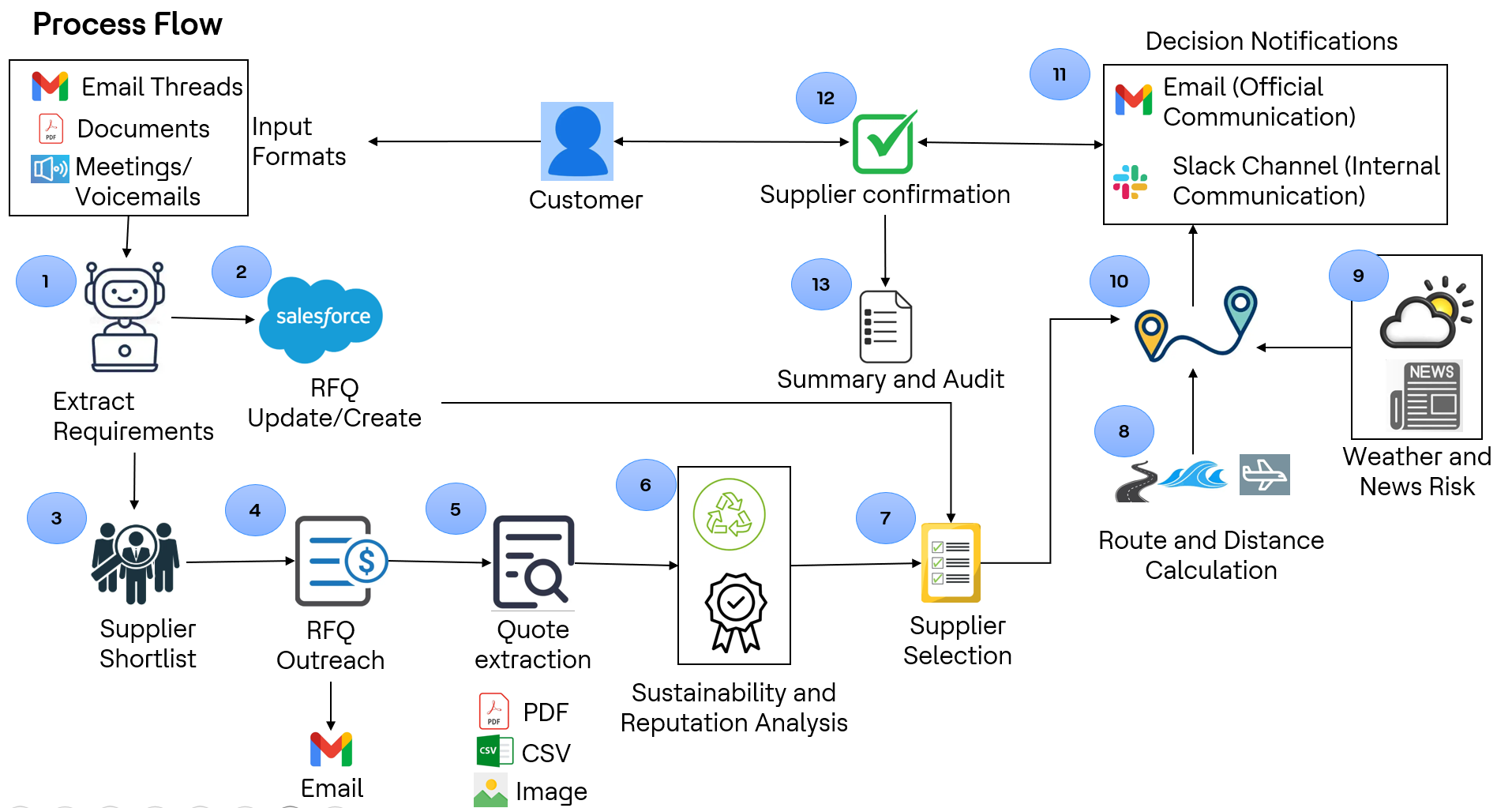
Process Flow
-
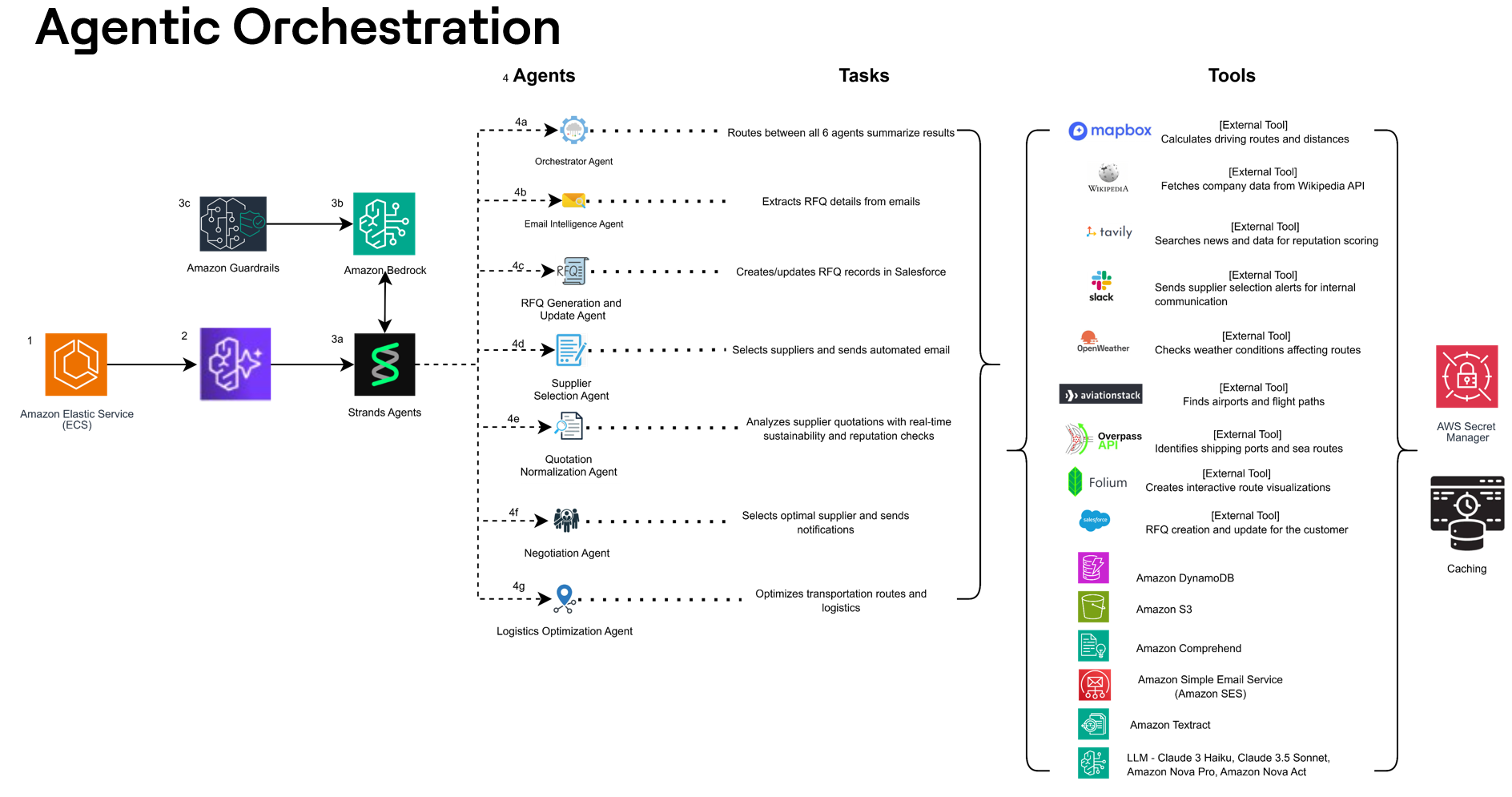
Agentic Flow
-
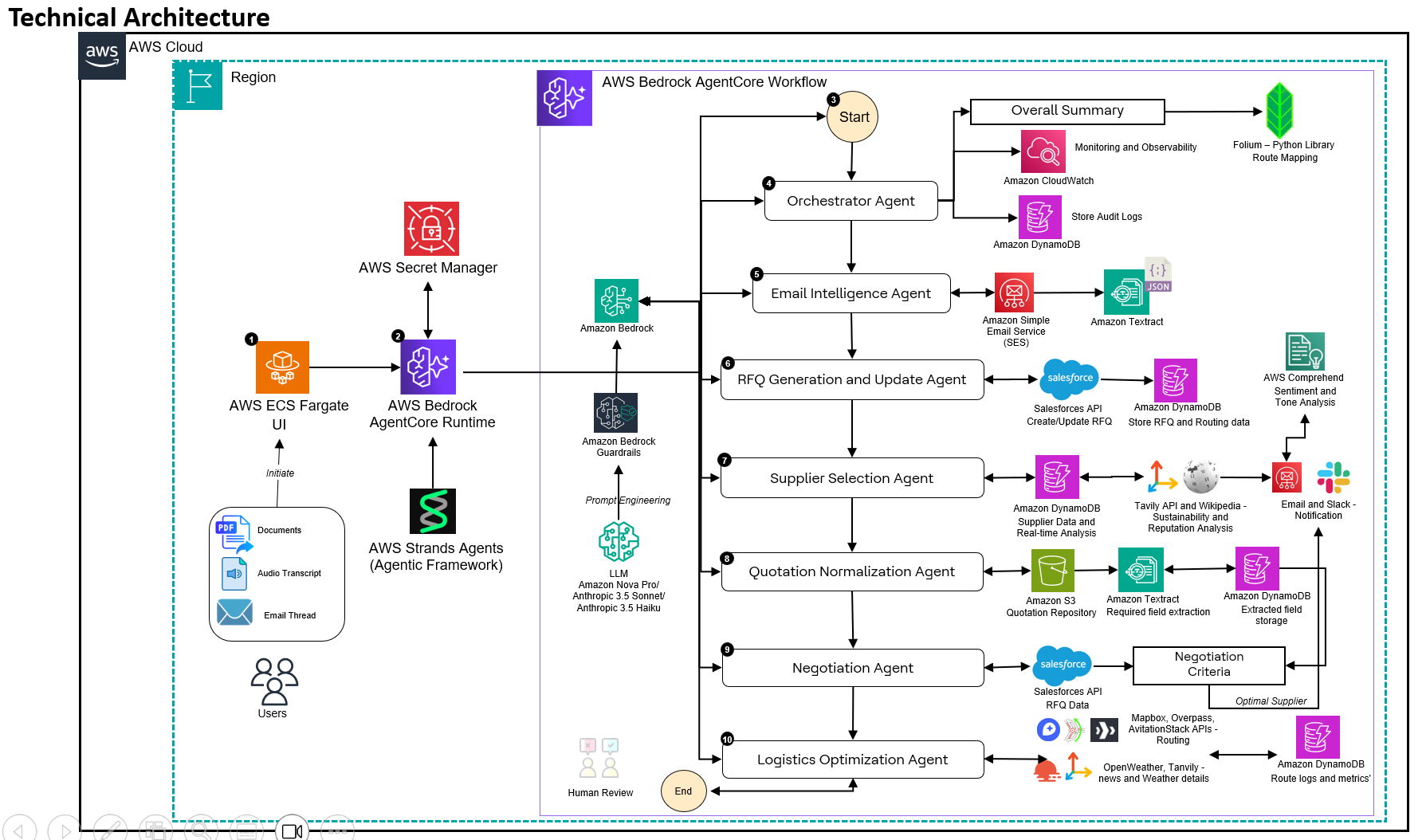
AWS Tech Architecture
Inspiration
Supply chains today are highly digital yet painfully unstructured. Procurement teams still manage RFQs, supplier quotes, and logistics plans through emails, PDFs, and spreadsheets. Data lives in silos across systems like Salesforce, ERP, and Slack — making every sourcing cycle slow, manual, and reactive.
What it does SupplyChain Copilot automates the RFQ-to-Fulfillment lifecycle using coordinated GenAI agents hosted on Amazon Bedrock Strands Agents.
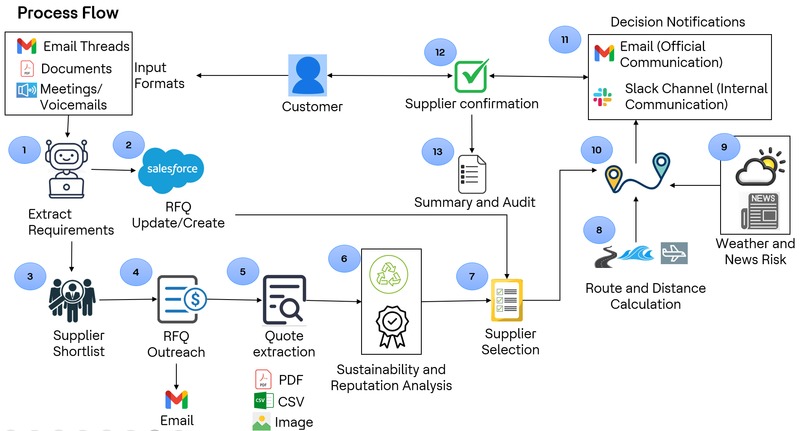
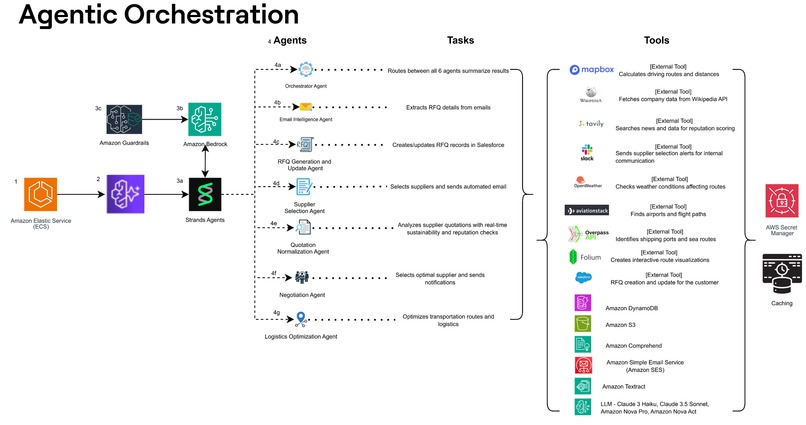
It acts as an intelligent digital coworker that: Reads unstructured supplier emails and attachments to extract structured RFQ data. Creates or updates RFQs in Salesforce and DynamoDB. Identifies and scores suppliers based on price, delivery lead time, and quality. Normalizes quotes and evaluates each supplier’s reputation & sustainability using Wikipedia + Tavily web data. Drafts negotiation or award emails and posts updates to Slack via AWS SES + Comprehend sentiment checks. Plans optimal shipping routes (Air / Sea / Road) using live data from MapBox, AirLabs, Open-Meteo, and Folium for visualization. A Supervisor Agent (Nova Pro) orchestrates all six sub-agents, monitors state, manages retries, and produces an end-to-end audit summary of every sourcing decision.
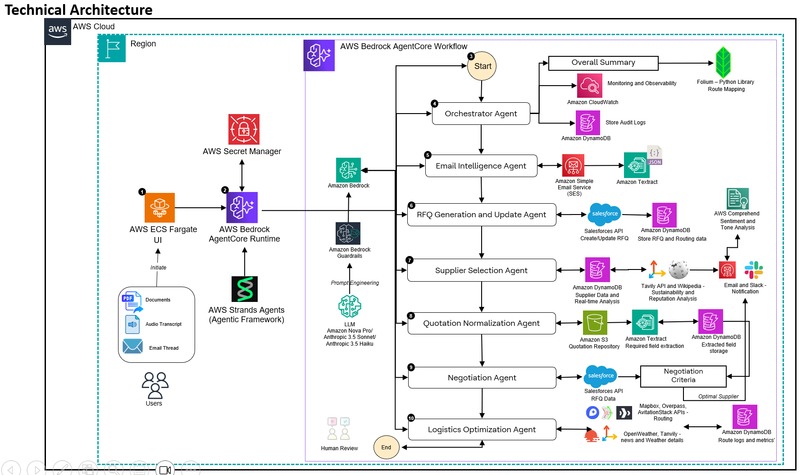
How we built it Framework: Amazon Bedrock AgentCore Runtime + Strands Agents SDK
Models Used: amazon.nova-pro-v1:0 – Supervisor orchestration & reasoning anthropic.claude-3-5-sonnet-20241022-v2:0 – Negotiation, analysis, summaries anthropic.claude-3-5-haiku-20241022-v1:0 – Extraction & normalization
AWS Services: DynamoDB, SES, Textract, Comprehend, S3, CloudWatch External APIs: Salesforce, Slack, MapBox, AirLabs, Tavily, Open-Meteo Implementation Highlights: Each agent was implemented as a Python Strands Agent with specific tools and prompt logic. Supervisor orchestrates 0 → 5 execution via master-agent-runtime-entrypoint.py. Environment security handled through .env bootstrap and AWS Secrets Manager. Audit logs and agent outputs persisted to scm_* DynamoDB tables. Route maps dynamically generated using Folium + MapBox.
Challenges we ran into Designing tool-driven orchestration across three different Bedrock LLMs while keeping responses deterministic.
Managing secure credentials for Salesforce, Slack, and AWS APIs within SageMaker notebooks. Handling asynchronous dependencies between agents (e.g., RFQ creation before supplier evaluation). Balancing latency vs. accuracy when orchestrating multiple Bedrock model calls and API integrations. Ensuring reproducible audit logs and observability through DynamoDB + CloudWatch
Accomplishments that we're proud of Built the first end-to-end GenAI Supply Chain workflow completely on AWS Bedrock + Strands Agents.
Achieved a 70 % reduction in RFQ cycle time compared to manual procurement flows. Demonstrated explainable decision-making with structured audit trails and sustainability scoring. Seamless human-in-the-loop via Slack and SES notifications. Proved that multi-agent reasoning can orchestrate real enterprise workflows safely and transparently.
What we learned Agentic AI = collaboration > automation. Each agent must have a distinct role, tools, and schema.
Nova Pro excels at orchestration reasoning; Sonnet provides structured analysis; Haiku delivers fast text extraction. Prompt engineering discipline and schema validation are key to stable orchestration. Explainability and logging are vital for stakeholder trust in GenAI-driven decisions. Building securely with environment variables and .gitignore hygiene prevents credential leaks in AI projects.
What's next for SupplyChain Copilot – Multi-Agent Orchestration Integrate Amazon Nova Act for autonomous supplier-site browsing and PO creation.
Add Amazon Q Business for natural-language Q&A over RFQ and shipment history. Extend with a Predictive Disruption Engine using historical weather + port data. Introduce Voice RFQs: speech → text → agent pipeline. Apply Guardrails for secure, compliant outbound communication


Log in or sign up for Devpost to join the conversation.