Inspiration
Our inspiration came directly from the market. When we reached out to Diamond Foods during early validation, their team confirmed what we suspected: demand spikes, expiry losses, and last-minute carrier scrambles were recurring pain points — and their tools weren't designed to talk to each other. That conversation became the north star for SupplyMind.
What it does
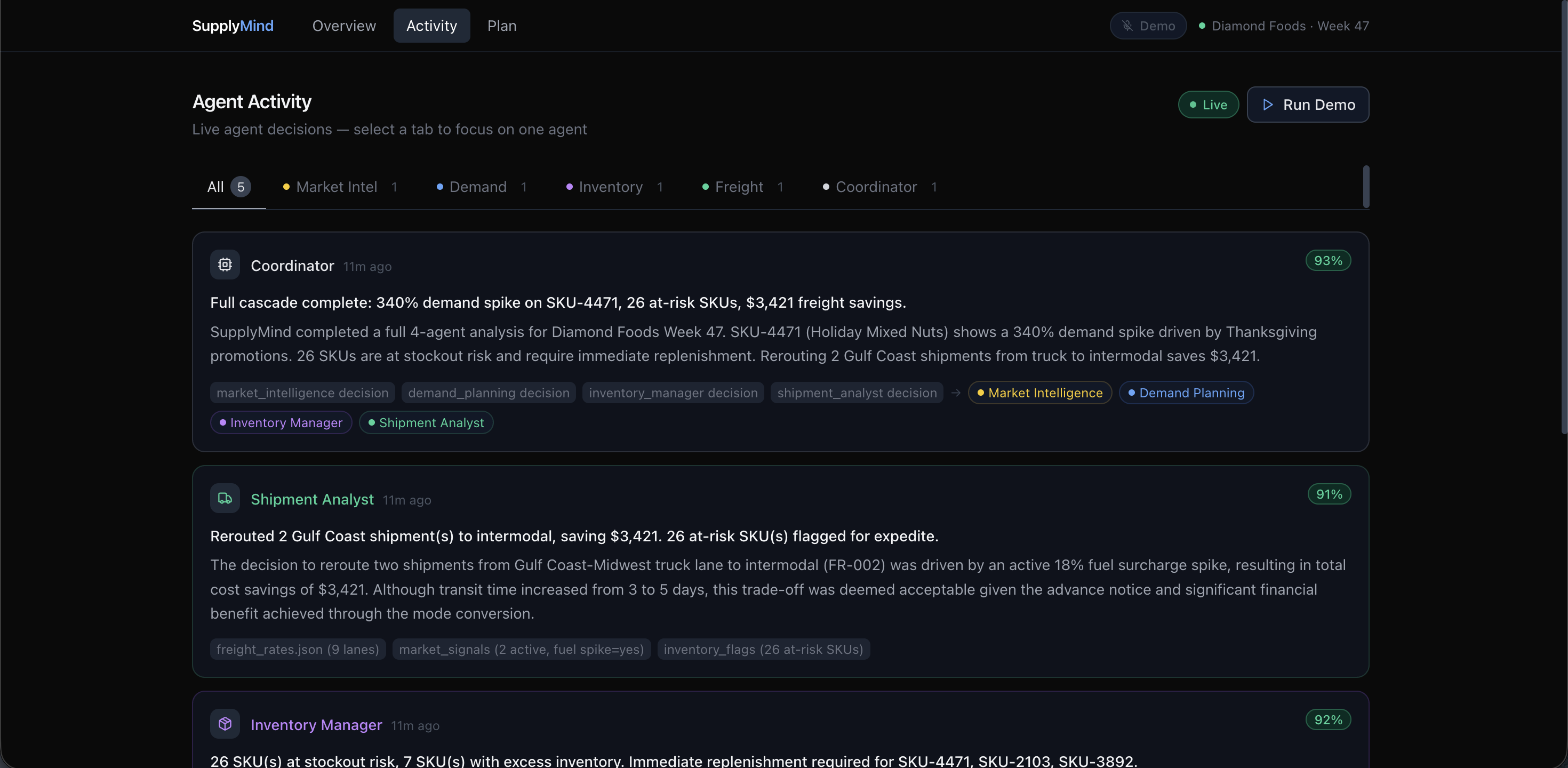
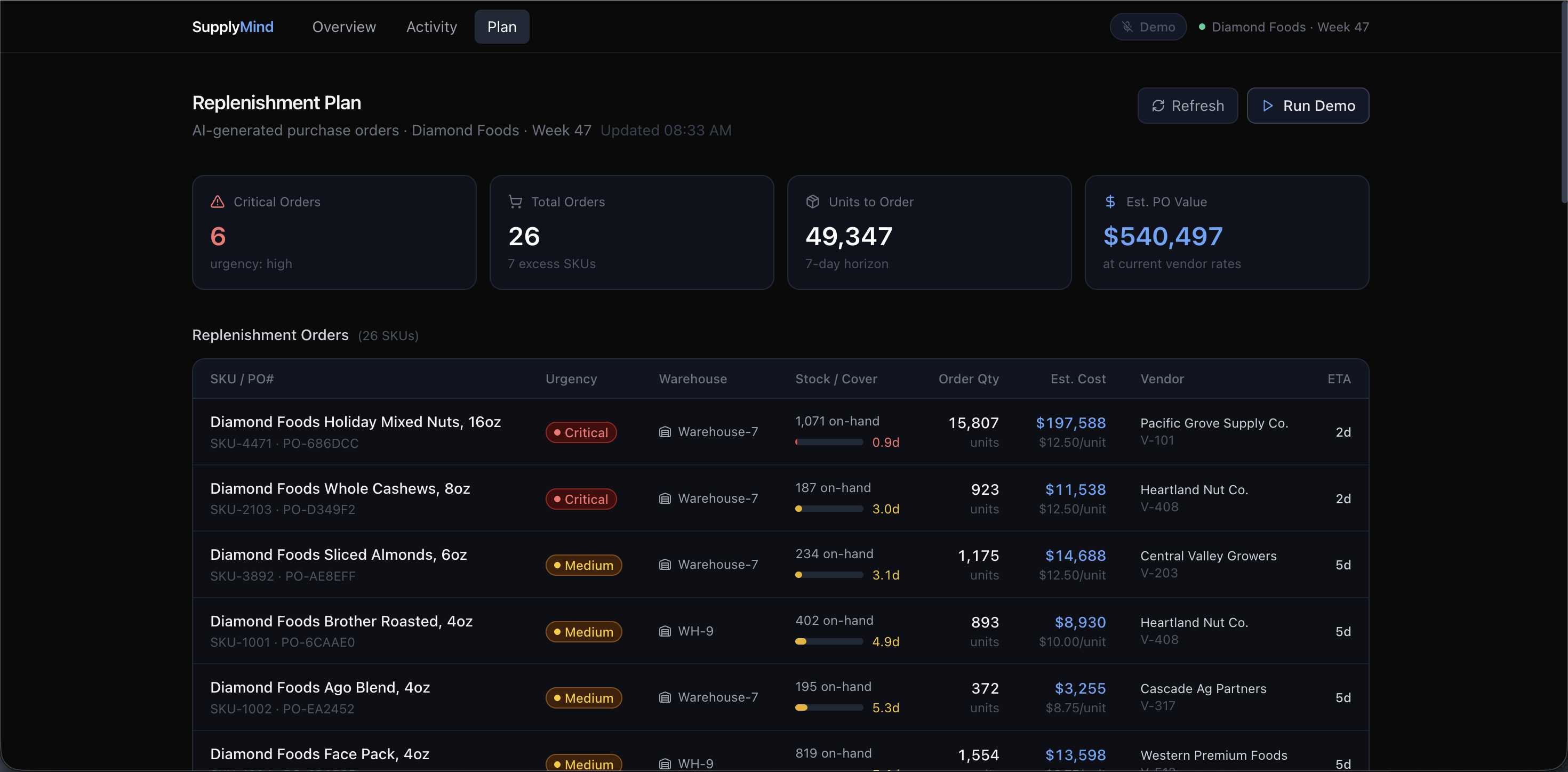
SupplyMind is a multi-agent supply chain orchestration system that automates the five most time-sensitive decisions in demand planning and replenishment. Five specialist agents run under an OmegaClaw orchestrator built on Fetch.ai's uAgents framework:
| Agent | Role |
|---|---|
| Demand Planning | 7- and 30-day SKU forecasts, spike detection |
| Replenishment | Reorder points, safety stock, automatic POs |
| Inventory Manager | FIFO rotation, hold flags, expiry alerts at 72 / 48 / 24 h |
| Shipment Analyst | Carrier optimization, landed cost, delay flagging |
| Supply Line Optimizer | Vendor scoring, single-source risk, order consolidation |
The full stack runs locally via docker compose up with no cloud egress — designed to be deployable on dedicated on-premise hardware like the ASUS Ascent GX10.
How we built it
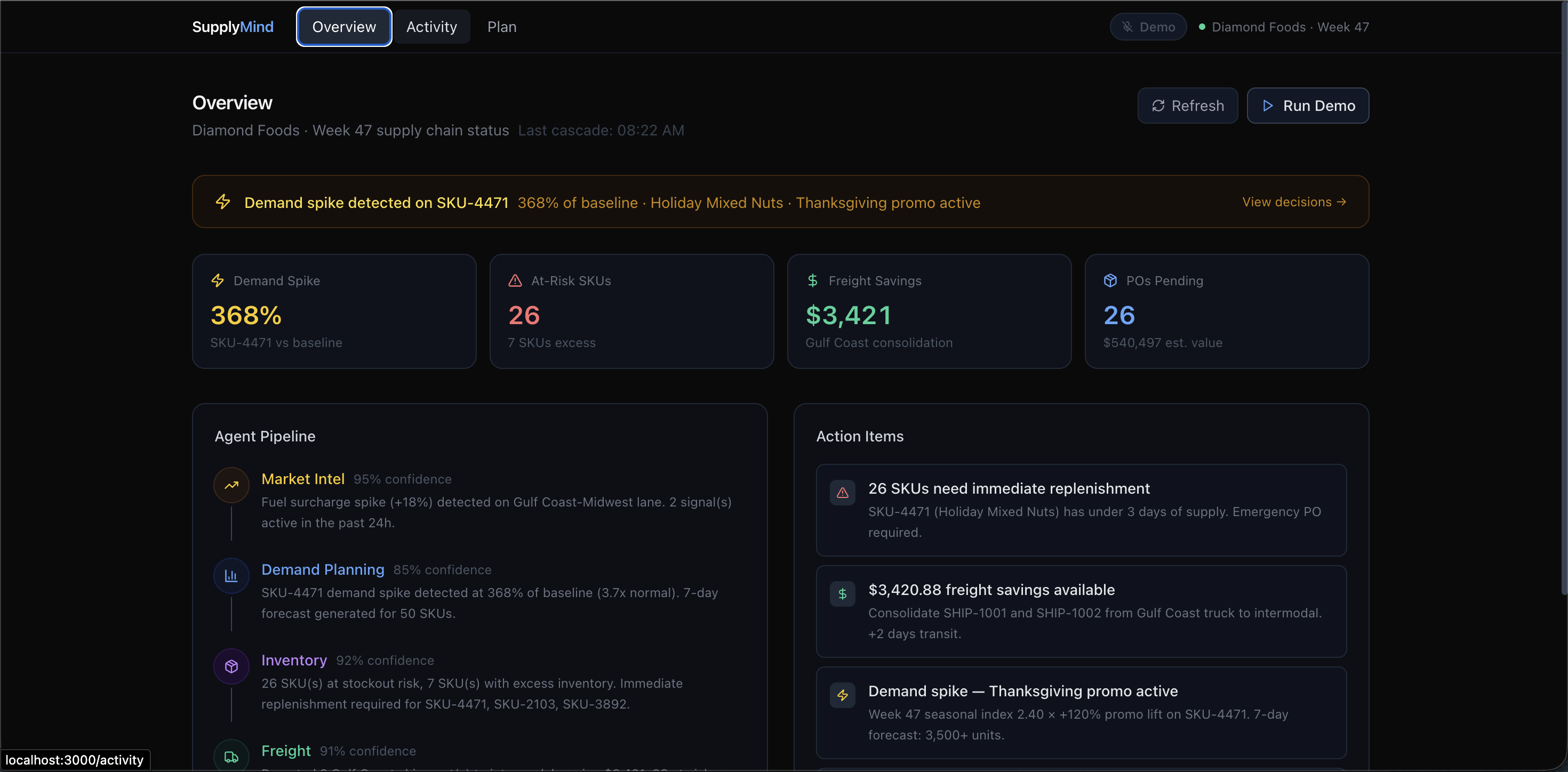
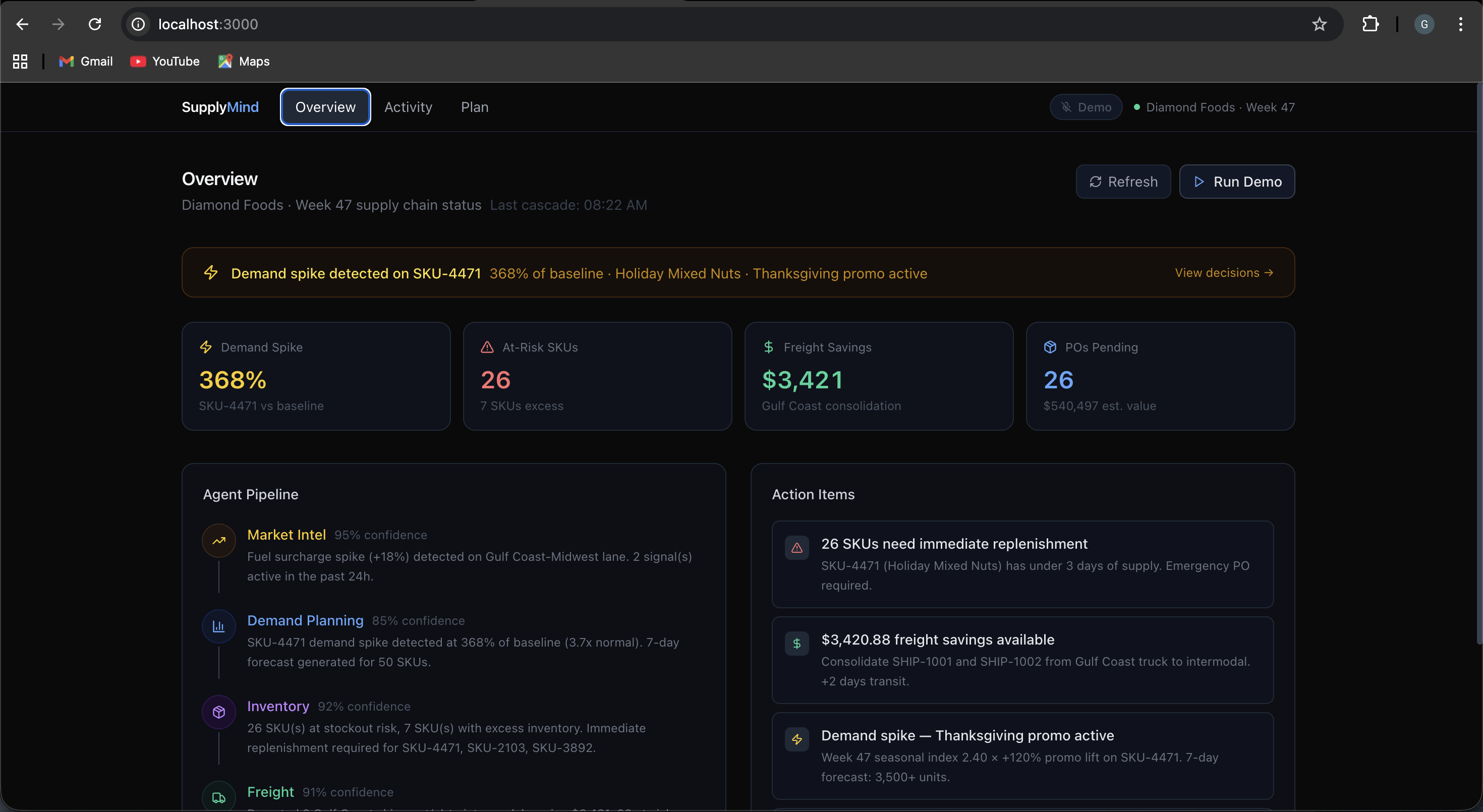
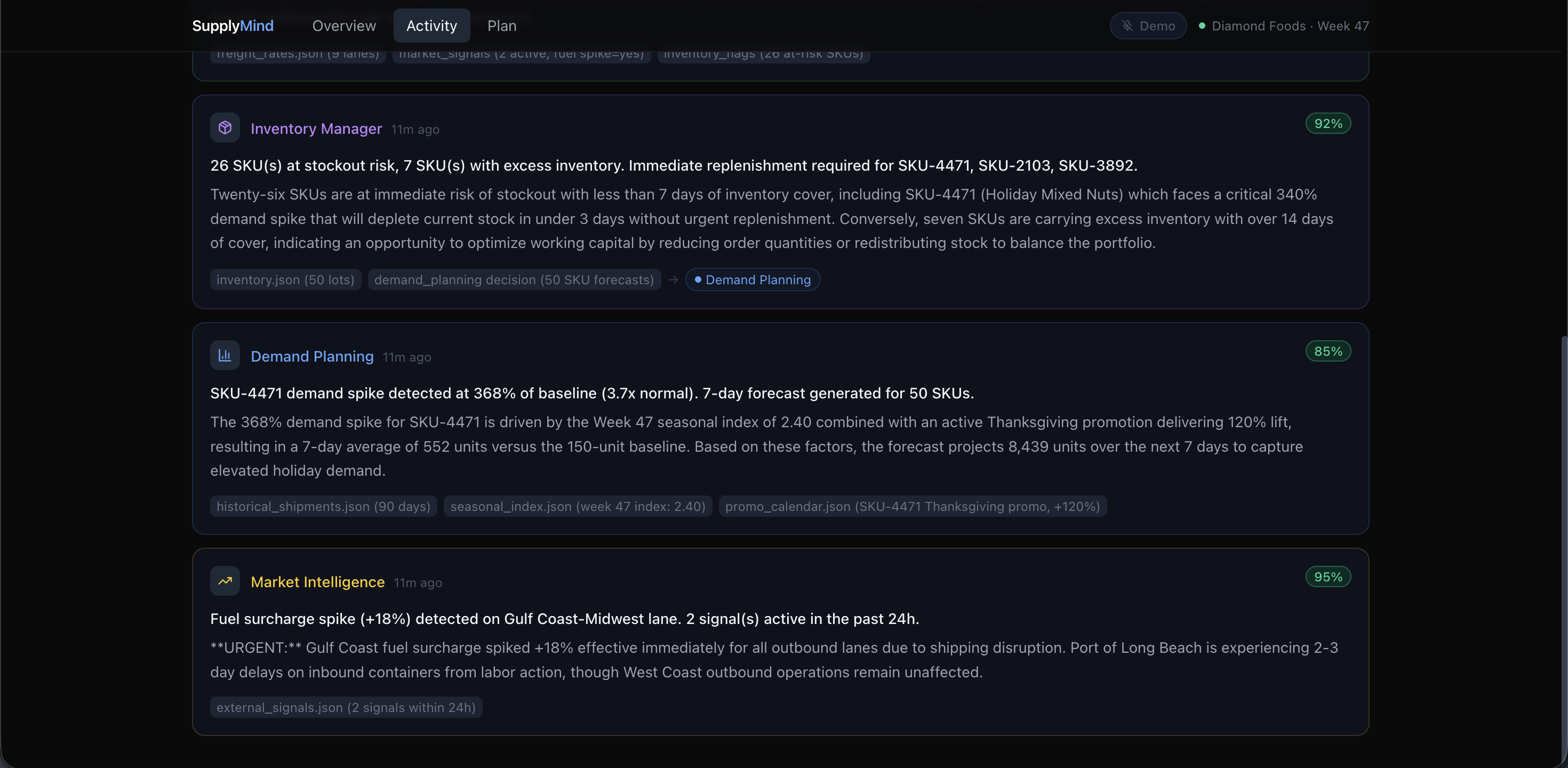
We started with a Docker Compose environment and synthetic ERP data generated with Python's Faker library, then built a FastAPI backend as the shared event bus for all agents. The Demand Planning and Replenishment agents came first, registered on AgentVerse and wired through OmegaClaw. We then added the remaining three agents and integrated ASI-1 for cross-agent reasoning and decision summaries. The Next.js dashboard surfaces live KPIs, forecast charts, inventory tracking, and a real-time agent activity log with reasoning traces. We also integrated ElevenLabs to narrate orchestrator decisions during the demo.
Challenges we ran into
Getting five agents to coordinate without conflicting was the core engineering problem. Early on, the Replenishment agent would commit to a vendor before the Supply Line Optimizer finished scoring — producing contradictory POs. We solved it with a handshake protocol: Replenishment sends a VendorQueryRequest and waits for a VendorScoreResponse before triggering any purchase order. Learning Fetch.ai's uAgents SDK, AgentVerse bureau registration, and ElevenLabs under time pressure also added real friction to the middle hours of the sprint.
What we learned
We learned how to build a genuinely coordinated multi-agent system — not just parallel LLM calls, but agents with defined message contracts and state ownership. ASI-1 proved to be a strong reasoning backbone for structured supply chain decisions, and ElevenLabs made the orchestrator's reasoning legible to non-technical judges in a way log traces couldn't. The biggest takeaway: multi-agent coordination is an architecture problem first, a model problem second.
What's next for SupplyMind
More market validation — we want to bring SupplyMind to food & beverage, pharma, and consumer electronics teams who share the same expiry and replenishment pain points. On the technical side, the priority is connecting to real ERP data (SAP, NetSuite) and benchmarking forecast accuracy against historical actuals. We also want to complete the hardware deployment story and run the full stack on an ASUS Ascent GX10 in an air-gapped enterprise environment, which the containerized architecture already supports.

Log in or sign up for Devpost to join the conversation.