Inspiration
What if I could identify a supplier problem before it becomes a production problem?
In manufacturing, a single unreliable supplier can disrupt an entire production line. Late deliveries, recurring defects, and increasing warranty costs can quickly affect operations, profitability, and customer satisfaction.
What interested me most was that organizations often already have the data needed to identify these risks. The problem is that the information lives across different systems, making it difficult to connect the dots and take action.
That inspired me to build Supplier Risk Radar.
I wanted to explore how Snowflake's native AI capabilities could transform traditional supplier reporting into something more intelligent and actionable.
My goal was to build a solution that could answer three simple questions:
- WHO are my highest-risk suppliers?
- WHY are they considered risky?
- WHAT should I do about them?
Rather than creating another dashboard full of charts, I wanted to demonstrate how data analytics, semantic modeling, and generative AI could work together to support real business decisions.
What it does
Supplier Risk Radar is a Snowflake-native application that helps procurement and supplier quality managers identify, investigate, and prioritize supplier risks.
It combines supplier performance, delivery reliability, quality defects, and warranty exposure into a transparent risk score from 0 to 100.
I built the application with several key capabilities:
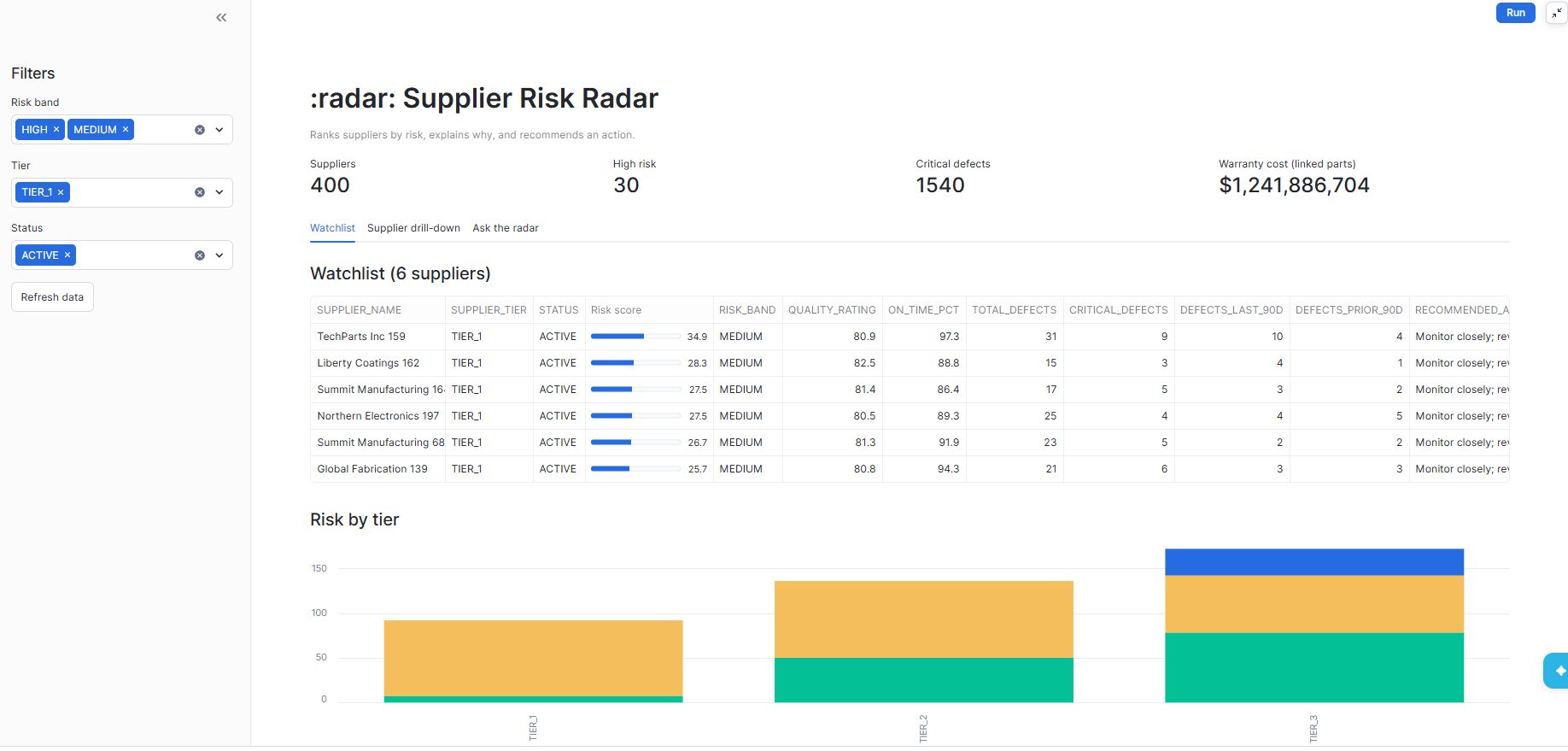
- Supplier Risk Watchlist: Ranks suppliers and groups them into HIGH, MEDIUM, and LOW risk categories.
- Explainable Risk Scoring: Uses six weighted business indicators to calculate risk rather than relying on an AI-generated score.
- AI-Powered Issue Summaries: Uses Snowflake Cortex
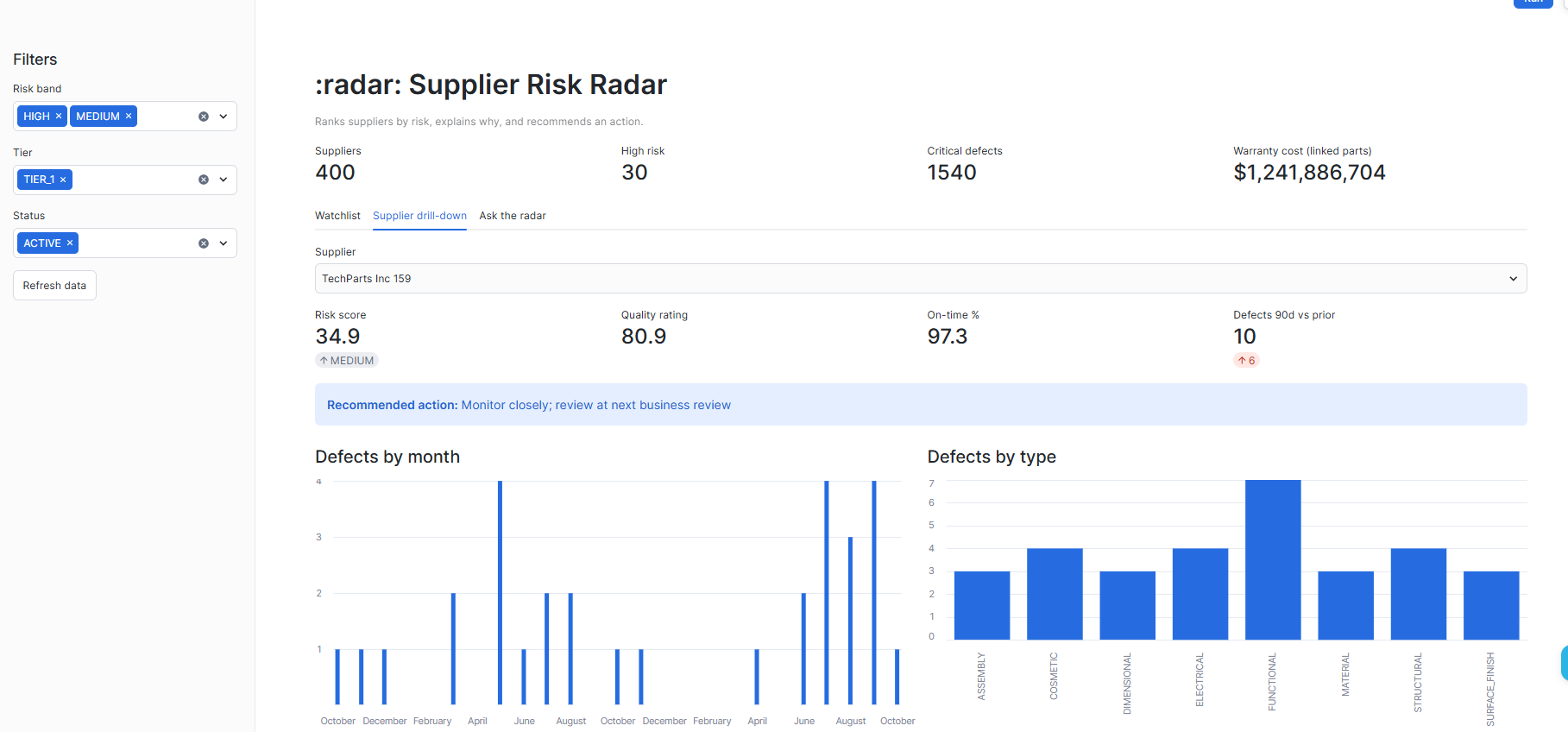
AI_AGGto summarize recurring defect patterns and root causes for high-risk suppliers. - Supplier Drill-Down: Provides detailed visibility into quality ratings, on-time delivery, defect trends, and recommended actions.
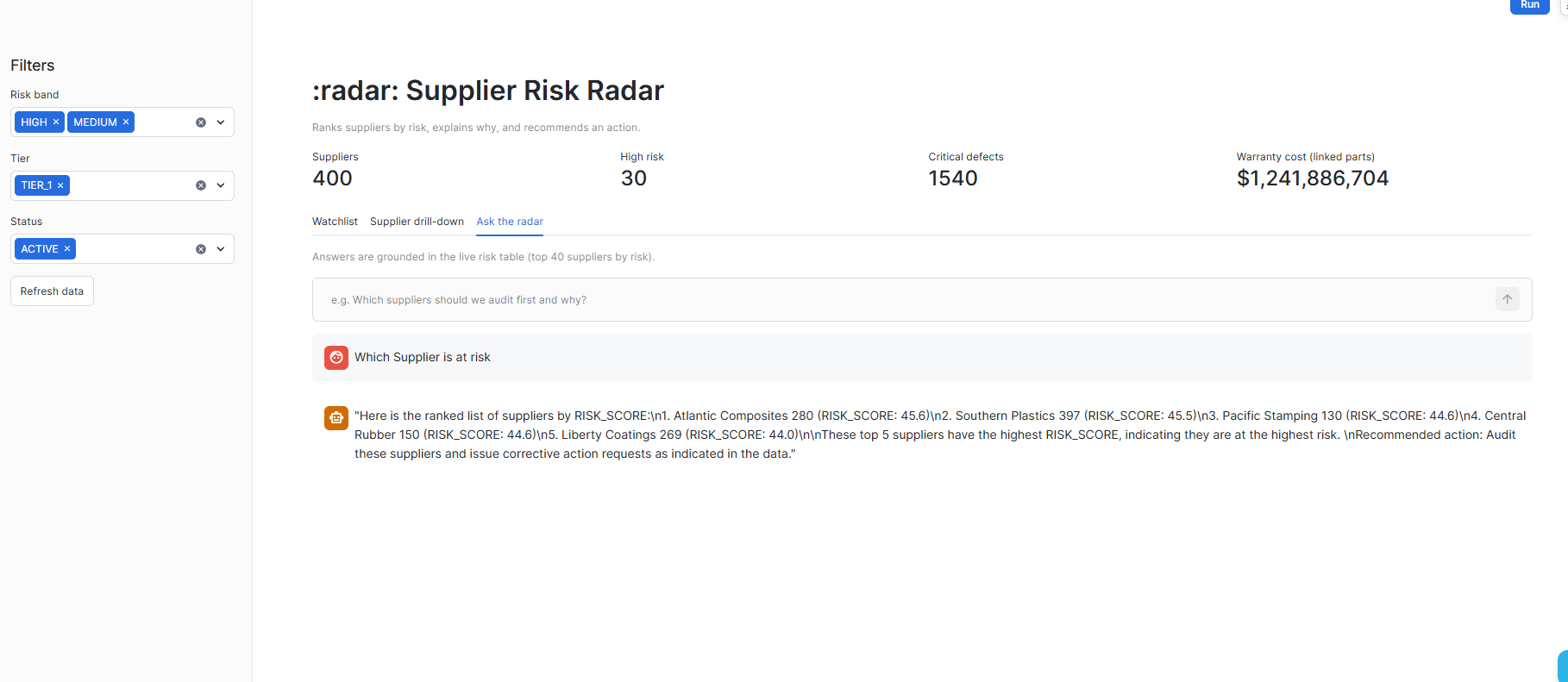
- Ask the Radar: A conversational interface powered by Snowflake Cortex
AI_COMPLETEthat allows users to ask questions about supplier risks. - Cortex Agent: Uses a Snowflake Semantic View to support natural-language supplier risk investigations through Snowsight.
The idea is to move beyond simply identifying a problem and help users understand the evidence behind it.
From "Which supplier is risky?" to "Why is this happening, and what should I investigate next?"
How we built it
I designed and developed Supplier Risk Radar using Snowflake, SQL, Snowflake Cortex AI, Semantic Views, and Streamlit.
Step 1 — Understanding and connecting the data
I started with the AUTO_MFG_DW manufacturing data warehouse and explored the relationships between supplier records, purchase orders, quality defects, and warranty claims.
The first challenge was understanding how these datasets could work together to provide a meaningful picture of supplier performance.
Step 2 — Building the supplier risk model
I developed a SQL-based risk scoring model using six weighted indicators:
- Quality rating — 25%
- On-time delivery — 20%
- Defects per 1,000 orders — 25%
- Critical defect share — 10%
- Recent defect trend — 10%
- Warranty cost exposure — 10%
The model produces a risk score and categorizes suppliers into HIGH, MEDIUM, and LOW risk bands, along with recommended actions.
I deliberately used SQL-based calculations for the scoring logic so the results would be transparent and explainable.
Step 3 — Bringing AI into the picture
I integrated Snowflake Cortex AI_AGG to analyze defect descriptions and generate summaries of recurring quality issues for high-risk suppliers.
This added a layer of interpretation to the numerical risk scores.
Step 4 — Creating the semantic layer and agent
I created a Snowflake Semantic View to define the business context used by Cortex Analyst.
I also configured a Cortex Agent that can answer natural-language questions about supplier risks and recommended actions.
Step 5 — Building the application
I developed an interactive Streamlit application inside Snowflake with a risk watchlist, supplier drill-down, and conversational AI experience.
For the in-app chat, I used AI_COMPLETE with the llama3.3-70b model, providing supplier risk information as context.
The Cortex Agent operates separately through Snowsight.
My focus was to keep the architecture Snowflake-native while combining structured analytics and generative AI in one experience.
Challenges we ran into
Building the solution independently meant handling everything from data modeling and SQL development to AI integration and the user interface.
Creating a meaningful risk score: Combining quality ratings, delivery performance, defect counts, and warranty costs was not straightforward. Each metric has a different scale, so I needed to normalize the indicators and define practical weights.
Connecting warranty claims to suppliers: Warranty claims relate to parts, while supplier relationships come through purchase orders. I had to account for cases where multiple suppliers provided the same part.
Handling data inconsistencies: Some on-time delivery percentages exceeded 100%, requiring additional logic to cap those values before using them in the risk calculation.
Grounding AI in business context: One of my priorities was ensuring AI explanations were based on available supplier and defect information rather than treating AI as the source of the actual risk score.
Managing the complete solution as a solo builder: Working independently required me to balance backend logic, semantic modeling, AI capabilities, and the Streamlit user experience while keeping the application practical and understandable.
Accomplishments that we're proud of
What I'm most proud of is bringing multiple technologies together into one meaningful solution, entirely as a solo project.
I was able to:
- Design a multi-factor supplier risk scoring model using SQL.
- Connect supplier, procurement, quality, and warranty information.
- Use Snowflake Cortex AI to summarize recurring supplier quality issues.
- Create a Semantic View to support business-aware natural-language analysis.
- Configure a Cortex Agent for supplier risk investigations.
- Build an interactive Streamlit application that brings the capabilities together.
One of my favorite parts is the combination of explainable analytics and generative AI.
Instead of asking AI to invent a risk score, I calculate the score using defined business logic and use AI to help interpret the supporting evidence.
For me, the biggest accomplishment was demonstrating how a single developer can bring data engineering, analytics, semantic modeling, and AI together into a functional prototype.
What we learned
This project reinforced something I strongly believe:
AI is only as useful as the business context behind it.
A powerful language model doesn't automatically understand what makes a supplier risky. It needs reliable data, clear business definitions, meaningful relationships, and supporting evidence.
I learned more about how Snowflake Semantic Views and Cortex AI can complement traditional SQL-based analytics.
I also gained practical experience combining deterministic calculations with generative AI capabilities.
Another important takeaway was that not everything needs AI.
SQL is well suited for calculating measurable risk indicators. AI becomes valuable when interpreting complex defect descriptions and making information easier to explore.
Building the project independently also pushed me to think across the entire solution, from data relationships and architecture to the experience of the person using the application.
What's next for Supplier Risk Radar
I see Supplier Risk Radar as a foundation that can evolve into a more proactive supplier intelligence solution.
Some enhancements I'd like to explore include:
- Proactive Risk Alerts: Notify procurement teams when supplier risk crosses critical thresholds.
- Historical Risk Tracking: Monitor changes in supplier performance over time.
- Predictive Risk Analysis: Explore machine learning models to identify emerging supplier problems earlier.
- Automated AI Summaries: Refresh defect summaries as new operational data becomes available.
- Corrective Action Tracking: Help users track investigations and supplier improvement activities.
- Additional Risk Indicators: Incorporate financial stability, geographic exposure, and external supply chain disruptions.
My longer-term vision is to move from simply monitoring supplier risk to helping organizations anticipate problems and take informed action earlier.
Because the best time to address a supplier problem is before it disrupts production.

Log in or sign up for Devpost to join the conversation.