-
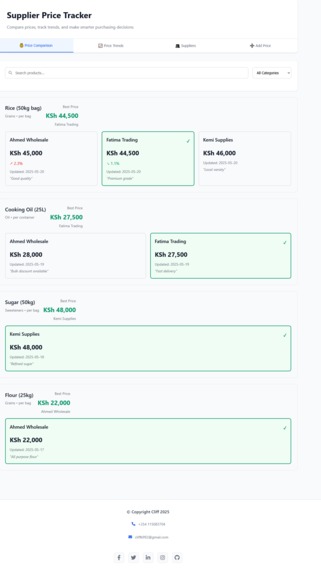
homepage screenshot
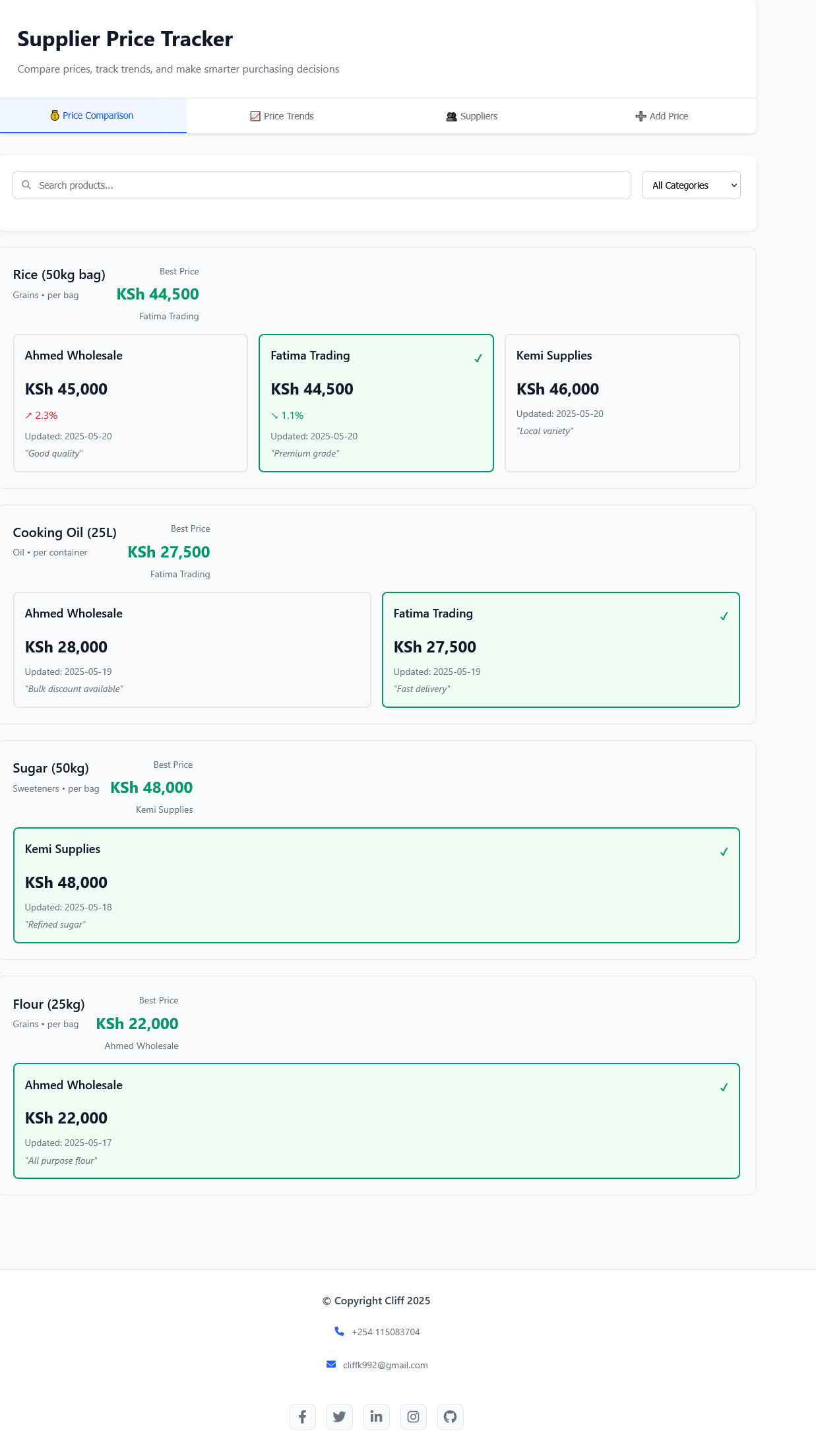
Inspiration
In the dynamic landscape of informal markets, retail shopkeepers often face a significant challenge: rapidly fluctuating supplier prices. This makes it incredibly difficult to make informed purchasing decisions, impacting their profit margins and inventory management. The Price Tracker Tool is a web-based solution designed to empower these shopkeepers by providing a centralized platform to compare, track, and analyze supplier prices, enabling them to make smarter and more profitable purchases. The Problem
Imagine a shopkeeper who needs to restock their inventory. They call multiple suppliers, each quoting different prices that can change daily or even hourly. Keeping track of these quotes, remembering which supplier offered the best price for a particular item, and identifying price trends over time becomes an overwhelming task.
What it does
The Price Tracker Tool addresses these pain points directly by offering a user-friendly and intuitive platform that allows shopkeepers to: Centralize Supplier Information: Store details of all their suppliers in one place. Record and Compare Prices: Easily input and view current prices for various products from different suppliers side-by-side. Track Price History: Maintain a historical record of prices, allowing them to identify trends and patterns. Identify Best Deals: Quickly determine which supplier offers the most competitive price for a specific product at any given time. Make Smarter Purchases: Leverage data-driven insights to optimize their purchasing strategy, leading to increased profitability.
How it works
Shopkeeper logs in: Accesses their personalized dashboard. Adds Products: Inputs details of the items they sell (e.g., "Sugar 1kg", "Cooking Oil 5L"). Adds Suppliers: Registers their go-to suppliers (e.g., "Wholesale Mart", "Bulk Goods Inc."). Enters Prices: When a supplier quotes a price for a product, the shopkeeper quickly enters it into the tool, associating it with the product and supplier. Compares & Tracks: The tool then displays the current and historical prices for that product from all associated suppliers, highlighting the best available price.
Challenges I ran into
Data Consistency and Standardization:
Problem: Shopkeepers might enter product names inconsistently (e.g., "Sugar 1kg," "Sugar - 1 KG," "Sukari kilo"). This makes comparison difficult.
Challenge: Implementing robust fuzzy matching, normalization, or suggestion systems to standardize product names and prevent duplicate entries.
Handling Missing or Incomplete Data:
Problem: Users might forget to enter a date, supplier, or even the price for a product.
Challenge: Designing the UI/UX to guide complete data entry and implementing backend validation to reject or flag incomplete records, along with strategies for handling partial data.
Scalability for Price History:
Problem: Over time, the volume of price entries will grow significantly, especially for frequently purchased items.
Challenge: Ensuring the database and backend services can efficiently handle large datasets for historical lookups and charting without performance degradation. Optimizing queries and indexing will be crucial.
Real-time vs. Near Real-time Data:
Problem: Supplier prices can change rapidly. True "real-time" updates might be challenging if shopkeepers are manually entering data.
Challenge: Managing user expectations and designing the system to reflect the most recently updated prices effectively, rather than promising instant, automated updates that aren't feasible with manual input.
Offline Capability (Potential Future Feature):
Problem: Internet connectivity might be unreliable in some informal market areas.
Challenge: If offline access is desired, designing a robust synchronization mechanism to ensure data entered offline is safely uploaded when connectivity is restored, and conflicts are resolved.
Security and Data Privacy:
Problem: Shopkeepers' pricing information and supplier lists are sensitive business data.
Challenge: Implementing strong authentication, authorization, and data encryption (both in transit and at rest) to protect user data from unauthorized access or breaches.
Complex Charting and Visualization:
Problem: Displaying clear and interactive historical price trends with multiple suppliers on the same graph can become visually cluttered or hard to interpret.
Challenge: Selecting the right charting libraries and designing intuitive visualization options that cater to users who may not be data analysis experts.
Accomplishments that I'm proud of
Here's a list of significant accomplishments the Price Tracker Tool could achieve, highlighting its impact on retail shopkeepers and the broader informal market in Kenya: Accomplishments to be Proud Of: Price Tracker Tool
The Price Tracker Tool, by addressing a critical need in Kenya's informal markets, has the potential to achieve transformative impacts. Here are accomplishments we would be incredibly proud to celebrate: I. Empowering Shopkeepers & Boosting Profitability
Directly Increased Shopkeeper Profit Margins:
    Achievement: Documented instances where shopkeepers, using the tool, consistently identified and purchased goods at lower prices, leading to a measurable increase in their daily, weekly, or monthly profit margins.
    Impact: This translates directly into improved livelihoods for shopkeepers and their families.

Reduced Operational Costs for Small Businesses:
    Achievement: Helped thousands of shopkeepers significantly reduce their average purchasing costs by facilitating smarter supplier selection.
    Impact: Frees up capital for other business needs or personal investments, strengthening small businesses.

Enhanced Purchasing Intelligence and Confidence:
    Achievement: Transformed shopkeepers from reactive buyers to proactive, data-driven decision-makers, giving them confidence in their purchasing choices.
    Impact: Reduces stress and uncertainty, allowing shopkeepers to focus more on sales and customer service.

Time Savings for Busy Entrepreneurs:
    Achievement: Saved shopkeepers countless hours previously spent manually contacting multiple suppliers and tracking prices in notebooks or memory.
    Impact: Allows shopkeepers to reinvest valuable time into other aspects of their business or personal life.

Improved Inventory Management:
    Achievement: Enabled shopkeepers to optimize their stock levels by purchasing at optimal times, reducing waste and carrying costs.
    Impact: More efficient use of space and capital within their small shops.
What I learned
Simplicity Trumps Features:
- The most valuable lesson will be that for users with low digital literacy or time constraints, an extremely simple, intuitive interface with minimal steps for core actions is far more effective than a feature-rich but complex one. Every extra click or field is a barrier.
2.The Power of Visuals and Minimal Text: Relying heavily on clear icons, color-coding, and visual cues (like green for "best price") rather than extensive text instructions is crucial for adoption and usability in diverse linguistic contexts.
3.Onboarding is Not a One-Time Event: Effective onboarding isn't just a first-time tutorial; it's an ongoing process. In-app tips, contextual help, and clear value propositions need to be reinforced regularly to maintain engagement. Understanding the "Why": It's not enough to build a tool; understanding why a shopkeeper would take the time to use it (e.g., direct financial benefit, reduced stress) is critical for designing compelling features and messaging. The value proposition must be immediately clear.
4.Direct User Feedback is Gold: Regular, in-person feedback from actual shopkeepers in their environment (not just in a controlled setting) will reveal pain points and opportunities that no amount of theoretical planning can.
What's next for Supplier Price Tracker
AI-Powered Price Predictions & Recommendations:
Goal: Leverage historical data and external market indicators (e.g., seasonal changes, major events) to provide shopkeepers with predictive insights on future price trends for specific products.
Impact: Enables proactive purchasing, allowing shopkeepers to stock up when prices are low.
Automated Price Updates (where feasible):
Goal: Explore integrations with digital wholesale suppliers or market information feeds to automatically update certain product prices, reducing manual entry for common goods.
Impact: Saves significant time for shopkeepers, increasing tool efficiency and data accuracy.
Advanced Supplier Rating & Reliability:
Goal: Allow shopkeepers to rate suppliers based on factors beyond price (e.g., delivery speed, credit terms, product quality, trustworthiness).
Impact: Provides a more holistic view of "best value," empowering shopkeepers to build better supplier relationships.
Personalized "Smart Alerts":
Goal: Develop a sophisticated alert system that learns a shopkeeper's typical purchase patterns and budget, then sends personalized notifications about optimal buying times or significant price drops for their most important inventory items.
Impact: Moves from reactive tracking to proactive, personalized guidance.
Built With
- claude
- css
- cursor
- html
- javascript


Log in or sign up for Devpost to join the conversation.