-
-
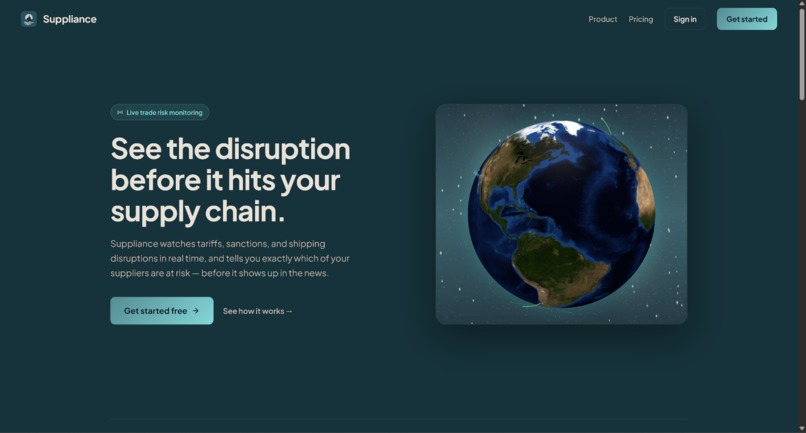
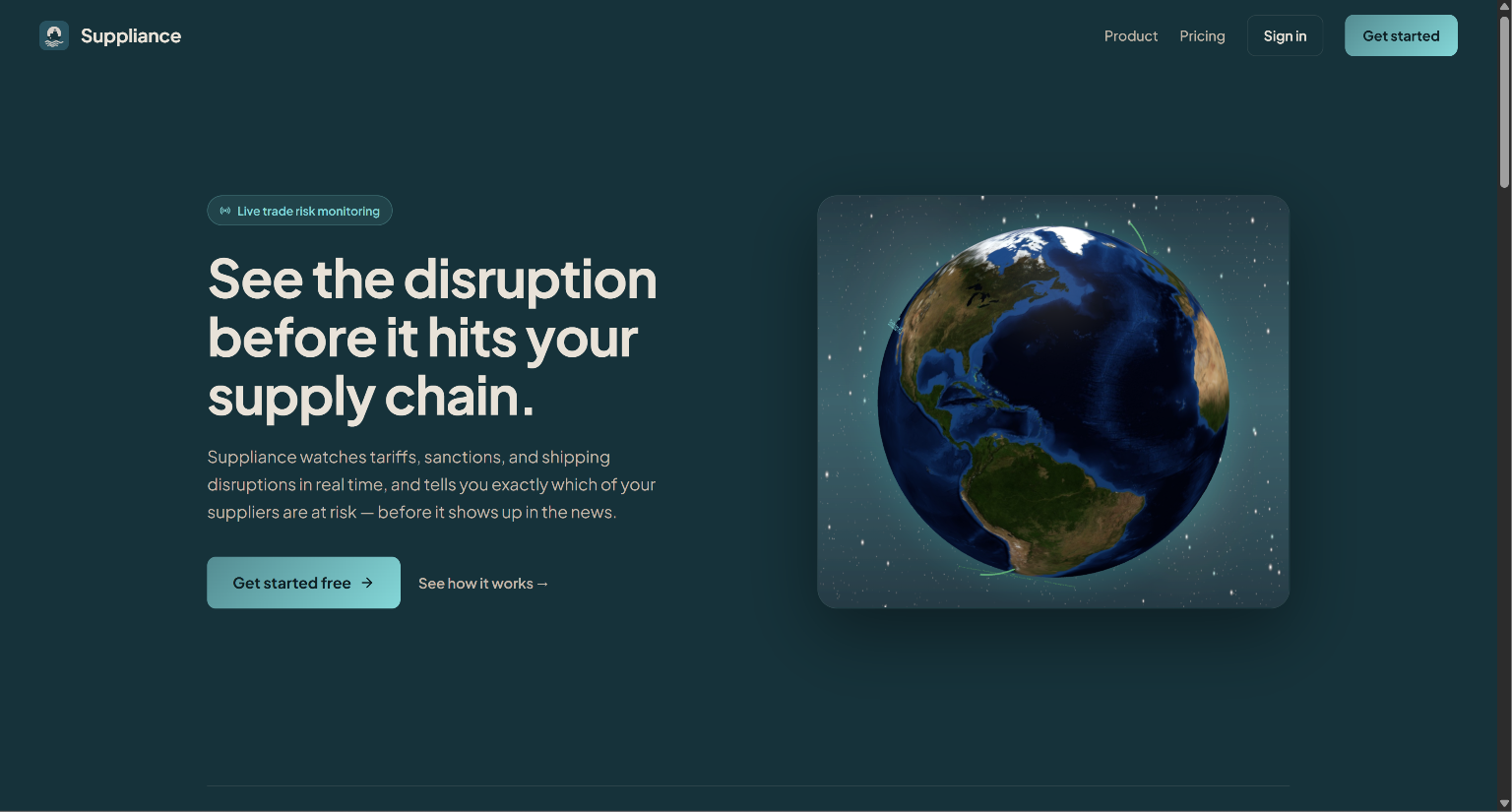
Suppliance Landing page
-
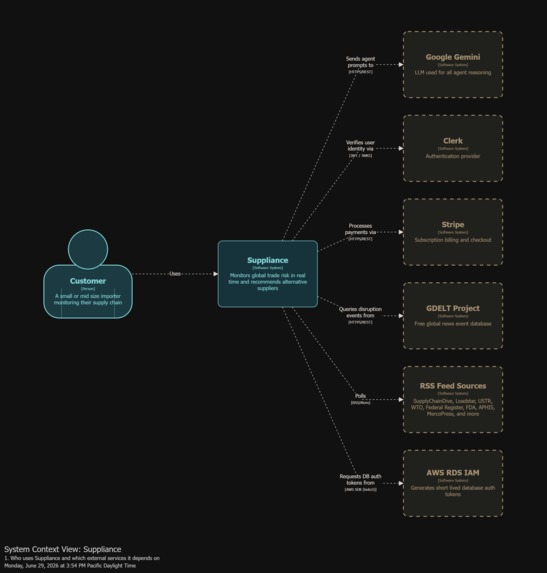
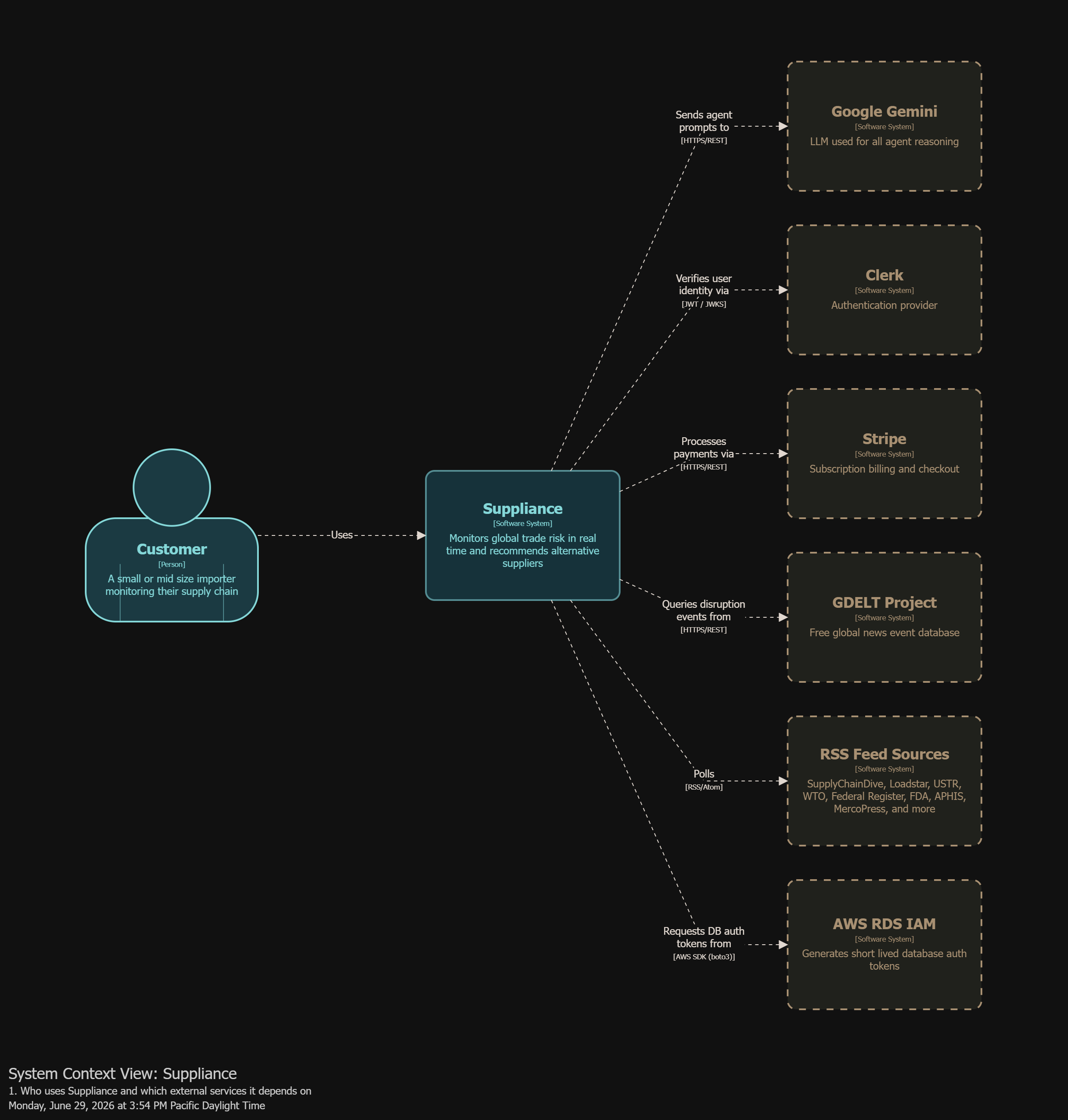
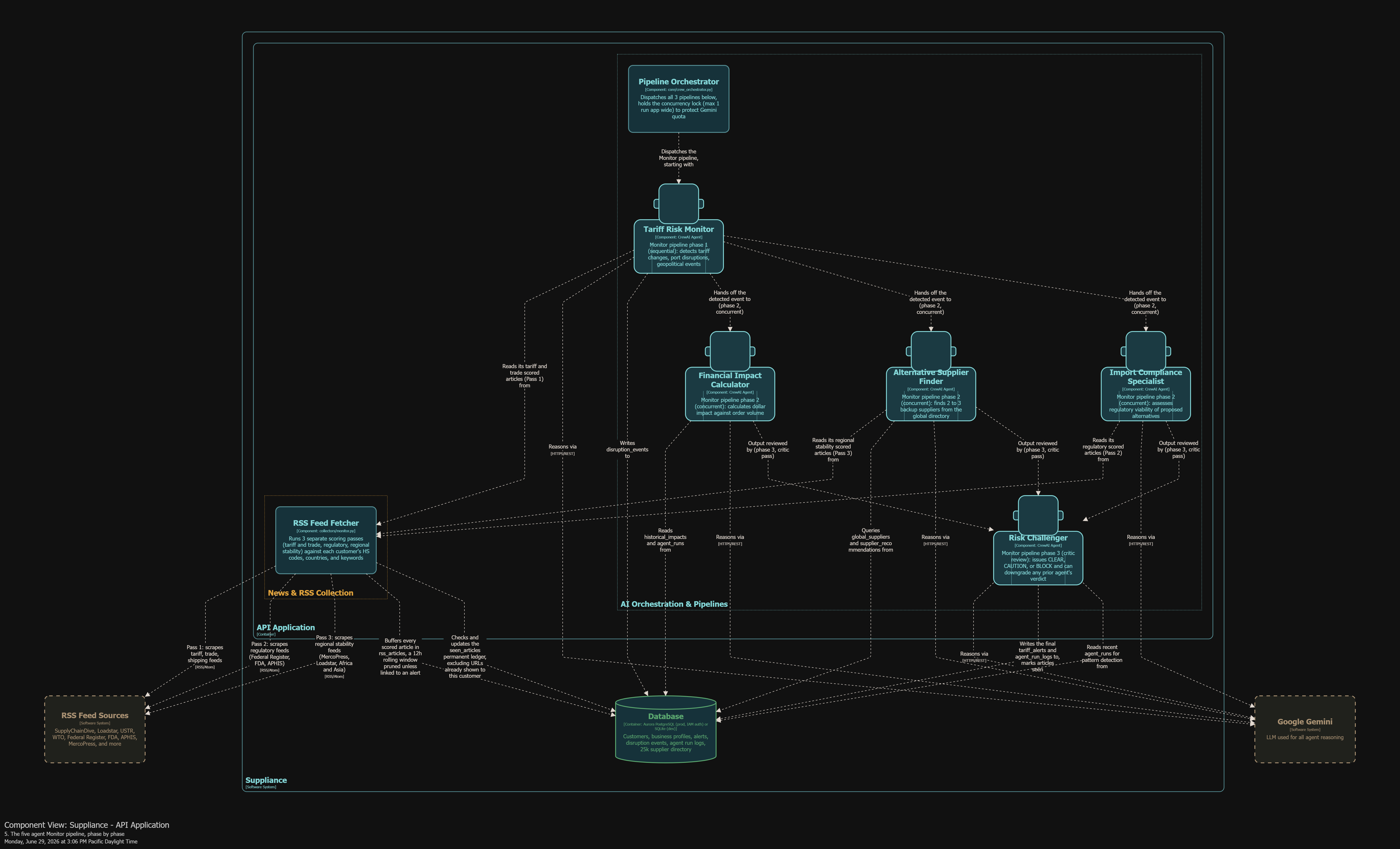
Diagram representing tech architecture
-
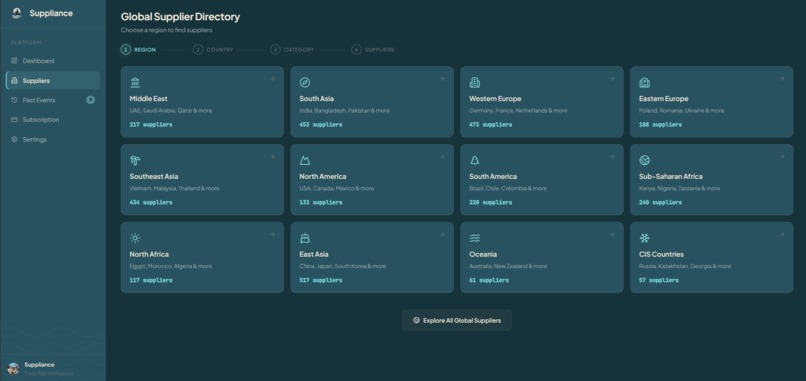
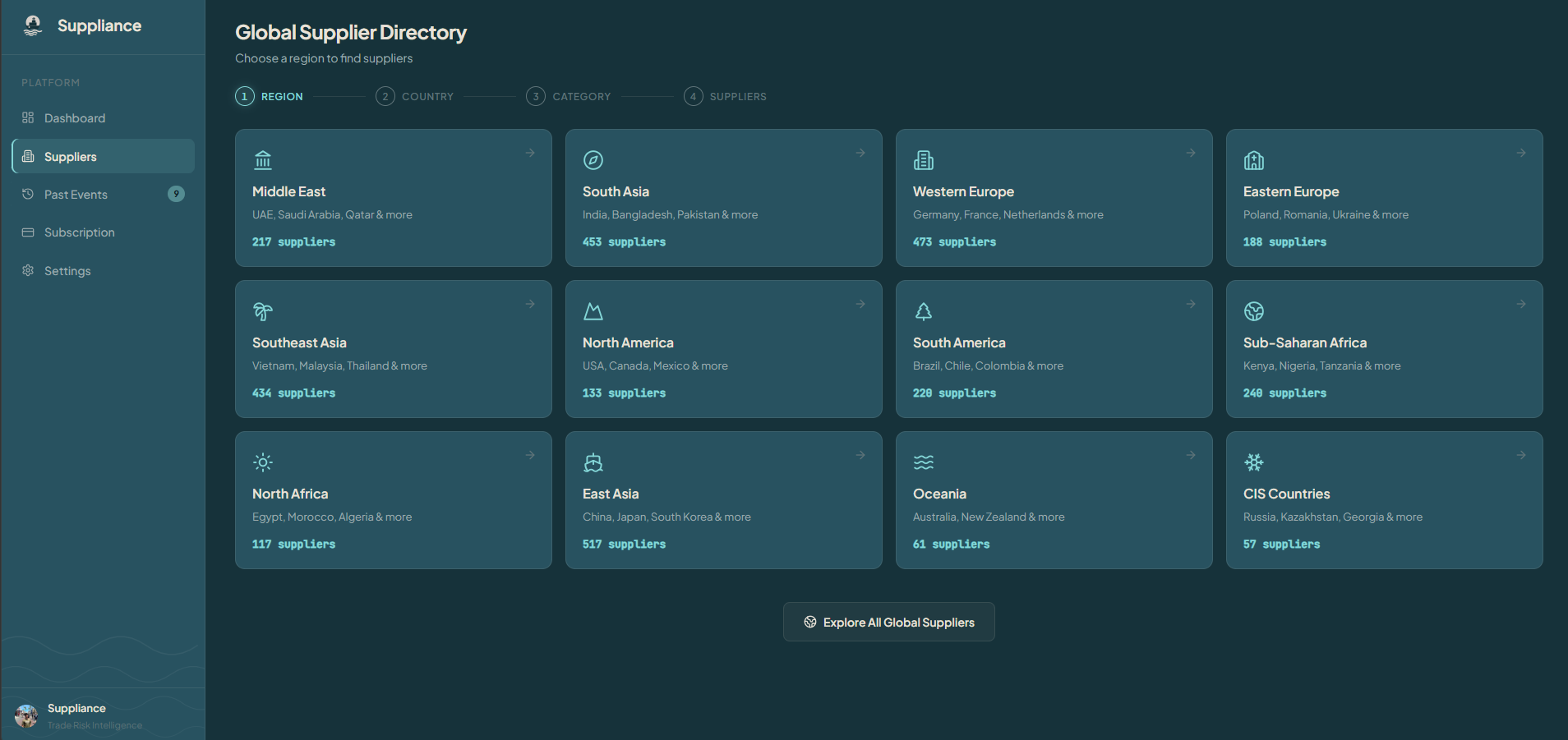
Directory of 25000+ suppliers
-
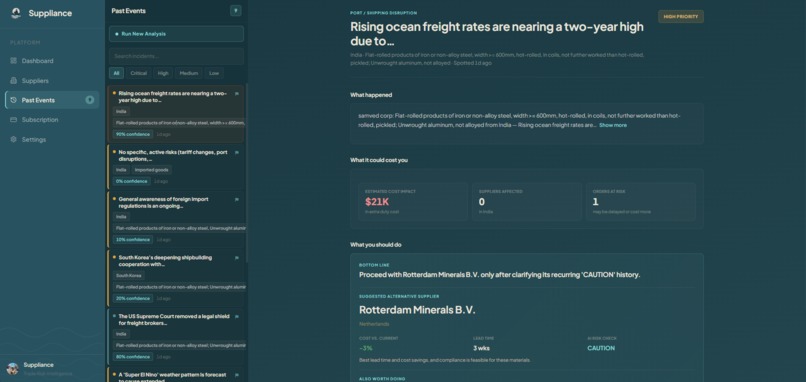
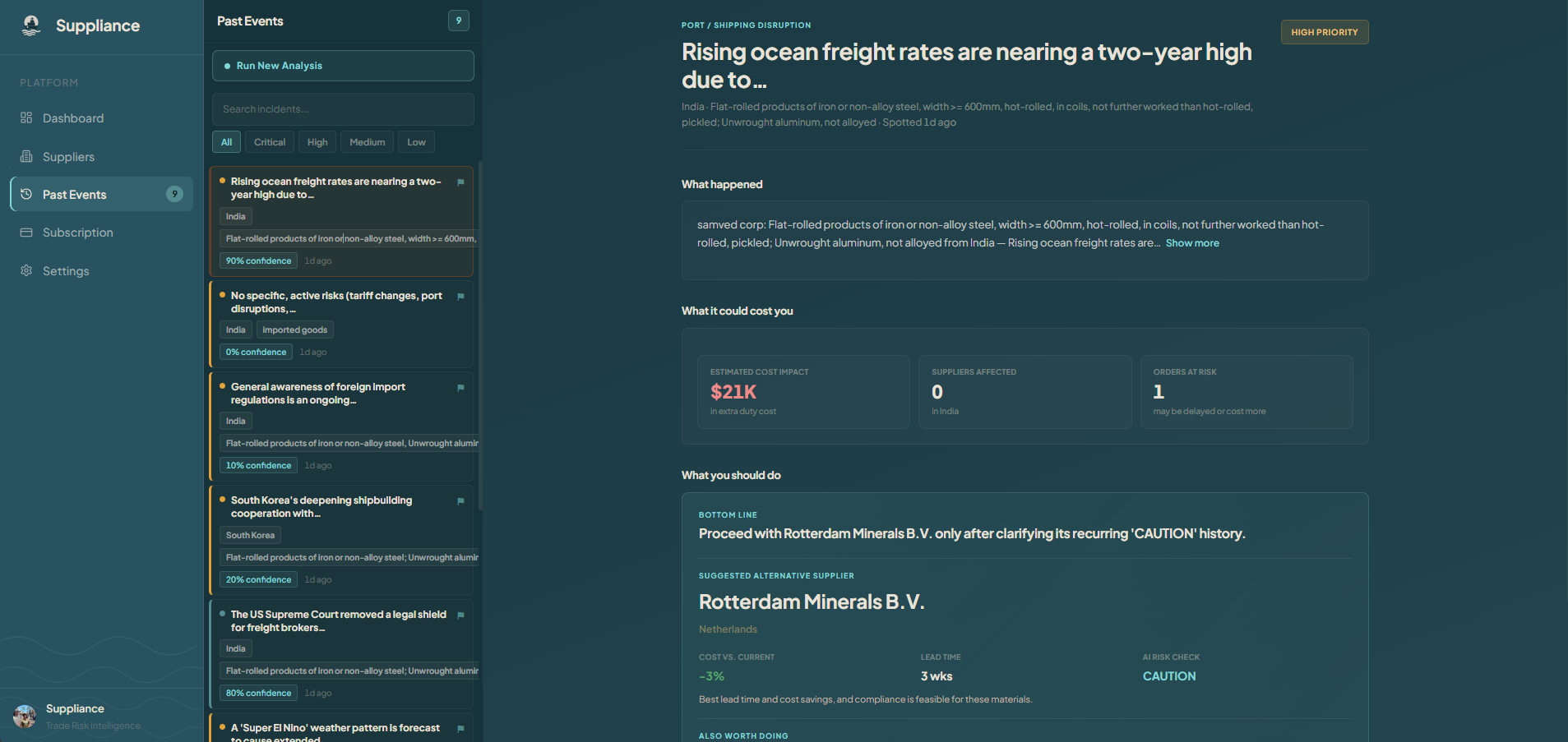
Events listed in the Past events section
-
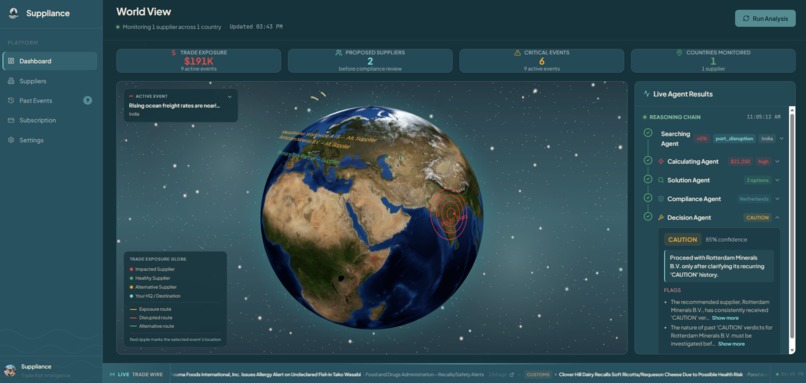
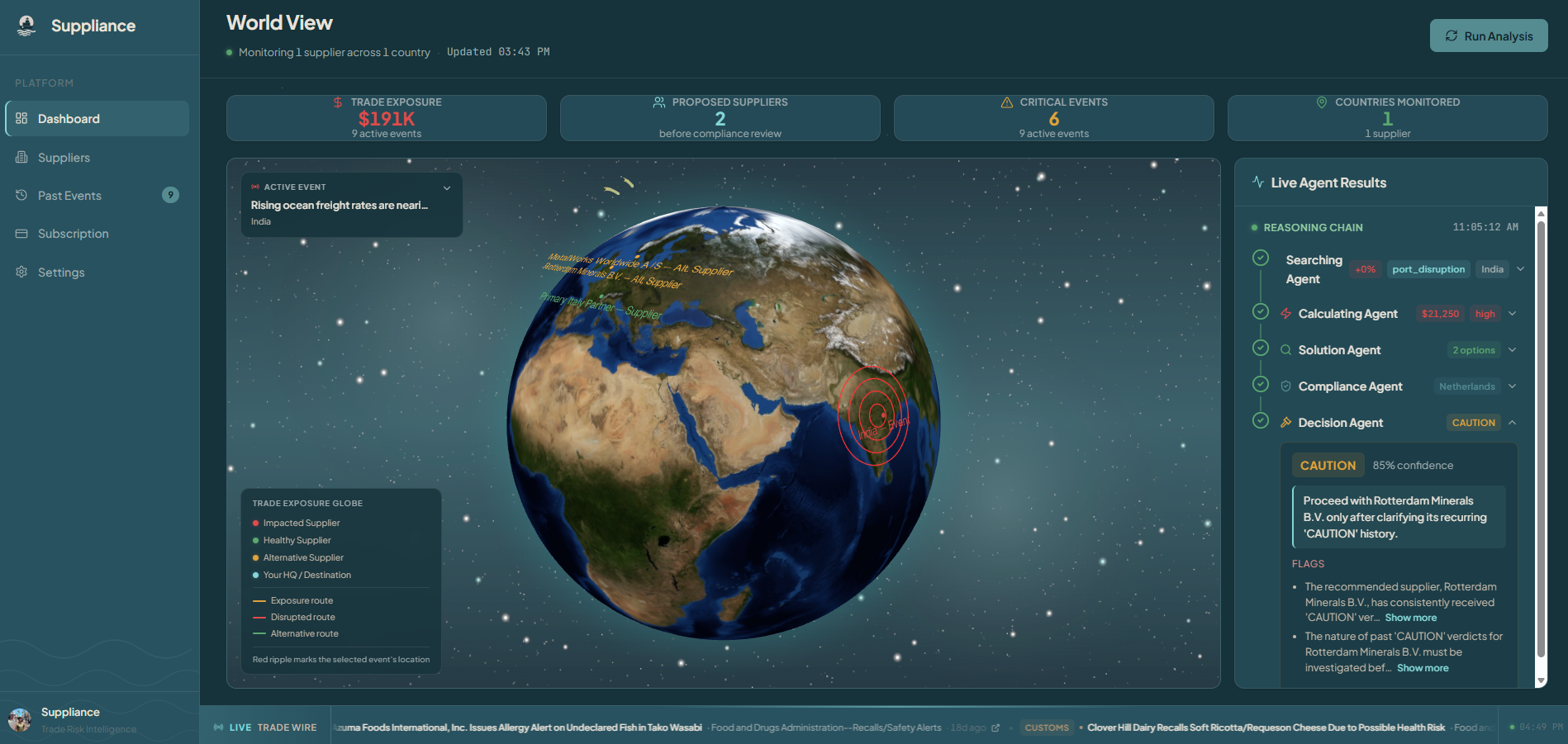
Dashboard of Suppliance
-
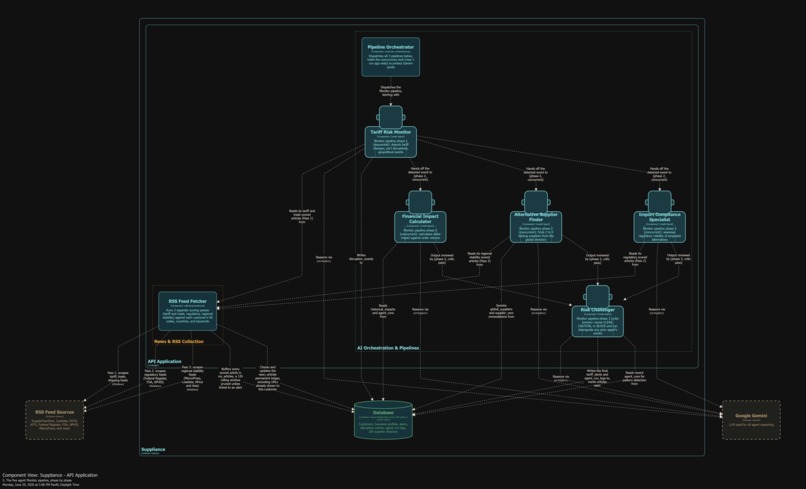
Agentic Pipeline Architecture
Inspiration
A global trade disruption doesn't just affect multinational corporations. It affects the small businesses importing everyday products too. The difference is that large companies usually have the people and tools to respond immediately. Small businesses often don't.
The disruption is the same. The ability to respond is not.
Before writing any code, we spent our first week researching. We explored different industries, read market reports, government publications, and academic research, and kept asking ourselves the same question: What problem is real, recurring, expensive, and important enough that businesses would actually pay to solve?
Many ideas sounded interesting. Some lasted a day. Very few survived that filter.
Supply chain risk did.
The more we researched, the more we realized that supply chain problems often start long before goods move. They start with information. Tariffs, supplier disruptions, regulations, and geopolitical events all happen long before businesses feel their impact. Large enterprises have dedicated teams that monitor these risks and decide how to respond. Most small and medium-sized businesses don't.
Research confirmed this wasn't just our assumption. In May 2026, the U.S. Small Business Administration identified information gaps and limited technical capacity as key supply chain challenges facing small businesses. We also found research showing that AI can significantly improve supply chain risk management, operational visibility, and decision-making for SMEs.
The information already exists. The challenge is turning thousands of articles, announcements, regulations, and trade updates into a clear answer:
Does this affect me? How much could it cost? Am I still compliant? What are my options?
Large enterprises already have teams and tools that answer those questions. Most small businesses don't.
That's the gap we built Suppliance to close.
Sources
U.S. Small Business Administration Supply Chain Gaps and Entrepreneur Assistance (May 4, 2026) https://advocacy.sba.gov/2026/05/05/supply-chain-gaps-and-entrepreneur-assistance/
SCODM Journal Artificial Intelligence and Supply Chain Management of Small and Medium-Sized Enterprises (March 14, 2025) https://scoddm.reapress.com/journal/article/view/25
What it does
- Keeps track of tariffs, sanctions, port congestion, supplier disruptions, and other global trade events as they happen.
- Connects those events to the suppliers a business actually relies on, so users can immediately see what affects them instead of digging through trade news.
- Uses five AI agents to estimate the impact, check import compliance, suggest alternative suppliers, and review every recommendation before it's shown.
- Brings everything together in a live dashboard with an interactive world map, real-time alerts, supplier status, and a simple breakdown of why each recommendation was made.
- Includes a dataset of 25,000+ global suppliers (seeded/synthetic for demo purposes, structured to match real supplier directory schemas) for exploring alternative sourcing options by country, region, and product category.
- Helps businesses spend less time reacting to disruptions and more time making informed sourcing decisions.
- Includes an adversarial review agent that critiques every recommendation for hallucinations, weak evidence, or overlooked edge cases before it reaches the user — so the output isn't just five agents' first-draft opinions
How we built it
- Languages: Python, TypeScript, JavaScript, HTML, CSS
- Frontend: React, Vite, Tailwind CSS v4, react-globe.gl, Three.js, Framer Motion
- Backend: FastAPI, Python, SQLAlchemy
- Database: Amazon Aurora PostgreSQL with pgvector enabled as forward infrastructure for future semantic search, IAM authentication
- Cloud & Deployment: AWS (Aurora), Vercel (frontend), Render (backend)
- AI & Agent Frameworks: CrewAI, Google Gemini, LLM-based multi-agent workflows
- Authentication & Billing: Clerk, Stripe
- Data Sources: Google RSS Feeds, Trade News Sources, GDELT
- Project Management: Scrum-inspired sprint planning
Our data model centers on five core tables — global_suppliers, business_profiles, disruption_events, tariff_alerts, and historical_impacts — with relational integrity across suppliers and disruption events being the core reason we chose Aurora Postgres over DynamoDB; supply chain risk is fundamentally about relationships between entities (which supplier is exposed to which disruption, and how that maps to a business's sourcing footprint), not flat lookups. We've also registered pgvector on Aurora as forward infrastructure, so the same database that handles our relational queries can support semantic search over historical_impacts and disruption_events down the line, without standing up a separate vector store alongside a NoSQL option. The backend runs containerized via Docker Compose for local/deployment parity, with CI (GitHub Actions) running the pytest suite and frontend build on every push.
Challenges we ran into
- Finding the right problem took longer than building the first version. We explored several ideas before finally settling on supply chain intelligence after nearly a week of research.
- We had far more ideas than we had time to build, but deciding what truly added value, and what could wait, was a challenge throughout the hackathon.
- As the project grew, so did our documentation. We ended up with a shared Google Doc containing 15+ tabs covering everything from research and sprint planning to APIs, datasets, UI ideas, architecture, and meeting notes. Keeping it updated was almost a project in itself, but it made collaboration much easier.
- Getting five agents to work together consistently turned out to be much harder than we expected. A small change in one agent often affected everything downstream.
- Making complex trade information easy to understand took several iterations and lots of feedback from friends, family, and peers.
- Working across a 12.5-hour time difference (Seattle ↔ India) meant many mornings we'd wake up to new features, bug fixes, or completely new ideas. Staying aligned required constant communication and documentation.
- Knowing when to stop building. Like any hackathon team, we had a long list of features we wanted to build, but learning what to leave for the next version was just as important as deciding what to include.
Accomplishments that we're proud of
- Successfully bringing together AI agents, supplier intelligence, and Amazon Aurora into a single platform that helps businesses make better supply chain decisions.
- Taking an idea from a whiteboard sketch to a working trade intelligence platform.
- Despite working across a 12.5-hour time difference (Seattle ↔ India), development rarely stopped because someone on the team was almost always working.
- Exchanging 1,000+ messages and maintaining a shared Google Doc with 15+ tabs covering research, sprint planning, architecture, APIs, datasets, UI ideas, and meeting notes to keep everyone on the same page.
- Adopting a Scrum-inspired sprint workflow that helped us break a big idea into smaller milestones while still leaving room to adapt as the project evolved.
- Constantly questioning our own work. We redesigned screens, changed workflows, and revisited assumptions instead of settling for the first version that worked.
What we learned
This project taught us that good products are built through good communication.
Building across a 12.5-hour time difference (Seattle ↔ India) forced us to communicate clearly, trust each other, and stay organized.
Throughout the hackathon, we regularly showed new versions of the product to friends, family, and peers. Their feedback helped us catch things we had overlooked, simplify workflows, and make the product much easier to use.
On the technical side, one of the biggest learning experiences was CrewAI. We had all read about agentic systems and understood the concepts in theory, but this was the first time many of us had actually built and deployed a multi-agent workflow ourselves. Going through that process gave us a much deeper understanding of how agents interact, how workflows should be structured, and how to make outputs more reliable.
Working with Amazon Aurora PostgreSQL taught us a lot about designing systems with memory and persistence. We used v0 early on to scaffold and iterate on UI components quickly, then built out the production frontend in React and Vite. Vercel's automatic preview deployments for every GitHub commit made testing, reviewing, and sharing progress incredibly easy.
Most importantly, this project gave us confidence. Many of the technologies, frameworks, and ideas used in Suppliance were things we had only learned about in theory before. Actually using them in a real product taught us far more than any tutorial could.
What's next for Suppliance
While Suppliance currently helps businesses react faster to trade disruptions, our long-term vision is to help them anticipate disruptions before they occur.
Our first priority is integrating richer real-world data sources, including live customs updates, trade databases, sanctions lists, and logistics APIs. This would allow Suppliance to move beyond monitoring public news and provide even more accurate, business-specific insights.
We're also exploring predictive capabilities. Rather than simply identifying disruptions after they happen, future versions of Suppliance could recognize patterns across historical events, supplier behavior, and trade activity to surface potential risks earlier.
We also want to build richer supplier intelligence. Today, Suppliance recommends alternatives. In the future, we envision supplier profiles that include reliability signals, historical disruption exposure, geographic concentration risk, and trade relationships.
Ultimately, we want Suppliance to become more than a monitoring platform. Our goal is to build a trade intelligence layer that helps small and medium-sized businesses make better sourcing, procurement, and risk-management decisions with the same confidence traditionally reserved for much larger organizations.
Built With
- amazon-aurora
- amazon-web-services
- clerk
- crewai
- css
- dockerfile
- fastapi
- framer-motion
- github
- github-actions
- javascript
- pgvector
- postgresql
- pydantic
- python
- react
- react-globe.gl
- render
- sqlalchemy
- stripe
- three.js
- typescript
- v0
- vercel
- vite

Log in or sign up for Devpost to join the conversation.