-
-
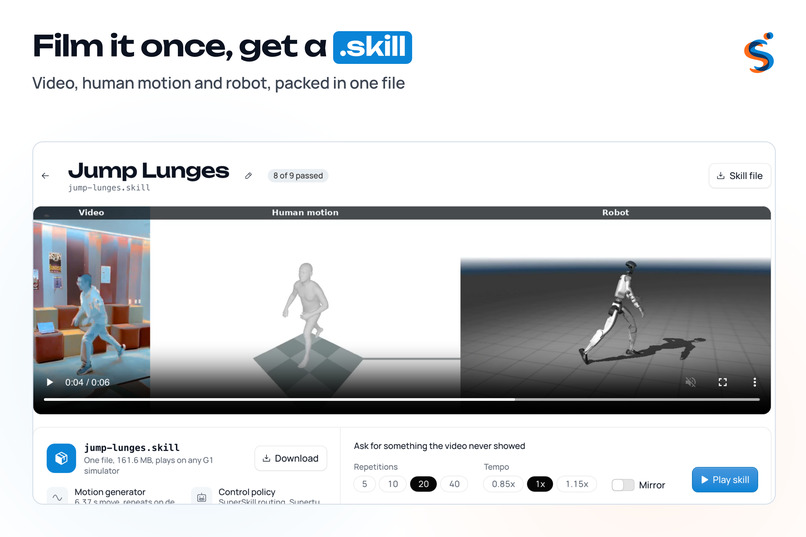
Get a humanoid ".skill" from a single video of a person, shot on your phone
-
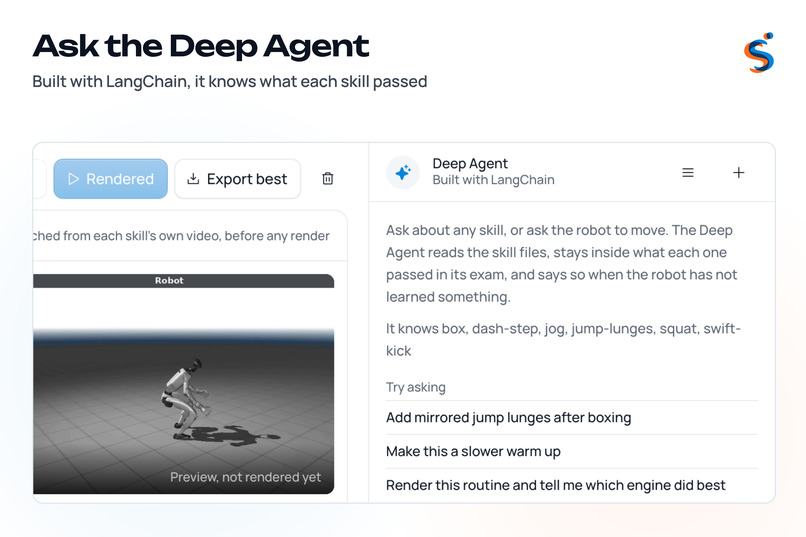
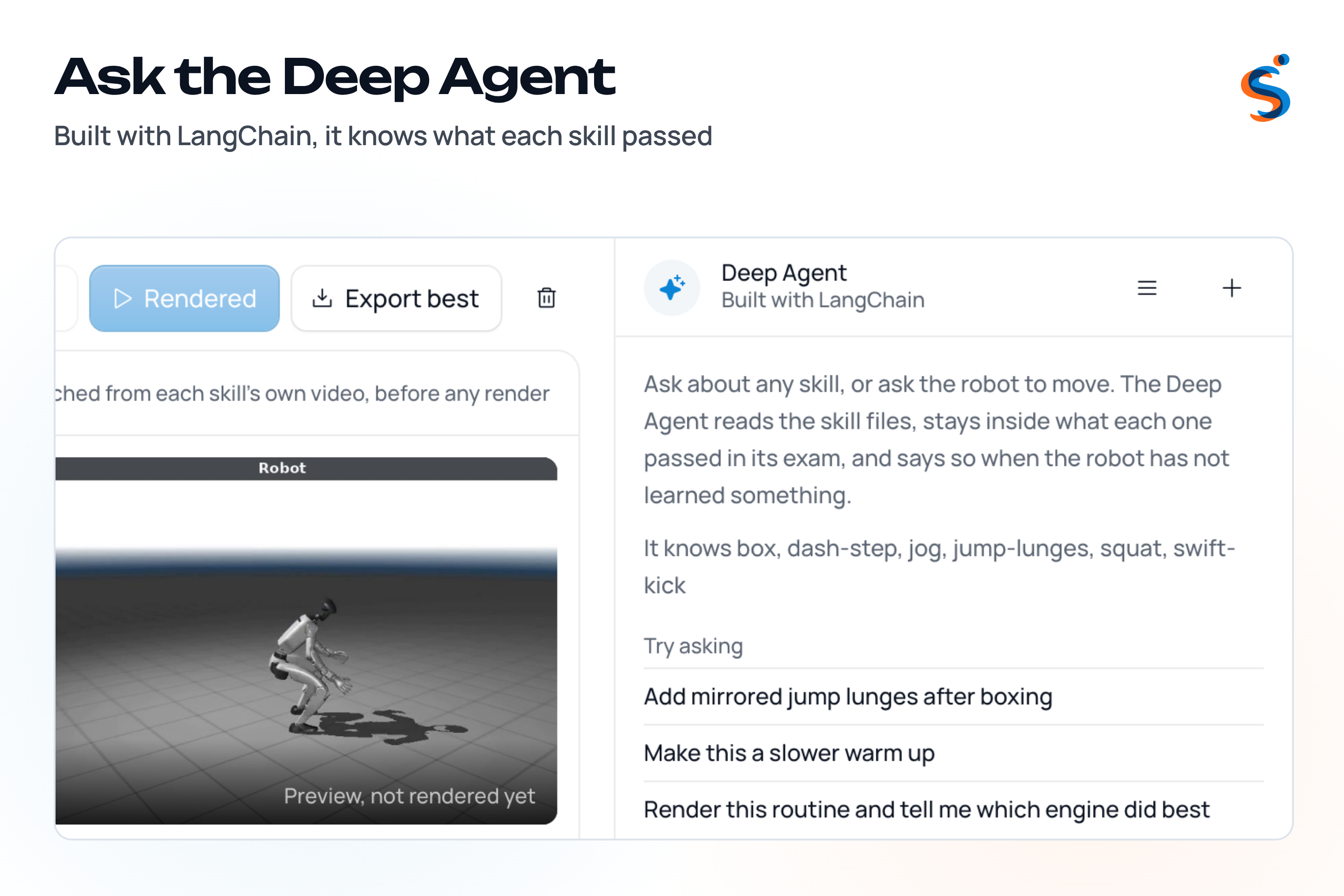
Deeply intergated, the LangChain Deep Agent monitors & improves training with its tools, provides useful insight, and handles tasks for you
-
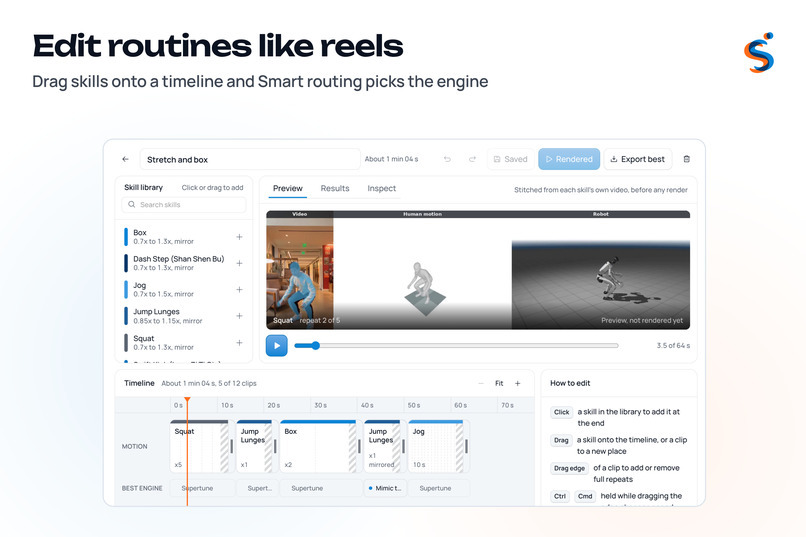
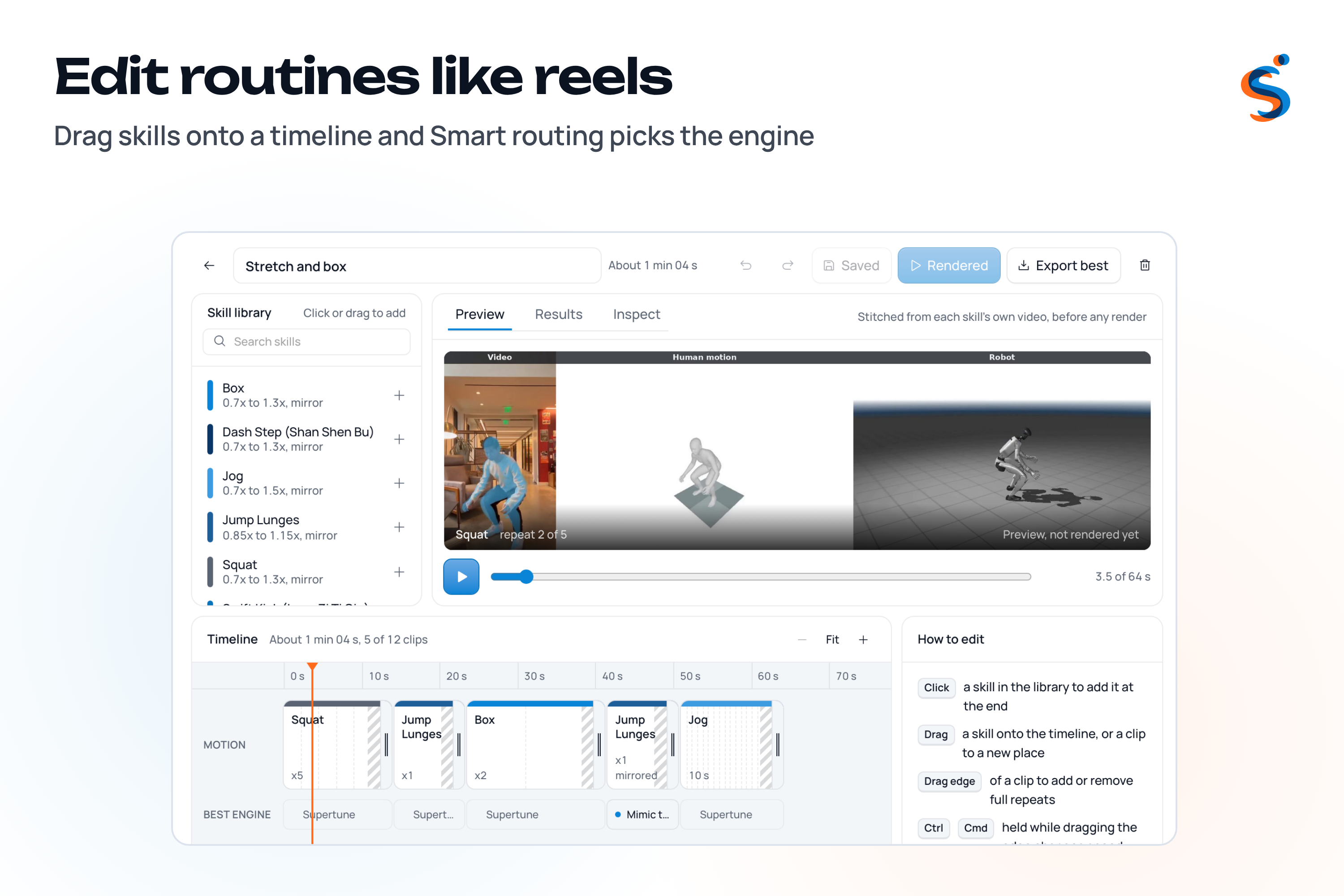
Edit a series of tuned skills in an interface designed just like a video editor
-
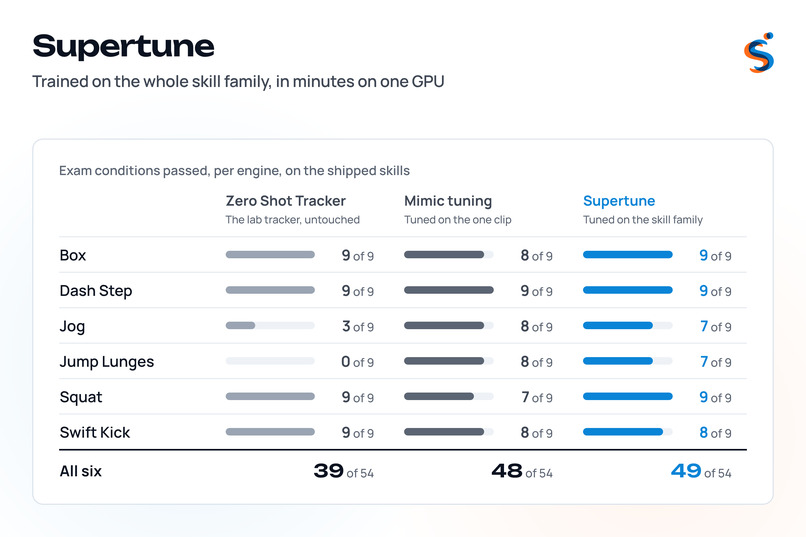
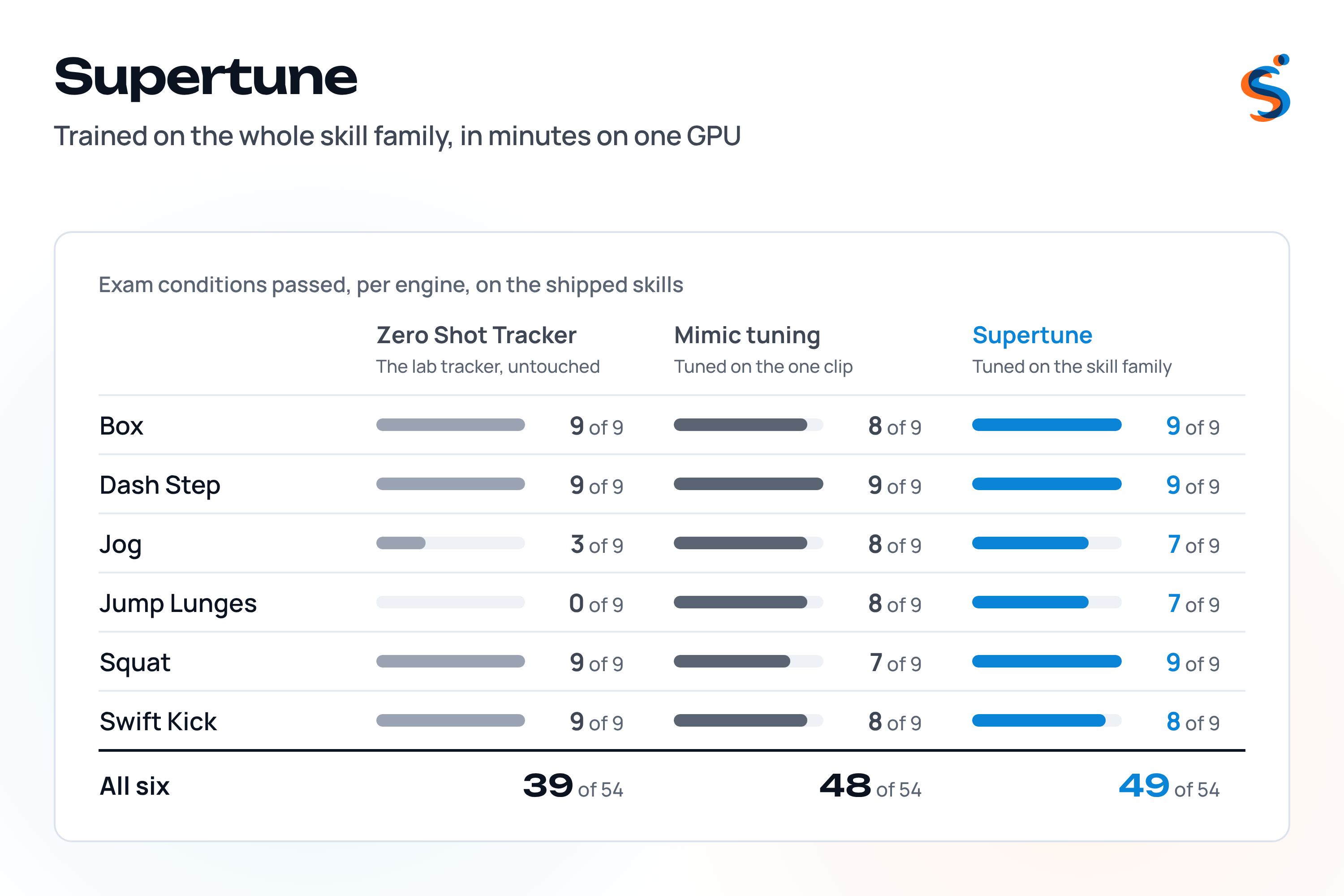
Supertune, a new method, fine tunes bots in the whole range of parameters possibly supported by each skill to improve performance
-
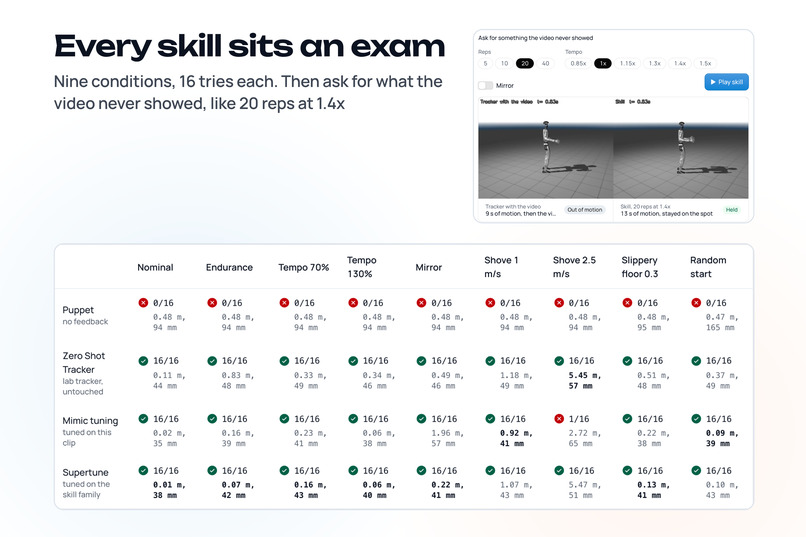
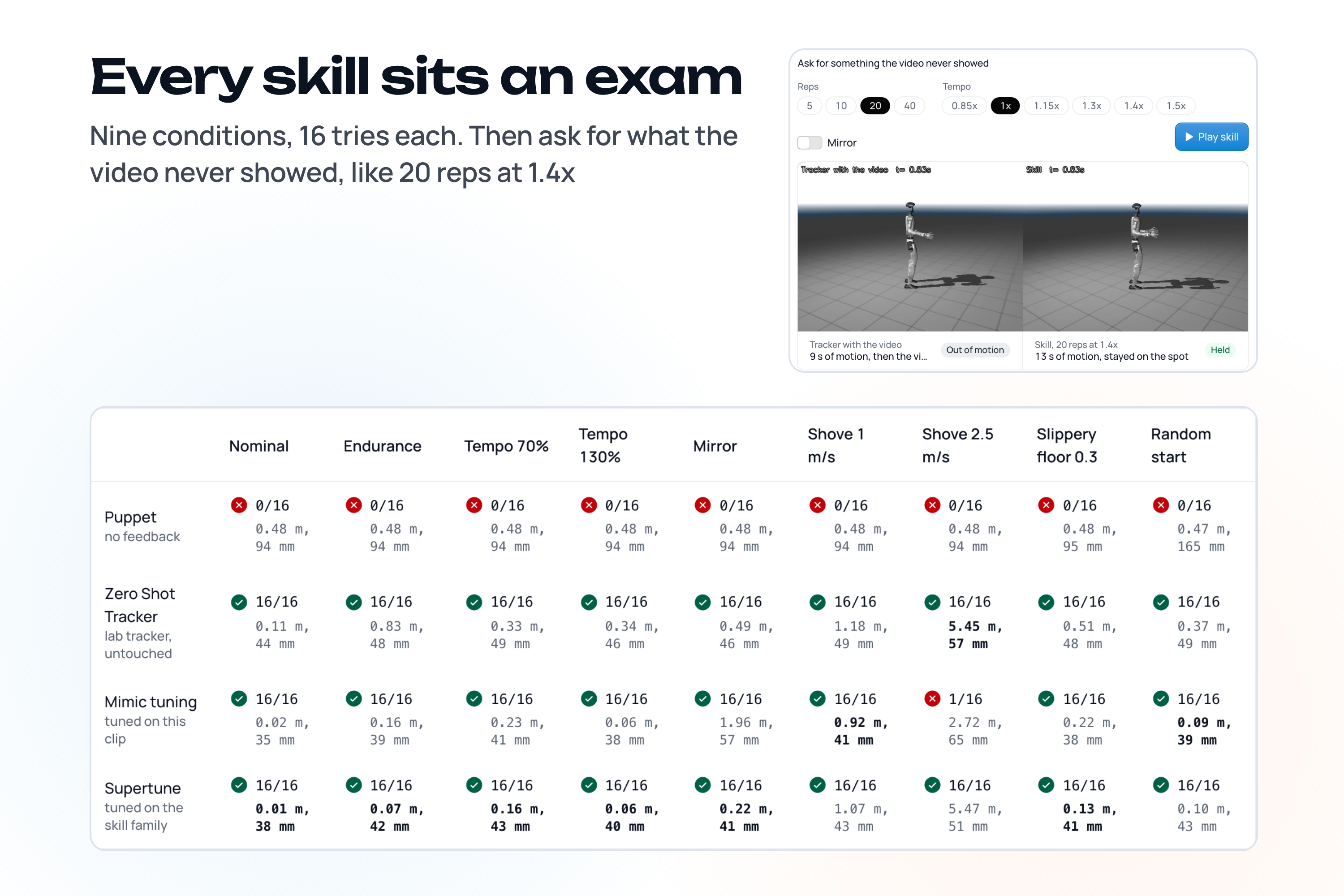
Smart Routing tests all methods in an exam to decide what's best for the skill
-
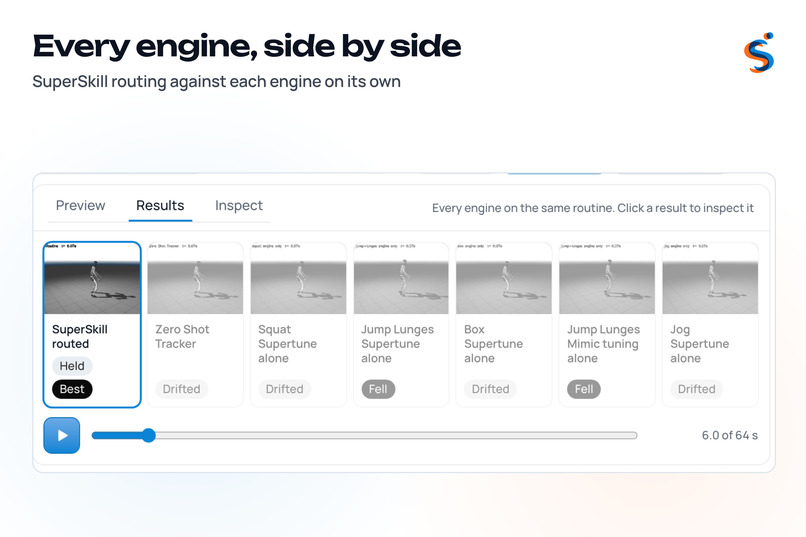
Choose the best possible run for each routine, and export it to run on your robot
Inspiration
Japan once ran the world's largest care robot programme. The robots worked, but to make a robot do anything an engineer had to program it, there wasn't much content, and carers told us it added to their workload.
SuperSkill started as an answer to that: if only the person who knew the movement could teach the robot! Domain experts, such as therapists, firefighters, and dance teachers, know which movements are useful (exercises for patients, motions to test protective gear, dances to impress friends and family). SuperSkill focuses on making it easier to transfer such motions to robots.
Many traditional Chinese dances have recently gone viral on Chinese social media, demonstrating a continued interest in learning such dances. We hope SuperSkill can also offer a new avenue for preserving such cultural practices.
Most people don’t have access to humanoid robots, but almost everyone has access to a smartphone with a camera! While prior work has shown humanoid robots can imitate motions from videos, SuperSkill aims to transform such imitated motions into skills that can be saved, modified, repeated, and even chained with other skills!
What it does
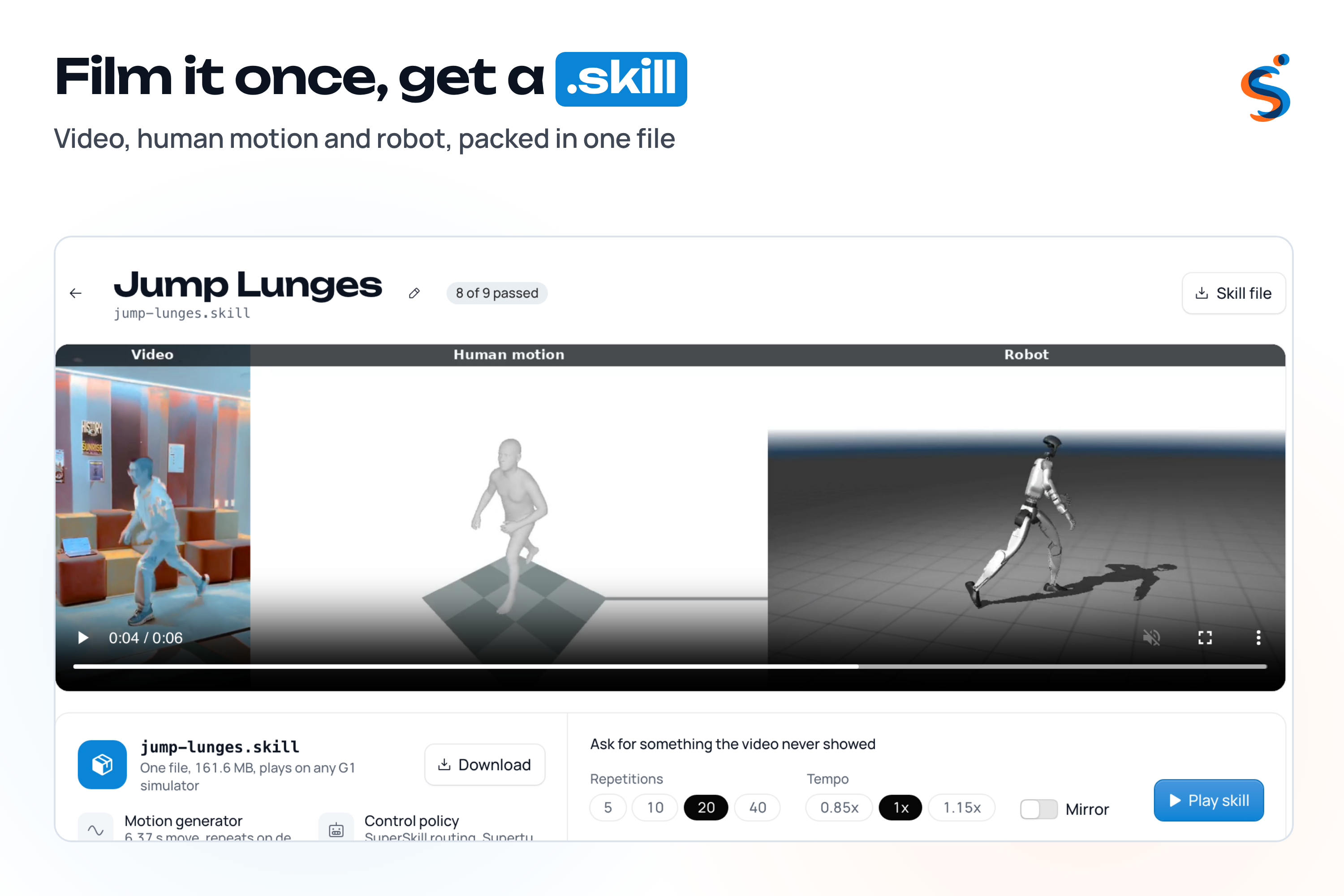
SuperSkill enables a user to teach a full-body motion skill to a Unitree G1 humanoid in the MuJoCo simulator from a demonstration video. Such skills can be repeated, sped up or slowed down, mirrored, and chained with other skills!
Just like video editing software, motions can be dragged from a library of learned motions onto a timeline. Users can also drag on the edge of motions to repeat them, hold Cmd and drag to modify the speed of motions, and click on motions to mirror them. Users can preview chained motions on the timeline (using only preview videos of learned motions!) and can render such chained motions to observe the full chained motion in simulation!
From a single demonstration to a motion primitive, and from motion primitives to motion sequences!
For each learned motion, SuperSkill compares three policies:
- Zero Shot Tracker: directly uses the pretrained PartyMimic tracking policy
- Mimic: further tunes the PartyMimic policy using the demonstration
- Supertune: further tunes the PartyMimic policy using modified versions (different speeds) of the demonstration
To determine which policy best tracks each learned motion, SuperSkill administers each policy a "motion exam" with 9 exam scenarios (different speeds, pushed, slippery floor, longer horizon) and 16 trials per exam scenario. SuperSkill saves the policies along with exam results as well as metadata (e.g., demonstrator name, permission for use) in the learned motion file. At deployment time, SuperSkill employs a simple routing algorithm to automatically deploy the policy that performed best in exams for a given motion and speed (different motions such as squatting, kicking, and jogging may be best tracked by different policies!). Users can also manually specify policies to deploy.
We’ve also built a LangChain Deep Agent that can read motion files, plan and execute motions, observe execution results, and even retry failed motions with different policies! The agent also employs a notebook to remember information across conversations and can even be given permissions to operate some features of SuperSkill! For example, users can ask the agent to make their robot perform some behavior, and the agent can alert the user about missing motions and even provide instructions on how to record demonstrations!
The motion file ties everything together: from human demonstration to robot deployment, performance metrics to agent planning!
How we built it
To make motions, we use GVHMR for 3D pose estimation from videos, GMR to retarget human motions to Unitree G1, and roll our own motion postprocessing. For policy learning, we build on top of PartyMimic and conduct simulation using MuJoCo. All policies can be trained on a consumer GPU. SuperSkill is developed using FastAPI and React.
Steven Peng and Michael Wei initially developed the policy learning stack, and Michael Wei additionally added LangChain agent functionality. I focused on thinking about what constitutes a reusable motion "skill", developing features to organize motions into editable routines, smart policy routing and saving routing decisions with motions, improving SuperSkill portability, enhancing policy learning (learning to track at different speeds, dealing with perturbations), integrating the agent harness, and more!
We also implemented some features to make SuperSkill presentable without a live GPU, including an offline mode that can play back previously recorded simulation runs.
Challenges we ran into
- It’s not as easy as it seems to make motions faster! We developed an iterative process for learning faster motions where we re-use previously learned successful tracking behaviors to aid in learning faster tracking. We only increase the tracking speed if the robot successfully passes through our exam framework. For example, for learning to track jogging motions, we test tracking from 0.7× to 1.5× speeds and smart policy routing ensures that the fastest tracking policy is deployed if the user requests faster jogging!
- Learned motion tracking skills must mesh well with one another! We had to ensure that our skill orchestration framework accounted for motion repetitions, speed, mirroring, and ordering so that the high-level routine specified by the user in our routine editor meshed nicely with our low-level motion tracking and execution framework. We’re proud that we got this to work end-to-end!
- Some motions made us nervous! We were nervous about whether our system could learn to track motions like Jump Lunges (since the robot has to be in the air!), Swift Kick (Lang Zi Ti Qiu) (since the robot has to balance itself while kicking), and Dash Step (Shan Shen Bu) (since the robot has to quickly change directions), but it worked!! We were super happy about these results since these motions posed different tracking challenges beyond the motions we initially considered!
Accomplishments that we're proud of
We’re proud that we developed:
- Routines for organizing motions learned from demonstrations into editable sequences!
- Skill orchestration for enabling an agent to intelligently plan, deploy, evaluate, and improve learned skills!
- Smart policy routing that is automatically conducted for each learned skill and can be reused to intelligently improve learned skills and entire learned routines!
- An accessible motion learning process where users can start with just a video of a motion recorded on their phone!
Results we measured
Smart policy routing results in better tracking in routines! For example, when executing a routine that consists of a sequence of boxing, jogging, and squatting motions, SuperSkill only deviates 0.11 m from the intended final position whereas always deploying the Zero Shot Tracker results in a 1.32 m deviation!
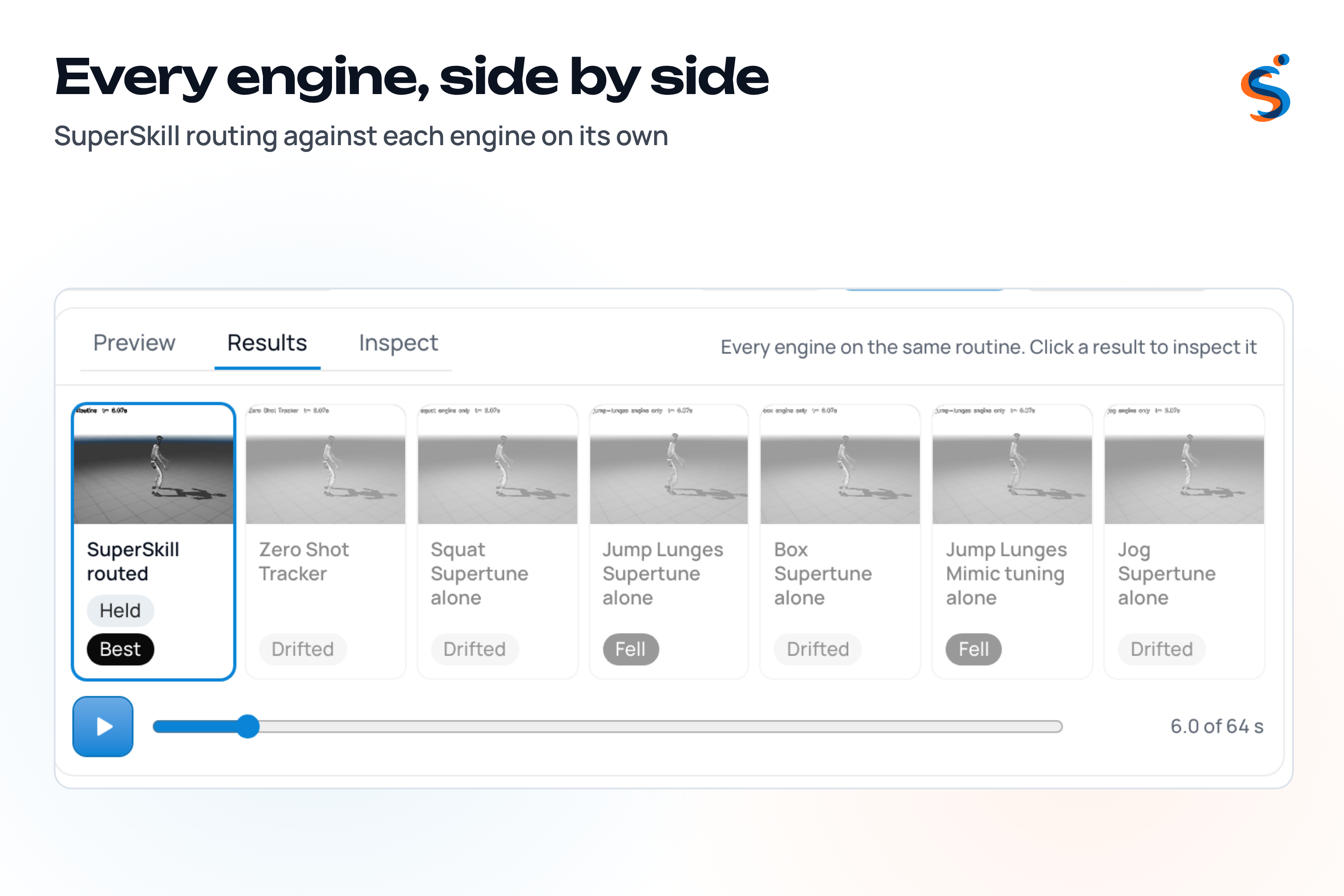
Our longest routine so far ("Stretch and box", 64 seconds, consisting of squatting, jump lunges, boxing, mirrored jump lunges, and jogging) can be executed without falling using smart policy routing (deviating only 0.52 m from the intended final position) whereas always deploying any one policy results in either falling or large (2.4-3.3 m) deviations from the intended final position!
We’re especially excited about these results because they show that SuperSkill not only improves motion tracking but also improves the tracking of motions working together in routines through smart policy routing!
Skill exam results enable smart policy routing! Some quantitative results from our Skill Exams are tabulated below (we conducted 16 rollouts in simulation for each setting). We observe that smart policy routing (SuperSkill) matches or outperforms always deploying any single policy. For example, when pushed as hard as we tested for boxing, policies learned using Supertune do not fall over in 16/16 trials whereas Mimic tuned policies only stand up in 1/16 trials. When learning to track a longer jogging motion, Supertune results in a final position error of 0.43 m whereas Mimic tuning and the Zero Shot Tracker result in final position errors of 0.99 m and 10.6 m, respectively!
| Skill | Zero Shot Tracker | Mimic | Supertune | SuperSkill routed |
|---|---|---|---|---|
| Squat | 9/9 | 7/9 | 9/9 | 9/9 |
| Boxing | 9/9 | 8/9 | 9/9 | 9/9 |
| Jog | 3/9 | 8/9 | 7/9 | 8/9 |
Exam scenarios passed, out of 9.
Tracking diverse motions stress-tests SuperSkill! Some motions we tested on (squatting, jogging, boxing) were demonstrated by Steven. I recorded Michael Wei doing Jump Lunges on my iPhone at 2:30am the morning of our demo... Jump Lunges is particularly challenging for the robot since it requires the robot to be in the air! After 3 minutes 39 seconds of training on our GPU, the learned Jump Lunges policy passed 8 of 9 exam settings!
For the following two motions, we used full-body video demonstrations by Tiechun Zhao (university professor)!
Dash Step (Shan Shen Bu) requires quickly dashing back and forth. We learned a motion tracking policy from a 7-second Dash Step (Shan Shen Bu) performance in Anhui Huagudeng!
Swift Kick (Lang Zi Ti Qiu) involves kicking while one of the robot’s feet is off the ground! Here the Deep Agent autonomously selects which portion of the demonstration video to train on, evaluates how well the robot is tracking the motion, and makes policy learning decisions. Over a one-minute run, the chosen policy tracking strategy results in tracking that only deviates 0.06 m from the intended final position (2.98 m for the Zero Shot Tracker)!
What we learned
Different motions benefit from different policy tracking strategies! Motions that are easy to track, motions that are robust to disturbances, and motions that encourage the robot to stay close to a reference trajectory all benefit from different tracking strategies. Hence, we developed the notion of conducting Skill Exams and smartly routing motions to different tracking strategies!
What's next for SuperSkill
- Deploy our learned skills on a physical Unitree G1.
- Learn even more skills from motion experts.
- Apply our speed-up process to even more learned skills.
- Combine multiple motion demonstrations to learn more robust skills!