-
-
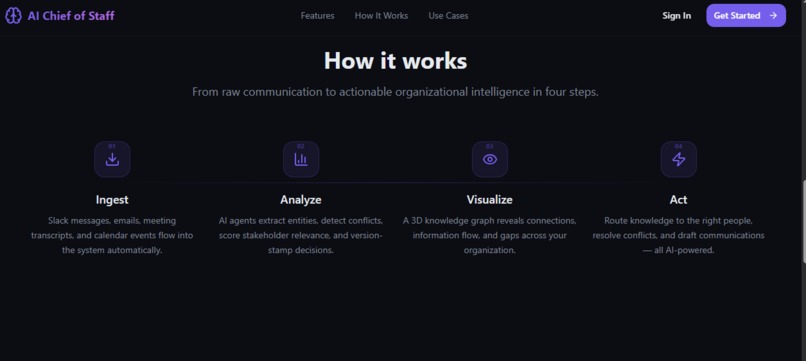
How it work
-
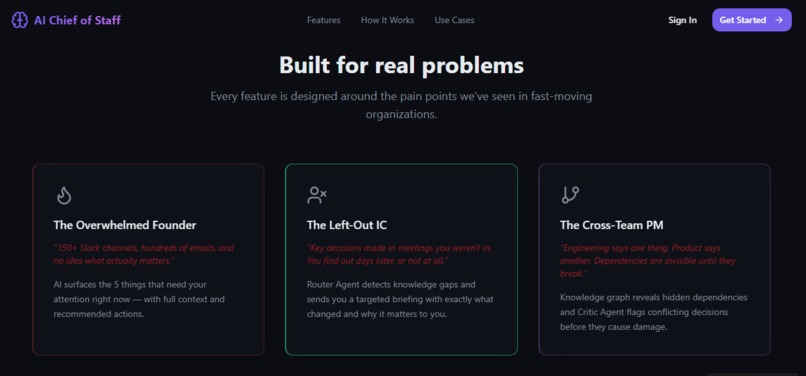
Target Audience
-
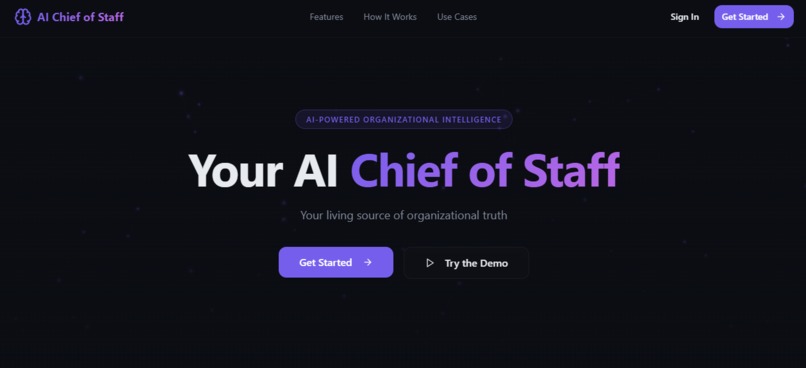
Hero
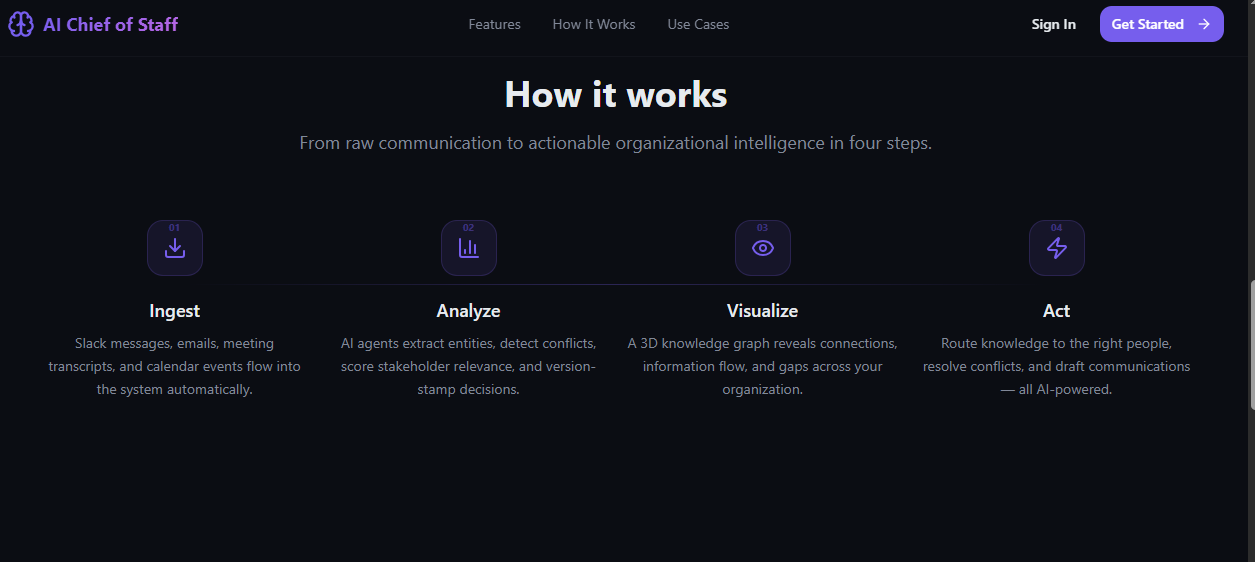
Inspiration
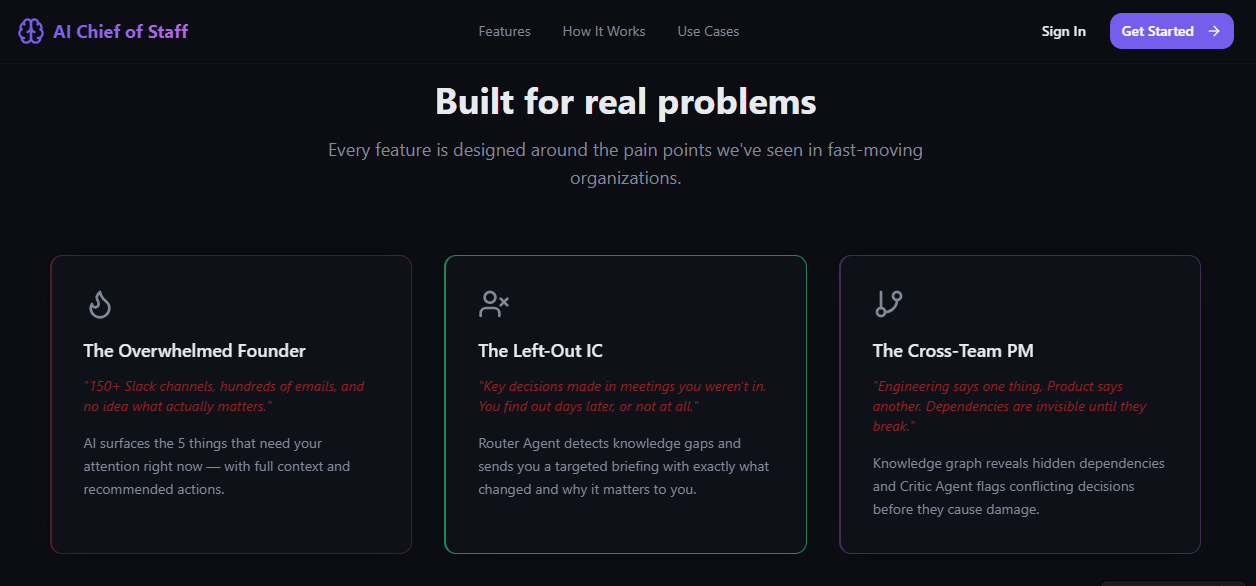
Superhuman AI Chief of Staff was inspired by a recurring pattern we saw across modern teams: the same organization could have brilliant people, great tools, and strong intentions, yet still lose critical context between meetings, channels, and departments. We wanted to build something that behaves like a real Chief of Staff: always listening, always synthesizing, and always connecting the right people to the right decisions at the right time.
At a deeper level, the motivation came from the cost of information entropy in organizations. If we think of organizational clarity as (C), a simplified intuition is:
[ C \propto \frac{\text{shared context} \times \text{decision visibility}}{\text{silo friction}} ]
Our project exists to maximize the numerator and reduce the denominator.
What it does
Superhuman AI Chief of Staff is an AI-powered organizational intelligence platform that captures and structures organizational knowledge, routes updates to stakeholders, and proactively flags conflicts before they become expensive mistakes.
It combines a multi-agent system:
- Memory Agent to extract entities and store institutional memory
- Router Agent to decide who needs to know what
- Critic Agent to detect contradictions, gaps, and staleness
- Coordinator Agent to orchestrate responses through natural language interactions
It also provides dashboards, communication workflows, project tracking, and a graph-based view of how people, topics, and decisions connect.
How we built it
We built the project as a modern web platform with a multi-agent AI backend and layered data architecture:
- Frontend: React 18 + TypeScript + Vite + Tailwind CSS + Framer Motion
- UI components & charts: shadcn/ui, Radix Primitives, Recharts
- Backend platform: Supabase (PostgreSQL, Auth, Storage, Edge Functions)
- AI orchestration: Lovable AI Gateway (Gemini, GPT-5) for extraction, reasoning, and summarization
- Semantic memory: Pinecone + OpenAI embeddings for relevance retrieval
- Knowledge graph: Neo4j Aura for relationship modeling and traversal
- Integrations: Google Calendar API + OAuth 2.0
- Testing: Vitest
From an implementation standpoint, we used a pipeline where communication artifacts are ingested, transformed into structured memory + embeddings + graph relationships, then re-surfaced through AI-assisted querying and role-aware notifications.
Challenges we ran into
Cross-system consistency: Keeping PostgreSQL records, vector embeddings, and graph relationships synchronized demanded careful schema and workflow design.
- Signal vs noise: Not every message should trigger routing or alerts; relevance scoring had to reduce notification fatigue.
- Conflict detection quality: Semantic similarity can surface false positives; we had to tune thresholds and enrich context.
- Multi-tenant safety: Enforcing strong org isolation with role-based access required disciplined data modeling and policy checks.
- Real-world UX complexity: Teams need power without cognitive overload, so we balanced deep functionality with approachable dashboards and agent explanations. ## Accomplishments that we're proud of Built a working multi-agent organizational intelligence system end-to-end.
- Integrated structured DB + vector memory + graph memory in one coherent product.
- Delivered reasoning transparency through agent-specific “thinking” experiences.
- Enabled proactive knowledge routing and conflict detection, not just passive chat.
- Shipped a product that is both technically ambitious and immediately useful for real teams. ## What we learned The biggest challenge in organizational AI is not model capability alone—it is knowledge architecture.
- Multi-agent systems are most useful when each agent has a clear boundary and measurable responsibility.
- Trust increases when users can see why the system recommended something.
- The quality of downstream insights is tightly coupled to upstream data hygiene and entity extraction quality.
- Product success depends on human workflow fit as much as technical sophistication.
What's next for Superhuman AI Chief of Staff
Next, we want to evolve from “smart assistant” to “strategic operating layer” for organizations:
- Add stronger autonomous follow-through on action items and dependencies
- Improve conflict prediction with temporal and causal modeling
- Expand integrations (Slack, Jira, Notion, email) for richer organizational coverage
- Ship executive-level simulation and scenario-planning tools
- Increase personalization by learning each org's communication dynamics over time
The long-term goal is to make organizational intelligence compounding: each decision should make the next decision faster, clearer, and better.
Built With
- actions
- calendar
- ci/cd
- frontend-|-react-+-vite-+-tailwind-+-react-force-graph-3d-|-|-auth-|-supabase-auth-(email-+-google-oauth)-|-|-relational-db-|-supabase-postgresql-(rls
- github
- gmail
- multi-tenant)-|-|-graph-db-|-neo4j-|-|-vector-db-|-pinecone-|-|-embeddings-|-openai-text-embedding-3-small-|-|-edge-functions-|-supabase-|-|-voice-|-openai-realtime-api-|-|-integrations-|-slack
- testing
- vitest


Log in or sign up for Devpost to join the conversation.