-
-
SuperBonds Finance - Financial NFT Market on Solana
-
MetaYielder and MetaLend
-
-
-
-
-
-
-
-
-

Inspiration
The inspiration for SuperBonds came from the glaring need for a risk-averse product, one with a guaranteed yield, and predictability. As it stood, fixed yield (USD equiv) was possible by surrendering custody (placing coin/selling futureon a CEX, or depositing with a large desk). But in DeFi, most yield was based on 3rd party token value. Why did they need to be mutually exclusive? Whereby, a user could self-custody a fixed-interest rate outcome (as a financial NFT). This was important to us because it solved for 2 key audiences: 1. The newbie who was afraid of their own fat fingers and didn’t know how to navigate DeFi. A simple UI/UX, and a clean presentation of what and how the yield is accumulated would be materially different from the yield-generating processes of the existing DeFi world. 2. The DeFi aficionado who was farming so aggressively, but still always had some dry powder. Parking it in fixed-yield outcome, even for short duration, was a perfect complement, as the NFT was as good as cash (easily redeemable for it), and was not sitting dormant.
The marriage between NFTs and traditional fixed-income bonds was the game changer we knew we had to pursue as a product.
What it does
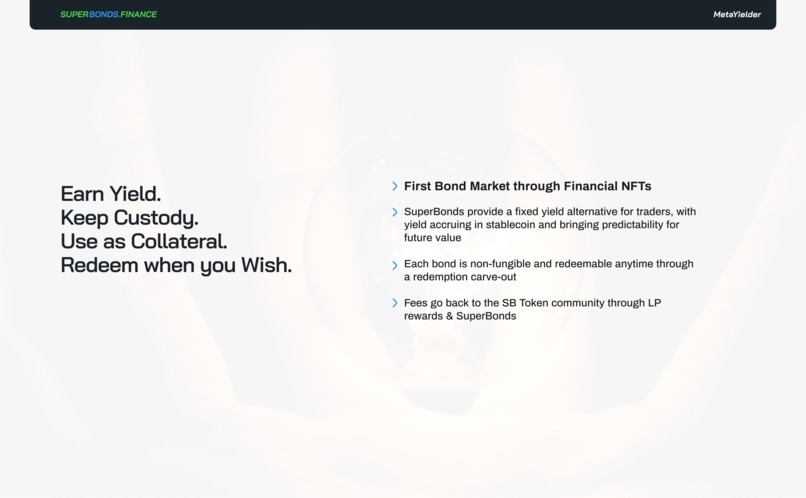
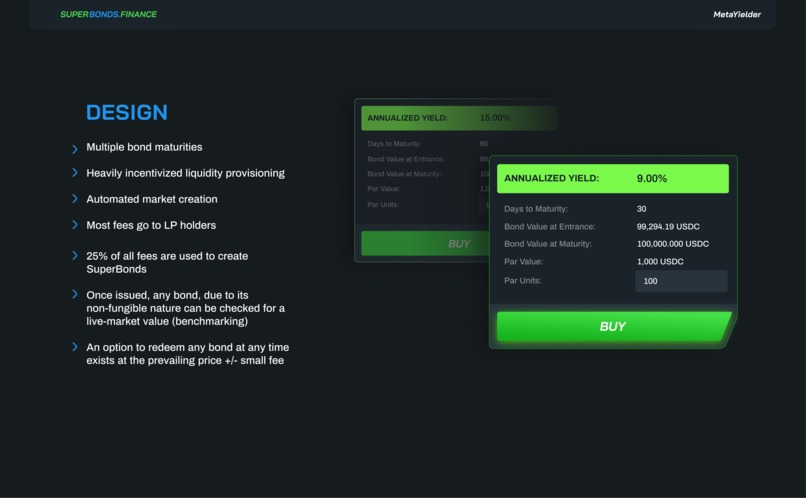
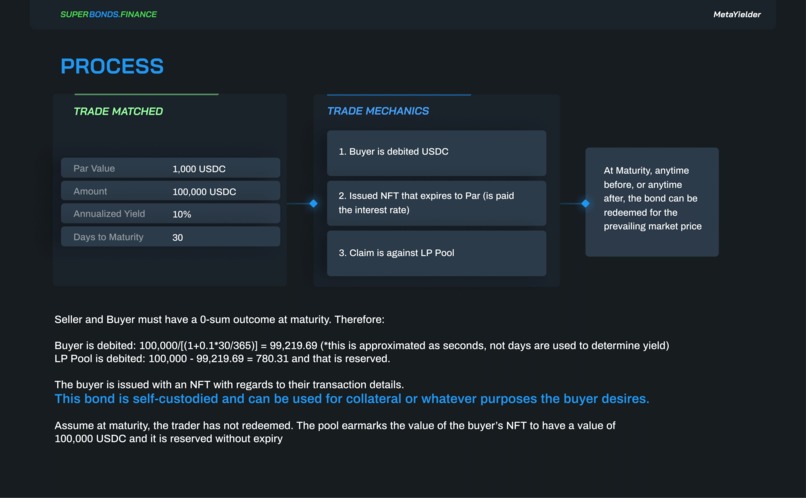
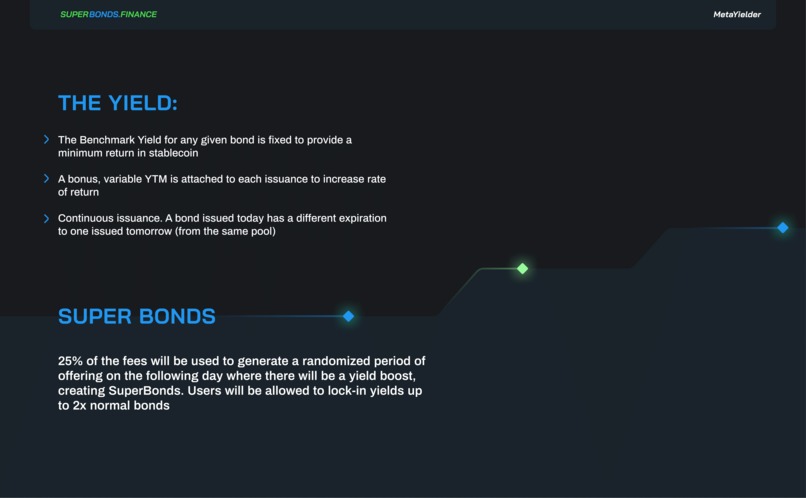
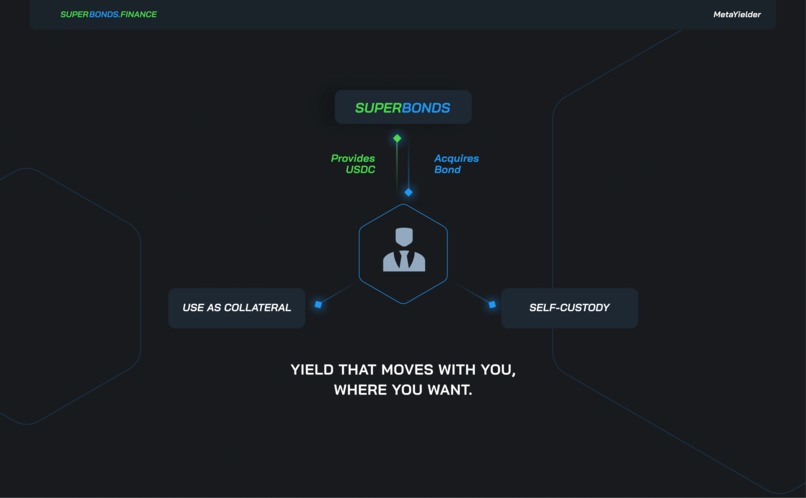
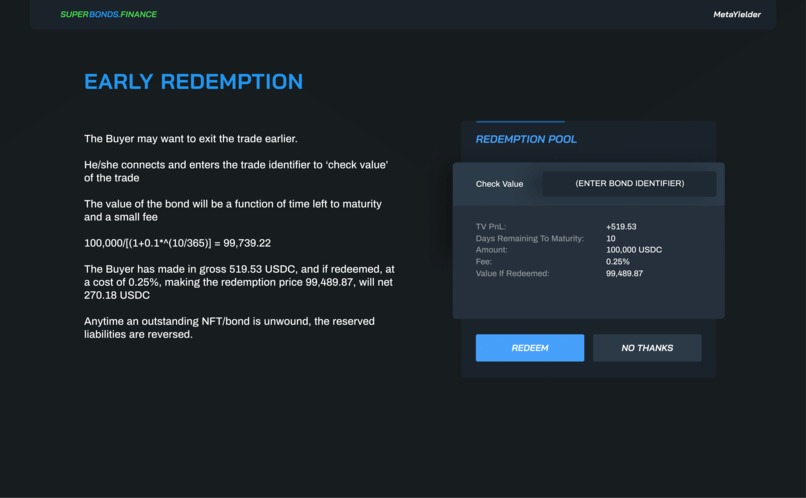
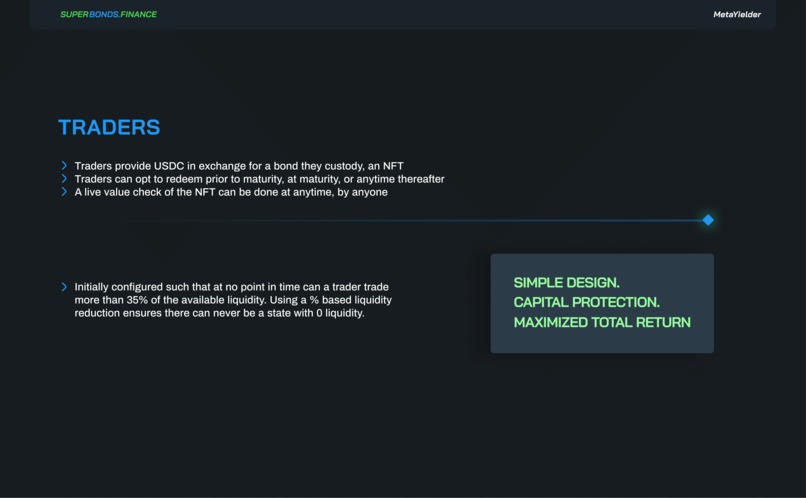
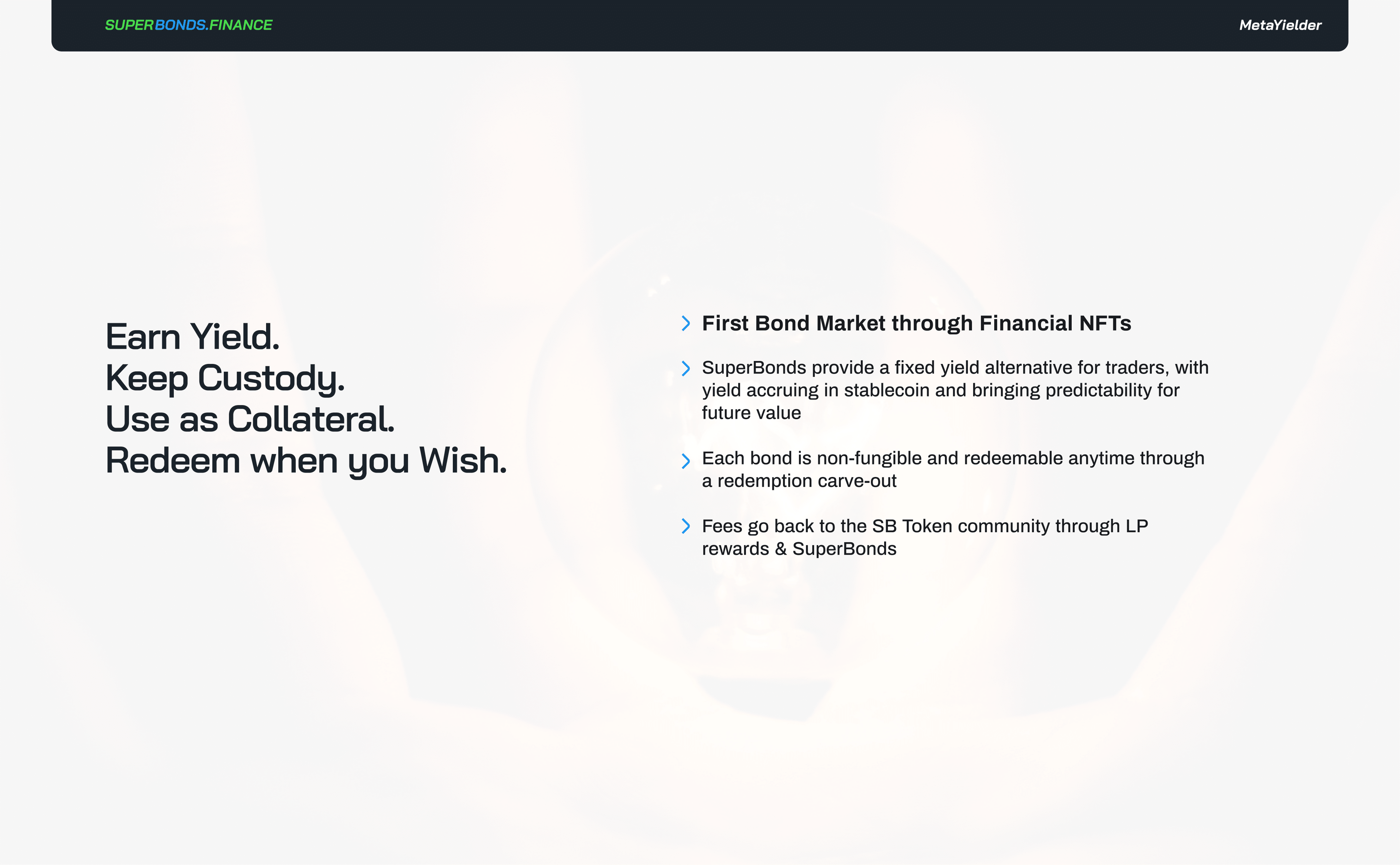
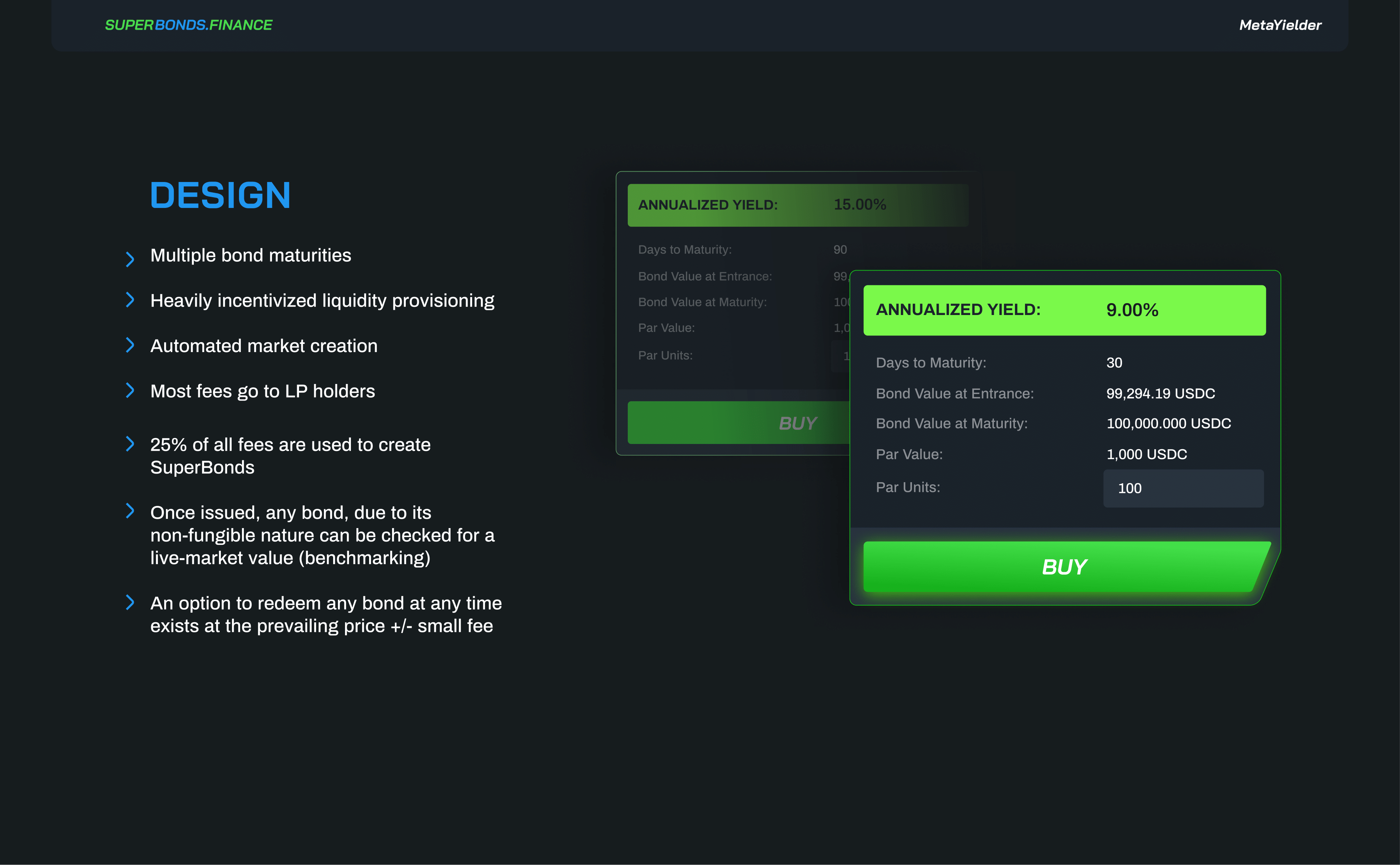
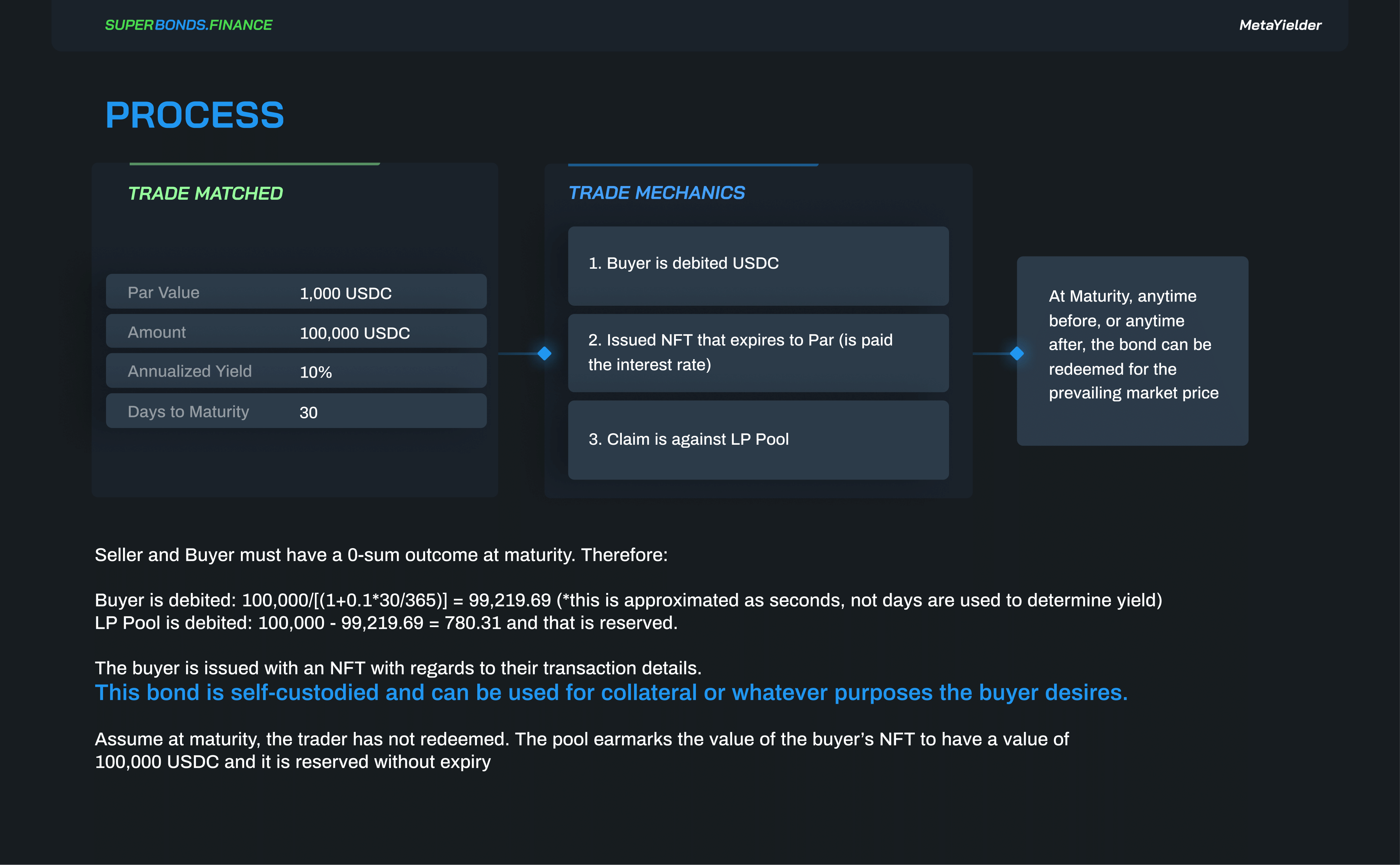
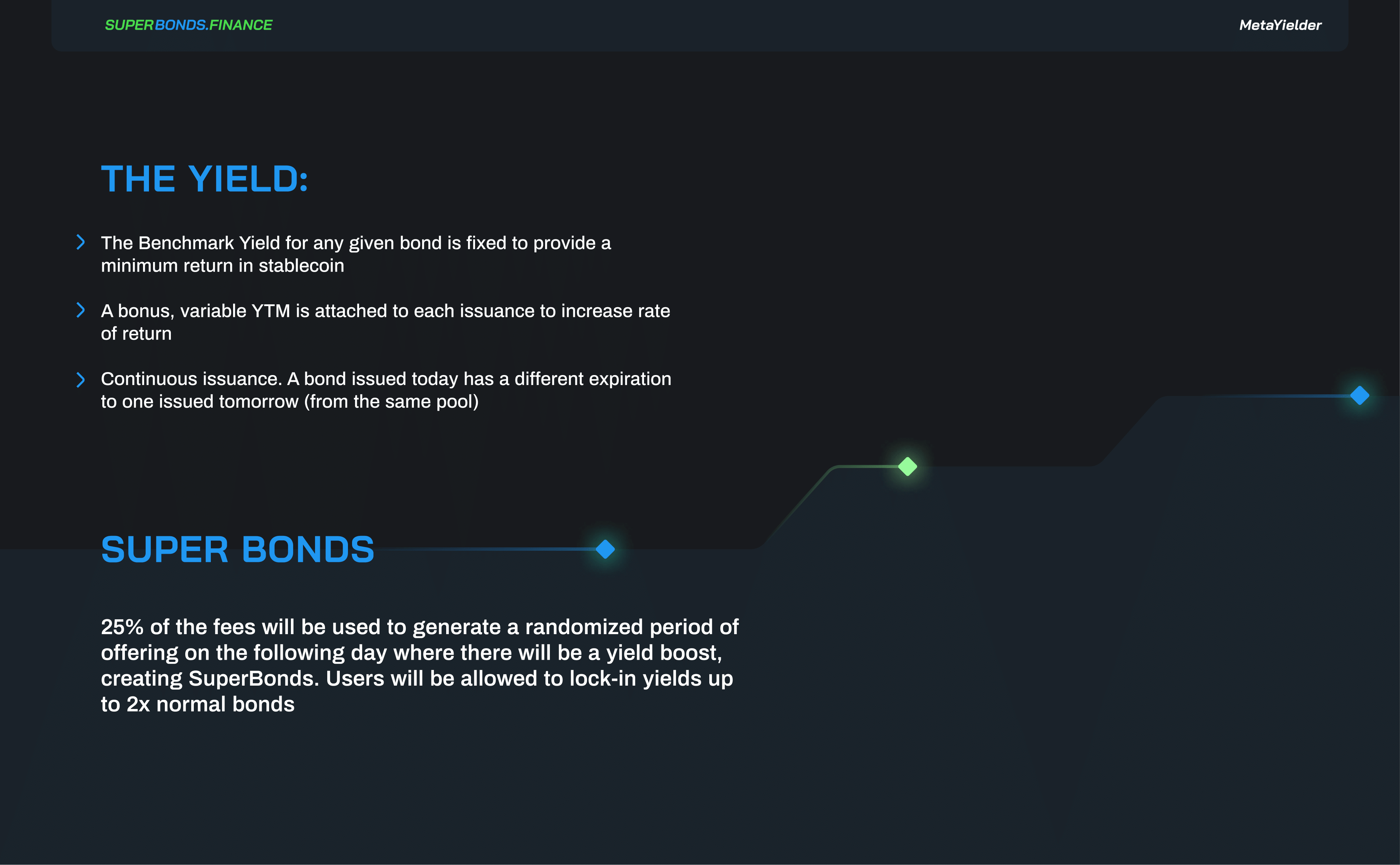
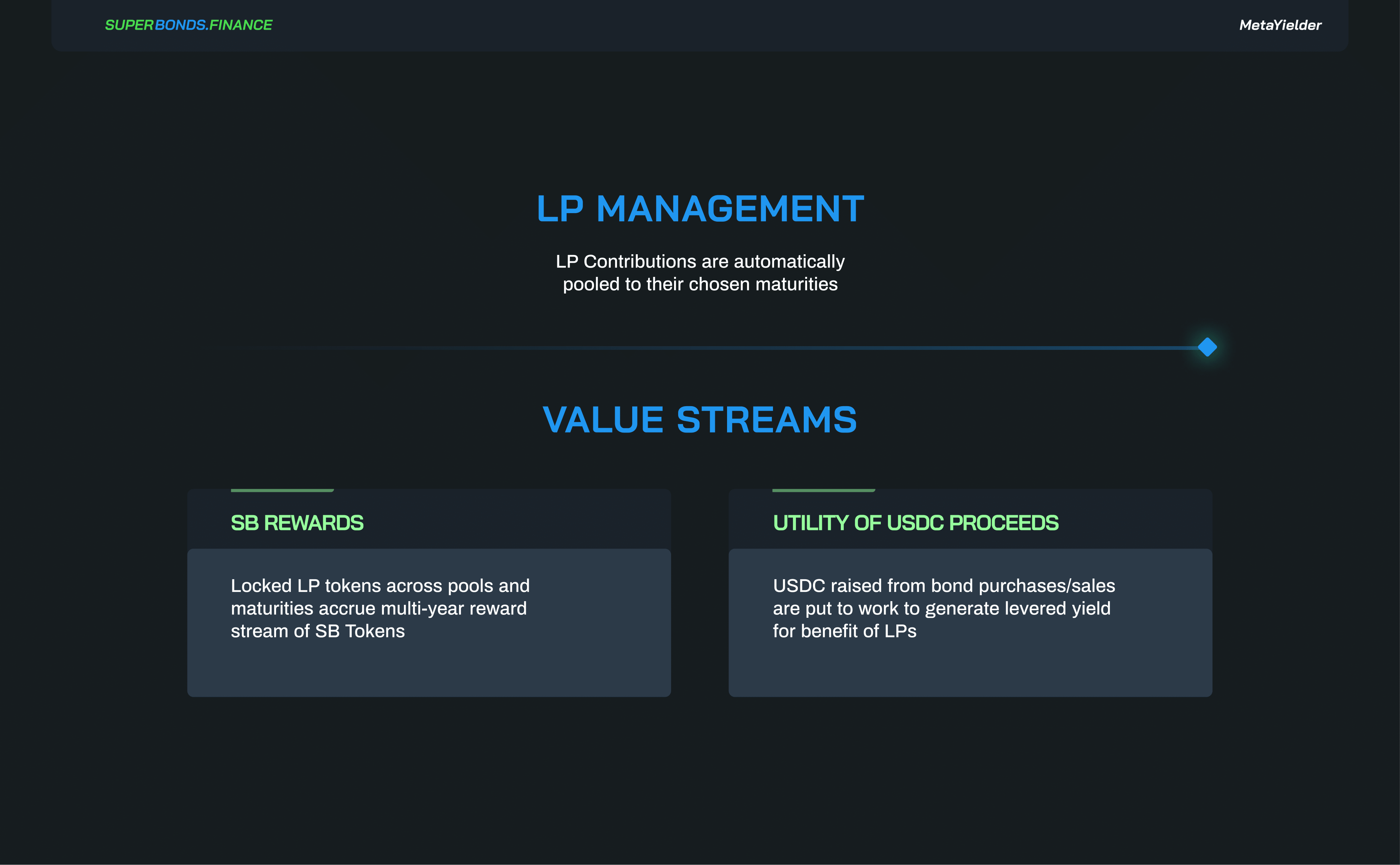
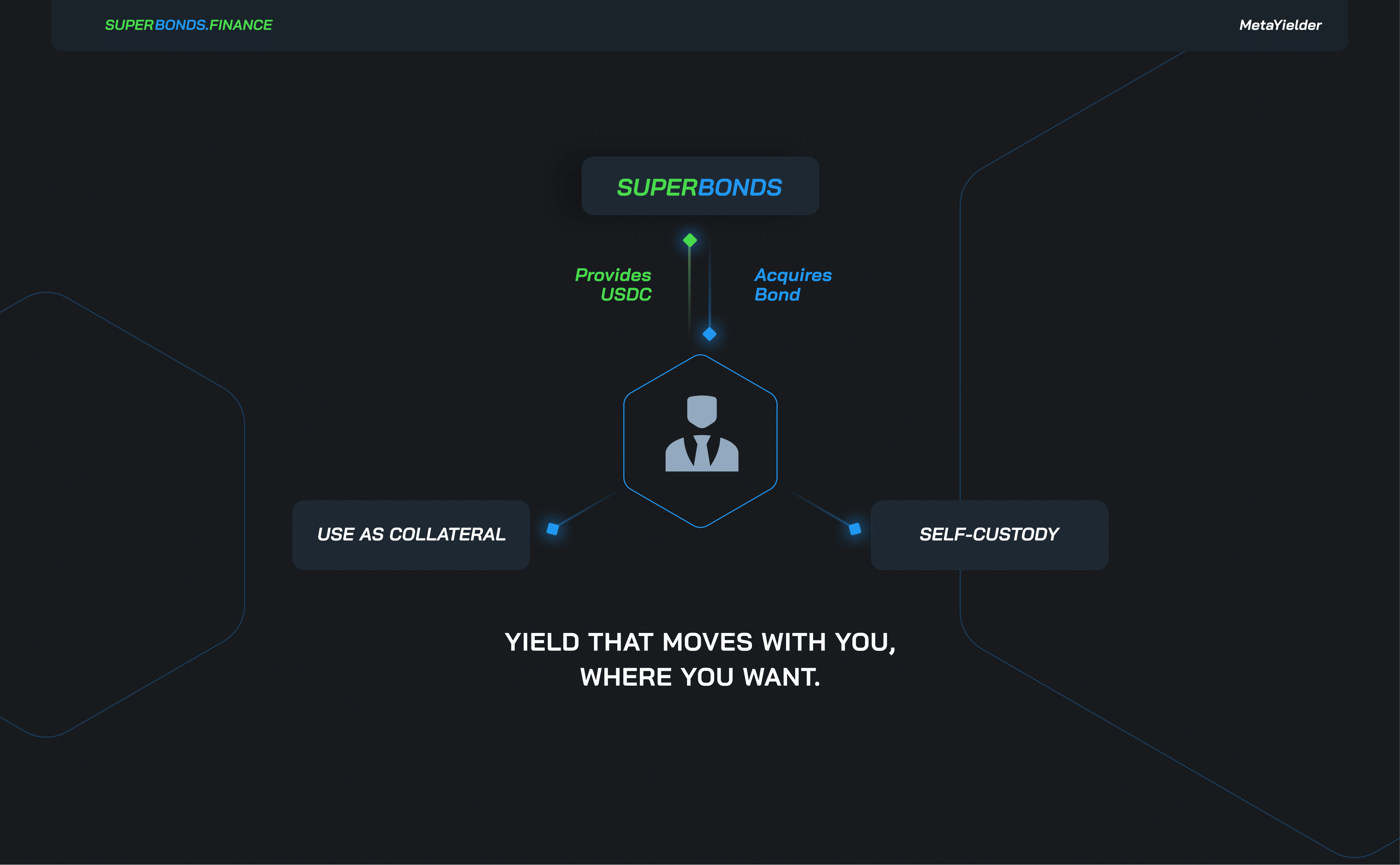
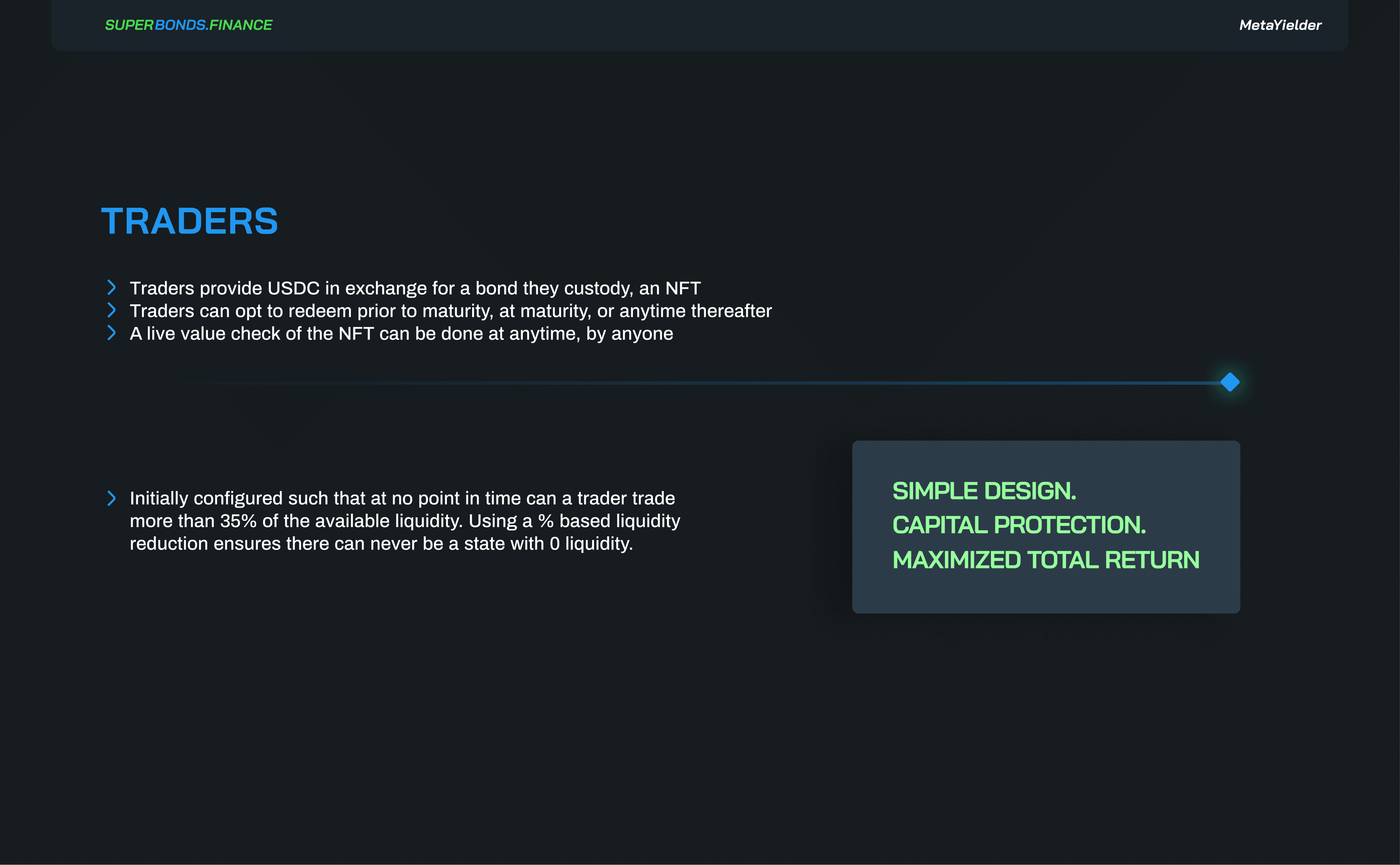
The SuperBonds platform allows traders to earn a guaranteed yield via zero-instalment bonds. In exchange for USDC, Traders are issued financial NFTs (bonds) that have a minimum (higher) fixed value. (It is noted as minimum because bond holders are also able to claim a bonus of SB tokens). These bonds can be kept in any SPL (Solana) wallet and can be utilised as collateral or freely transferred anywhere. This is made possible by LPs, who are happy to underwrite this yield, because they in exchange receive a variable, but much higher income stream. As traders & LPs are looking to achieve different outcomes, this creates a natural fixed-for-float market.
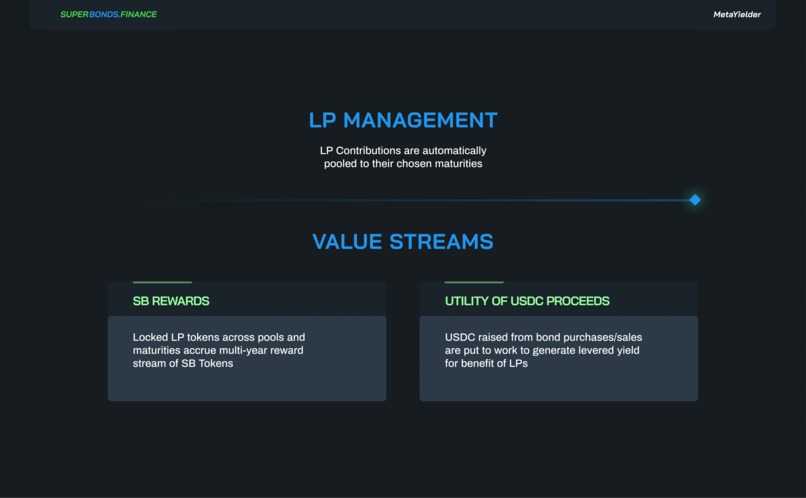
Users, whether they are LPs or traders or SB token holders, will be able to stack their yields by staking their LP Pool tokens/SB tokens in various staking pools. The SuperBonds ecosystem thus incentivises users to be active participants on the platform via economic incentives, whether they wish to earn yield on their stablecoins or tokens.
How we built it
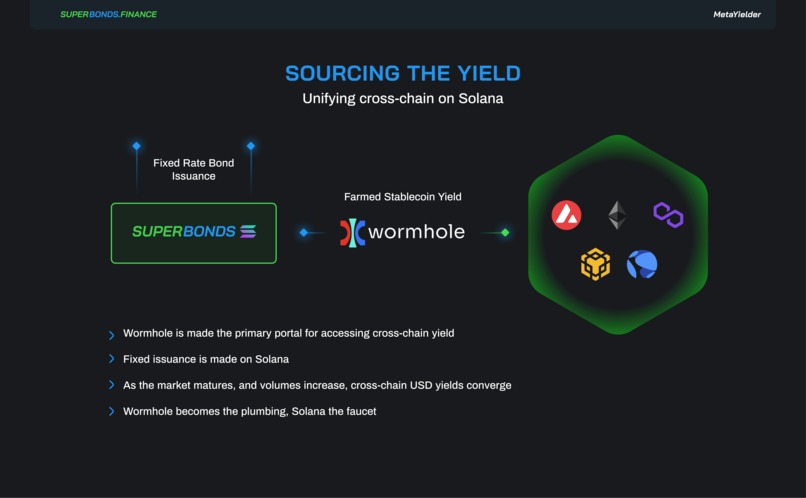
The platform is built on Solana, as low fees and high-speed transactions were a major consideration. Moreover, programming on Solana allows for the much-needed modularity in development via a combination of smart contracts deployed on-chain and traditional servers for managing siloed logic. In tandem with utilizing Wormhole to capitalize on the cross-chain farming yields, the majority of infrastructure is on the Solana network, with AWS filling in the gaps as and where required.
Challenges we ran into
One of our biggest challenges was deciding whether we should develop on Ethereum (or other EVM) or on Solana. Ethereum had the benefit of liquidity, ubiquity, and various DApps for yield generating potential. However, inconsistent (and high) fees made it nearly impossible to adapt it to a real-time outcome; the requirement was for a trader’s blockchain. Our early toying with Solana illustrated for it to be the better option.
But having gone the route of Solana, the issue that was naturally going to prop up, was the capacity of funds on the DApp. The amount of bonds available for purchase would ultimately be determined by the TVL of stablecoin pools across Solana. That number was (and is) still growing, and quite small compared to Ethereum. This is where Wormhole solved our equation. By converting SPL USDC to ETH USDC (native), we enabled the $ value of farmed yield cross-chain to support the issuance of SPL-denominated bonds. It was as if SuperBonds became the faucet for cross-chain $ yield.
Solana’s program structure, and the complexity of our implementation also meant we would often hit contract limits while developing on Solana, as there were several moving parts to the platform. We finally solved it by the modularity of logic: shift calculations onto secured servers, such that onchain transparency and the sanctity of our offering (full visibility) would still be preserved and not affect the security of the overall smart contract, but also allow us to operate within contract limits.
Accomplishments that we’re proud of
- Launch of a proprietary risk framework (first to be fully transparent)
- Functional (and updating) devnet
- Idea validation - growing communities
- The increasing innovative ideas (stemming from what we have built thus far)
We had a very strong ideal requiring this platform to be fully transparent, and onchain, whereby anyone, without needing to analyze the code of SuperBonds, would be able to track the flow of funds. A lot of DApps that exist right now have some element of human intervention or off-chain activity, and it was important to us (as we focused on longer-term scale), that this obfuscation be dealt with. Our framework is run through scripts that warehouse an intricate logic that mitigates risk while trying to maximize yield. When the platform is eventually managed through a multi-sig governance model, this will eliminate the possibility of inside bad-actors. Such an implementation, we feel, is truer to the spirit of DeFi.
This has thus far culminated in a fully-functional devnet, that is operating as intended; yield is garnered from a number of destinations and is helping underwrite the demand for bonds. We have pushed out multiple iterations onto the devnet, and further improvements continue to be rolled out.
The idea is receiving validation. As our community grows, our strong investor base also continues to help us solidify our positioning.
And importantly, an intangible, but priceless achievement has been that there is a strong gelling within the team; ideas are flowing, and the conversations are about growing, improving, and scaling the platform and new products. This synergy has contributed to a strong work ethic that has resulted in the actioning of the v2 of the platform.
What we learned
We learned quite a bit, and are still learning everyday. Ideating a solution is not the same as executing it. Automating a risk framework to generate yield cross platform sounds utopian, and is equally difficult in implementation. It requires constant updates to logic, which then have to be tested. In our case, we deal with everything from the everyday admin bottlenecks, to the complicated issues (i.e. a DApp that we want to connect to is only on mainnet). In every instance, the team has gotten together to forge a solution, allowing us to learn that we work well together.
What’s next for SuperBonds Finance
Up next is our code-audit, which is to be done by Ullam Labs in February. Following that, we anticipate our mainnet to be live in March.
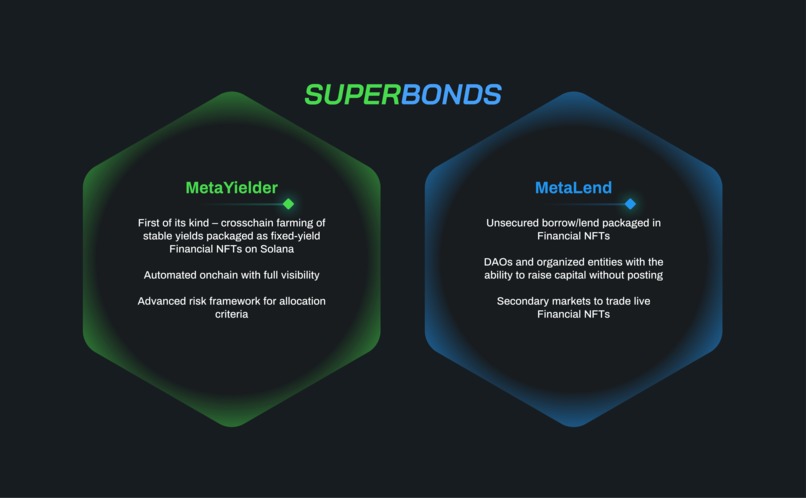
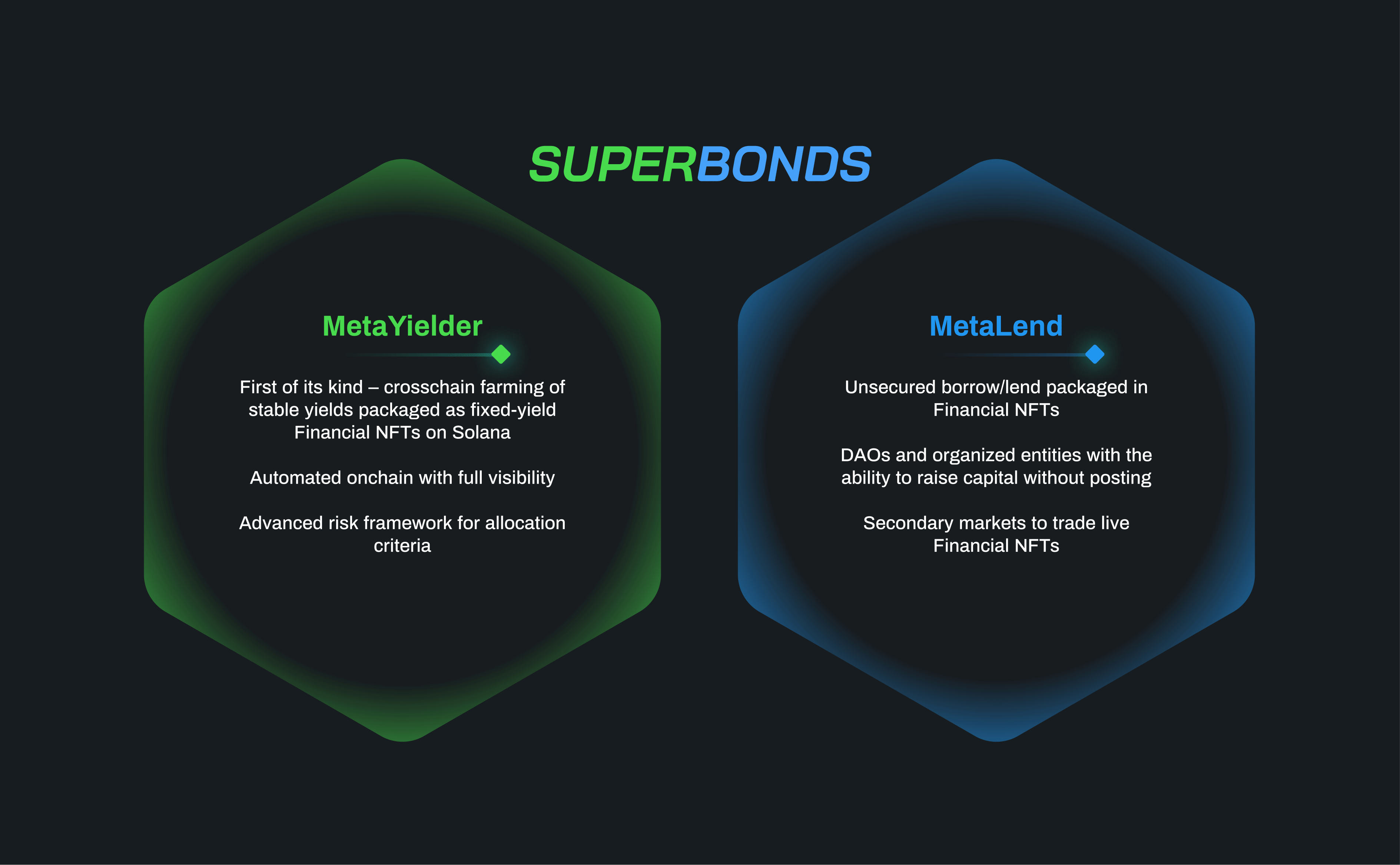
In parallel, we have begun the classification of SuperBonds into 2 distinct portals. The existing portal we are labelling MetaYielder, the new one MetaLend. MetaLend will be an industry-first unsecured lending platform for onchain entities. DAOs (and equivalents) will be able to raise financing (issue debt) in the form of financial NFTs, and a secondary market will be created for trading those bonds. This is anticipated to be live in late Q2.


Log in or sign up for Devpost to join the conversation.