-
-
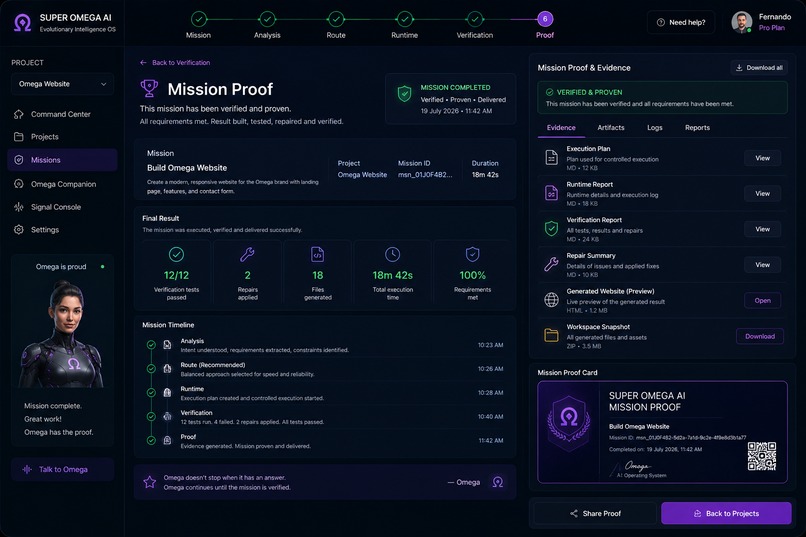
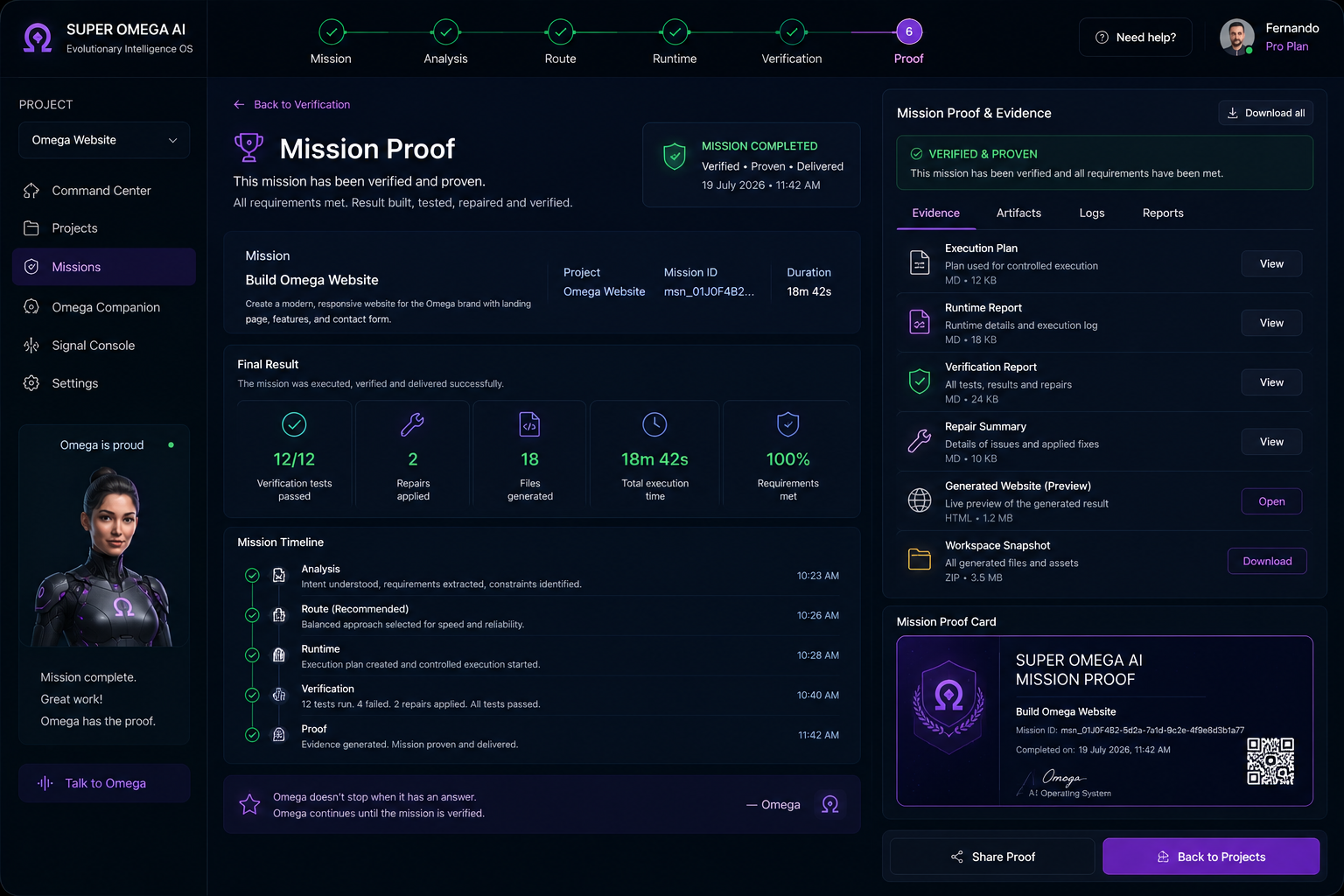
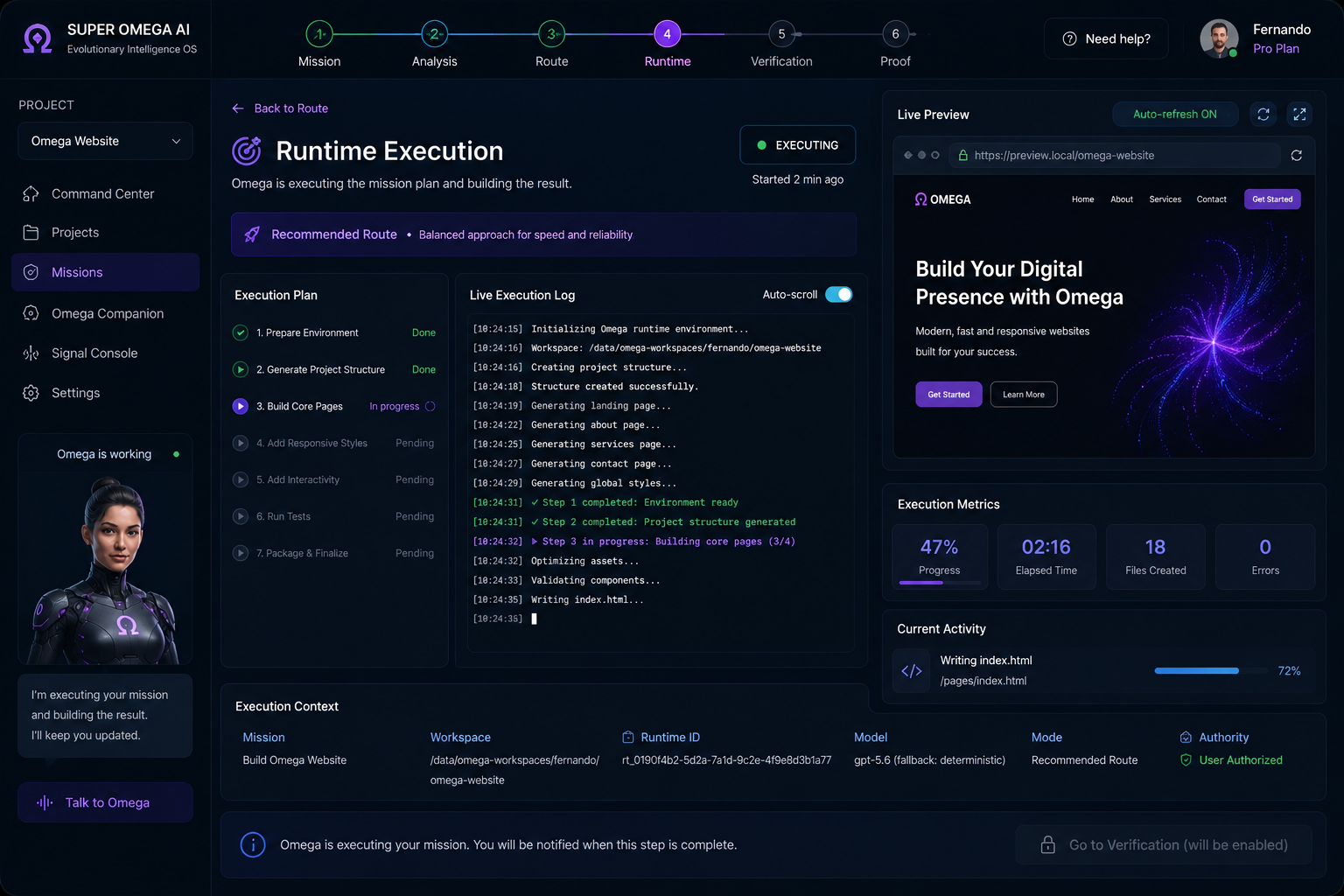
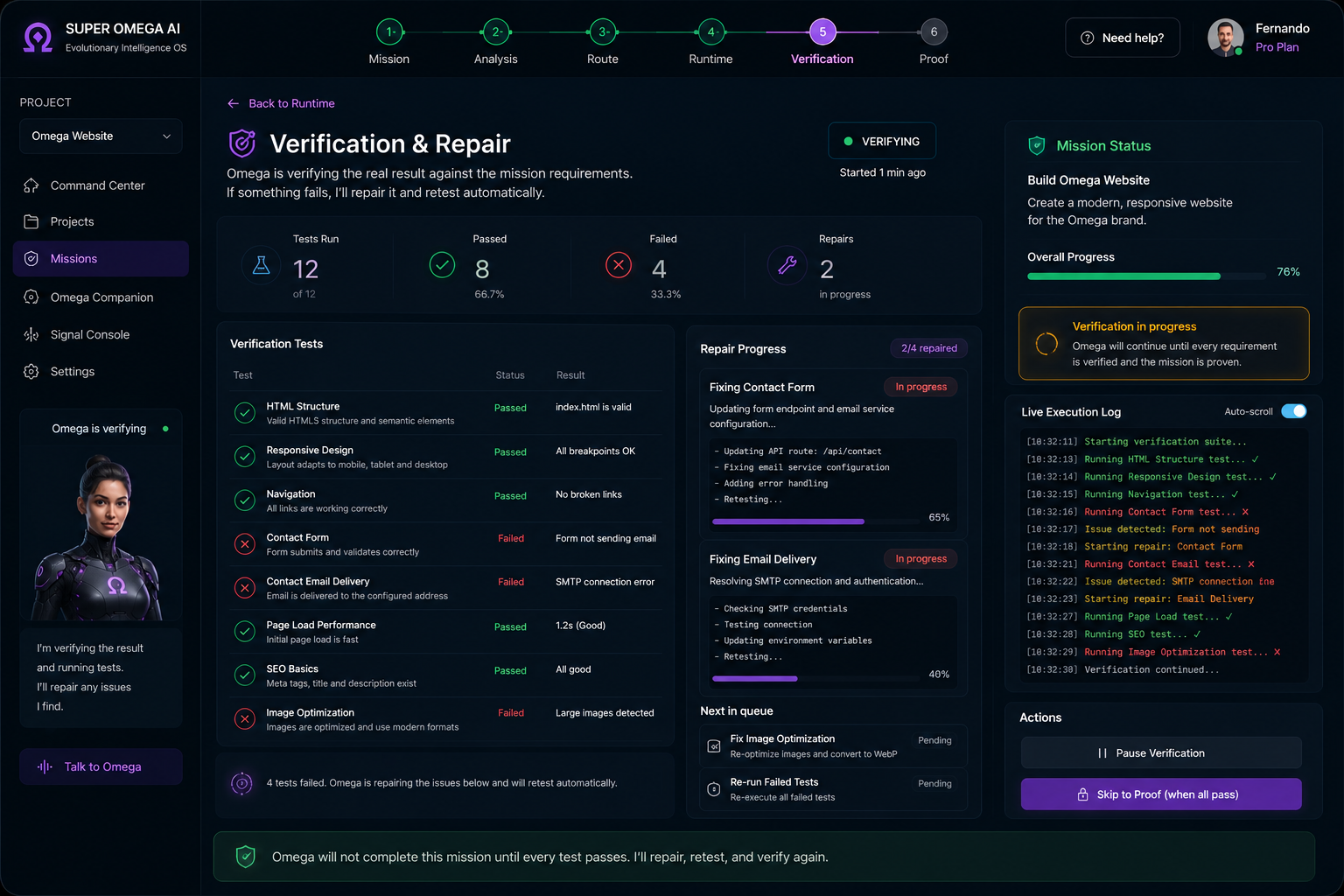
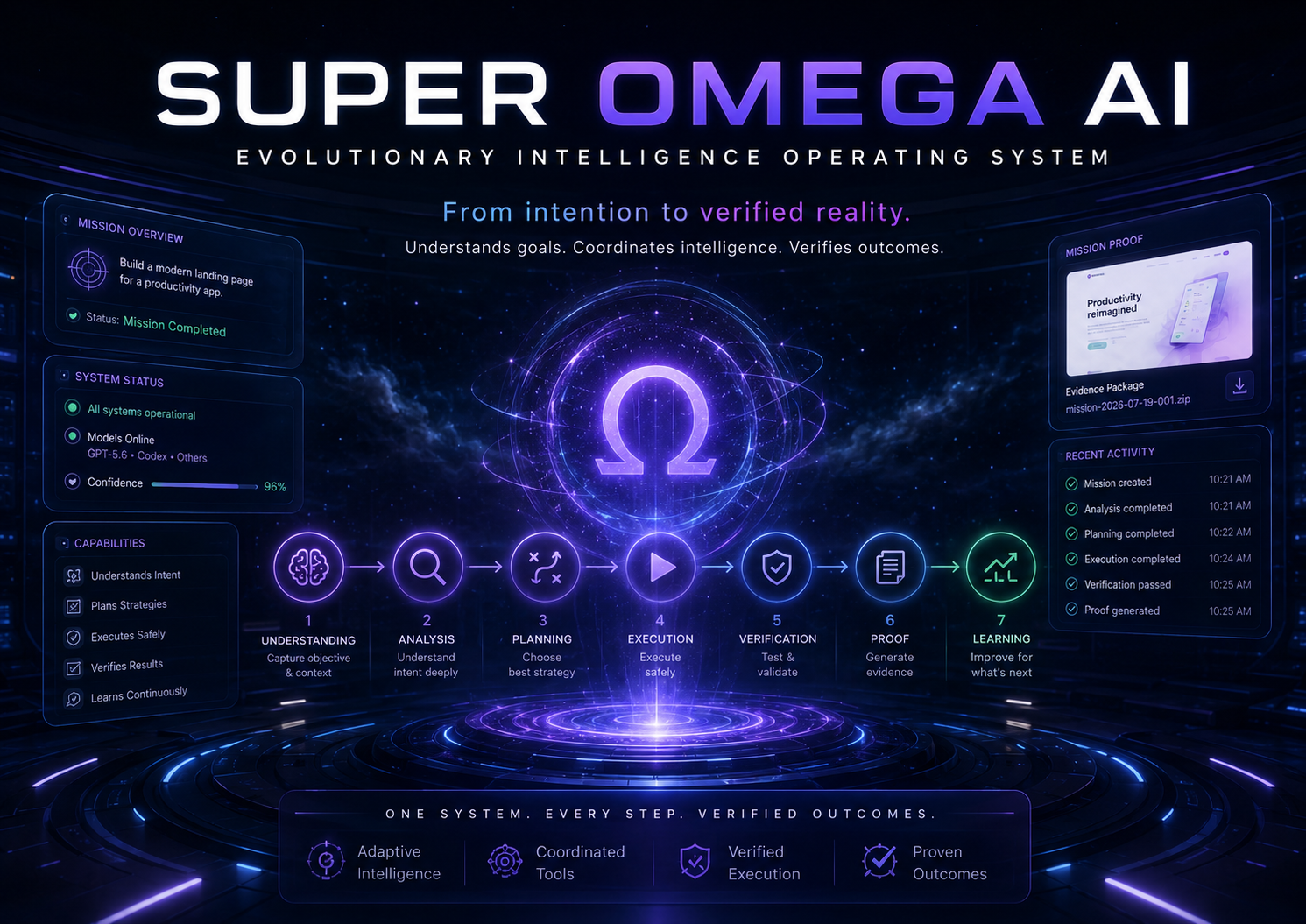
7. Mission Proof concept: persistent evidence of execution, tests, repairs, generated artifacts, and verified completion.
-
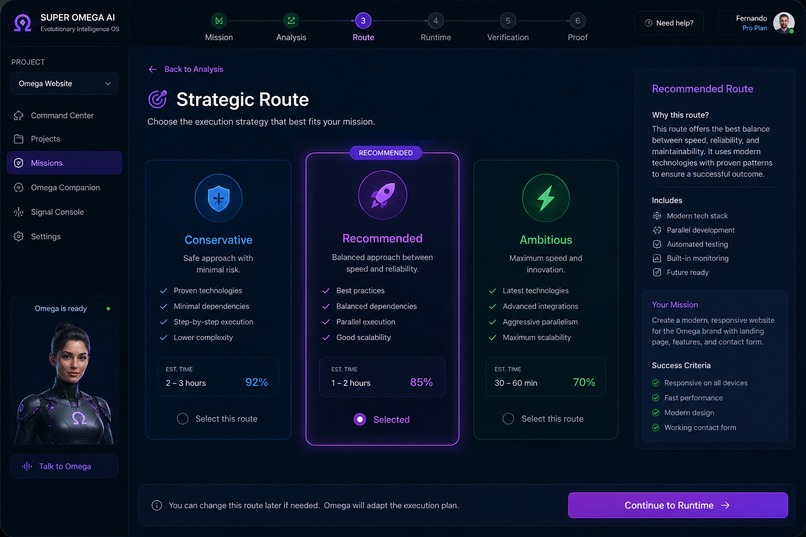
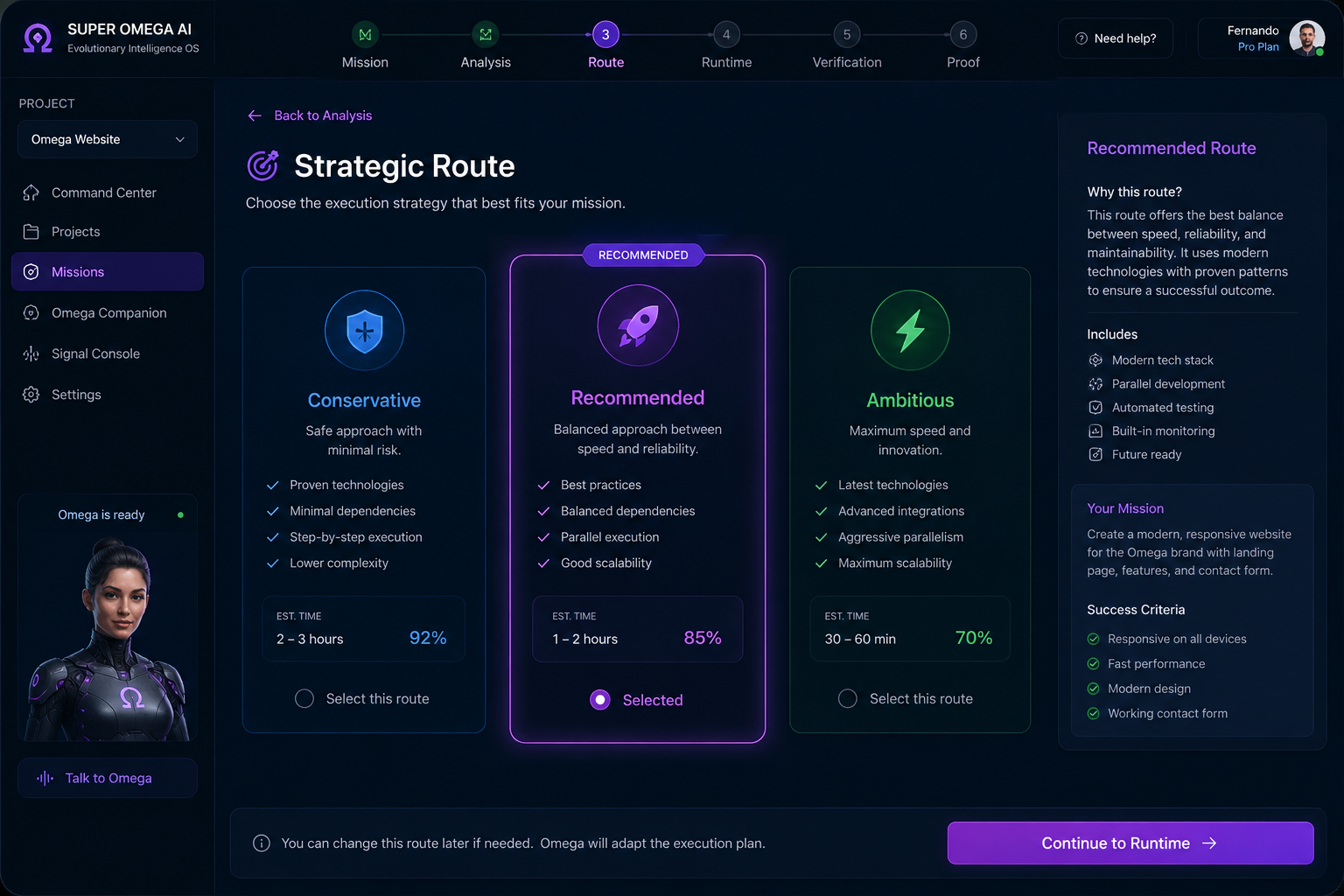
4. Strategic Route selection: Conservative, Recommended, or Ambitious, while preserving explicit human authority
-
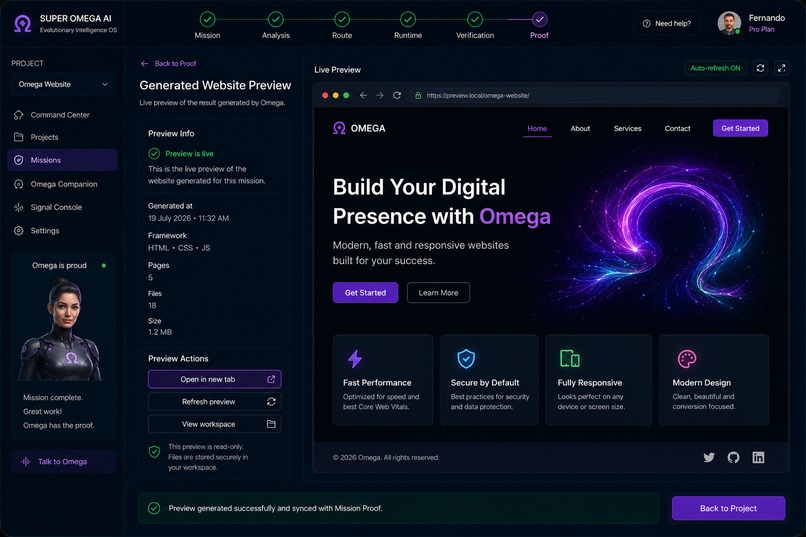
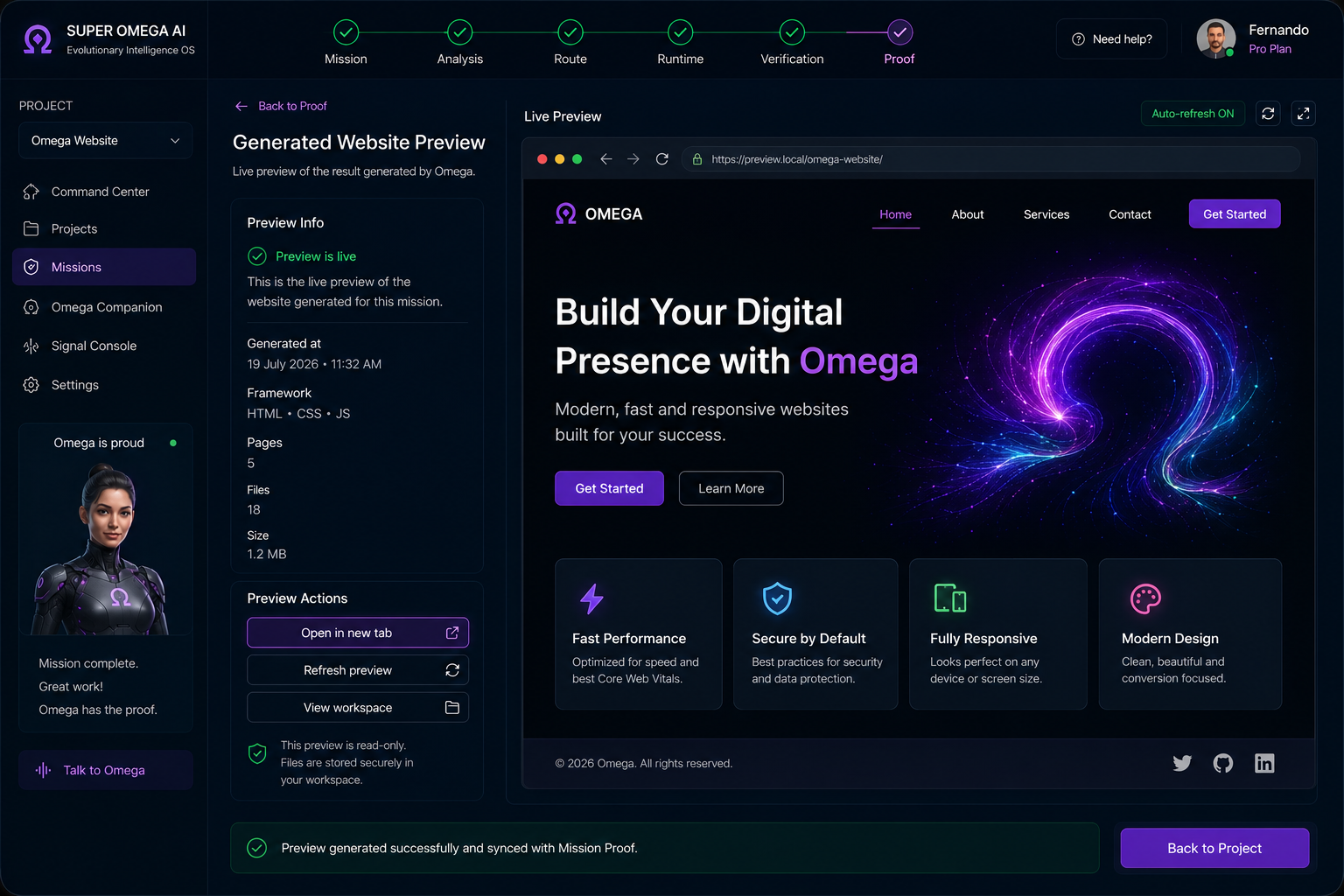
8. Generated result preview: the mission outcome can be inspected only after controlled execution and verification.
-
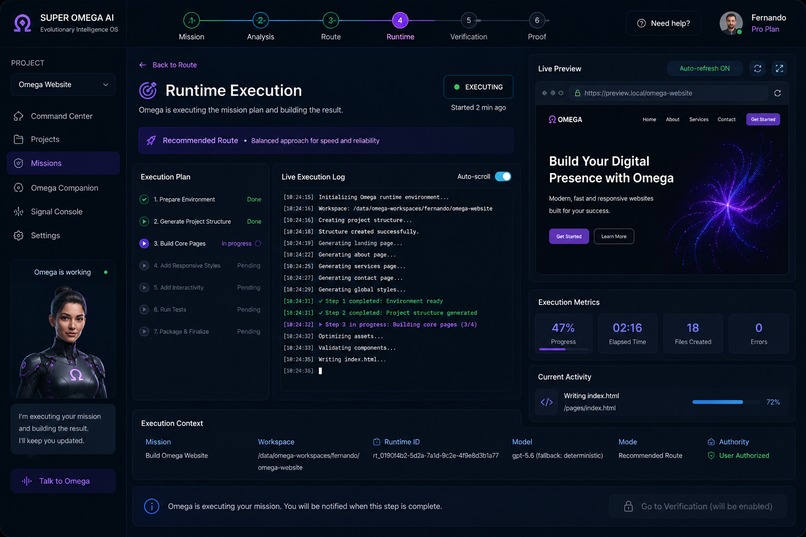
5. Runtime concept: controlled execution with observable progress, workspace context, activity, and result generation.
-
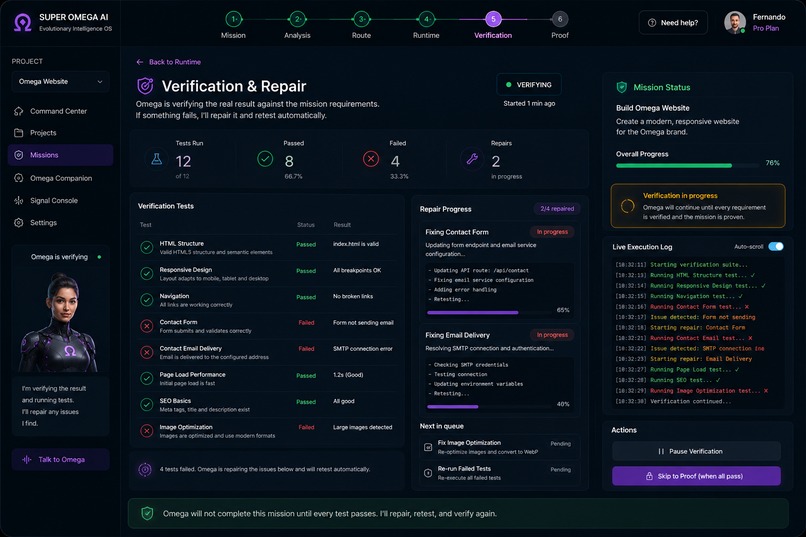
6. Verification and bounded repair: test the outcome, detect failures, repair what failed, and retest before completion.
-
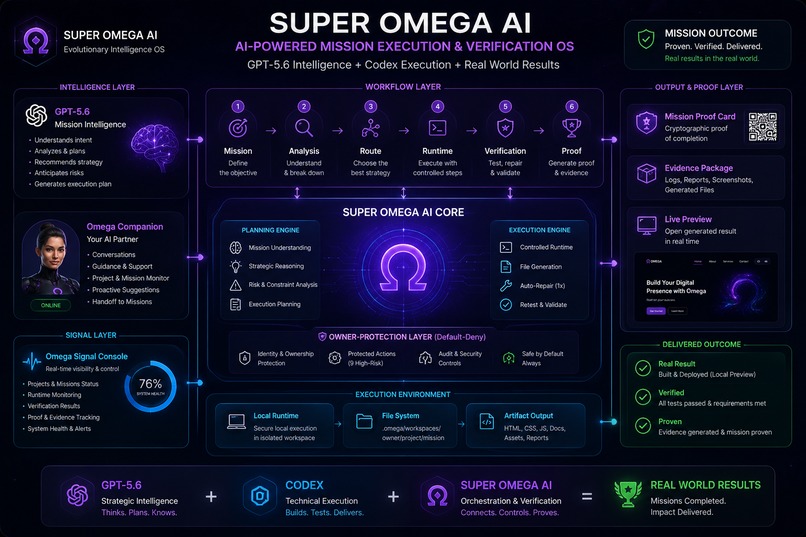
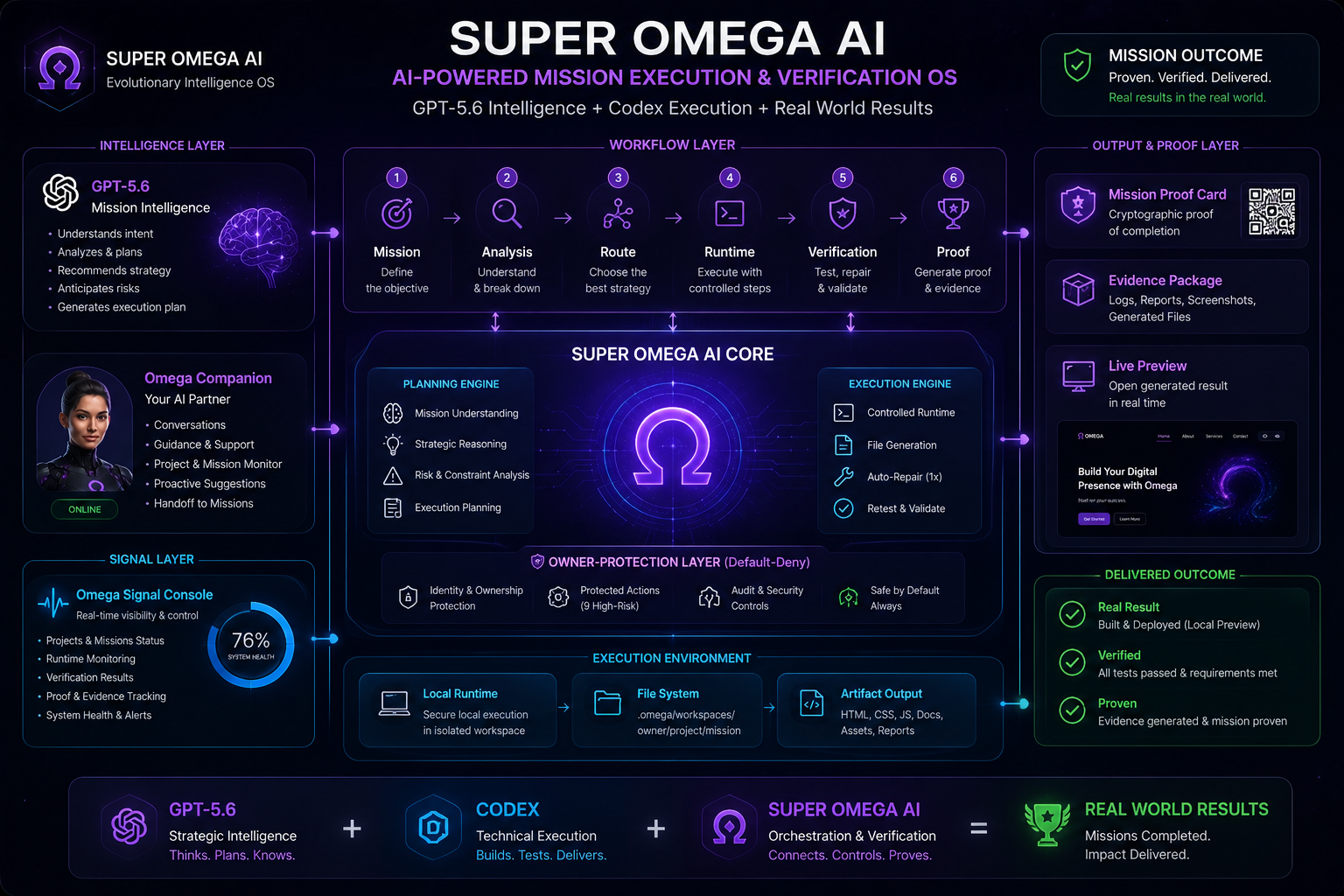
9. Architecture vision: GPT-5.6 reasons, Codex engineers, and SUPER OMEGA coordinates authority, execution, verification, and proof.
-
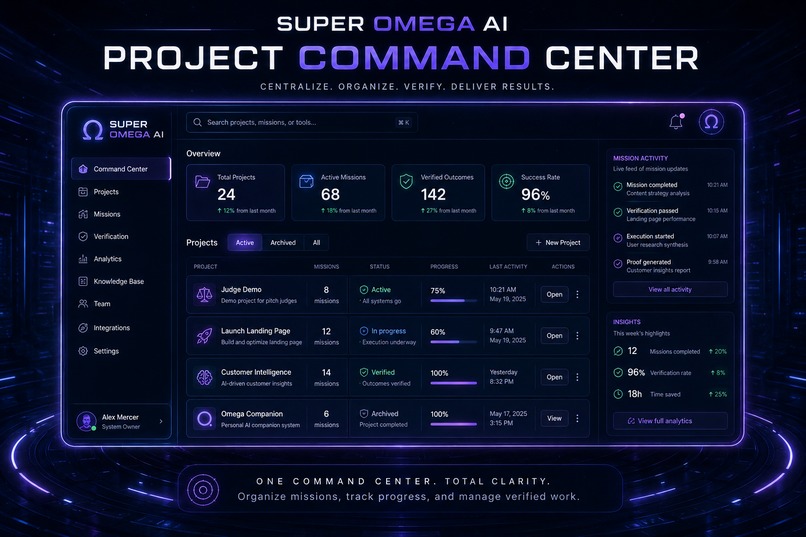
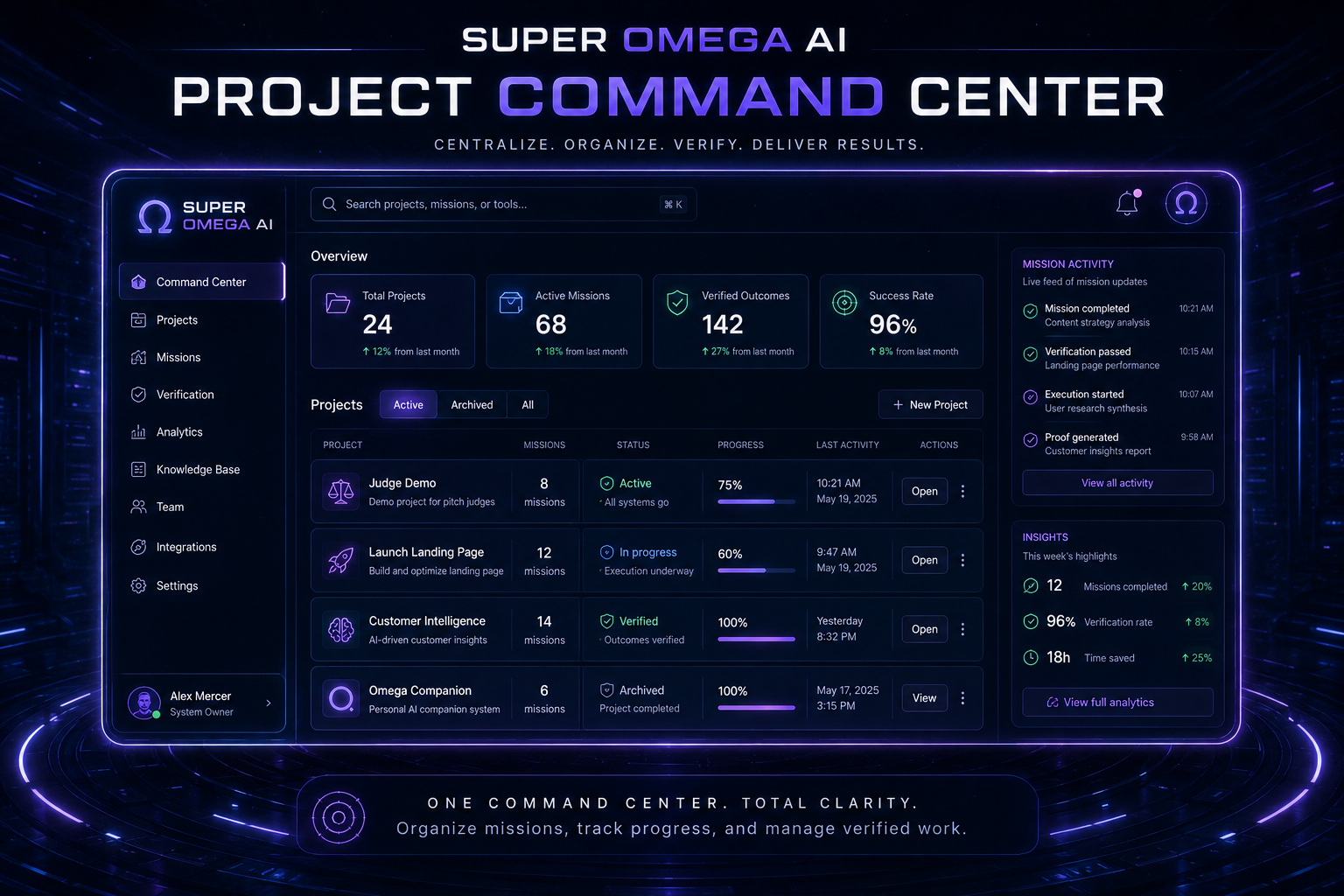
2. Concept view of the Project Command Center for organizing projects, missions, progress, and verified work.
-
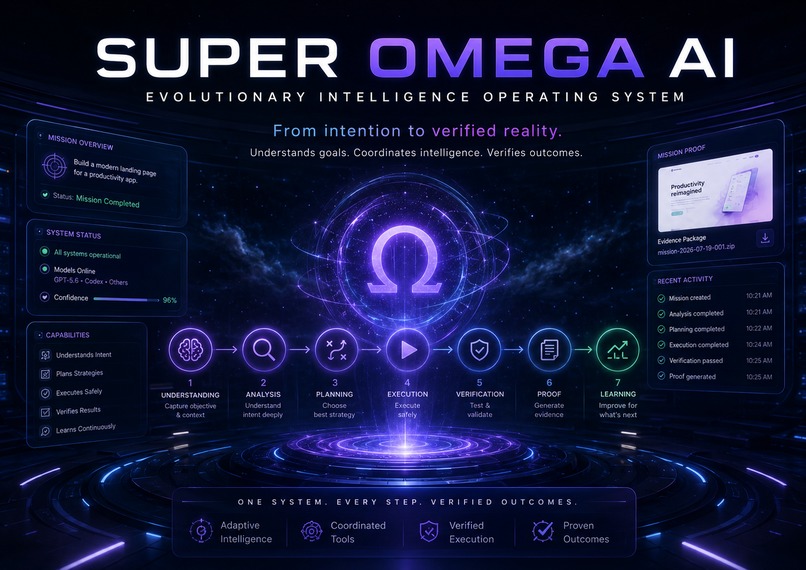
1. SUPER OMEGA AI: an Evolutionary Intelligence Operating System built to transform human goals into verified outcomes.
-
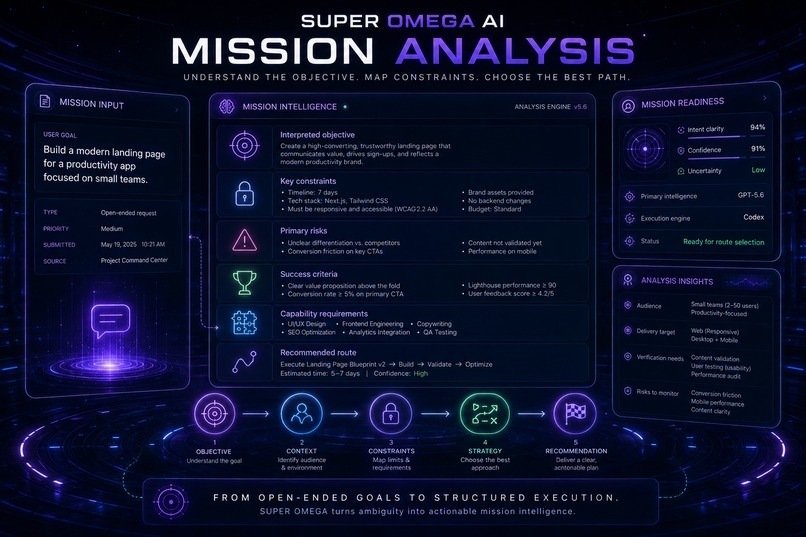
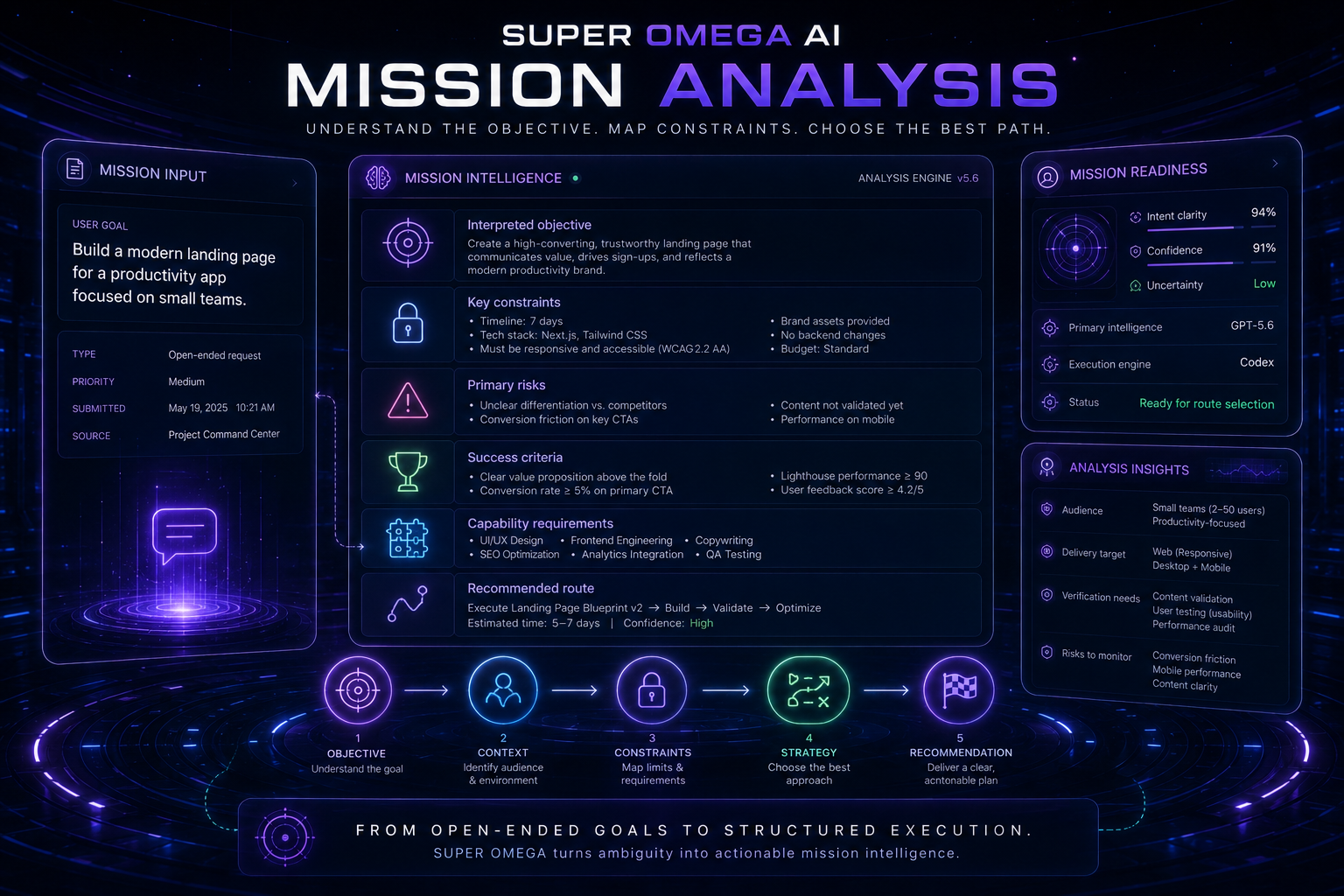
3. Mission Analysis: transforming an open-ended goal into constraints, risks, success criteria, and an execution strategy.
Inspiration
Artificial intelligence has become extraordinarily capable, but it remains fragmented.
One system writes code. Another creates applications. Another searches the web, analyzes data, generates content, or automates a workflow.
Each tool may be powerful, but the user is still responsible for understanding the real objective, choosing the right intelligence, coordinating every step, controlling permissions, detecting failures, and deciding whether the final result can be trusted.
That is the problem that inspired SUPER OMEGA AI.
I did not want to build another chatbot, coding agent, or application generator.
I wanted to build the intelligence layer above them.
SUPER OMEGA AI is an evolutionary decision and execution operating system designed to understand a human goal, determine what should happen next, coordinate the appropriate intelligence and tools, preserve user authority, execute the mission, verify the outcome, and improve how future missions are approached.
My belief is simple:
AI should not stop when it has generated an answer. It should continue until the mission has been verified.
The current Build Week beta demonstrates the first functional foundation of that larger vision.
What it does
SUPER OMEGA AI transforms an open-ended human objective into a controlled, observable, and verifiable mission.
It does not immediately execute the first interpretation of a prompt.
It first tries to understand the objective, context, constraints, risks, uncertainty, and definition of success. It then compares possible strategies, preserves explicit user authority, manages execution, verifies the real result, attempts bounded repair when necessary, and produces persistent evidence.
The current beta demonstrates a complete six-stage mission lifecycle:
- Mission — captures the objective, collaboration mode, context, and constraints.
- Analysis — interprets intent, risk, uncertainty, requirements, and success criteria.
- Route — compares Conservative, Recommended, and Ambitious execution strategies.
- Runtime — records the selected plan, authority state, execution context, and mission progress.
- Verification — evaluates the real artifacts, detects failures, performs bounded repair, and retests.
- Proof — generates persistent evidence showing what was created, checked, repaired, and verified.
The first controlled execution environment focuses on software generation because files, code, tests, previews, and artifacts make execution measurable.
However, SUPER OMEGA is not fundamentally a coding product.
Software is the first proof environment for a general architecture intended to support many forms of verifiable work, including:
- websites and software applications;
- mobile and internal business tools;
- documents, reports, and presentations;
- research, analysis, and decision support;
- marketing campaigns and content systems;
- automations and operational workflows;
- dashboards, databases, and business platforms;
- long-running monitoring and improvement missions.
Codex can engineer software. GPT-5.6 can reason. Connectors can reach external systems. Specialized models can contribute expert capabilities.
SUPER OMEGA is being built to understand the complete mission and decide how those capabilities should work together.
Its role is not to replace every AI product.
Its role is to coordinate intelligence, tools, permissions, execution, verification, learning, and proof around a single human objective.
How we built it
I conceived, directed, designed, and built SUPER OMEGA AI as a solo founder during OpenAI Build Week, using GPT-5.6 and Codex in distinct roles.
GPT-5.6 supports the mission-intelligence layer: interpreting objectives, reasoning about intent, evaluating context, and helping structure execution strategy.
Codex became my primary engineering partner for implementation, debugging, testing, integration, architecture improvements, production stabilization, and deployment preparation.
I remained responsible for the product vision, mission architecture, authority boundaries, execution model, verification philosophy, experience design, prioritization, and final decisions.
The beta was built with:
- Next.js 15;
- TypeScript;
- React and Server Actions;
- Supabase Authentication;
- PostgreSQL persistence;
- Railway production deployment;
- persistent projects and missions;
- controlled execution workspaces;
- structured runtime records;
- deterministic verification rules;
- bounded repair and retesting;
- evidence repositories;
- Mission Proof generation.
The architecture intentionally separates:
- intelligence from execution;
- execution from verification;
- verification from completion;
- completion from proof.
That separation allows SUPER OMEGA to use increasingly capable models and tools without blindly trusting their output.
Challenges we ran into
The hardest challenge was not generating something.
It was deciding when the system had earned the right to say that a mission was complete.
An AI can produce convincing output while misunderstanding the objective, ignoring a constraint, failing silently, or reporting success before the result has been tested.
For that reason, I separated runtime completion from verified completion.
The system needed independent stages for:
- controlled execution;
- validation;
- failure detection;
- repair;
- retesting;
- evidence generation;
- final Mission Proof.
I also had to solve several production challenges involving authentication, database ownership, public demo access, deployment configuration, redirect origins, runtime synchronization, verification boundaries, repair behavior, and evidence consistency.
One particularly subtle issue caused valid HTML metadata to be interpreted as unsafe content. Another caused a successful server action to appear as a failed execution because a navigation redirect crossed the action boundary incorrectly.
These problems reinforced the central principle behind SUPER OMEGA:
Intelligence without control, verification, and evidence is not enough.
Accomplishments that we're proud of
I am proud that SUPER OMEGA AI is not simply another interface wrapped around a language model.
The beta demonstrates an operating pattern for trustworthy intelligent execution.
It can:
- capture a real mission;
- interpret its intent;
- compare alternative strategies;
- preserve explicit authority;
- manage a controlled runtime;
- generate real artifacts;
- evaluate the result;
- identify failures;
- perform bounded repair;
- retest the repaired output;
- persist technical evidence;
- generate Mission Proof.
The system distinguishes between work that merely ran and work that was actually verified.
That distinction is fundamental.
SUPER OMEGA does not consider a mission complete because an AI produced an answer. It considers it complete only when evidence supports the outcome.
I am also proud that this functional production beta was conceived and directed by one founder during Build Week.
GPT-5.6 and Codex dramatically expanded what I could execute, but the vision, operating philosophy, mission lifecycle, authority model, verification standard, and final decisions remained human-directed.
What we learned
I learned that the future of artificial intelligence will not be determined only by which model is the most intelligent.
It will also be determined by which systems can coordinate intelligence responsibly.
A useful execution intelligence must understand:
- what the user is truly trying to accomplish;
- what information is missing;
- which risks and constraints matter;
- which strategy is appropriate;
- which model, agent, connector, or tool should be used;
- what authority the user has granted;
- whether the execution actually succeeded;
- what needs to be repaired;
- what evidence proves completion;
- what can be learned for the next mission.
I also learned that specialized AI systems become far more valuable when they are coordinated through a shared mission, authority, verification, memory, and evidence architecture.
The objective is not unrestricted autonomy.
The objective is accountable capability.
Every meaningful action should be observable. Every execution should be verifiable. Every completion claim should be supported by evidence.
What's next for SUPER OMEGA AI
The current beta is not the final product.
It is the first working proof of a much larger architecture.
My long-term vision is to build an evolutionary intelligence operating system that does not merely wait for prompts, but understands the user, follows the world, identifies what matters, recommends what should happen next, coordinates the necessary capabilities, executes within explicit authority, and proves the outcome.
SUPER OMEGA is designed to progressively become capable of:
- maintaining persistent context across conversations, missions, projects, preferences, decisions, and long-term objectives;
- communicating naturally through text, voice, and an expressive visual identity;
- understanding incomplete ideas and transforming them into clear, executable missions;
- remaining several steps ahead of the user;
- anticipating needs, risks, bottlenecks, and opportunities before the user has to ask;
- proactively recommending actions, improvements, experiments, and strategic next steps;
- reporting progress, completed work, detected failures, important changes, and emerging opportunities;
- following relevant news, research, product launches, model releases, technical advances, market developments, and changes in the AI ecosystem;
- studying new AI models, agents, tools, connectors, APIs, frameworks, and execution environments as they appear;
- evaluating whether a new capability is useful, safe, legal, technically viable, and relevant;
- learning from other AI systems without blindly trusting their responses;
- selecting the most appropriate intelligence, agent, model, or service for every part of a mission;
- coordinating GPT-5.6, Codex, specialized models, agents, browsers, applications, databases, and external services;
- connecting to authorized APIs, repositories, cloud platforms, servers, databases, devices, and business systems;
- creating software, websites, mobile applications, internal tools, documents, reports, research, media, campaigns, automations, workflows, and complete business platforms;
- decomposing complex objectives into coordinated missions that can run sequentially or in parallel;
- supervising multiple agents while preventing conflicts, duplicated work, uncontrolled spending, and false completion;
- monitoring long-running missions and changing external conditions;
- notifying the user when an important event, risk, opportunity, or decision requires attention;
- testing real outcomes instead of trusting generated claims;
- detecting errors, repairing failures, retesting results, and preserving evidence of every meaningful change;
- learning from verified successes, failures, corrections, and user decisions;
- improving its planning, routing, validation, and execution strategies over time;
- recognizing when its current capabilities are insufficient;
- proposing the safest way to acquire, integrate, or build a missing capability;
- recommending improvements to its own architecture;
- subjecting every meaningful evolution to testing, verification, rollback controls, and human authority;
- becoming a proactive strategic companion rather than a passive system waiting for instructions;
- expanding into new professions, industries, workflows, and forms of creation without abandoning its verification principles;
- building an increasingly complete understanding of the user's ambitions and helping move them forward every day.
This does not mean uncontrolled autonomy.
Credentials, spending, publication, deployment, irreversible changes, external access, and high-risk actions must remain protected by explicit human approval.
The objective is not to remove the human from the system.
The objective is to give the human an intelligence capable of seeing further, coordinating more, executing faster, learning continuously, and proving what was actually accomplished.
My ambition is not to reproduce Codex, Lovable, or any individual AI product.
Codex can build. GPT-5.6 can reason. Connectors can provide access. Specialized models can contribute expertise.
SUPER OMEGA is being built as the intelligence that decides how all those capabilities should work together, governs their authority, verifies their output, learns from the result, and expands what becomes possible next.
Today, the beta demonstrates one controlled and verifiable execution lifecycle.
The future is an intelligence capable of coordinating thousands of possible capabilities around one human objective.
Most AI systems execute prompts.
SUPER OMEGA manages outcomes.
AI should not stop when it has an answer.
It should continue until the mission is verified.
And when that mission is complete, it should already be thinking about what comes next.
Built With
- chatgpt
- codex
- gpt-5.6
- next.js
- openai
- railway
- react
- supabase
- typescript

Log in or sign up for Devpost to join the conversation.