-
-
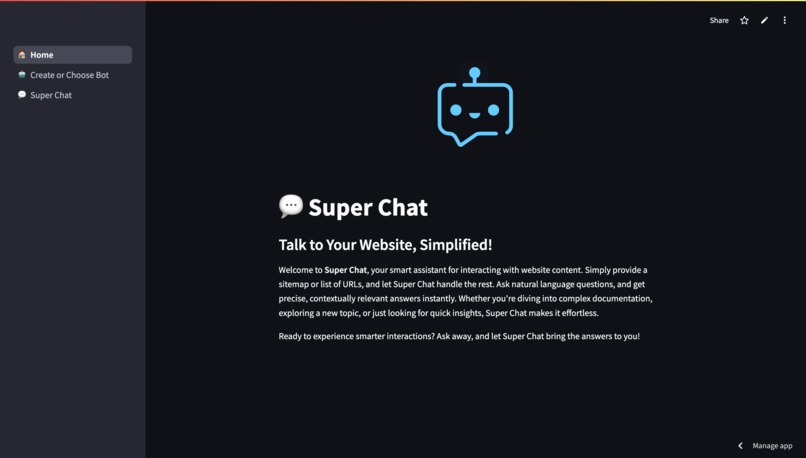
Home
-
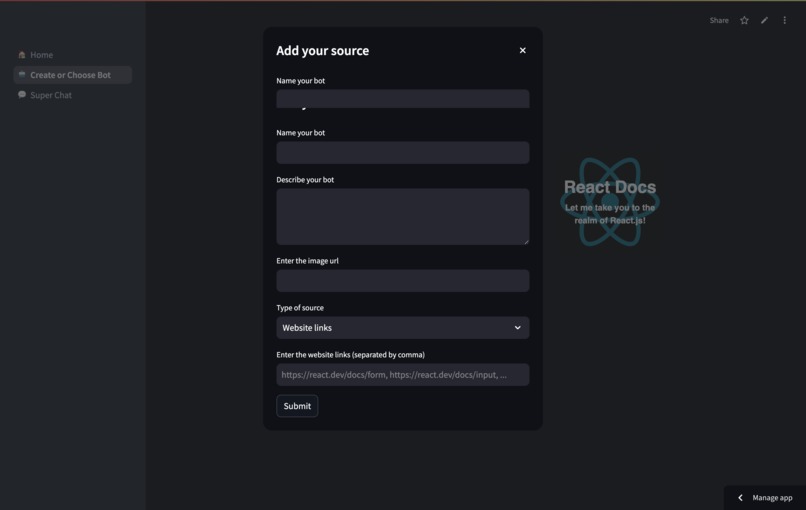
Create a bot with website links or sitemap
-
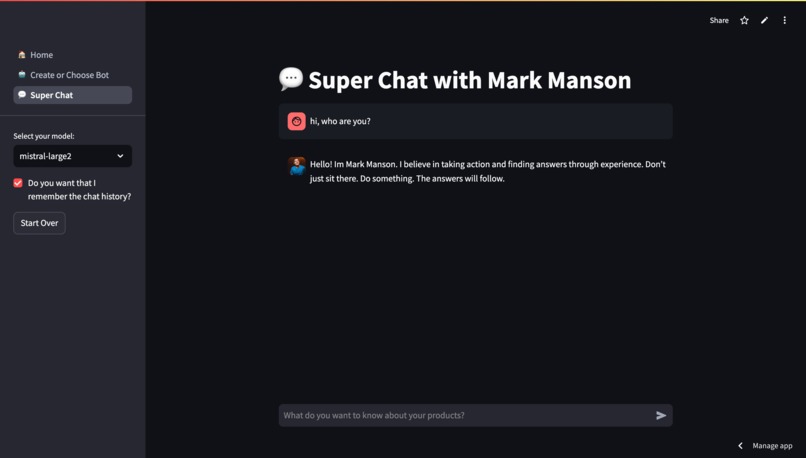
Talk to Mark Manson
-
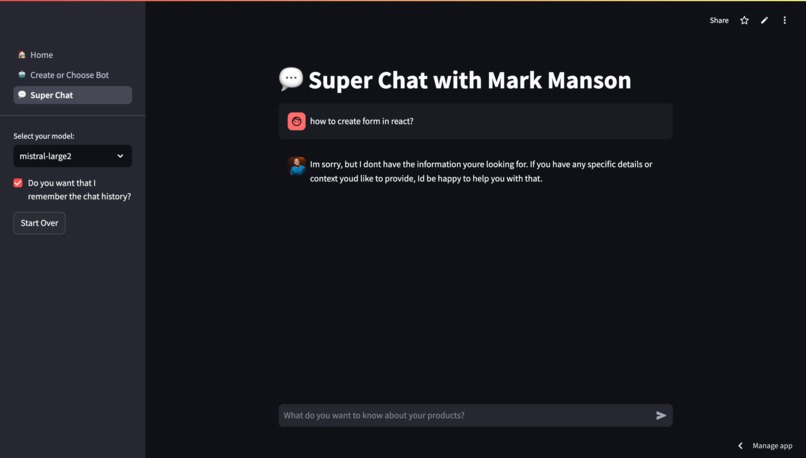
Mark can't create react forms
-
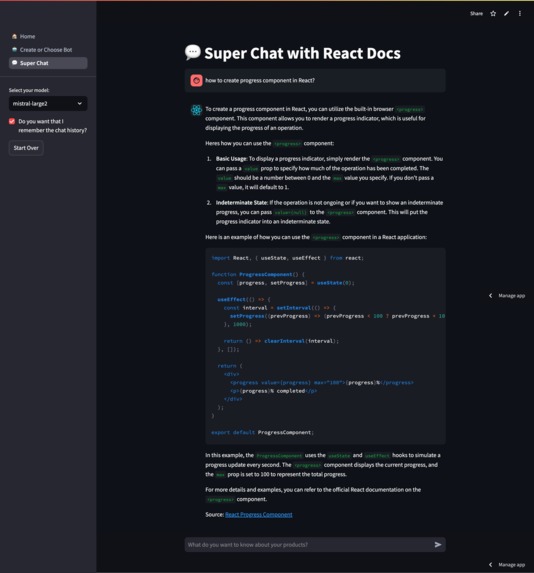
Here is the documentation from React Docs Bot


Inspiration
I’ve always been passionate about productivity. Whether finding new ways to work smarter or diving into blogs and articles that spark inspiration, I’m drawn to ideas that make life more efficient. Writers like Mark Manson, with his no-nonsense clarity, and Cal Newport, who champions the power of focus, have greatly influenced me. Their ideas made me reflect on how much time we spend looking for answers in an ocean of information, often losing focus and momentum.
As a programmer, I face this challenge every day. Whether it’s navigating endless API documentation, troubleshooting issues, or reading tutorials, finding the exact piece of information I need can feel like searching for a needle in a haystack. I thought, “What if I could just ask the documentation itself?”
That’s where Super Chat comes in. It was born out of my love for coding and the desire to combine convenience and productivity. Instead of manually searching through pages of text, imagine simply uploading a sitemap or a list of URLs and having a chat interface that gets you the exact answers you need. Super Chat doesn’t just save time—it makes interacting with information smarter and more intuitive.
This project is my way of merging my passion for technology, learning, and productivity, while also solving a problem I deeply relate to. Super Chat is more than a tool—it’s a new way of engaging with the vast knowledge the web has to offer.
What it does
Super Chat is an AI-powered tool that transforms how users interact with websites. Instead of manually searching for information across multiple pages, users can simply provide a sitemap or a list of URLs, and Super Chat does the rest. Here’s how it works:
- Ingest Website Data: Super Chat reads and processes the content from the provided URLs or sitemap, indexing the text for efficient retrieval.
- Ask Questions, Get Answers: Users can ask natural language questions, and Super Chat retrieves relevant information using Cortex Search, then generates contextually accurate responses using Mistral LLM.
- Smart Context Management: The tool ensures responses remain contextual by intelligently chunking and structuring the website data.
- User-Friendly Interface: Built on Streamlit Community Cloud, Super Chat provides a simple and intuitive interface for users to upload their data, ask questions, and view results seamlessly.
Super Chat is perfect for developers working with documentation, researchers analyzing resources, or anyone looking to save time while engaging with online information.
How I built it
Data Processing and Retrieval
- I used a custom preprocess to process the sitemap or list of URLs. The tool efficiently indexed and retrieved relevant text chunks, ensuring fast access to meaningful content.
- Data was chunked and stored in Snowflake using LangChain’s text processing capabilities, maintaining contextual overlap for improved response quality.
- I used Cortex Search for the retrieval of the relevant documents, which are provided to the Mistral-Large2 LLM.
Language Model Integration
- I integrated Mistral LLM to generate conversational responses based on the data retrieved by Cortex Search.
- Fine-tuned prompt engineering ensured high-quality responses tailored to user queries.
Frontend Development
- I leveraged Streamlit Community Cloud to build an interactive and visually appealing interface.
- Implemented features for easy file uploads, query submission, and dynamic result displays.
Automation
- I used Snowflake Streams and Tasks to automate the ingestion and processing of new data. This ensured Super Chat remained up-to-date with minimal manual intervention.
TruLens Integration
- Since Super Chat deals with Retrieval-Augmented Generation (RAG) on large documentations and personal websites, maintaining high response quality is critical. To ensure this, I integrated TruLens, a feedback-driven observability and optimization tool.
- How TruLens Helps:
- Feedback Functions: TruLens provides feedback functions like context relevance and answer groundedness to measure the quality of responses.
- Guardrails: I applied context filtering guardrails to ensure only the most relevant chunks are passed to the Mistral LLM, improving response accuracy.
- Observability: By instrumenting key methods (e.g., retrieval and response generation) with TruLens, I can analyze and optimize the pipeline in real-time, identifying bottlenecks and improving performance.
- Metrics Dashboard: TruLens enables me to monitor important metrics such as Answer Relevance, Latency, and Context Overlap, ensuring a balance between performance and quality.
- TruLens ensures that Super Chat consistently delivers high-quality responses, even when dealing with vast and complex data.
Challenges I ran into
Data Chunking and Context Preservation:
- Breaking large documents into chunks without losing context was tricky. I iterated on chunk sizes and overlap parameters to strike a balance between relevance and efficiency.
Model Response Quality:
- Ensuring Mistral LLM generated concise and accurate answers required careful prompt engineering and rigorous testing.
Scalability:
- Ensuring the system could handle large sitemaps or multiple simultaneous queries without degrading performance was a significant technical challenge.
Feedback Integration:
- Designing feedback functions and applying guardrails seamlessly into the pipeline required experimentation and refinement.
Accomplishments that I’m proud of
Seamless User Experience:
- Delivered a simple yet powerful interface that makes interacting with websites effortless.
Efficient Information Retrieval:
- Successfully indexed and retrieved data from diverse website structures, providing users with accurate answers in seconds.
Technical Innovation:
- Designed a robust pipeline that integrates state-of-the-art AI tools like Cortex Search, Mistral LLM, and TruLens feedback mechanisms.
Real-Time Observability:
- Leveraged TruLens to maintain high standards for response quality and identify improvement areas.
What I learned
The Power of RAG:
- Combining retrieval with generation opens up exciting possibilities for AI-powered applications.
Streamlining AI Pipelines:
- Building an efficient pipeline that balances processing time and accuracy is key to success.
Feedback-Driven Development:
- TruLens feedback functions and guardrails provided insights into model performance, improving response quality.
User-Centric Design:
- The importance of designing with the user in mind, focusing on simplicity and convenience.
What's next for Super Chat: Talk to Websites, Simplified!
Enhanced Features:
- Improving conversational context retention across multi-turn interactions.
Broader Use Cases:
- Expanding beyond documentation and websites to applications like e-commerce (product comparison) and research (scientific papers).
Scalability and Performance:
- Optimizing the system for larger datasets and more concurrent users.
Open-Source Contribution:
- Releasing parts of the pipeline as open source, encouraging community collaboration and innovation.
TruLens Expansion:
- Building additional feedback functions (e.g., user engagement metrics).
- Visualizing feedback insights on interactive dashboards for developers and users.
Built With
- cortex
- langchain
- mistral-large2
- python
- snowflake
- streamlit


Log in or sign up for Devpost to join the conversation.