Inspiration
It sucks that organizations can’t prototype strategy.
Organizations can test products and interfaces before committing. But when the decision is about growth, capacity, operations, or capital allocation, teams usually have to make the call with spreadsheets, meetings, intuition, and increasingly, an AI conversation.
AI can discuss a decision convincingly. But a convincing answer is not the same as a tested one.
I built SupaSim because important decisions often involve feedback loops, delays, constraints, trade-offs, and changing evidence. Teams need a way to test such decisions before they implement them.
What it does
SupaSim is an AI-powered strategy simulation tool.
It turns supplied documents, operational data, and conversations into:
- A living, evidence-grounded Knowledge Wiki
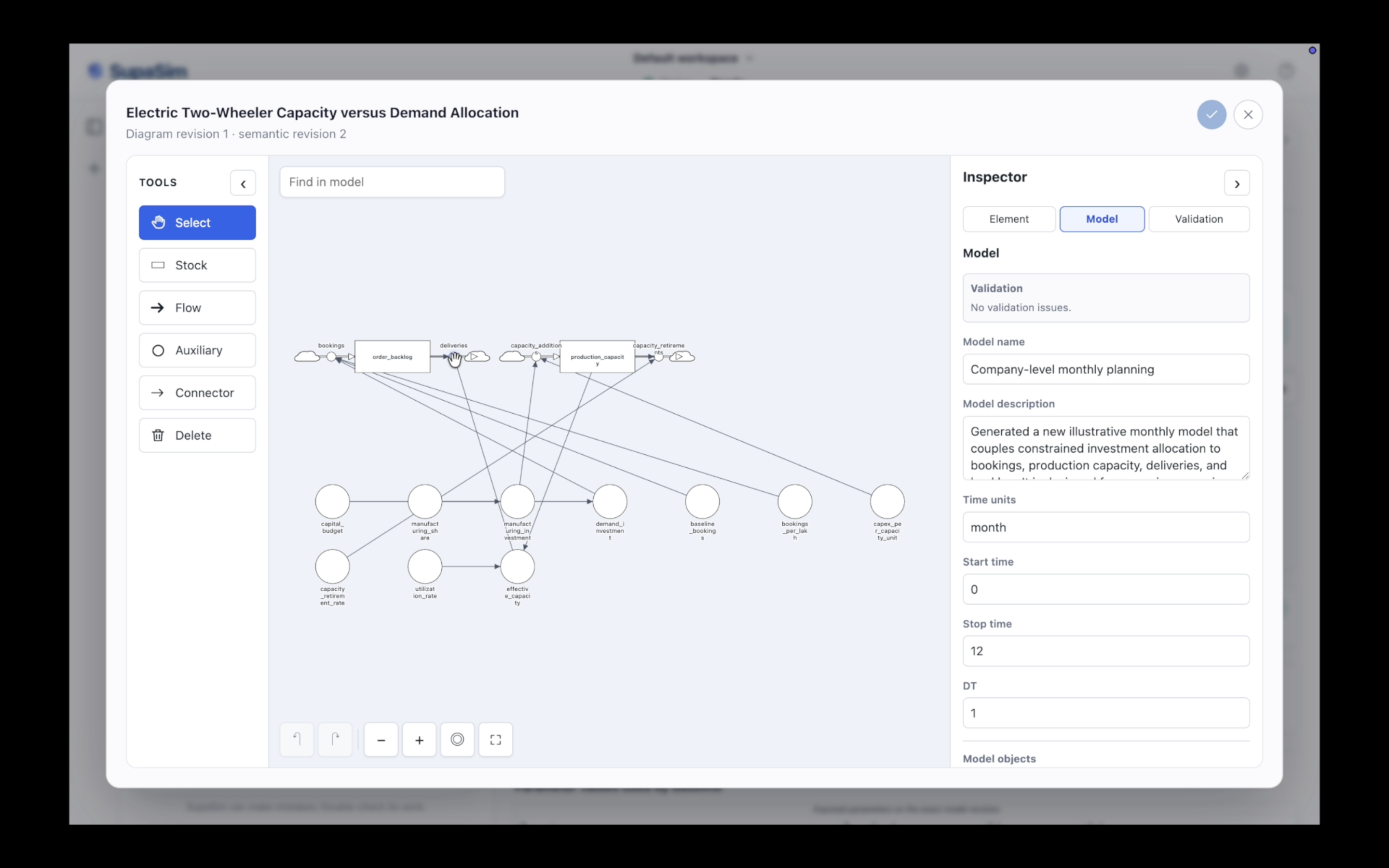
- An executable causal decision twin
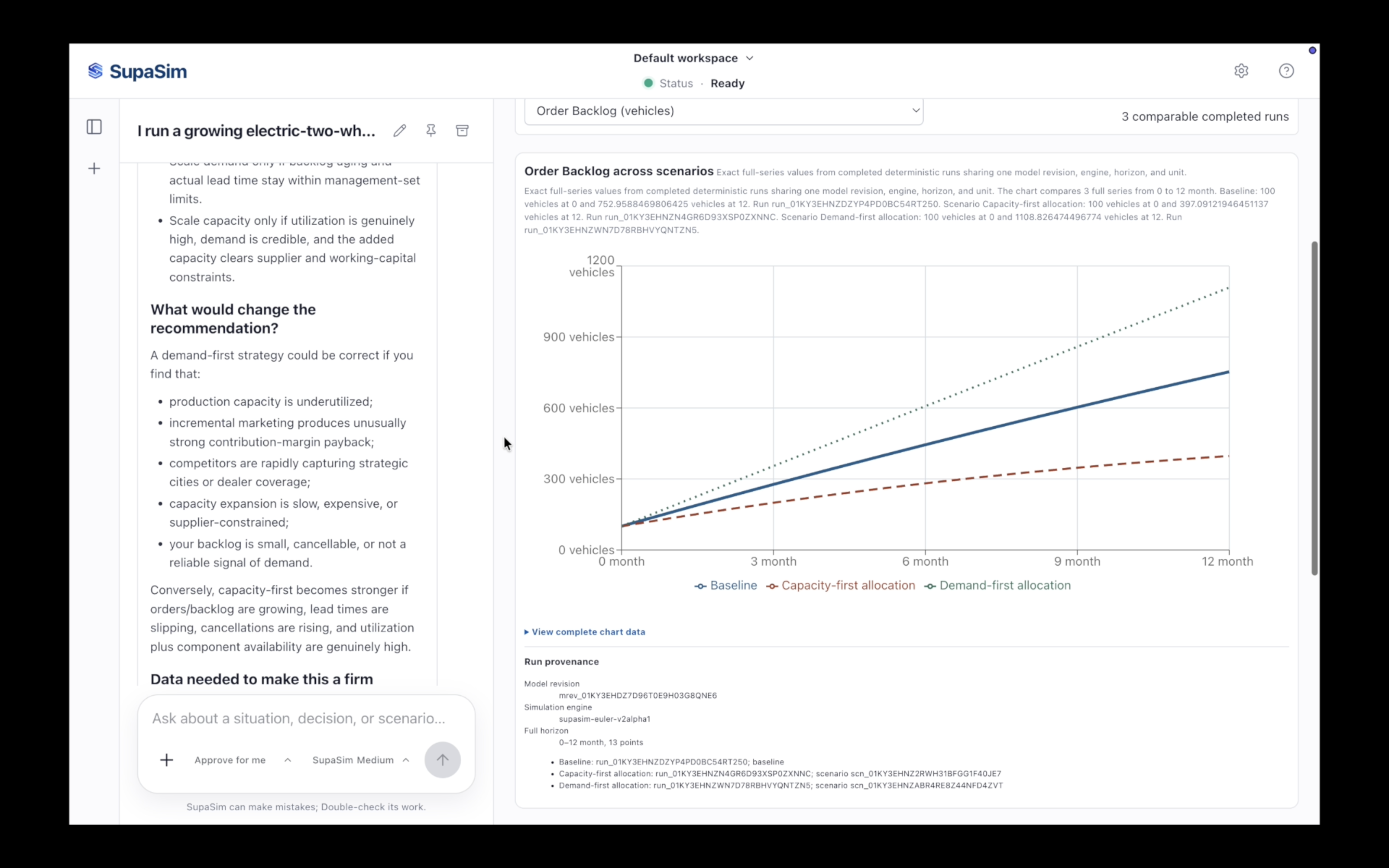
- Deterministic scenario simulations
- A reproducible Decision Brief
The goal is simple: make important strategic decisions testable.
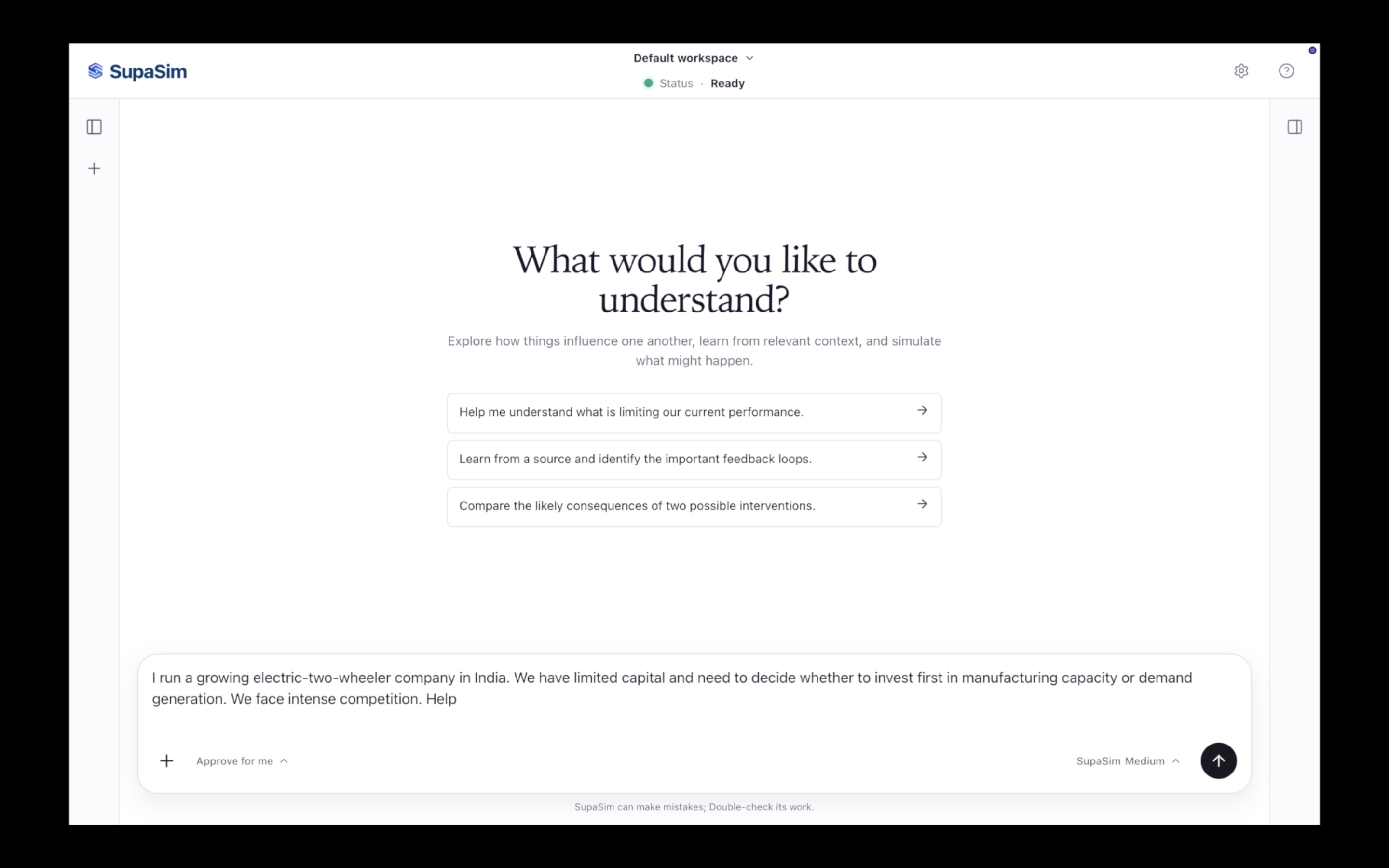
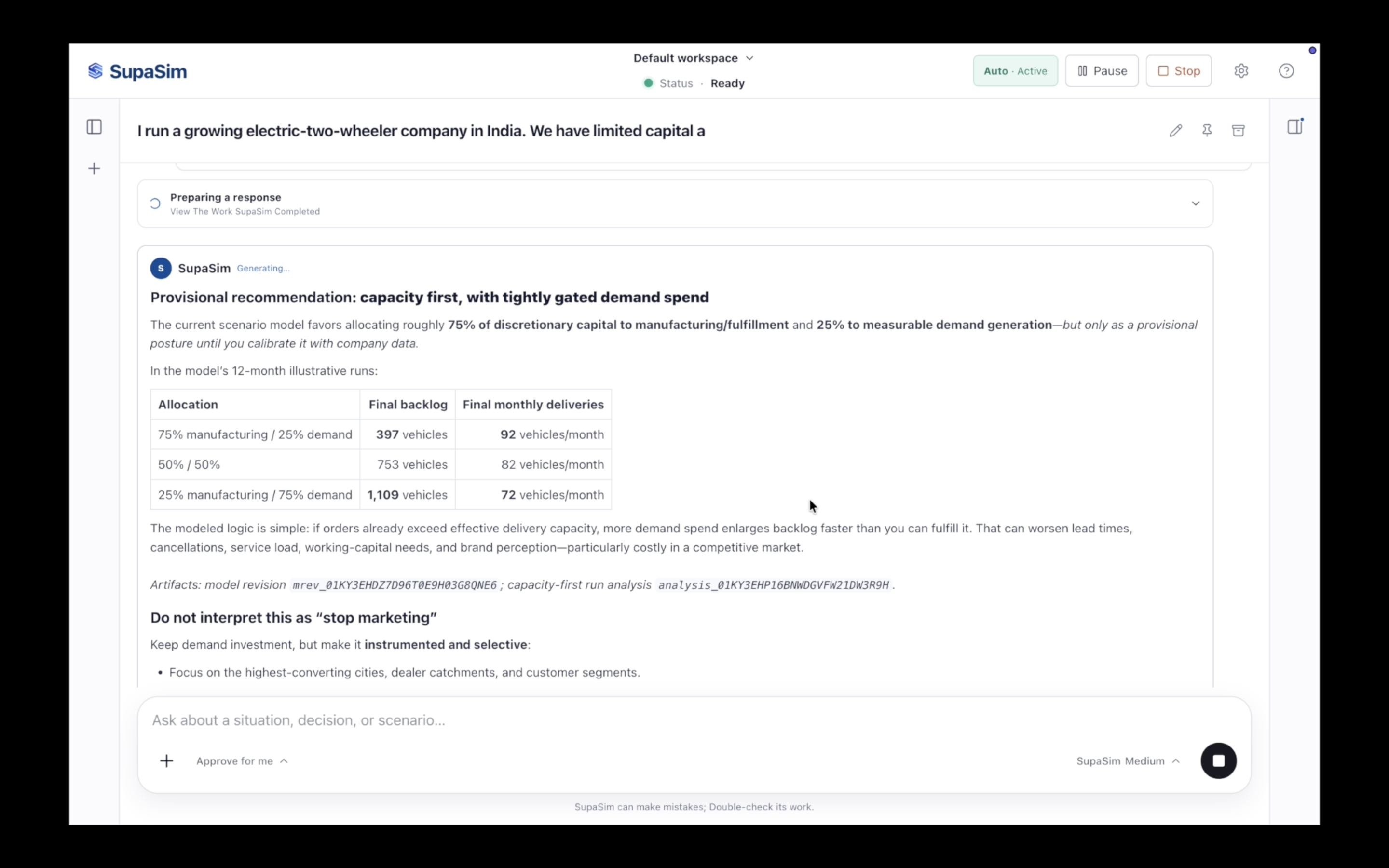
In the demo, a fictional Indian electric-two-wheeler company must decide how to balance manufacturing capacity and demand generation.
SupaSim uses the prompt to propose and validate a causal model, then compares baseline, demand-first, capacity-first, and staged strategies across the same time horizon.
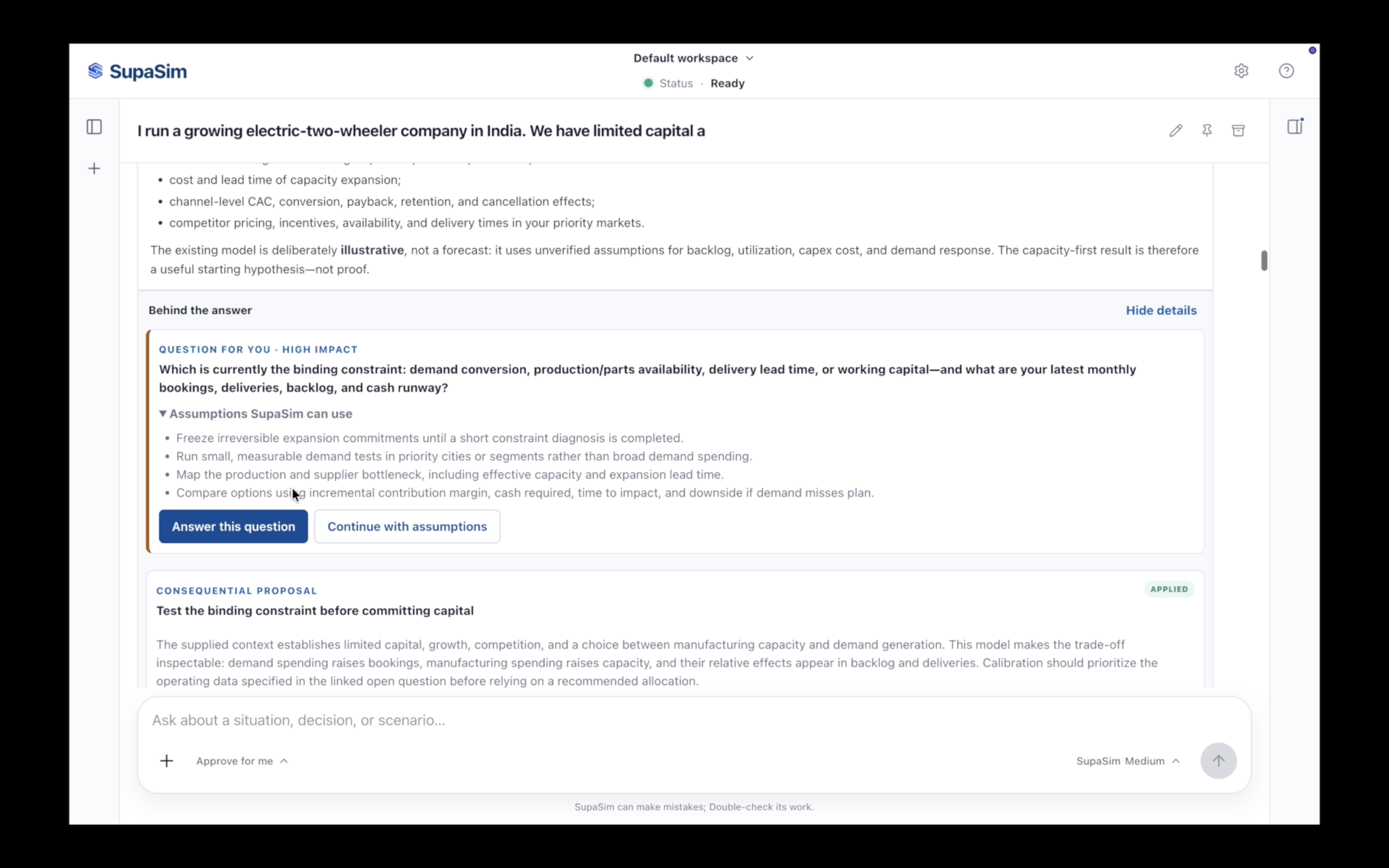
The result is not just a persuasive answer. Users can inspect the evidence, assumptions, causal mechanisms, scenario inputs, deterministic outputs, and the conditions that could reverse a recommendation.
How it was built
GPT-5.6 Sol worked for 11 hours straight. Non-stop.
The ask: build a tool that combines the power of GPT-5.6 with a living Knowledge Wiki and numerical simulations—a tool for organizations to test out their plans before implementing them.
For sure, I had planned what I wanted in advance. In detail. From different angles. I had designed UI mockups and clarified the why of it all.
But even with all that, what GPT-5.6 Sol did was nothing short of magic.
With that spec, 5.6 Sol in Codex built a new version of SupaSim from scratch. It spun up multiple agents, reviewed and consolidated their work, evaluated its own progress, and kept going. Over the course of an eleven hour non-stop session, it implemented durable local storage, source ingestion, evidence grounding, retrieval, causal models, deterministic simulations, Decision Briefs, tests, packaging, and a real product interface.
Did the product need improvements after that eleven-hour marathon? Of course it did.
Did Codex help knock those out of the park too? Take a guess.
I used Codex with GPT-5.6 Terra for the follow on work of focused UI refinement, onboarding, responsiveness, workspace clarity, and the investigation workflow. I returned to Sol for further core functionality, including a workspace isolation lifecycle.
Challenges we ran into
The hard part was not generating a plausible recommendation. The hard part was making it trustworthy.
Every recommendation needs to remain connected to its source evidence, assumptions, model revisions, scenario inputs, and deterministic results. When evidence changes, the system must preserve history instead of silently rewriting the past.
That meant building explicit boundaries between:
- Source evidence and interpretation
- LLM-generated reasoning and deterministic simulation
- Provisional work and accepted revisions
- A useful recommendation and an overconfident claim
It also meant making a complex workflow feel like one coherent product rather than a collection of AI, data, modeling, and charting tools.
What I'm proud of
I'm happy that SupaSim was transformed from a prototype into what is not a a viable product over a matter of days. A complete decision workflow, not just a chat interface that talks about strategy.
It preserves evidence, creates a linked Knowledge Wiki, builds and validates causal models, compares deterministic scenarios, produces reproducible Decision Briefs, preserves corrections as revisions, and retrieves accepted learning in later chats.
The product is local-first and includes a packaged macOS Apple Silicon release path, automated integration and browser journeys, local backup/restore, and durable provenance for model and decision artifacts.
What we learned
AI makes simulation accessible. Simulation makes AI-supported decisions more grounded and inspectable.
The strongest version of an AI decision tool is not one that sounds the most confident. It is one that helps a user see why a recommendation follows, what evidence supports it, which assumptions matter, what could invalidate it, and what changes when new information arrives.
SupaSim is not just a chat interface, knowledge base, or simulator. It connects all three into a durable learning loop.
What's next for SupaSim
SupaSim V2 is the local-first foundation.
Next, I will validate the workflow with real organizations and pilot partners, improve model generation and calibration, expand the core library of reusable causal model archetypes, and make the product easier for teams to use on their own operational questions.
The long-term vision is simple: organizations should be able to build, test, revise, and retain useful models of how their world works—not merely ask AI to talk about it.
Built With
- api
- codex
- d3.js
- fastify
- gpt-5.6
- node.js
- openai
- pdfkit
- playwright
- react
- sqlite
- system-dynamics
- typescript
- vite
- vitest

Log in or sign up for Devpost to join the conversation.