
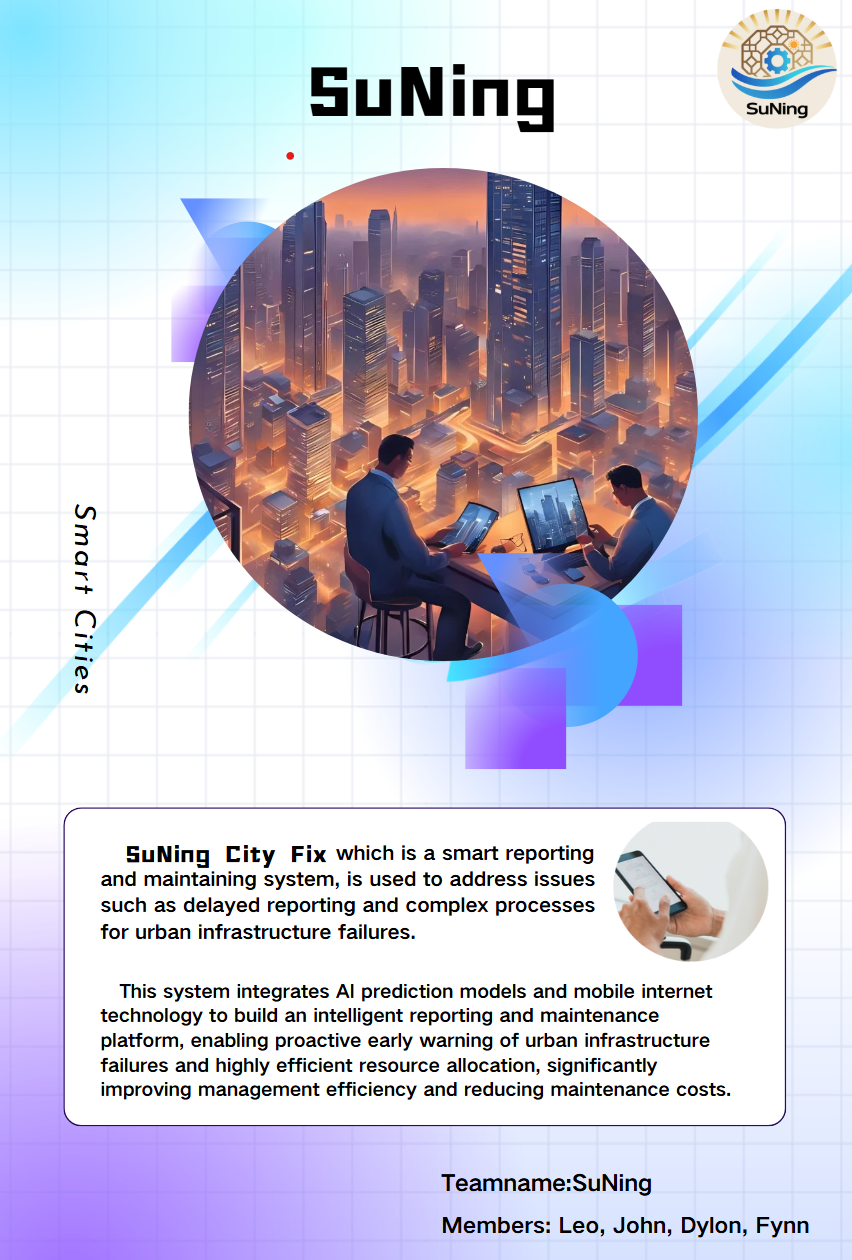
To address issues such as delayed reporting and complex processes for urban infrastructure failures, we have introduced a Smart Reporting and Maintenance System designed to streamline the submission process and improve response efficiency. Citizens can use the app to photograph and report infrastructure issues at any time. The system automatically captures the location and utilizes AI to identify the type of malfunction, reducing the barrier to submission. After reporting, users can track the handling progress in real time. On the management side, a smart dispatch system assigns work orders based on factors such as problem type and location.
- Problem and Motivation: What is the specific problem your project tackles? Why is it significant or challenging to address?
Currently, the untimely reporting and repair of urban infrastructure remain a prominent challenge in the construction of smart cities. In daily life, public facility issues such as road damage, malfunctioning streetlights, and missing manhole covers are common occurrences. However, governments often struggle to detect and arrange repairs in a timely manner, which not only impacts citizens’ travel convenience and quality of life but may also lead to safety incidents, posing direct threats to personal safety. The main reasons why this issue is difficult to resolve include the following: First, traditional reporting processes rely on manual inspections and telephone notifications, resulting in low efficiency and a high error rate in information transmission. Second, unclear division of responsibilities and insufficient coordination mechanisms among departments lead to delayed responses. Third, the vast number and wide distribution of urban facilities make it difficult to achieve comprehensive coverage through manual inspections alone. Fourth, the lack of effective public participation channels, incentives, and feedback mechanisms means that many problems fail to enter the management's view in a timely manner.
- Project Overview: Summarize your solution and explain how it directly addresses the identified problem. How is it different from existing solutions?
Our solution is to create a website designed to leverage the power of public participation for more efficiently identifying and reporting damaged urban infrastructure. Through this platform, users can proactively report malfunctions of public facilities in their surroundings that affect daily life. This information is aggregated in real-time and communicated to the relevant administrators, while the system automatically dispatches specialized maintenance personnel for timely resolution. Currently, in China, the public mostly still needs to report issues by making phone calls and providing verbal descriptions of the location and the condition of the facility. This method is not only inefficient and error-prone, but also often leads to misjudgments of the location or misunderstandings of the problem nature due to unclear descriptions, severely impacting the speed of maintenance response. In contrast, our platform can automatically obtain the user's current location, support the upload of on-site photos, and utilize AI image recognition technology to automatically determine the type and extent of damage, enabling structured information reporting. This mechanism significantly improves the accuracy and completeness of information, saving citizens time while also helping management departments formulate more precise maintenance plans, markedly enhancing the responsiveness of urban management and the service experience.
- Technical Implementation: Highlight the innovative aspects of your solution and detail the technologies or methods you used. Be sure to describe how you considered accessibility and ensured a positive user experience.
The website platform we designed introduces an innovative reporting mechanism in the field of urban infrastructure maintenance. Compared to traditional methods, this system allows users to directly take photos of damaged facilities via their mobile devices and submit reports with a single click, achieving a paradigm shift from "verbal description" to "visual documentation." This approach is not only intuitive and clear but also significantly lowers the barrier for users to submit information. More innovatively, the system incorporates automatic spatial data collection during the upload process. With user authorization, it captures precise real-time geographic location and intelligently associates this information with image data to generate structured maintenance work orders. This workflow eliminates positioning errors caused by manual descriptions and substantially enhances the accuracy and processing efficiency of work orders. By integrating computer vision and spatial information technology into public service scenarios, the platform establishes a highly efficient, reliable, and user-friendly model of public participation. It fully embodies the smart governance philosophy of "optimizing services through data-driven approaches."
- Impact and Scalability: What impacts does your solution have, and how can it scale effectively to reach more users or communities? What ideas do you have for potential future work on this project?
Through second-level reporting, heatmap visualization, and full-process tracking, this closed-loop system transforms urban governance from a "black box" backstage operation to a transparent "frontstage performance." Residents can see in real time who accepts tasks and how issues are handled, thereby fostering greater trust in the government and stronger willingness to collaborate with their communities. Meanwhile, multi-modal access points such as voice and phone calls enable vulnerable groups, including the elderly and children, to easily voice their concerns, promoting daily civic participation. In the future, the system will integrate a hardware perception layer and an AI predictive maintenance module to gradually achieve a fundamental shift from "reactive repair" to "proactive prediction." By deploying sensor networks, inspection robots, and mobile maintenance terminals on a large scale, facility status data will be collected in real time. AI algorithms will analyze both historical and real-time data to build fault prediction models, identify potential risks in advance, and generate customized maintenance plans. At the same time, the system will continue to enhance fairness and inclusivity: fair scheduling algorithms will be embedded, and resource allocation logic will be regularly reviewed in collaboration with communities.
- Design Process and Collaboration: What were some challenges you faced over the course of the hackathon? How did you overcome those challenges? What did you learn about the design process? How did your team delegate tasks, resolve conflicts, and communicate with each in order to work together most effectively?
During the design process of our smart-city repair system, we faced challenges such as multi-role authentication inconsistencies, secure file uploads, geolocation accuracy in China, and efficient auto-dispatch logic. We addressed these by building a tolerant authentication layer, implementing client-side down-scaling for large files, using coordinate transformations and fallback systems for mapping, and designing a simple scoring function for ticket assignment. Our team maintained clear role delegation across backend, frontend, ML/AI, and PM/design, with daily standups and efficient communication via WeChat. Utilizing Git feature branches and small PRs facilitated smooth code collaboration. By focusing on the core user flow, we successfully delivered a robust MVP with role-based access, resilient uploads, map visualization, AI assist, and auto-dispatch, all while keeping the codebase small and testable.
- Smart Cities: Solutions to problems in urban settings often reshape interactions among citizens and their cities. How might your solution influence community relationships, social dynamics, cultural attitudes, or civic engagement? Discuss any potential unintended social, cultural, or ethical impacts, and outline how your solution could be adapted to create stronger, more inclusive community bonds and equitable urban experiences.
Our smart urban infrastructure reporting system utilizes technology to empower the public, redefining the ways in which citizens interact with the city. Through an easy-to-use mobile application, the system turns residents into the city’s "sensory nodes," greatly improving the efficiency of detecting and addressing infrastructure issues. The social value of the system is reflected in three core aspects: firstly, it significantly enhances citizens' sense of involvement, and its low technical threshold enables more people to change from passive recipients of public services to active participants in co-building communities; secondly, the real-time transparency of the processing flow builds a bridge of trust between the government and residents, while data-driven management enables more scientific and credible resource allocation; most importantly, by promoting public attention and participation in maintaining public spaces, the system strengthens community identity and a sense of collective belonging. During implementation, we have also carefully considered potential risks: the primary concerns include guarding against tensions among residents caused by "excessive reporting," as well as the possible tendency of municipal departments to shift responsibilities; additionally, the centralized collection of geographic information and image data presents challenges related to privacy protection and data ethics. To build an inclusive and equitable urban governance experience, we propose the following optimized approaches: establish multi-dimensional access methods by integrating hotlines, offline service points, and multilingual support to ensure full coverage without blind spots; expand community-building features by introducing "initiative voting" and public data dashboards to foster a positive and constructive participatory culture; clarify the primary responsibility of the government, make service standards public, and maintain regular inspections to eliminate management gaps; finally, implement a "privacy-by-design" approach to enhance data security and compliance. Through systematic design optimization, it has the potential to become a socio-technical platform that promotes urban co-governance, shared benefits, and sustainable development.

Log in or sign up for Devpost to join the conversation.