-
-
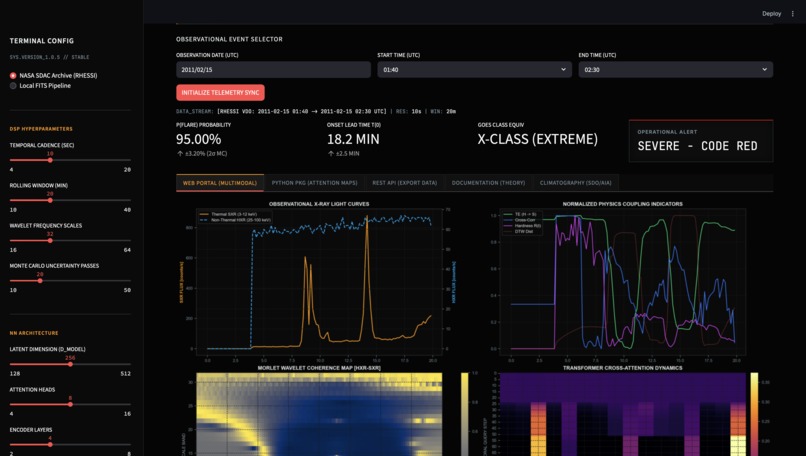
Web Portal - Climate Scientists
-
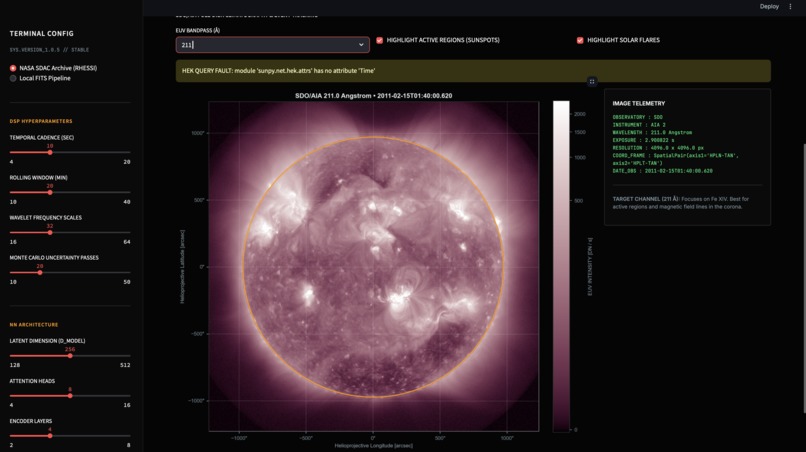
Web Portal - Climate Scientists
-
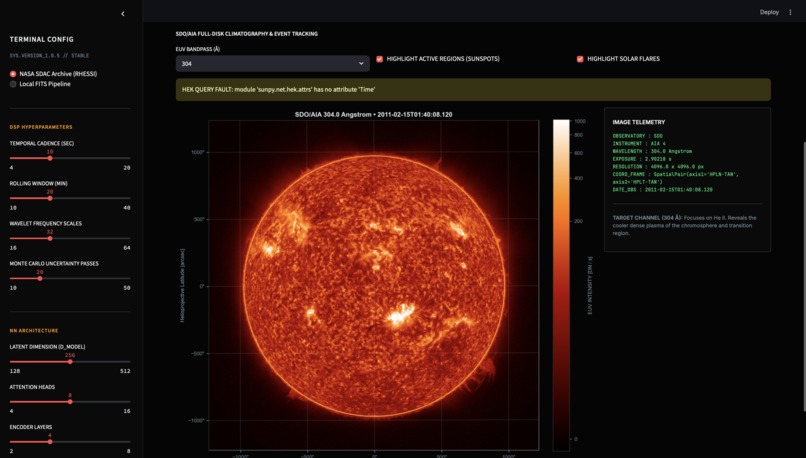
Web Portal - Climate Scientists
-
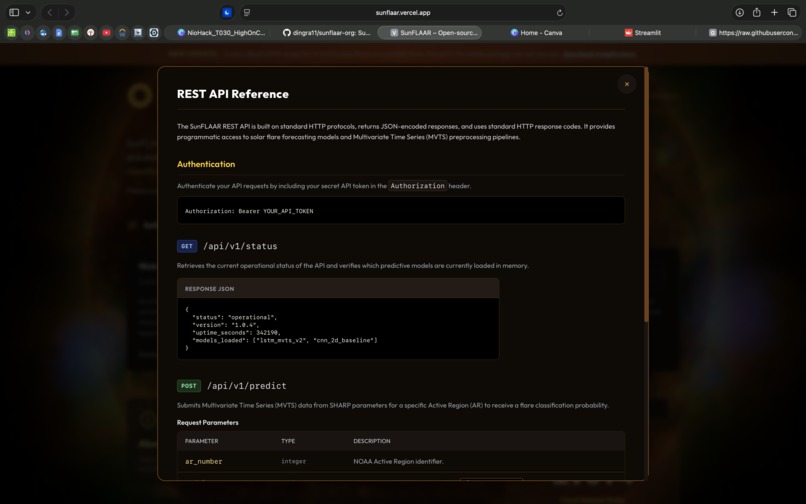
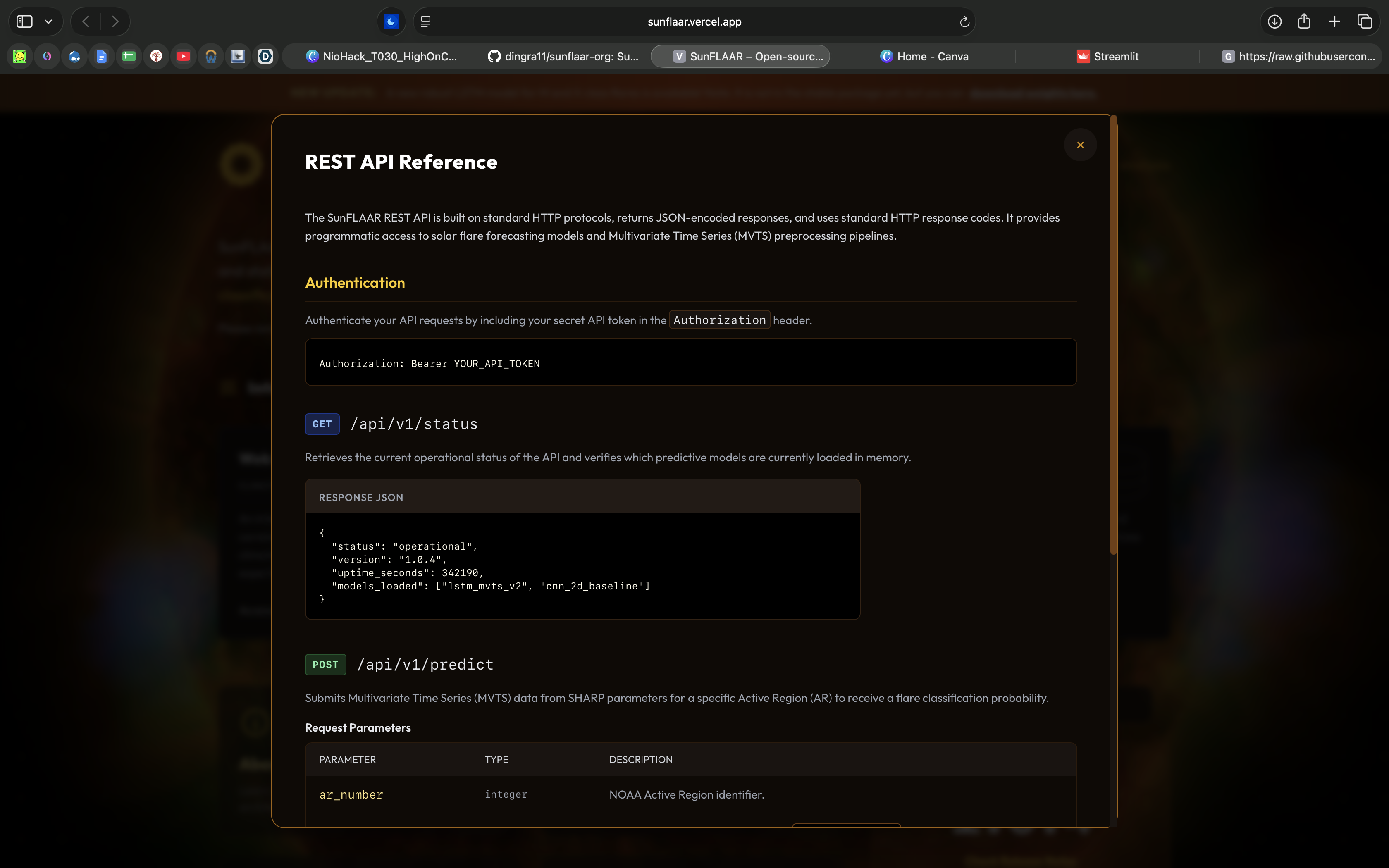
REST API - Everyone
-
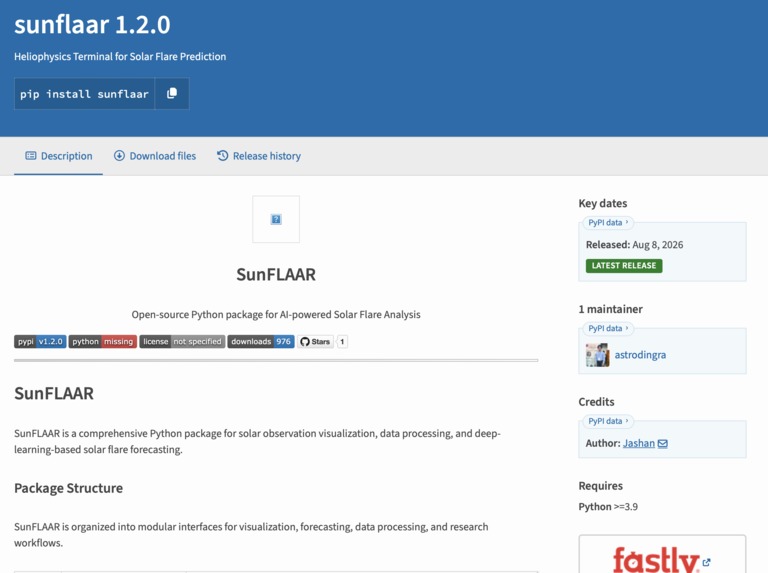
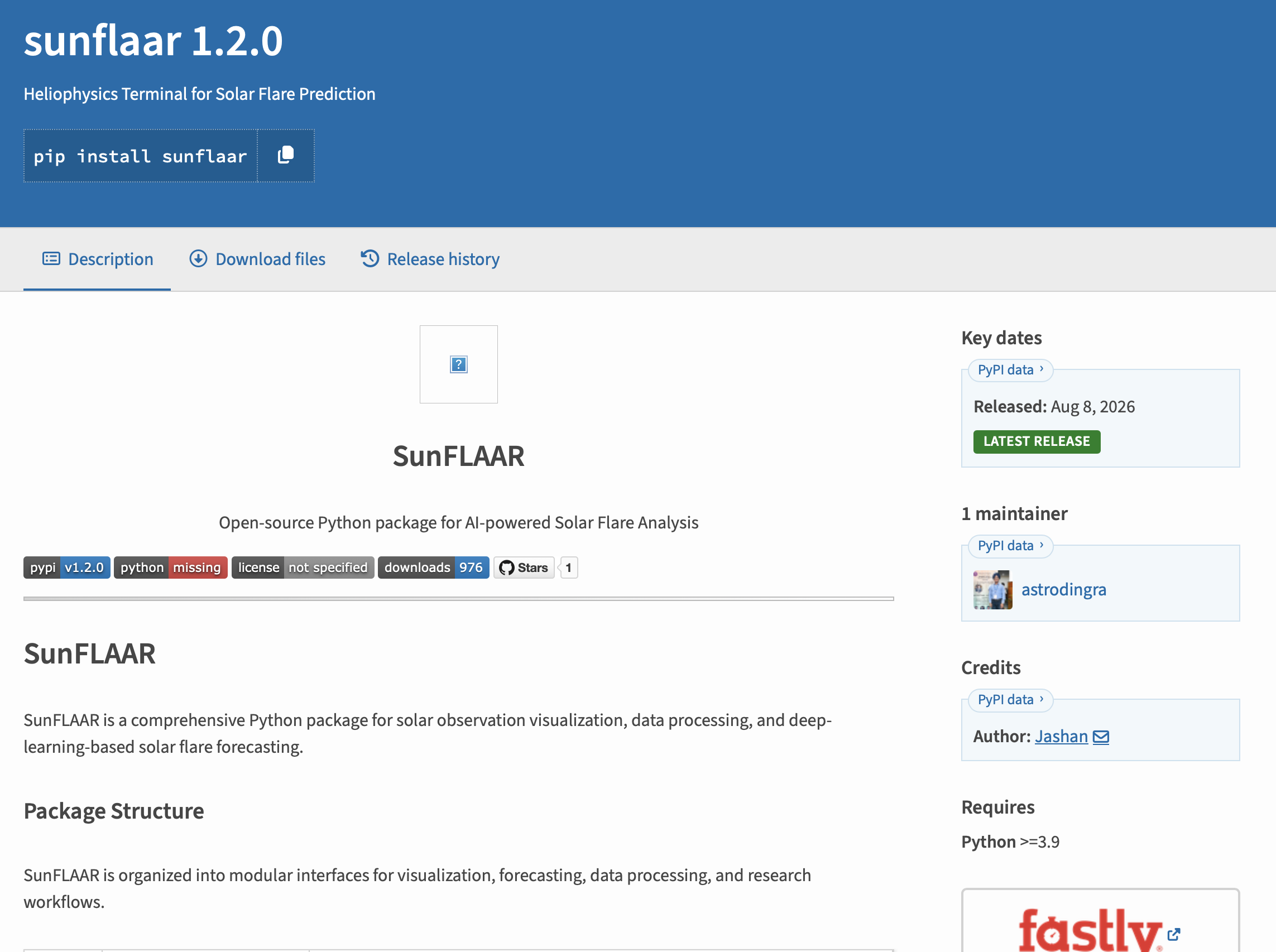
PYPI Package - Solar Physicists/Researchers
Inspiration
The Sun is the engine that drives our space environment, but it is also capable of producing some of the most powerful explosions in our solar system.
A solar flare can disrupt radio communication, satellites, navigation systems, and technologies that modern society quietly depends on. The challenge is that these events are difficult to predict, and the data needed to study them is enormous, complex, and constantly changing.
We asked ourselves a simple question:
What if we could turn years of solar observations into an intelligent system that helps us recognize a flare before it happens?
That question became the foundation of SunFLAAR — Solar Flare Analysis and Research.
We did not want to build just another machine-learning model. We wanted to build something that could actually be used by researchers: something open, reproducible, programmable, and accessible even to scientists who do not want to build an entire ML pipeline themselves.
That idea became our motivation to bring solar physics, machine learning, and software engineering together.
What it does
SunFLAAR is an open-source Python package and solar-flare analysis platform designed to automate major parts of the solar-flare research workflow.
It combines solar observations, multivariate time-series analysis, statistical methods, and deep learning to help researchers study and forecast solar flares.
SunFLAAR provides:
- Solar-data processing and analysis
- Multivariate time-series forecasting
- Active-region classification
- Deep-learning-based flare prediction
- Time-frequency analysis using wavelets
- Physics-based relationships between Soft X-ray and Hard X-ray signals
- Statistical evaluation for highly imbalanced flare datasets
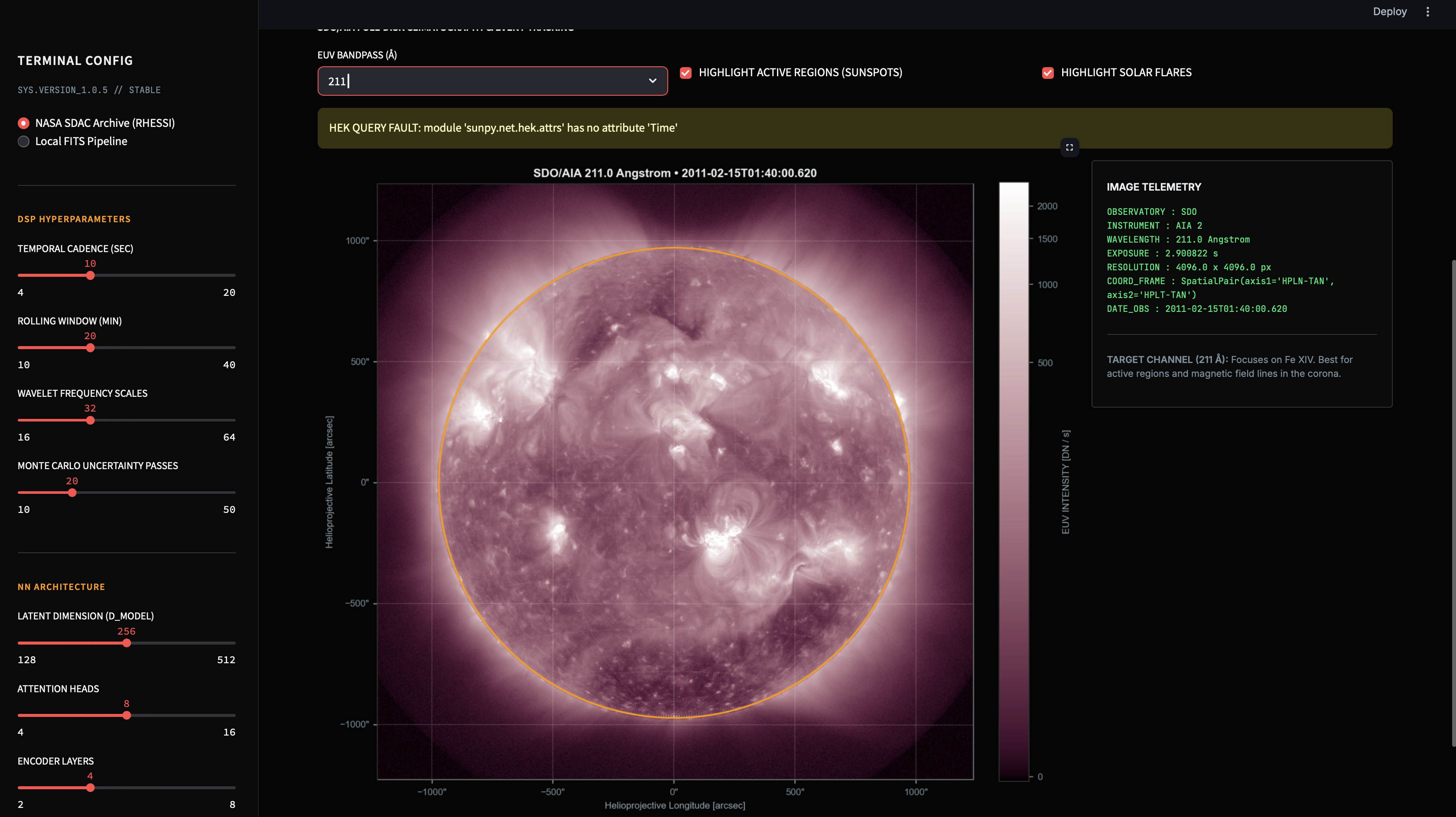
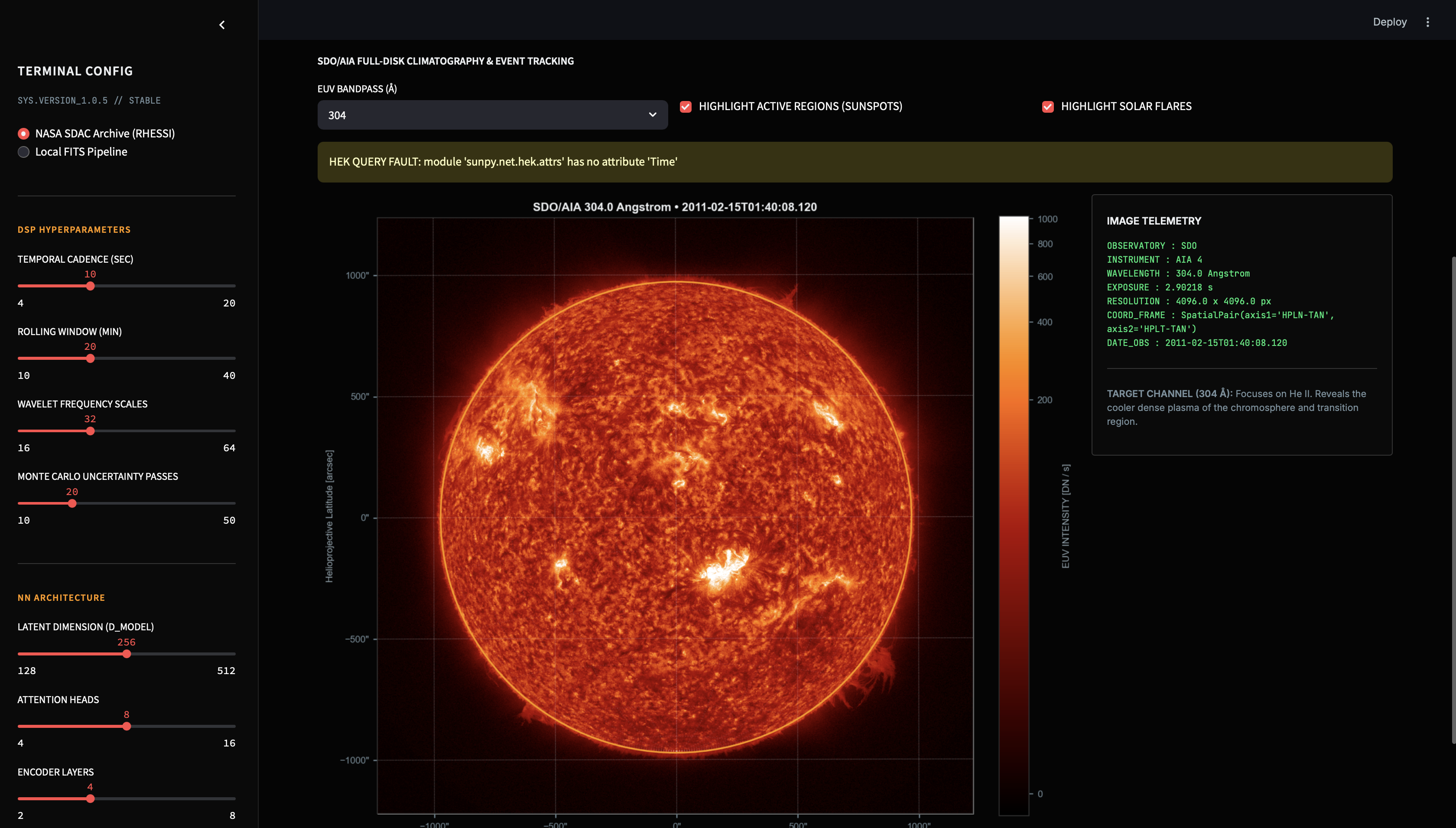
- Interactive solar-data visualization
- A Python package for researchers
- A web portal for users who prefer a visual interface
- A REST API for integrating predictions into other applications
The goal is simple: take complicated solar observations and turn them into information that researchers can actually use.
How we built it
We started from the science rather than the model.
First, we collected and processed solar observations from sources including NASA's solar data archives and active-region parameters. We then developed a pipeline capable of extracting meaningful temporal and physical information from the data.
Our approach combines multiple perspectives of the same solar event.
1. Physics-based coupling
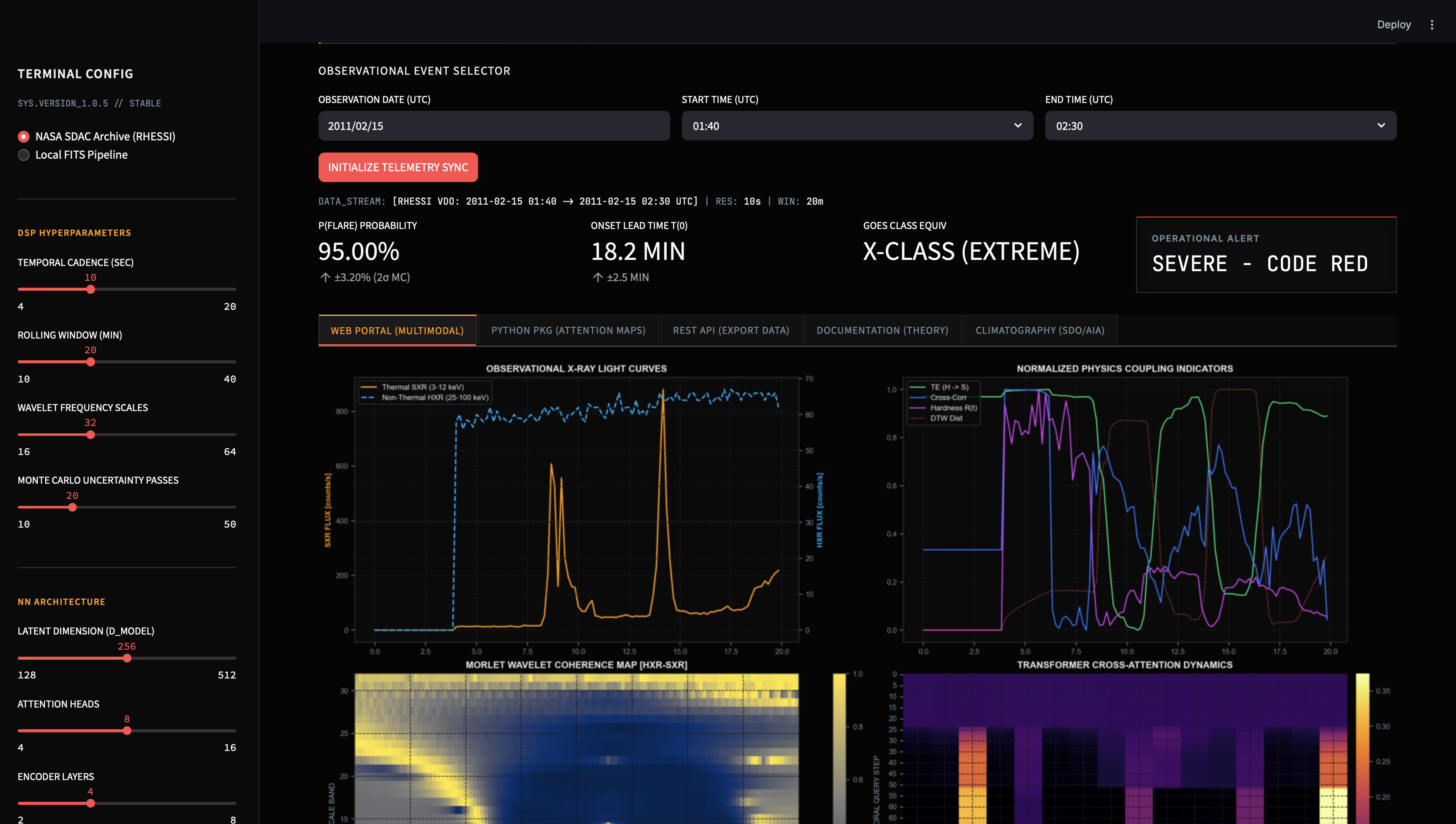
We extracted relationships between Hard X-ray and Soft X-ray light curves using features such as:
- Transfer Entropy
- Dynamic Time Warping
- Cross-Correlation
- Hardness Ratio
2. Time-frequency analysis
Solar signals are not stationary. Important patterns can appear and disappear across different time scales. We therefore used wavelet analysis to transform X-ray signals into time-frequency representations and capture precursor signatures and quasi-periodic behaviour.
3. Multimodal deep learning
Rather than relying on a single representation, we explored combining the extracted 1D physical indicators with 2D wavelet representations using a multimodal architecture with cross-attention.
4. Forecasting
The forecasting engine produces flare probabilities, predicted classes, and predictive lead-time information.
5. Turning research into software
We then moved beyond the notebook.
We packaged the functionality into SunFLAAR for PyPI, built an interactive web portal, and exposed the forecasting functionality through a REST API. This allowed us to turn a research pipeline into something that other people can actually interact with and integrate into their own workflows.
Challenges we ran into
The hardest part was not simply training a neural network.
Solar flares are rare events, which makes the dataset inherently imbalanced. A model can achieve impressive-looking accuracy while still failing to identify the events that matter most.
We therefore had to think carefully about preprocessing, feature selection, model evaluation, and metrics designed for rare-event forecasting.
Another challenge was the sheer complexity of the system.
We were simultaneously dealing with:
astronomical data → physics → signal processing → machine learning → HPC → Python packaging → APIs → web deployment.
Every layer introduced its own problems.
Training the models also required substantial computational resources. We used HPC resources at NISER Bhubaneswar to perform computationally demanding experiments and model training.
The real challenge was making all these pieces work together without losing the scientific purpose behind them.
Accomplishments that we're proud of
What makes us proud is that SunFLAAR did not remain an idea on a presentation slide.
We built a working ecosystem around it.
We developed an open-source Python package, made it available through PyPI, created an interactive web portal, and developed a REST API that allows external applications to access the forecasting framework.
Our experimental model-training pipeline achieved a reported 95.31% accuracy on the evaluated dataset.
But the number we are most proud of is not the accuracy.
It is the fact that we transformed a complex research problem into a tool that can be accessed in multiple ways:
Python package → for researchers
Web portal → for scientists and visual exploration
REST API → for developers and applications
We also successfully brought together solar physics, statistical analysis, deep learning, and software engineering into one project.
For us, that is what makes SunFLAAR more than a model.
It is an attempt to build infrastructure for the next generation of solar-flare research.
What we learned
SunFLAAR taught us that solving a scientific problem with AI is very different from simply training a model.
We learned that domain knowledge matters.
A neural network can find patterns, but understanding what those patterns mean requires physics. Similarly, having a scientifically meaningful model is not enough if nobody can reproduce or use it.
We learned how important it is to think about the entire journey of a model:
Data → Physics → Features → Model → Evaluation → Deployment → Research
We also learned that software engineering can have a real impact on scientific research. Packaging our work, building an API, and creating a web interface forced us to think beyond our own experiments and ask:
"How can someone else use what we built?"
That question changed the way we approached the project.
What's next for SunFLAAR
This hackathon is not where we want SunFLAAR to end.
It is where we want it to begin.
Our next goal is to make SunFLAAR increasingly capable of working with real-time solar observations, larger datasets, and more advanced forecasting architectures.
We want to expand the range of solar missions and observatories supported by the framework, improve the robustness of rare-event forecasting, and develop models that can provide more useful predictive lead times.
We also want to grow the open-source ecosystem around SunFLAAR so that solar physicists, climate scientists, researchers, and developers can contribute new models, datasets, and analysis techniques.
Ultimately, our vision is bigger than predicting a single solar flare.
We want to help move solar-flare research from reactive analysis toward proactive forecasting.
Because when something happening 150 million kilometres away can affect the technology we depend on here on Earth, even a little more warning can matter.
SunFLAAR is our attempt to make that warning smarter, more accessible, and more reproducible.
PRESENTATION LINK: https://github.com/dingra11/sunflaar-org/blob/main/doc/NextStepHack_26_HighOnCaffeine.pdf
Built With
- astronomy
- astropy
- docker
- fastapi
- firebase
- huggingface
- machine-learning
- mern
- nasa-astrophysics-data-system
- pypi
- python
- pytorch
- restapi
- sunpy
- timeseries


Log in or sign up for Devpost to join the conversation.