-
-

Sundials Logo
-
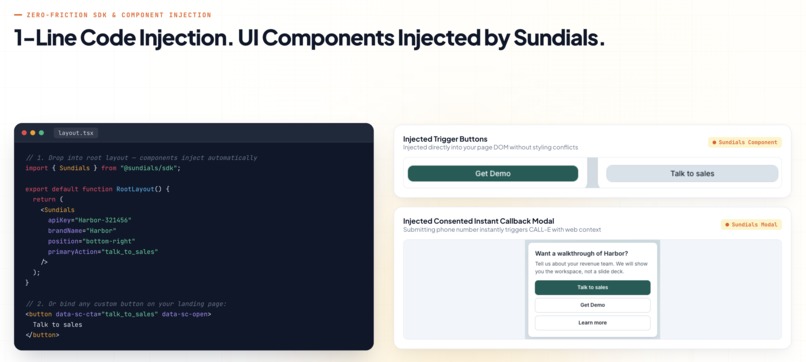
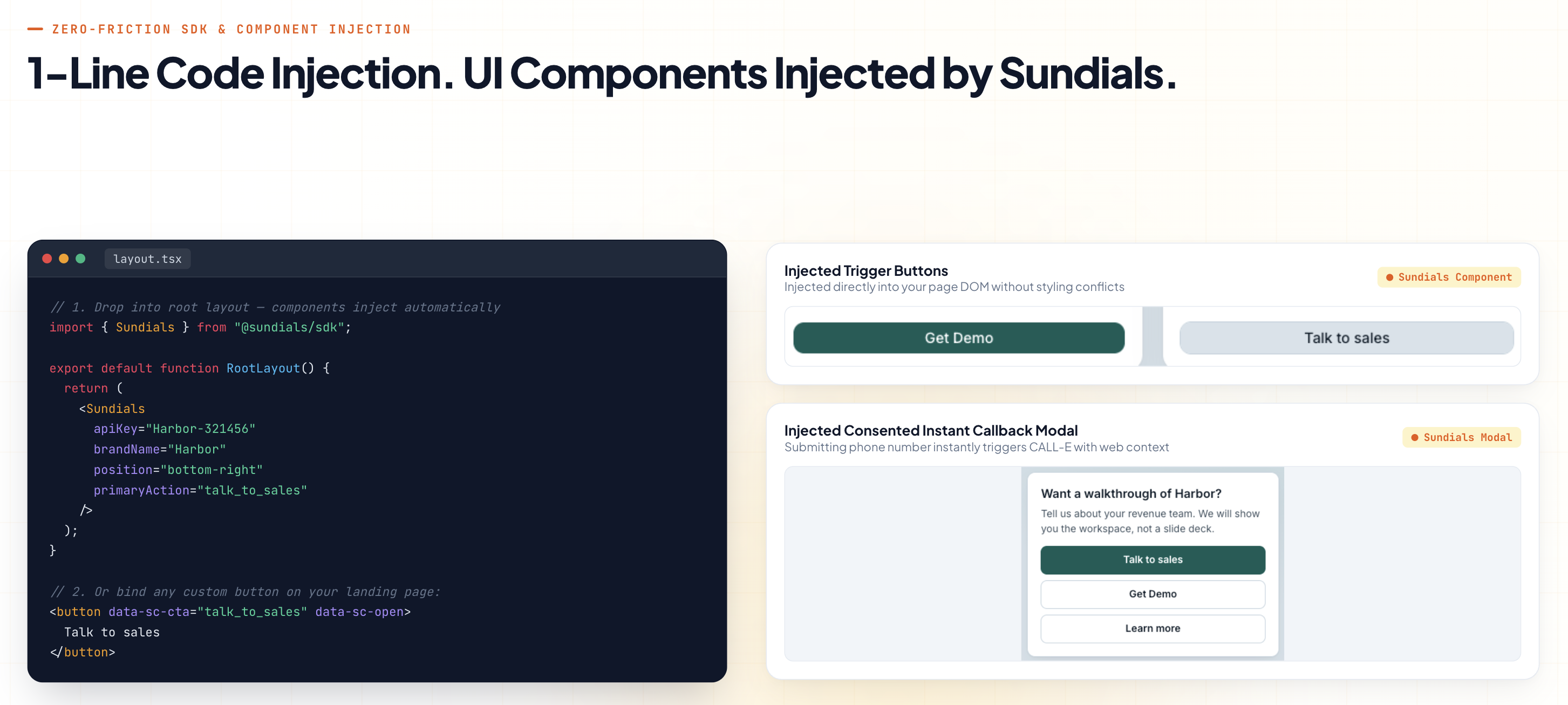
Seamless SDK Integration
-
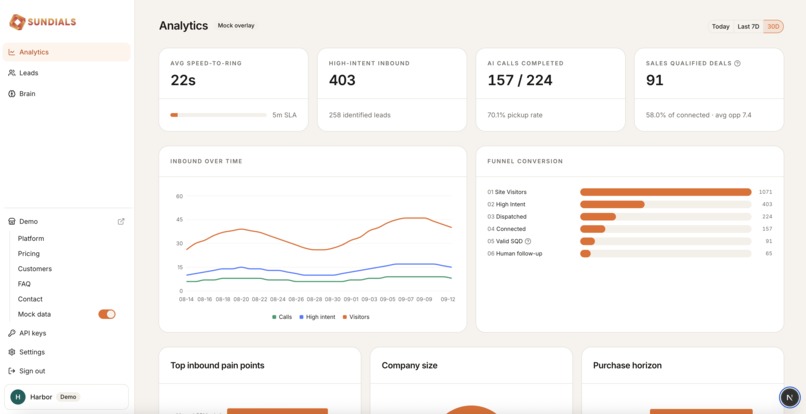
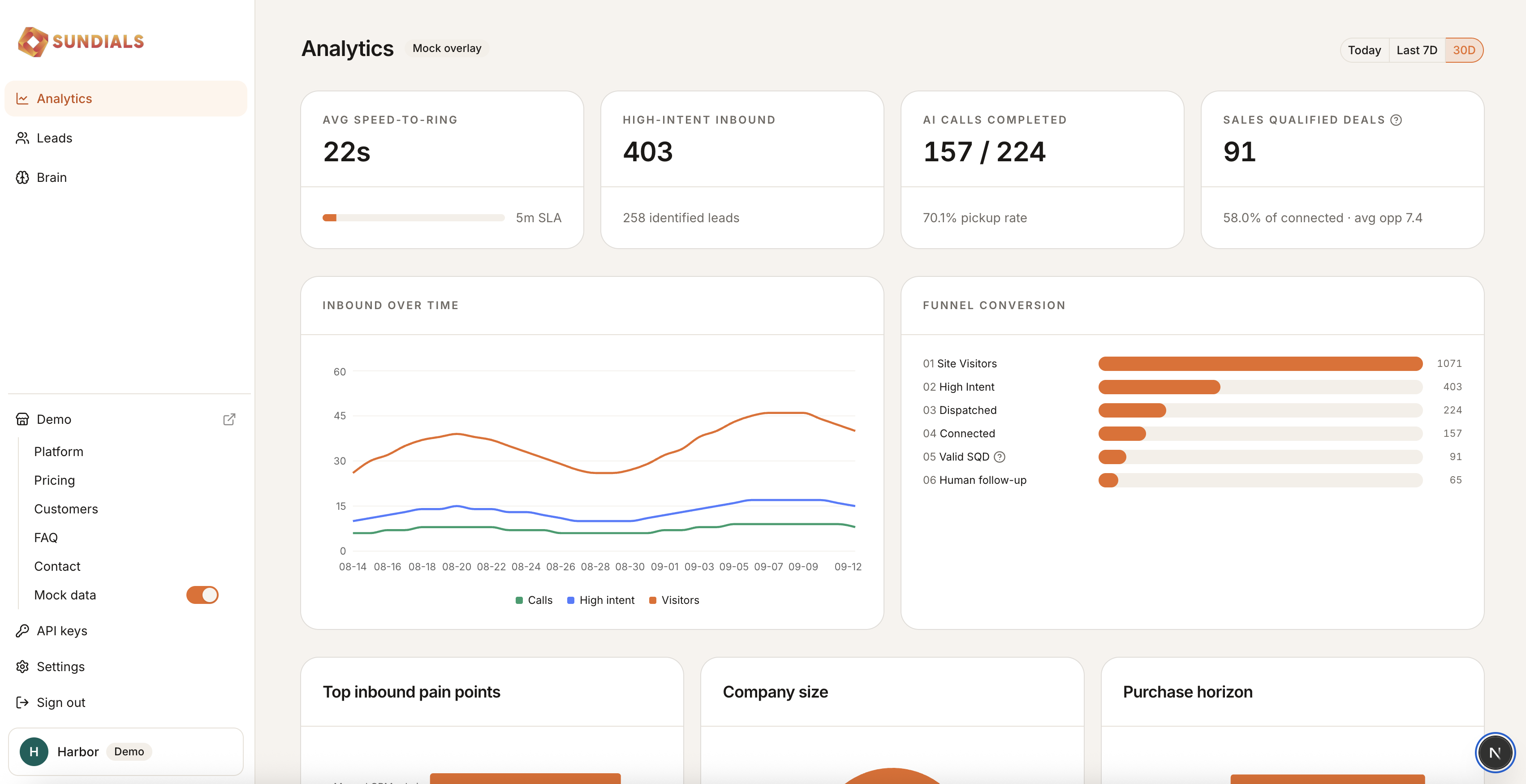
Sundials Business Dashboard - Analytics
-
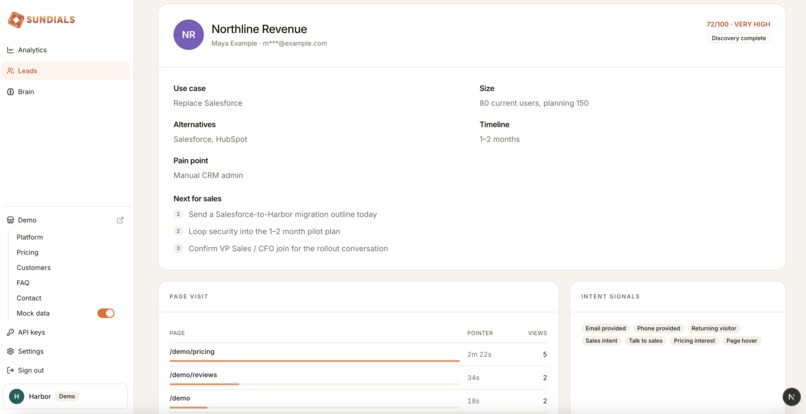
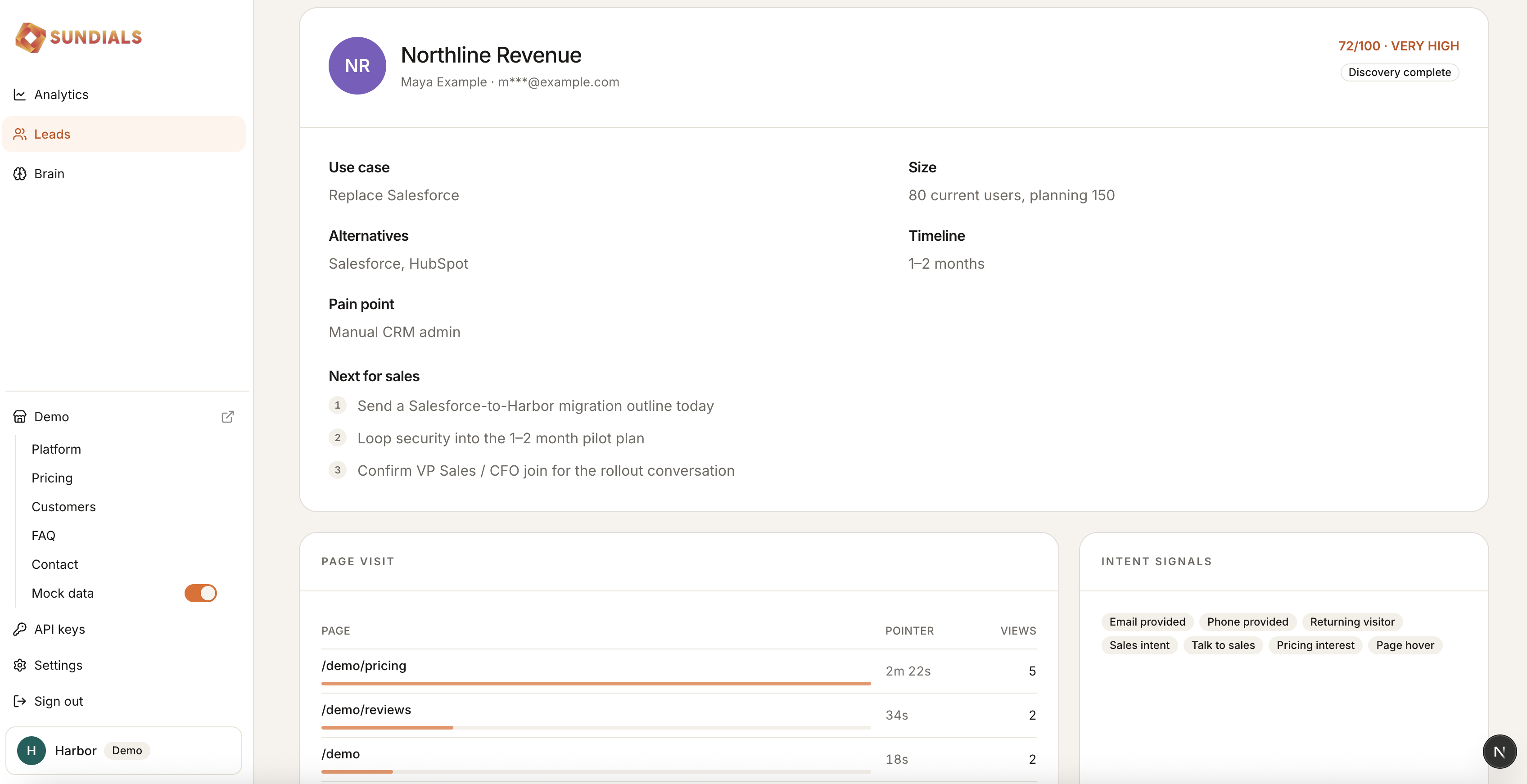
Sundials Business Dashboard - Lead Profile
-
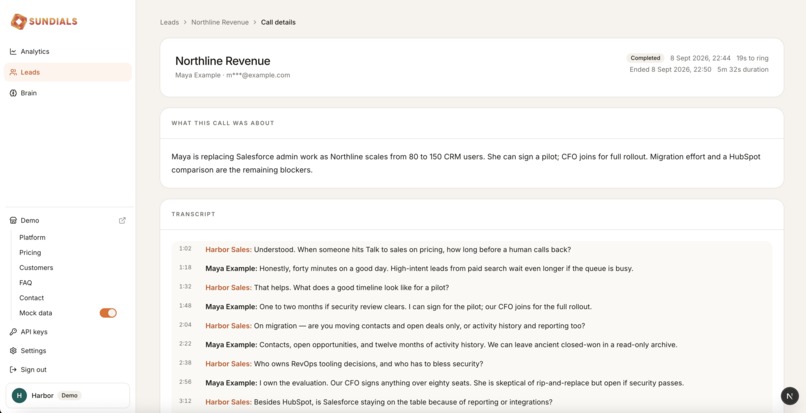
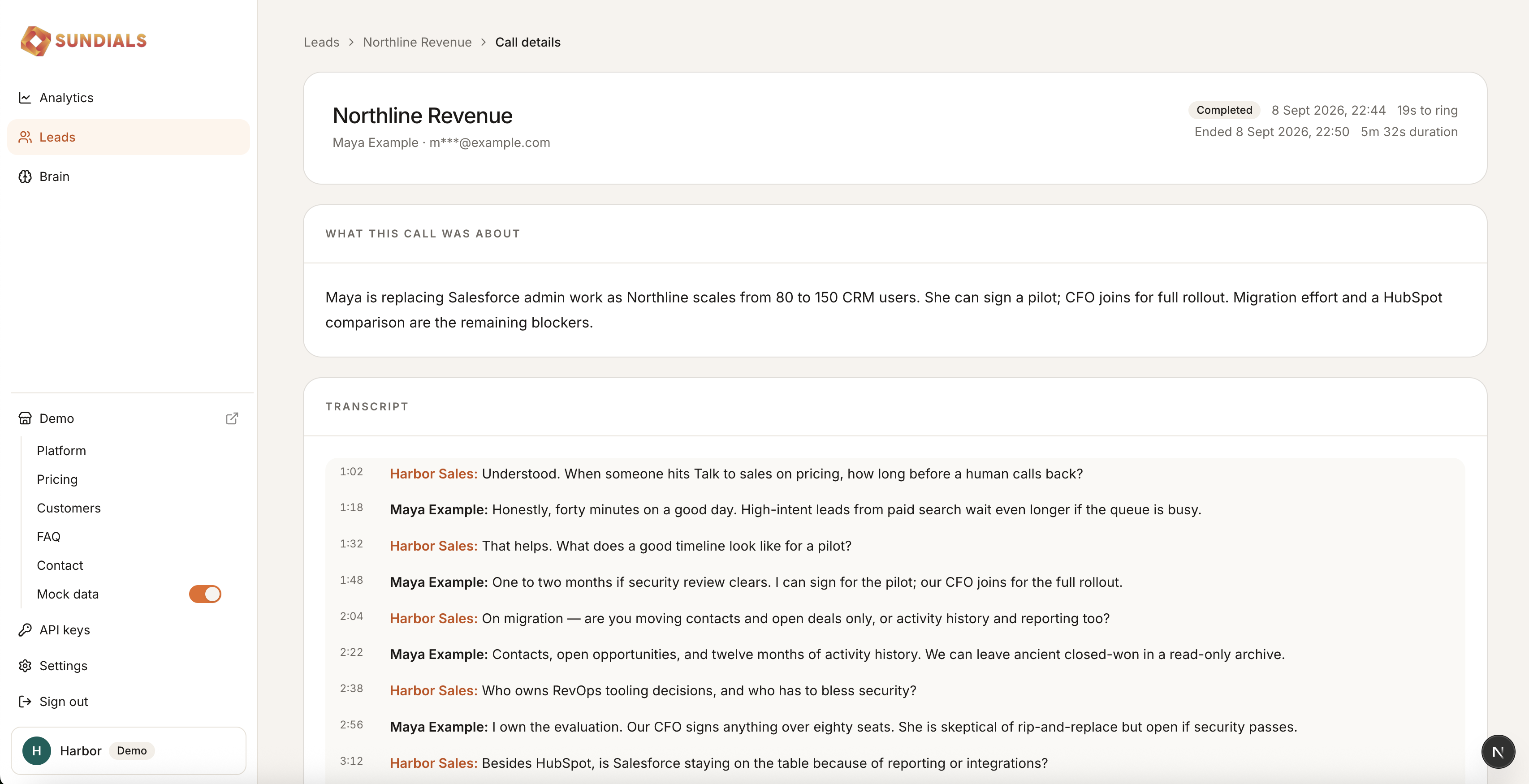
Sundials Business Dashboard - Call Profile
-
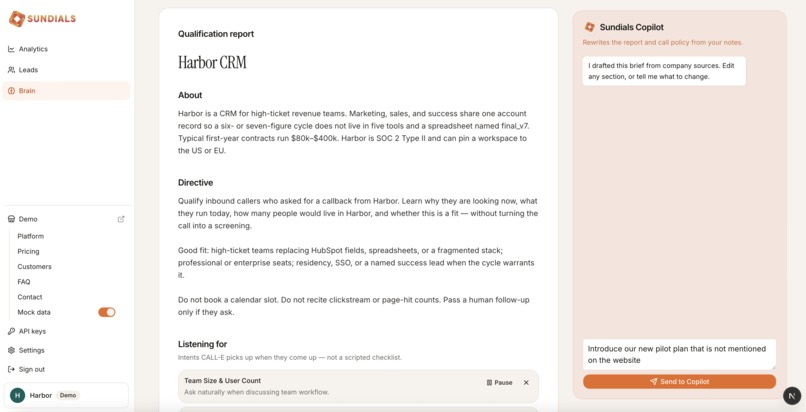
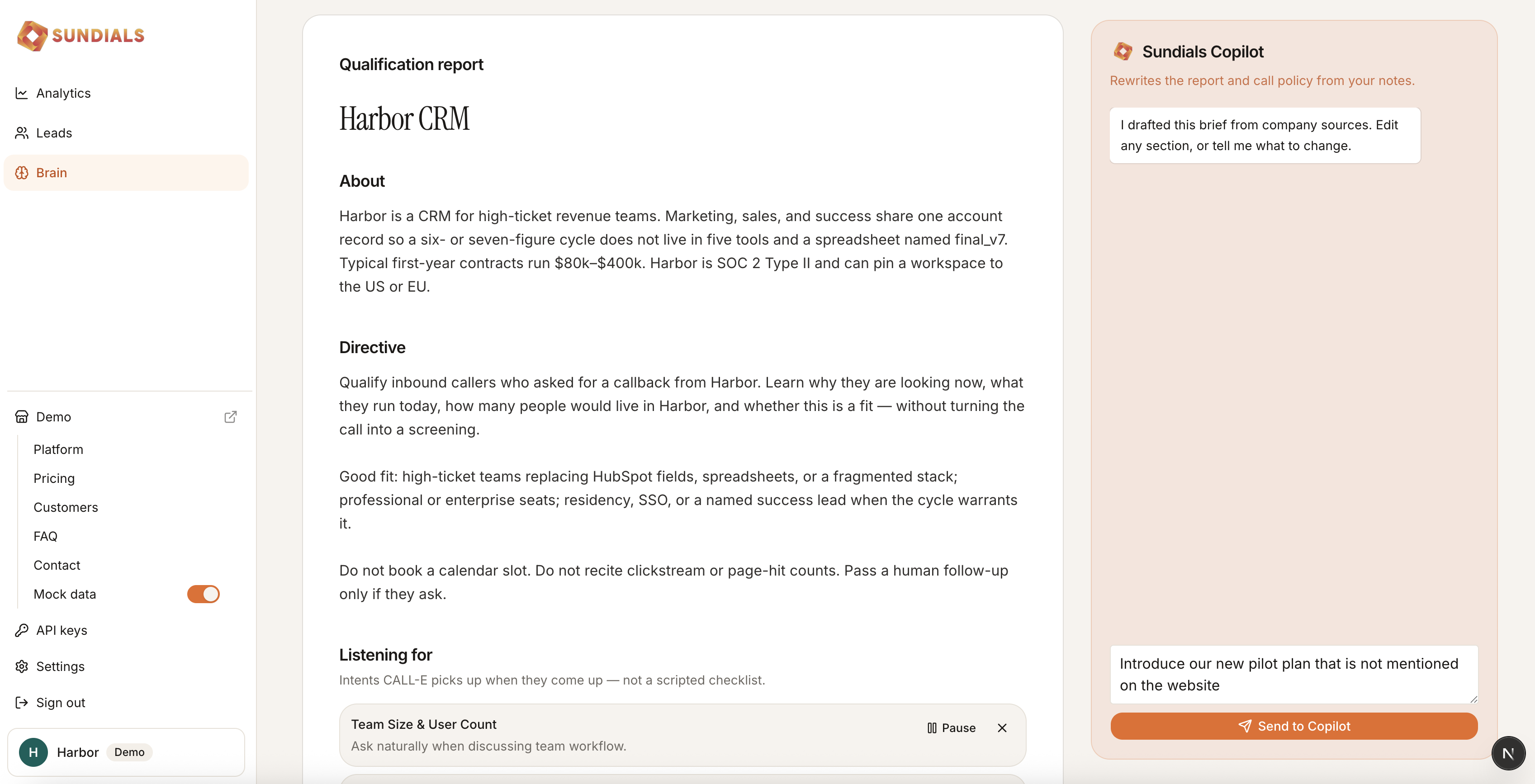
Sundials Business Dashboard - Brain Engine + Copilot

Inspiration
In high-ticket B2B enterprise sales, closing deals doesn't come down to having the flashiest slide deck—it comes down to speed to lead.
The landmark Lead Response Management Study by MIT and the Harvard Business Review proved a startling mathematical law: contacting an inbound lead within 5 minutes makes a sales team 21 × more likely to qualify the deal compared to waiting just 30 minutes. Furthermore, the odds of even getting a buyer on the phone plummet by over 100 × after the first half-hour.
Yet, the standard B2B buying experience remains fundamentally broken. An enterprise buyer scrutinizes a pricing table, examines the SOC 2 compliance badge, fills out a rigid "Talk to sales" form, and is told: "Thanks! An Account Executive will be in touch in 2–3 business days." By the time an SDR finally emails back, the buyer's purchase intent has decayed exponentially according to the half-life of digital attention:
We built Sundials to eliminate this friction entirely. Our philosophy is simple: call the lead while they are still warm.
What it does
Sundials is an autonomous inbound voice concierge and sales intelligence platform that turns fleeting website interest into qualified enterprise pipeline in under 60 seconds.
- 1-Line Drop-in Integration: Developers add literally one line of code () into their root React/Next.js layout with zero backend database configuration required.
- Real-Time Warmth Scoring: As visitors explore a SaaS site, Sundials passively captures high-intent dwell time (e.g., pricing tiers, security docs) and dynamically calculates a Warmth Score (W ∈ [0,100]).
- Sub-60s Inbound Voice Dispatch: When an interested prospect requests a conversation, Sundials ingests their browsing context and dispatches an autonomous AI voice agent in seconds, initiating discovery while the buyer is still at their desk.
- Executive Lead Dossiers: Before the human Account Executive joins the call, Sundials arms them with a pre-meeting dossier featuring exact page dwell telemetry, detected competitor displacement signals (e.g., Salesforce vs. HubSpot), and three AI-recommended talking points.
- Self-Improving Sales Flywheel: Every call transcript and customer objection automatically updates the Sundials knowledge graph, sharpening the AI's qualification logic and objection-handling battle cards for future inbounds.
How we built it
Sundials was built with an end-to-end modern stack designed for sub-second latency and zero developer friction:
- Frontend & SDK: Built with React and TypeScript (@sundials/react). It exposes a lightweight client component that monitors high-intent interaction semantics (viewport dwell times, pricing comparisons, and form field activity) without logging sensitive keystrokes.
- Warmth Scoring Engine: Implemented a real-time heuristic algorithm combining logarithmic dwell-time scaling with discrete intent signals.
- Telephony & Autonomous Voice (Call-E): Powered by Call-E (@call-e/calle) for autonomous, sub-60-second inbound phone discovery. Sundials dispatches Call-E asynchronously in the background so visitors never wait on dial tones, passing the buyer's live web session context into the call. Call-E conducts a natural, consultative qualification dialogue and returns structured JSON schemas (resultSchema for pain points, timeline, and competitor displacement) directly into the sales rep's executive dossier.
- Sales Rep Intelligence Console: Built with Next.js App Router, Tailwind CSS, and Lucide icons, featuring live warmth-ranked lead queues, visual telemetry timelines, and executive briefing drawers.
- Self-Improving Sales Brain (Gemini): Gemini analyzes completed call transcripts to generate executive summaries, classify deal intent, and autonomously train the Call-E agent with better objection-handling prompts after every interaction.
Challenges we ran into
Building Our First Web SDK with Zero-Friction DX: This was our first time building a client-side Web SDK from scratch. Our biggest design hurdle was thinking strictly from the external developer's point of view: How do we capture meaningful intent without forcing developers to rewrite their backend, configure complex webhook endpoints, or overhaul their existing forms? We iterated extensively on the API contract until we arrived at a true zero-overhead model -- a single drop-in component () that attaches seamlessly to any existing React/Next.js layout in under 5 minutes.
Resisting the Overbuilding Trap: When connecting web telemetry, telephony, LLMs, and sales consoles, it is remarkably easy to get lost in feature creep -- adding complex drag-and-drop workflow builders, multi-tier permissions, and custom routing engines. We had to ruthlessly discipline ourselves to lock in on our primary moat: capturing the warm window and getting Call-E on the phone in under 60 seconds. With that, we also made customising the brain extremely simple with a copilot and straightforward call directive.
Mastering Warm-Lead Domain Knowledge & First Impressions: An AI voice agent can easily alienate buyers if it sounds like a generic robotic dialer. We had to immerse ourselves in the domain mechanics of high-ticket B2B sales: What does an elite SDR say in the first 15 seconds? How do you acknowledge web intent without sounding invasive? We designed the Call-E dialogue flows to be consultative and lightweight, referencing the prospect's actual context (e.g., "Noticed you were exploring our Enterprise migration roadmap") to immediately earn trust and leave an exceptional first impression.
Accomplishments that we're proud of
- True Plug-and-Play Developer Experience (DX): We built a fully functioning, production-ready Web SDK that can be dropped into any new landing page right from the get-go.
- A Seamless, Cohesive UX and Visual Identity: From the interactive visitor widget to the sales rep console, we maintained a meticulous, unified aesthetic. Inspired by our solar brand identity ("Call while your lead is warm"), every screen features warm obsidian tones, radiant gold accents, and clean typography that feels as polished as modern enterprise tools like Linear or Raycast.
- Clean Directive Control with an In-Built Sales Copilot: Instead of treating AI as an uncontrollable black box, we engineered directive control into the sales workflow. The in-built copilot synthesizes complex browsing telemetry into three punchy, actionable battle cards for the Account Executive, while allowing managers to cleanly set conversational goals and boundaries for the Call-E voice agent.
Ultimately, we are proud that through the hackathon, we explored the capabilities of Call-E and delivered a living, end-to-end working prototype and a SaaS solution that provides value.
What we learned
- Call-E Makes AI Telephony Amazingly Simple: Telephony integration used to be a daunting engineering barrier involving complex SIP trunks, WebRTC audio streaming, and fragile STT/TTS latency hand-offs. Building with Call-E proved that spinning up an autonomous, natural voice agent can now be as clean and programmatic as calling a standard REST API. This simplicity opens the floodgates for applying voice agents to ultra-time-sensitive moments (ie. inbound warm-lead conversion, where human sales teams simply cannot dial every prospect within 60 seconds)
- The Value of an AI Call Extends Before, During, and After the Ring:
We realized that an AI voice call isn’t just a 2-minute conversation—its true leverage spans the entire lifecycle:
- Before: Pre-hydrating the call with real-time web browsing telemetry (e.g., exact dwell time on pricing tiers and security pages).
- During: Delivering a hyper-personalized, interactive experience where the buyer feels heard immediately, rather than answering repetitive qualification questions.
- After: Automatically transcribing, classifying intent, updating CRM opportunity profiles, and providing actionable items for human Account Executives before Call #1.
- The Power of the Self-Improving Sales Flywheel: Unlike human sales scripts that take months of training to update across a team, AI voice agents can be adjusted programmatically and agentically. Because every interaction produces structured transcript data and objection patterns, the system can self-improve on the fly. Feeding call insights back into the Sales Brain means objection handling, opening hooks, and qualification criteria get sharper after every single call—turning every conversation into an automatic product upgrade.
What's next for Sundials
- Seamless Bilingualism & Dynamic Language Switching: Enterprise buyers are global. We plan to expand the Sundials SDK to passively detect a visitor’s preferred language via browser locales and reading patterns. Leveraging Call-E's multilingual voice capabilities, the agent will greet buyers in their native language and fluidly switch languages mid-conversation if the buyer toggles between English, Mandarin, Spanish, or other tongues -- ensuring every high-value prospect feels completely at home.
- In-Call Autonomous Calendar Scheduling: When an enterprise lead qualifies as a high-ticket opportunity during the Call-E conversation, the agent shouldn't just send an email invite. Using agentic tool calling, Call-E will check the human Account Executive's live Google or Outlook calendar in real time, negotiate a mutual time with the caller over the phone, and book the meeting directly into the rep's schedule before hanging up.
- Real-Time Web Search & Company Enrichment: While the Call-E conversation is actively happening, Sundials will trigger background agentic enrichment tools. By parsing the caller’s corporate email domain and business name, the agent will dynamically search the live web for recent company news, headcount, funding stages, and tech stack dependencies. This gives the voice agent hyper-relevant context to weave into the live qualification dialogue—and delivers an even richer dossier to the human sales rep.
Built With
- call-e
- gemini
- next.js
- node.js
- python
- react
- tailwind
- typescript


Log in or sign up for Devpost to join the conversation.