Inspiration
B2B engineering teams face a massive, recurring crisis: Semantic Schema Drift. When third party APIs (like Stripe or Shopify) silently mutate their data structures, it instantly breaks downstream ingestion pipelines. Traditional monitoring tools only flag type errors, missing semantic changes entirely. I was inspired to stop building dashboards that just fire alerts, and instead build an autonomous "Data Immune System" that actually heals the pipeline in real time.
What it does
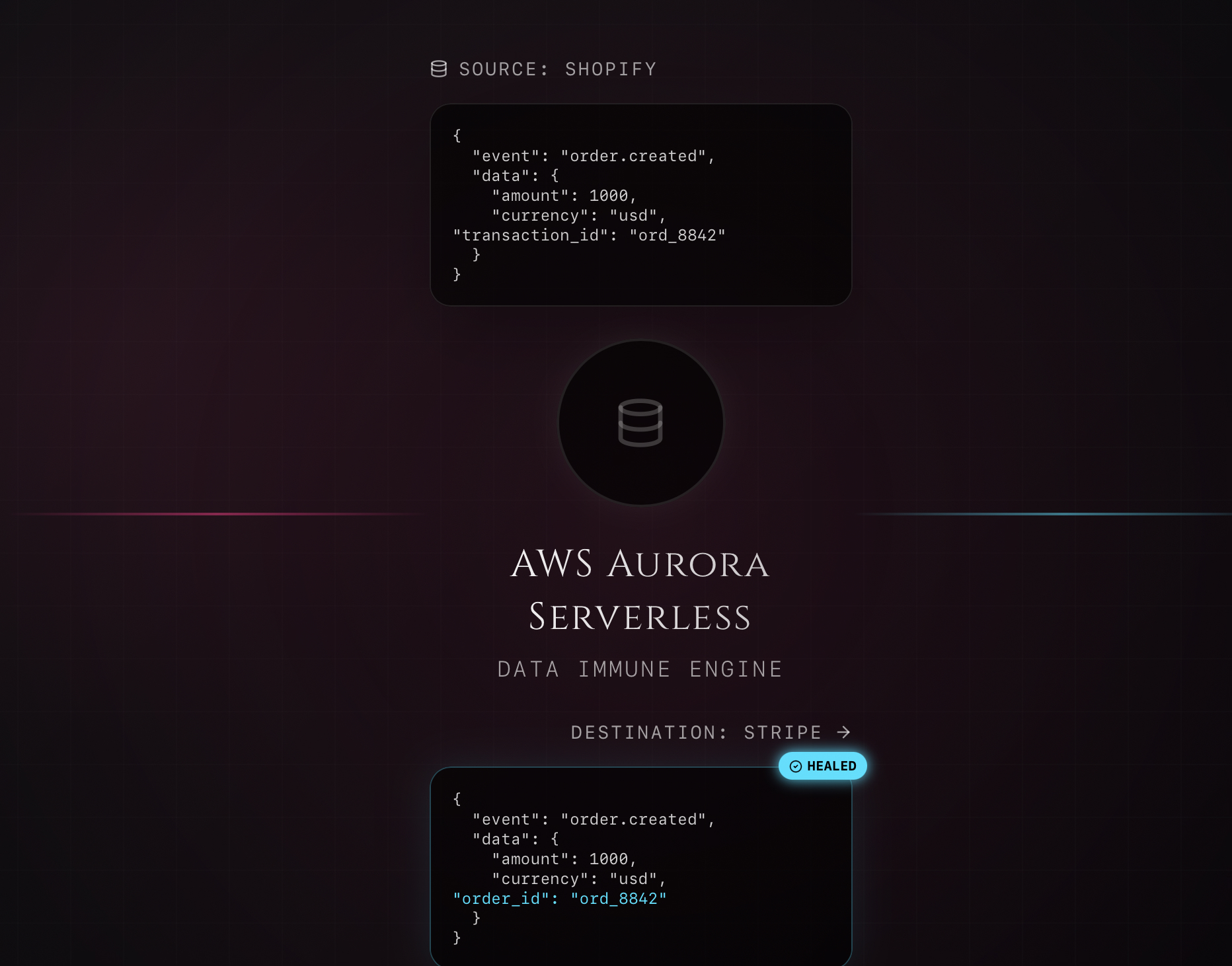
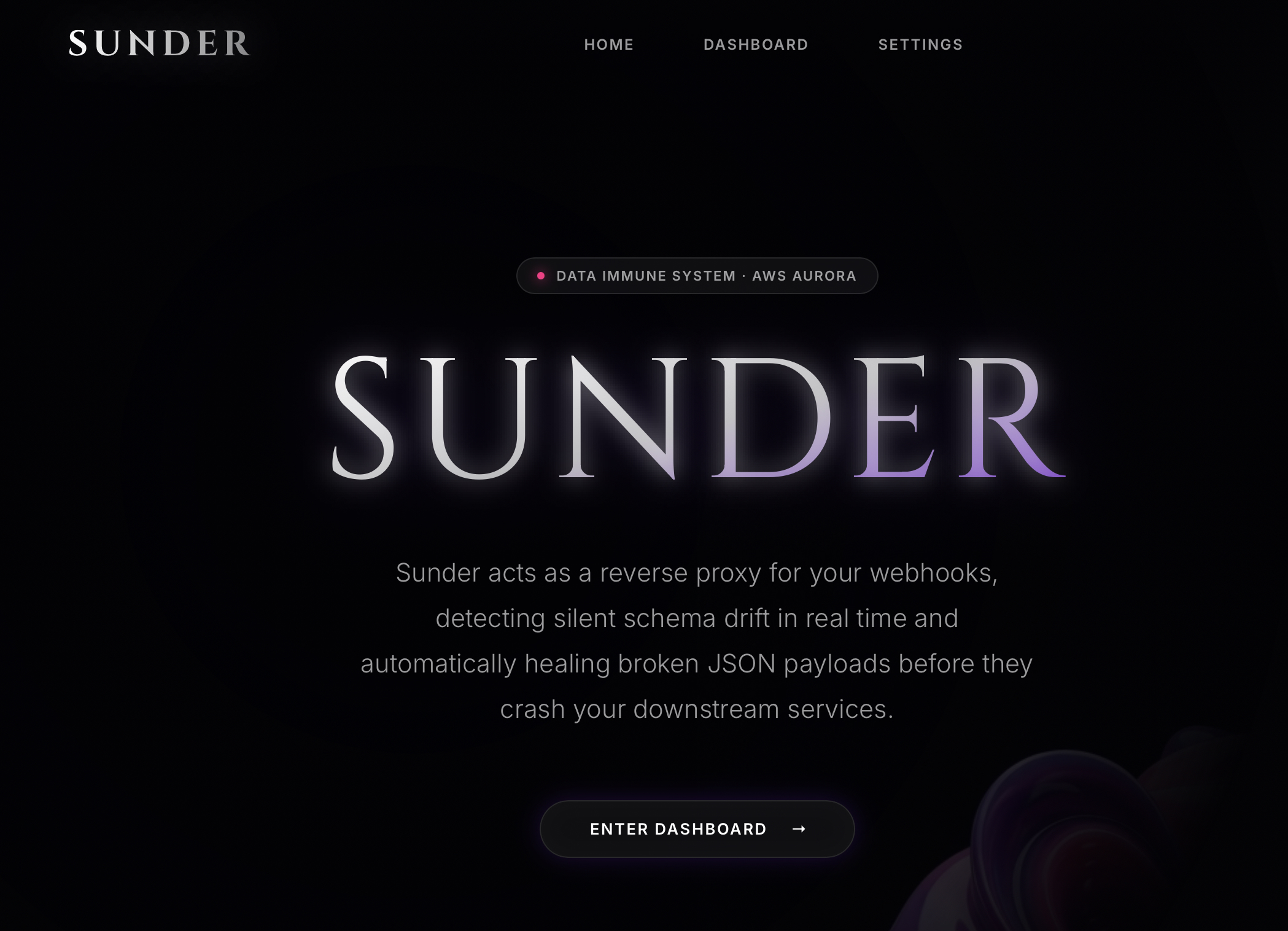
Sunder acts as a reverse proxy for your enterprise webhooks, designed to catch data mutations that standard type-checkers miss. When an upstream provider silently alters their API, Sunder intercepts the payload, mathematically proves the structural drift in milliseconds, and autonomously generates a JavaScript patch to remap the invalid JSON on the fly.
It dynamically heals complex semantic drift, such as:
- Deep Nesting: A provider stops sending
customer_emailat the root level and buries it inside a nesteduser: { contact: { email: "..." } }object. - Type Mutations: A payment gateway silently switches an
amount: 100(integer) toamount: "100.00"(string), which would normally crash a strict SQL database. - Format Shifts: A vendor switches from Unix timestamps (
1719244800) to ISO-8601 strings ("2026-06-29T14:00:00Z").
Clean data keeps flowing, preventing downstream services from crashing.
How I built it
I built Sunder strictly adhering to the "Zero Secret" philosophy, leveraging the absolute cutting edge of the Vercel and AWS ecosystems:
- v0 by Vercel: I quickly iterated on my UI using v0's generative capabilities.
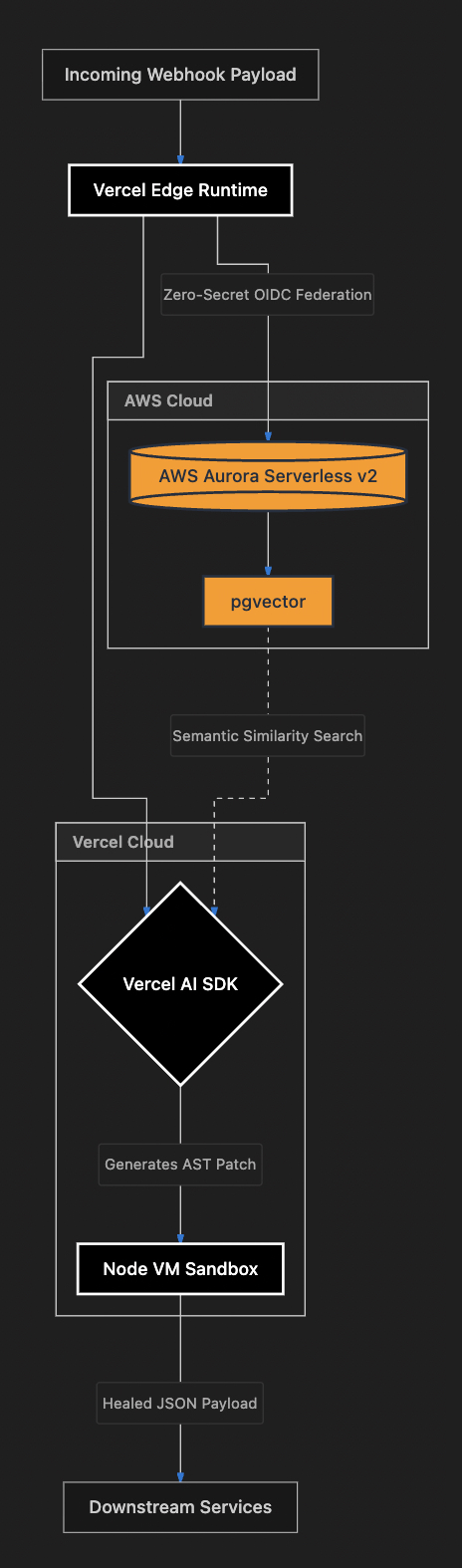
- Vercel AI SDK: When drift is detected, I use the AI SDK to dynamically generate the JavaScript payload-remapping logic.
- AWS Aurora Serverless v2 & pgvector: I execute a high speed semantic similarity search (\langle \vec{a}, \vec{b} \rangle) across Aurora using
pgvectorto instantly compare incoming payloads against expected historical schemas. - Vercel OIDC (Zero-Secret): To achieve enterprise security, I completely eliminated hardcoded AWS passwords. Sunder uses Vercel's official OpenID Connect (OIDC) Federation to dynamically assume AWS IAM roles using short lived, ephemeral STS tokens.
- Clerk: I implemented Clerk for secure, drop in user authentication and session management.
Challenges I ran into
Executing dynamically generated code on live production data is inherently dangerous. I had to ensure the Vercel AI SDK's output was strictly validated and sandboxed so it couldn't maliciously mutate the state. Furthermore, setting up a true Zero Secret architecture required deep configuration of AWS IAM Trust Policies to correctly federate identity with Vercel without relying on static .env secrets.
Accomplishments that I'm proud of
I successfully built a true Zero Secret application that proves AI can be used for autonomous, real time infrastructure healing, not just chatbots. I bridged the gap between predictive vector math and live data proxies entirely as a solo developer.
What I learned
I mastered the intricacies of vector similarity search using pgvector inside a relational database like Aurora, proving that you don't need a massive, dedicated vector database to do powerful semantic analysis. I also deeply learned how OIDC federated credentials work at scale.
What's next for Sunder
I plan to expand my integration suite to support GraphQL introspection drift, and I am building a visual AST (Abstract Syntax Tree) diff viewer so engineers can retroactively review exactly how Sunder patched their data.
Built With
- amazon-web-services
- aws-aurora
- next.js
- node.js
- pgvector
- postgresql
- react
- tailwind.css
- typescript
- v0
- vercel
- vercel-ai-sdk

Log in or sign up for Devpost to join the conversation.