-
-
SunBuddy: Join the Future of Sun Safety
-
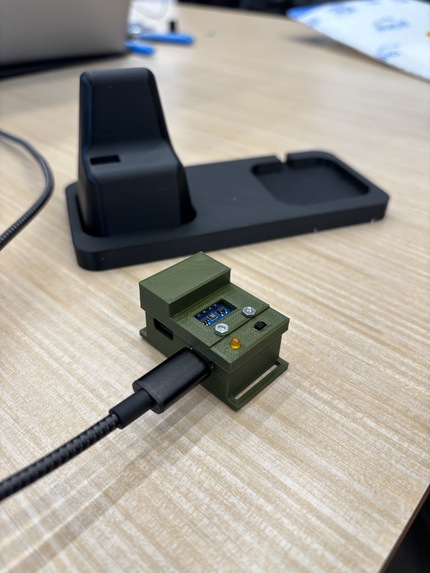
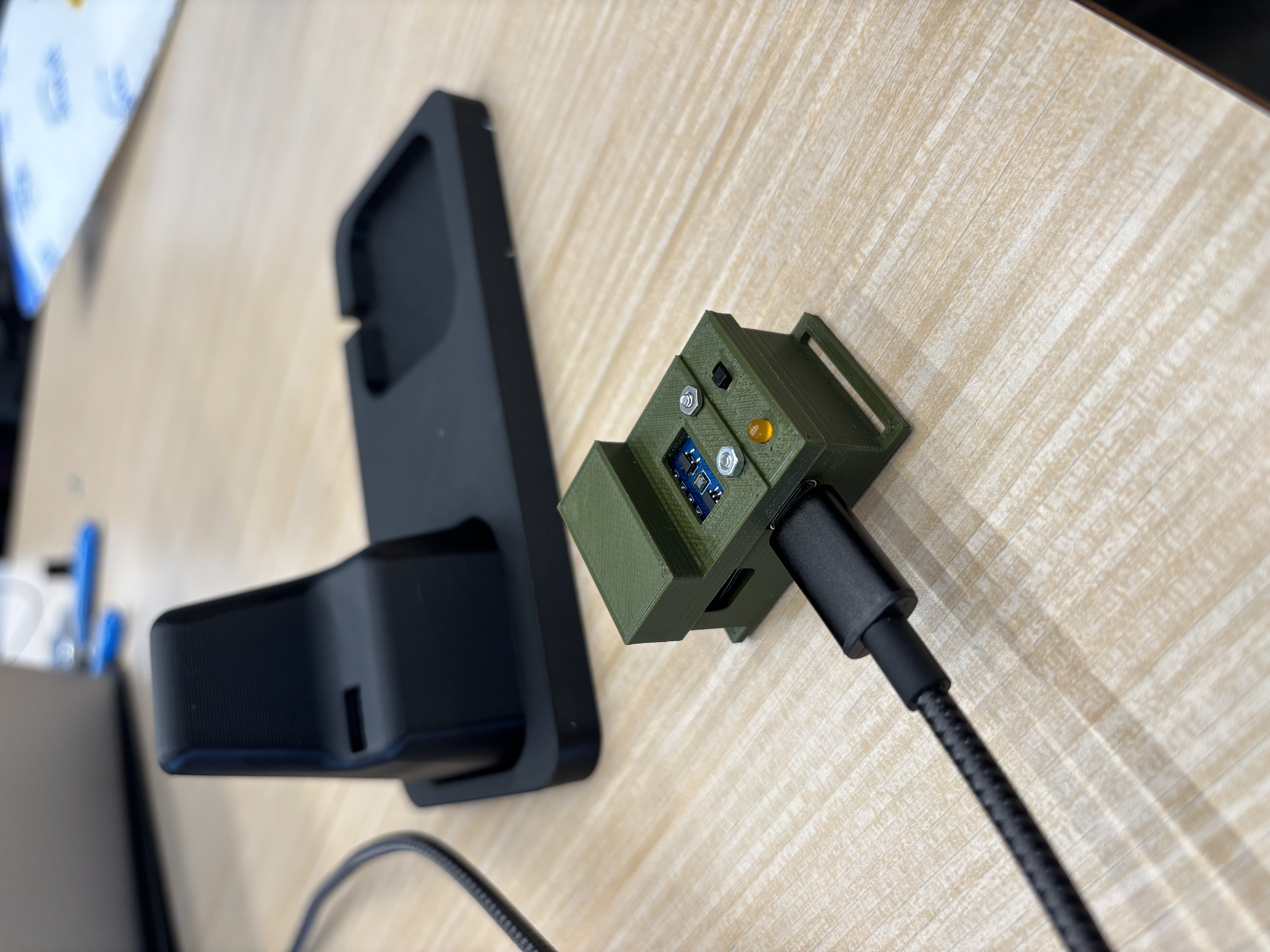
SunBuddy case with the electronics embedded
Overview
Real-time UV tracking for smarter skin protection, powered by your most loyal companion.
SunBuddy is a smart wearable ecosystem designed to make the invisible threat of UV radiation visible, audible, and personal. While traditional apps report UV based on your city's weather forecast, SunBuddy measures the actual UV intensity your skin is exposed to in real time and like a good buddy, it watches over you all day and debriefs you every evening.
Inspiration
Each one of our team members care deeply about the health of our skin. We want to protect it while we go about our day to day activities, including both work and play. According to the International Agency for Research, over 80% of Cutaneous melanoma (an aggressive form of skin cancer) was cause by UVR (Ultra-violet Radiation). Even though exposure to UVR is inevitable, you can still take measures to protect yourself from its damage to your skin. Typically, the measures that we take look like this: Look at the UV index for the day (or maybe not), put on some sunscreen (or maybe not), leave the house, forget to reapply, and then by the time you get home, you've probably been exposed to UV for 4-8 hours total. Depending on the season and location, you could be exposed for much longer.
What it does
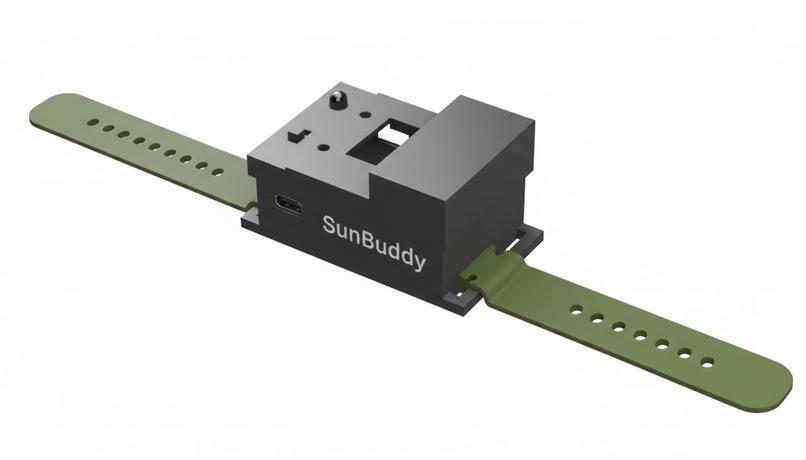
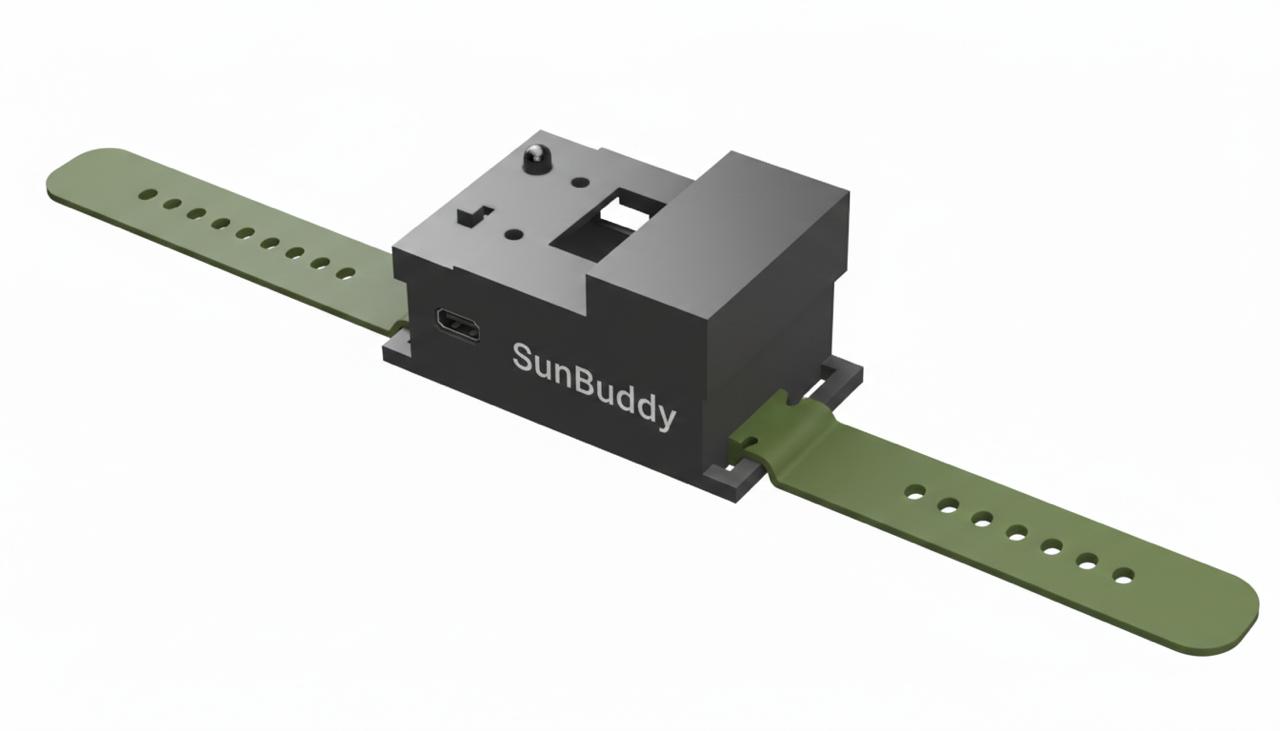
Our device is a UV sensing watch or headband that tracks your PERSONAL UV exposure. Situated on your wrist or your head, it senses the UV level you've been exposed to all throughout the day. When you're being exposed to UVR at a level 6 or higher during more than a certain time, the watch lights up to remind you to take measures (find shade, put on sunscreen) and you will get a notification on our phone through the app that is integrated with the UV sensing watch. In the app, you can press a button to indicate that you took the measures, and then the LED turns off. Additionally, you can find local areas of shade and keep track of your own habits related to UV exposure. These features help you understand if you should check your skin for early detection of skin cancer and also inform your healthcare provider.
How we built it
Software Stack: Swift (iOS App), C++ (Arduino). Hardware Stack: Fusion (CAD & 3D Printing), ESP32 Microcontroller (2), and UV Sensor. In our team, we had two people design the CAD for the physical case of our watch, two people work to configure the UV sensor with the ESP32 using Arduino and one person create on the iOS App. Then, we worked together to integrate the UV sensor data with the App to show what UV level it's detecting in real-time. Once we 3D printed the watch case and speaker parts, we tested the BLE connection to both ESP32 microcontrollers with the app before we soldered everything together, and put it in the case for our final working prototype.
A day with you SunBuddy
This is what a typical day looks like without SunBuddy: you glance at the weather app, maybe check the UV index, maybe apply sunscreen, leave the house, forget to reapply, and by the time you get home you've absorbed 6 hours of UV radiation with no idea if that was safe or not. Here's what a day with SunBuddy looks like:
Morning: You put on SunBuddy before heading out. The app reminds you to apply sunscreen based on yesterday's exposure data and today's forecast. Your buddy is watching.
Mid-morning: UV levels rise as the sun climbs. SunBuddy is silently tracking your personal exposure on your wrist, accounting for exactly where you are and what you're doing, not just the city average.
Lunchtime: You've hit a high UV threshold. SunBuddy's LED lights up and your phone buzzes with a notification: "Time to reapply sunscreen or find some shade." You tap "done" in the app to confirm you've taken action, and the alert resets.
Afternoon: UV keeps climbing. SunBuddy alerts you again, this time more urgently. The app shows you nearby shaded areas so you can make a smart decision about where to spend the next hour.
Evening: You get home and place SunBuddy on its docking station to charge. Your buddy wakes up. Using ElevenLabs voice AI, the station gives you a warm, personalized daily debrief on how much UV you absorbed, whether you stayed within safe limits, and specific advice for tomorrow. It's like having a dermatologist check in with you every evening, in plain language, in your own home.
Over time, SunBuddy learns your habits, and you become more aware of your skin health not through fear, but through a daily conversation with your companion.
How it relates to Healthcare?
SunBuddy acts as a preventative healthcare tool by bridging the gap between clinical data and daily habits.
Preventative Action: By alerting users exactly when UV exposure becomes dangerous, we move from "reactive" care (treating a burn) to "proactive" prevention (applying sunscreen or finding shade).
Data-Driven Insights: The ability to track long-term habits provides users with a digital diary of their exposure. This data is invaluable during dermatological check-ups, helping healthcare providers identify high-risk patterns and encouraging early detection of potential skin issues.
Health Literacy: We aren't just providing a number; we are educating the user on how environment, reflections, and duration affect their specific skin health, fostering a more health-conscious lifestyle.
How it relates to Seeed Studio Interactive Signage?
Our project leverages the core philosophy of Seeed Studio’s interactive ecosystem: making complex sensor data accessible and actionable.
Sensor-to-Screen Integration: SunBuddy utilizes the same principles of interactive signage by taking environmental input (UV levels) and translating it into an immediate visual and haptic "display" for the user.
Edge Computing & Connectivity: By using ESP32 microcontrollers, a staple in the Seeed Studio community, we demonstrate how "at the edge" sensing can create a responsive environment.
How It Relates to Elevenlabs?
When you place SunBuddy on its docking station at the end of the day, the station comes alive. Using the ElevenLabs voice AI, SunBuddy speaks to you directly through the speaker, delivering a personalized summary of your UV exposure based on your actual data from that day. It does not give generic advice, it responds to your specific day, telling you whether you stayed within safe limits, whether you need to be more careful tomorrow, and what steps you should take to protect your skin. It turns a number on a screen into a conversation with your buddy, making skin health advice feel personal, accessible, and human.
Challenges we ran into
The electronic part is always a challenge, you deal with uncertainties, whether everything is well connected and if it will do what it is supposed to do. However, we have managed to overcome this challenge.
Another challenging part of the project was the fact that we are building a wearable device which needs to be small and light. Building a small case to fit all the electronics was tricky and hard. However, we also managed to overcome the challenge.
Accomplishments that we're proud of
We are super proud of getting the UV levels that are being detected to be displayed on the app in real-time, and also to build all the electronics in such a small case.
What we learned
Building SunBuddy was a steep but rewarding learning curve for the entire team. We have gained experience in BLE (Bluetooth Low Energy) communication, learning how to combine an ESP32 and an iOS device to ensure real-time data streaming.
We have also learned that "wearable" means more than just "small." We had to iterate on our CAD designs multiple times to account for ergonomics and component placement, ensuring the UV sensor wasn't obstructed by the casing while keeping all the other parts shielded.
Finally, we learned the importance of modular development. By working on the app, the hardware, and the casing in parallel, we had to communicate constantly to ensure that when it came time to solder and assemble, everything fit together perfectly.
What's next for Sun Buddy
In the future, we would like to incorporate a body temperature sensor for the detection of heat stroke prevention. Moreover, we aim to change the wristband material to a color-changing fabric that reacts to UV Levels. Finally, we aim to embed all the components into a smaller system (miniaturization of the device) like a ring.

Log in or sign up for Devpost to join the conversation.