-
-
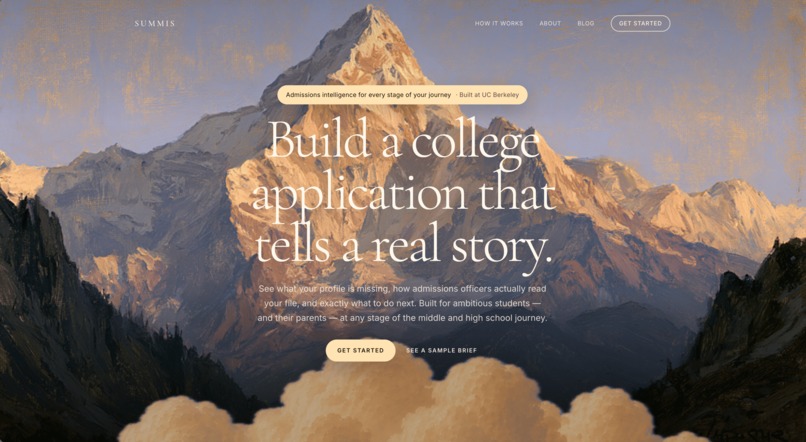
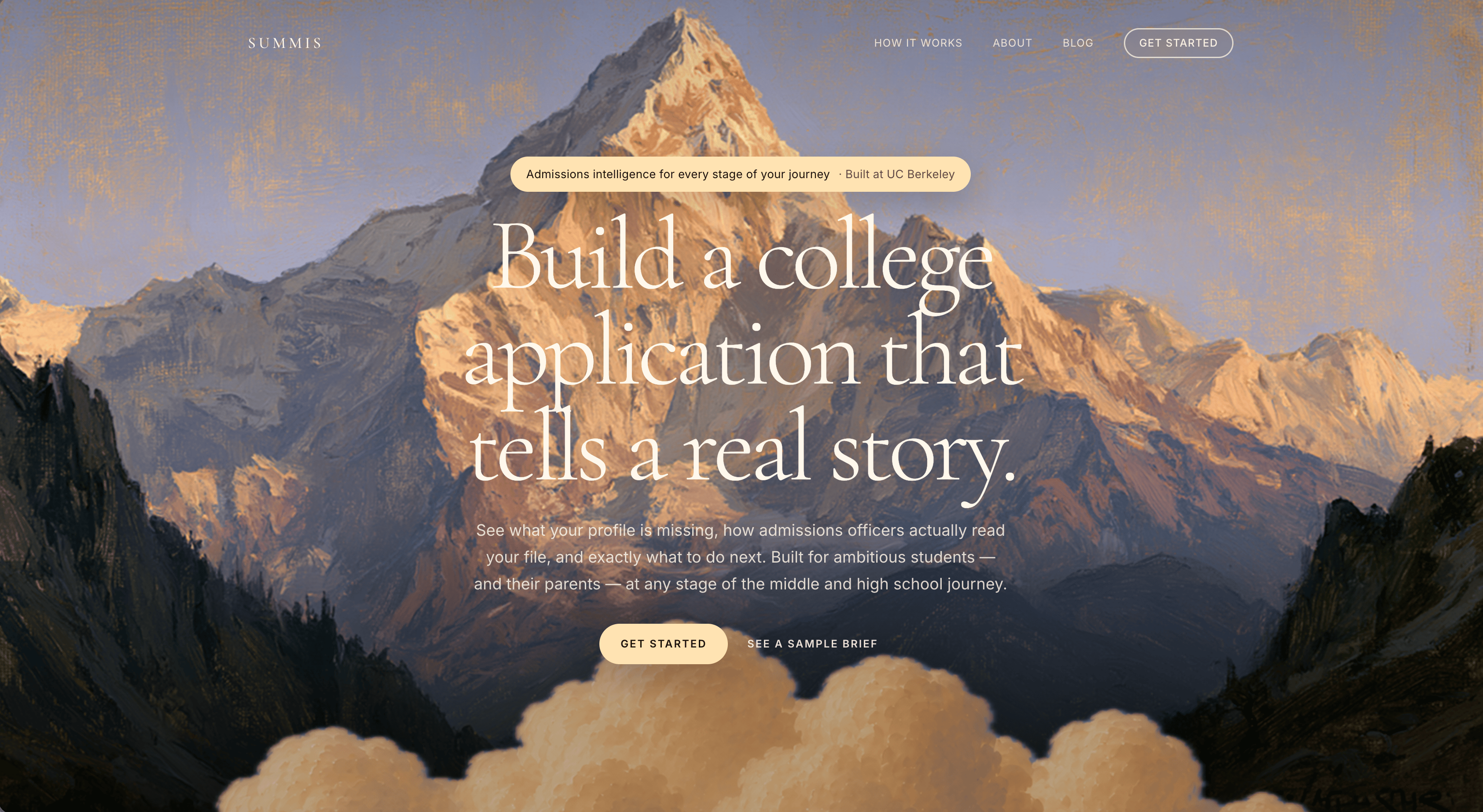
Landing Page
-
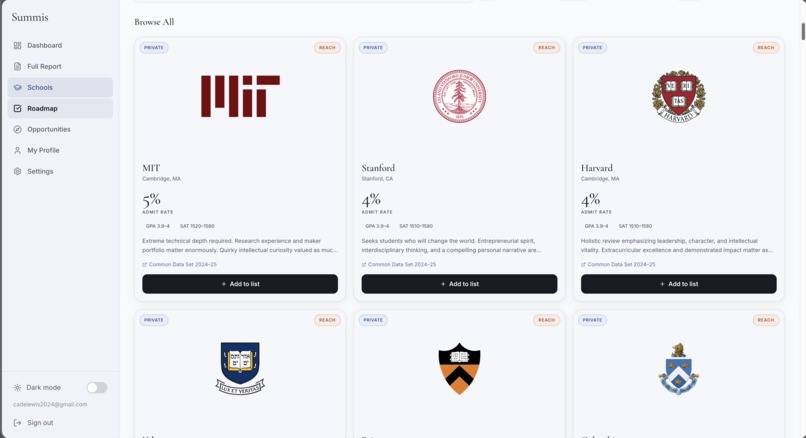
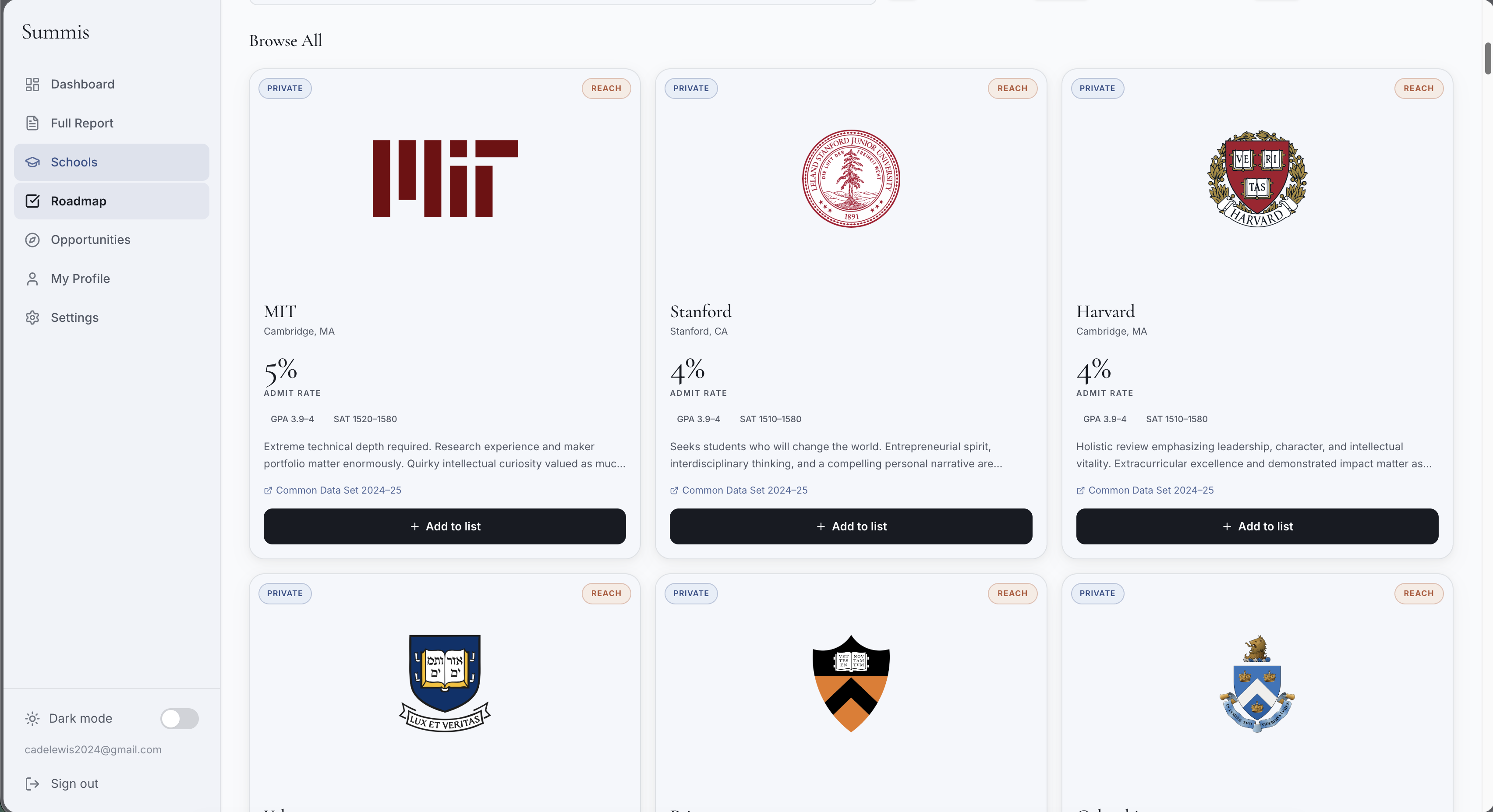
College Tab
-
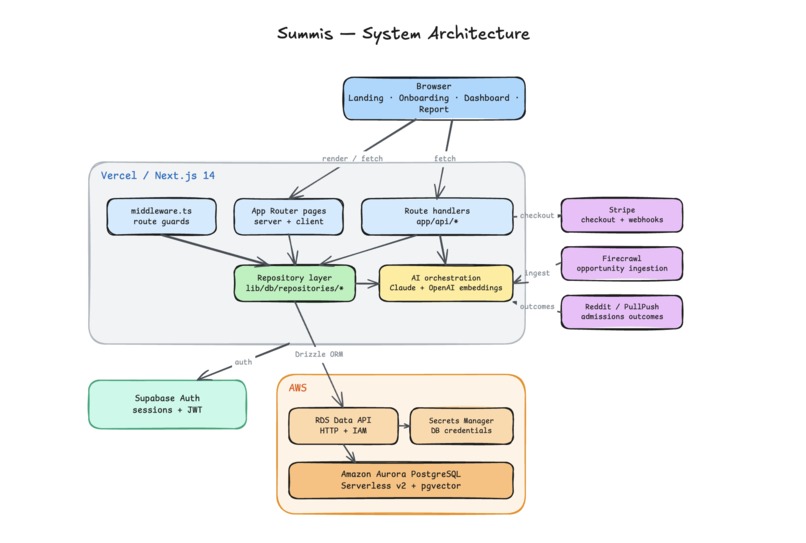
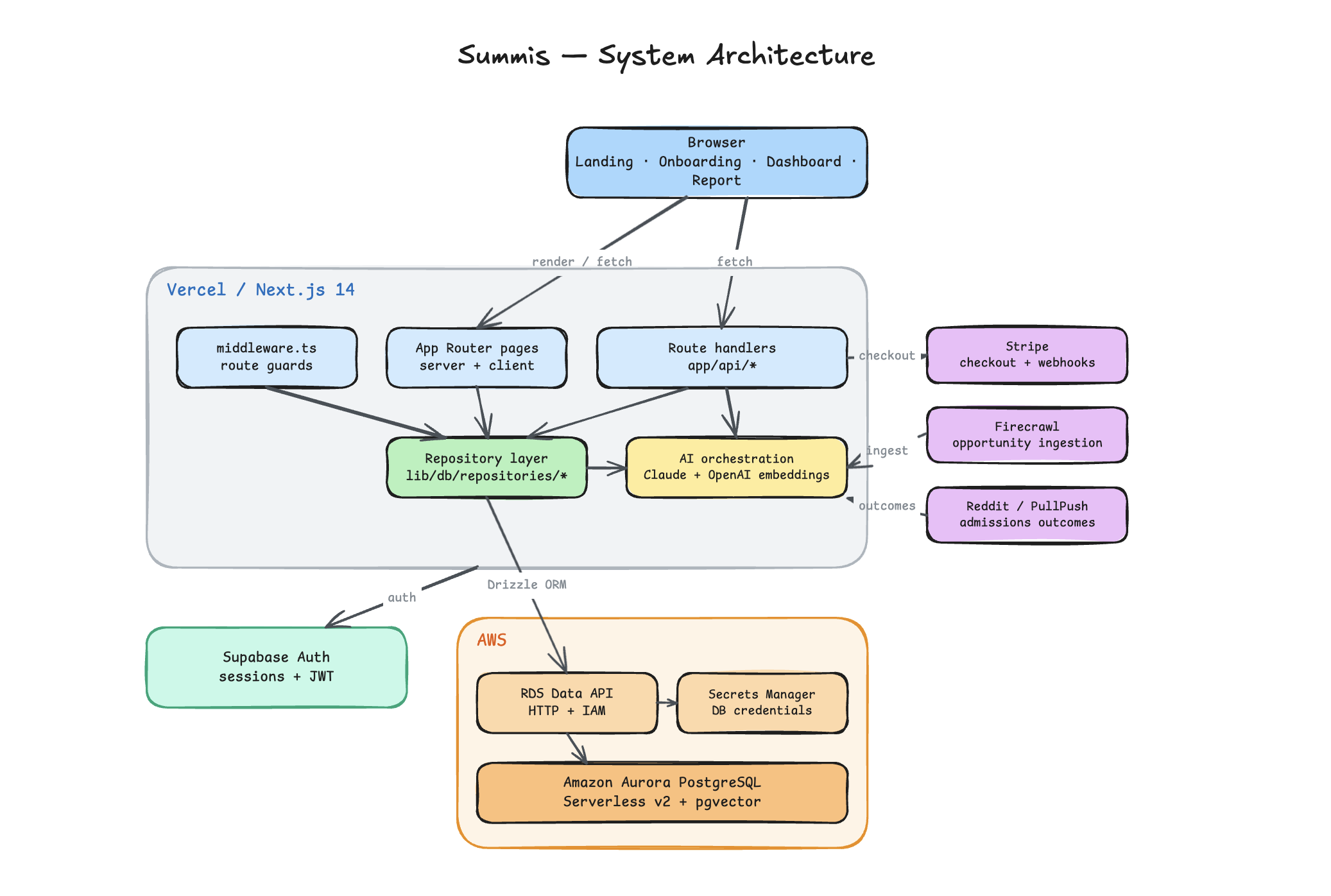
High level architecture
-
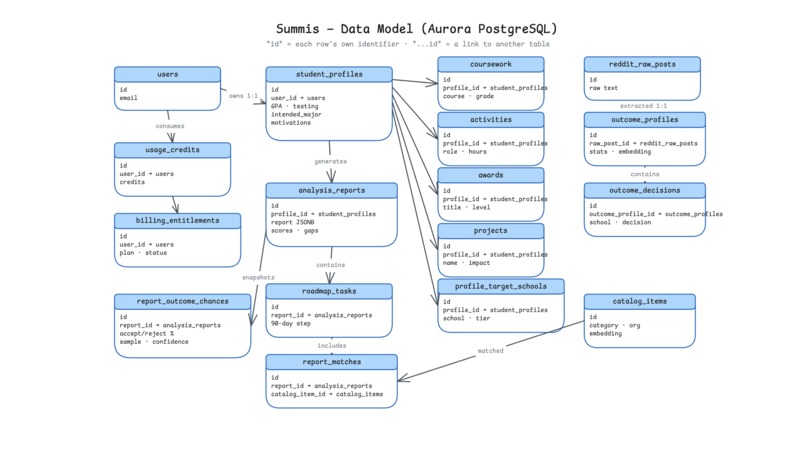
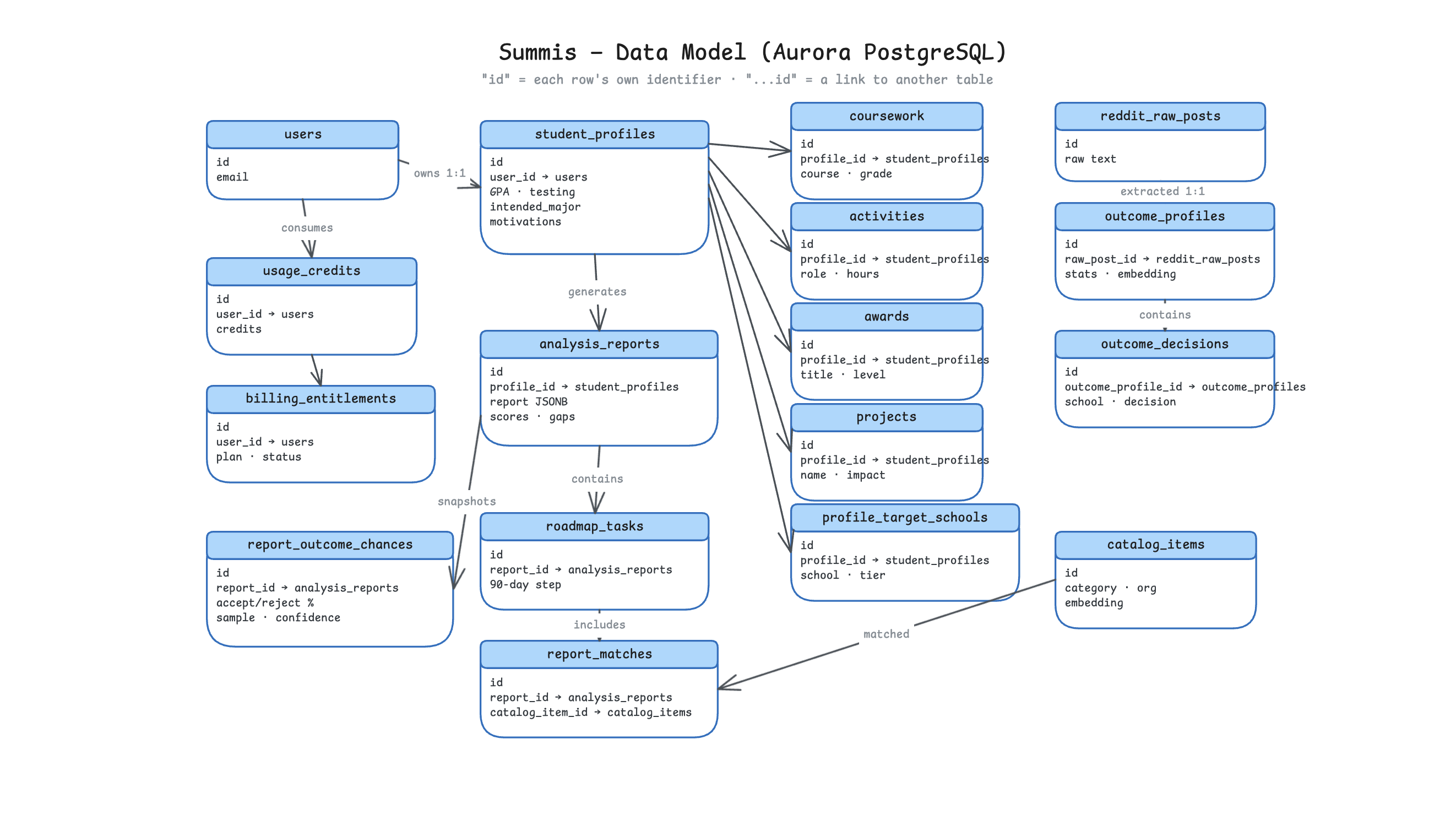
Data model with Aurora
-
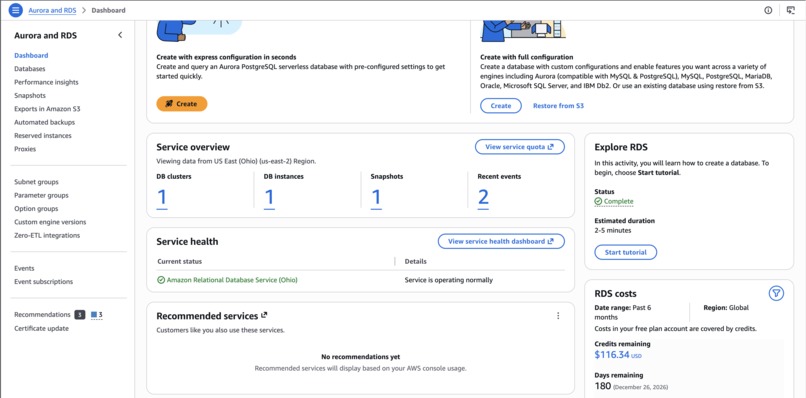
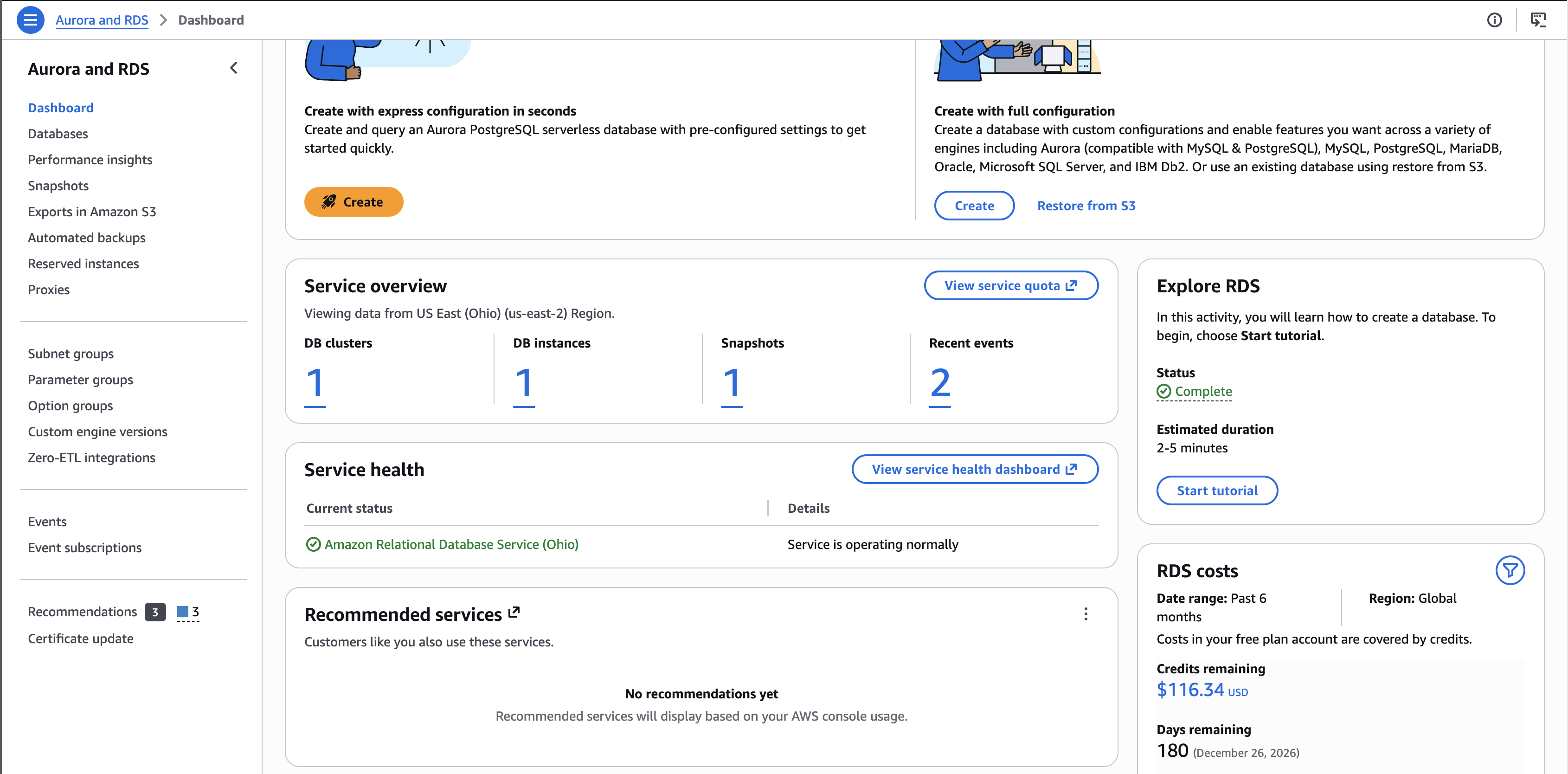
Aurora Proof
Inspiration
I built Summis because I know how stressful selective college admissions can become when you are trying to reverse-engineer what "good enough" means.
When I was applying to college, I spent hours reading posts from communities like r/collegeresults, comparing stats, activities, essays, summer programs, and outcomes. I was trying to understand what actually moved the needle. That research helped me, and I eventually got into UC Berkeley for Electrical Engineering and Computer Science, but the process was messy, obsessive, and inaccessible.
This year, my sister is applying to college, and I found myself thinking about the same problem again. Some families from my high school paid tens of thousands of dollars for private admissions consultants. They had access to strategy, narrative coaching, and insider guidance that most students simply cannot afford. I wanted to make something that could deliver that level of strategic clarity at a fraction of the cost.
Summis started from that question: what would an AI college consultant look like if it did not just give generic advice, but grounded its recommendations in real applicant stories, real admissions outcomes, and the student's actual narrative?
What it does
Summis is an AI-driven admissions strategy platform for high-achieving students and their families.
A student completes a 7-step profile covering academics, test scores, coursework, activities, awards, projects, personal motivations, and target schools. Summis then generates a personalized admissions strategy report that includes:
- A narrative summary of who the student is on paper
- Strengths, weaknesses, and application gaps
- School-specific admissions context
- Comparable outcome data from real applicants
- Recommended opportunities, programs, competitions, projects, and next steps
- A prioritized 90-day roadmap
- Activity-level insights that explain what to improve, expand, or reposition
The key idea is that admissions is not just a stats problem. A strong application has a coherent story. Summis looks at the student's motivations, interests, activities, and goals, then helps turn that into a concrete strategy.
For example, instead of simply saying "do more extracurriculars," Summis can identify that a student interested in computer science and animal welfare should build a real software project for a local shelter, document its impact, and use that as part of a stronger application narrative.
How we built it
Summis is a full-stack Next.js application deployed on Vercel and backed by Amazon Aurora PostgreSQL Serverless v2.
The frontend includes a landing page, authentication, a 7-step onboarding flow, a dashboard, a strategy report view, target-school tools, opportunities, roadmap tasks, and billing-gated report access.
On the backend, student profile data is stored relationally in Aurora PostgreSQL. The schema includes users, student profiles, coursework, activities, awards, projects, target schools, analysis reports, roadmap tasks, billing entitlements, usage credits, opportunity catalog items, Reddit admissions outcome profiles, outcome decisions, and persisted chance snapshots.
Aurora PostgreSQL was a strong fit because Summis needs both relational integrity and vector search. Student profiles, reports, roadmap tasks, billing state, and admissions outcomes are relational, while opportunity matching and comparable-profile retrieval benefit from pgvector similarity search.
For comparable admissions outcomes, I built an ingestion pipeline around r/collegeresults data. Raw posts are fetched, cleaned, structured into applicant profiles and school decisions, embedded with OpenAI embeddings, and stored in Aurora PostgreSQL with pgvector. When a student generates a report, Summis can retrieve similar applicant profiles, inspect their school outcomes, compute acceptance/rejection/waitlist patterns for target schools, and store a report-specific snapshot so the numbers remain stable.
For opportunity recommendations, Summis uses a catalog of programs, competitions, internships, research opportunities, prep resources, and actionables. Firecrawl helps collect opportunity data from the web, and embeddings allow the app to match opportunities to a student's interests, intended major, gaps, and timeline.
AI analysis is powered by Anthropic Claude, with OpenAI used for embeddings and fallback support. Stripe handles paid access. Supabase Auth is used for identity, while application data lives in Aurora.
The app connects to Aurora through Drizzle ORM over the RDS Data API, which works well with Vercel serverless functions because it avoids persistent database connections and connection-pool problems.
Challenges we ran into
The hardest part was turning messy admissions data into something structured and useful. Reddit posts vary wildly in format: some students list every course and decision clearly, while others write in paragraphs, abbreviations, or incomplete sections. I had to build a pipeline that could fetch posts, clean them, extract applicant details, normalize school decisions, flag low-confidence records, and store them in a searchable schema.
Another challenge was accuracy and responsible framing. Reddit data is biased because students who post online are not a perfect sample of all applicants, and successful applicants may be overrepresented. Summis handles this by showing sample size, confidence, caveats, and comparable examples instead of pretending that the output is a definitive admissions probability.
I also had to rethink the product from a generic AI wrapper into a real strategy platform. The valuable part is not "ask an LLM about college." The valuable part is combining a student's personal story with structured profile data, comparable outcomes, real opportunities, school context, and a roadmap that tells them what to do next.
On the infrastructure side, I had to design the app around production constraints: serverless deployment, secure database access, paid entitlements, durable reports, credit accounting, and a schema that can grow beyond the hackathon.
Accomplishments that we're proud of
I am proud that Summis became more than a chatbot. It is grounded in real applicant outcomes, a real relational database, a real onboarding flow, a real dashboard, and a real path toward becoming a paid product.
I am also proud of the technical architecture. Aurora PostgreSQL is not just being used as a basic table store. It powers relational profile storage, report persistence, billing state, opportunity matching, admissions outcome retrieval, and pgvector-based similarity search.
This is also the first project I have taken this close to launch. I built the landing page, email waitlist, authentication, onboarding, database schema, analysis flow, report UI, payments, and deployment path. I also bought a domain, set up a workspace email, and started applying for startup credits so I can keep building it after the hackathon.
What we learned
I learned that the best AI products are not just prompts. They need context, structure, grounding, product judgment, and a clear user workflow.
I also learned a lot about designing with databases in mind. Summis needs to model a student's profile, preserve report snapshots, support paid access, match opportunities, and retrieve comparable admissions outcomes. That pushed me to use Aurora PostgreSQL as the core system of record rather than treating the database as an afterthought.
Finally, I learned how important it is to be honest about uncertainty. College admissions is probabilistic and human. Summis should help students make better decisions, not pretend it can perfectly predict outcomes.
What's next for Summis
Next, I want to make the recommendations more specific, local, and actionable. Instead of only suggesting broad categories like "research" or "community service," Summis should help students find concrete nearby opportunities, build projects for real organizations, and turn their interests into measurable impact.
I also want to expand the admissions outcome dataset, improve extraction quality, add more school-specific context from Common Data Sets, refine the chance calculation layer, and continue hardening the app for launch.
Longer term, Summis can become an affordable admissions strategy platform for families who want the clarity of a private consultant without paying thousands of dollars.
Built With
- amazon-rds-relational-database-service
- claude-api
- firecrawl
- next.js
- openai-api
- stripe
- supabase-auth
- typescript
- vercel

Log in or sign up for Devpost to join the conversation.